

Iran's Crypto Holdings Hit $7.7B: Sovereign Wealth or Financial Mirage?
2026/05/22 16:57:02
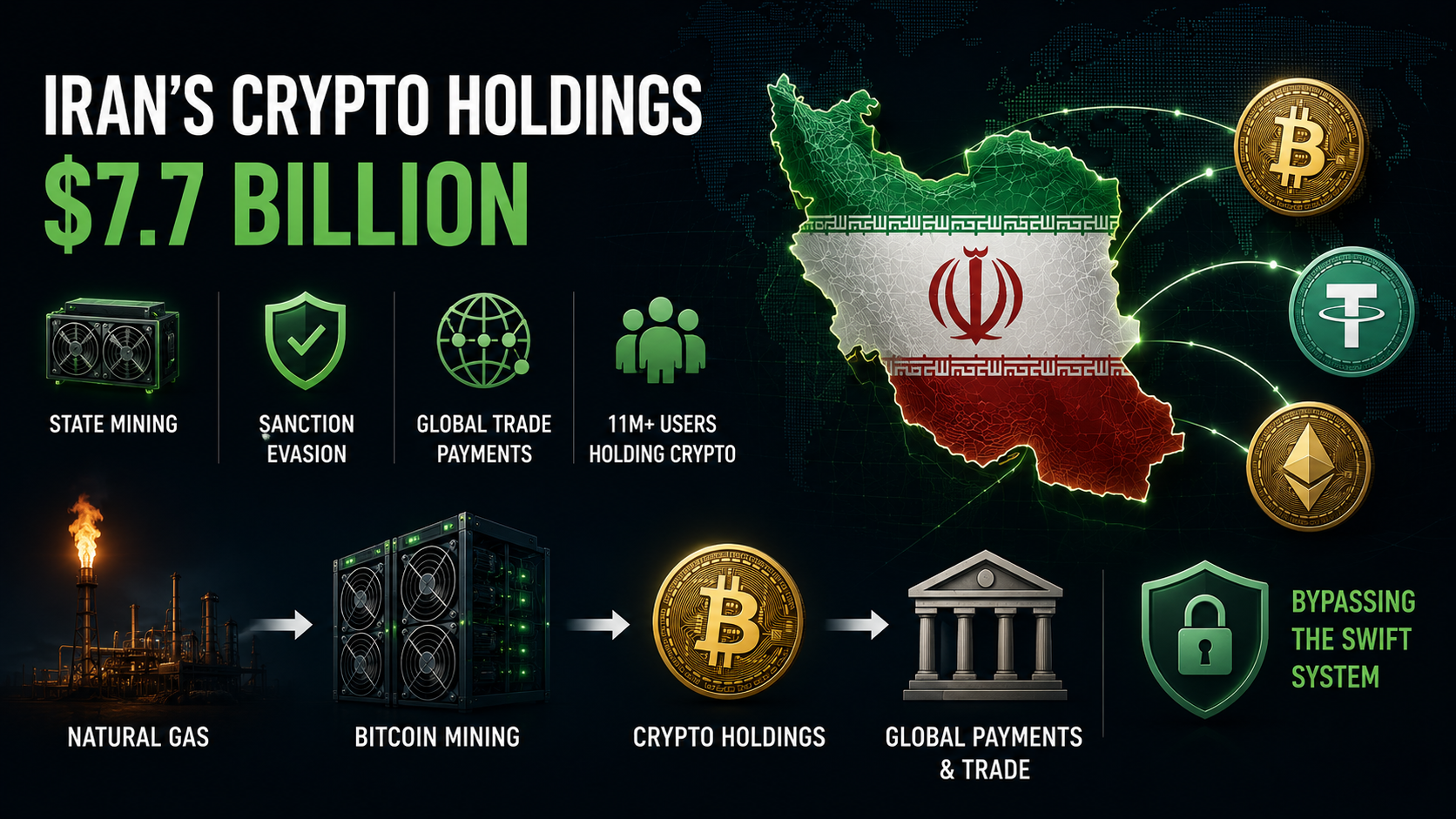
Global financial networks are experiencing an unprecedented paradigm shift as decentralized digital assets increasingly intersect with international geopolitical conflicts. Recent intelligence reports indicating that Iran's crypto holdings have reached a staggering $7.7 billion highlight how targeted nation-states leverage public ledger architectures to systematically bypass Western embargoes and reshape the dynamics of global economic isolation.
This comprehensive investigation unpacks the structural reality of Tehran's digital asset ecosystem, analyzing state-sanctioned mining operations, regional evasion networks, and the broader strategic implications of Iran's crypto holdings for global market participants.
Key Takeaways
-
The $7.7 Billion Discrepancy: The widely publicized $7.7 billion valuation of Iran's crypto holdings is an aggregate estimate of historical transaction volumes and mining output, rather than an audited, liquid sovereign treasury balance sheet.
-
State-Sanctioned Subsidized Arbitrage: The Iranian regime converts stranded domestic natural gas into Bitcoin via state-licensed mining facilities, establishing an alternative, censorship-resistant international trade settlement mechanism.
-
Military Procurement Channels: Entities linked to the Islamic Revolutionary Guard Corps (IRGC) utilize public ledger protocols to obscure transactional flows, settling military logistics and procurement bills outside the SWIFT framework.
-
Domestic Retail Flight: Over 11 million Iranian citizens use domestic digital asset exchanges like Nobitex to insulate personal capital against the catastrophic hyperinflation and systemic devaluation of the Iranian rial.
-
Regulatory Escalation Risks: The visibility of Iran's crypto holdings is driving severe Western regulatory blowback, accelerating the implementation of stringent, mandatory wallet-screening protocols for global compliance.
Decoding the Source: Where Does the $7.7B Claim Come From?
The sudden emergence of headlines declaring that Iran's crypto holdings have crossed the $7.7 billion threshold has triggered intense scrutiny across the digital asset industry. To understand the geopolitical risk this represents, market analysts must separate media sensationalism from the concrete mechanics of blockchain forensics. This multi-billion-dollar figure does not represent a static, centralized digital vault controlled by a single government official; instead, it is a complex data point derived from years of distributed network activity.
Sovereign digital asset footprints are notoriously difficult to audit due to the pseudonymous architecture of public blockcychains. To evaluate the validity of the $7.7 billion claim, analysts look at two distinct vectors: the theoretical macro-production of digital assets within Iranian borders and the specific threat intelligence reports compiled by Western defense analytics firms.
The Formula Behind the Figures: Mining Estimates vs. Real Liquid Stash
The mathematical foundation for the $7.7 billion valuation relies heavily on cumulative historical data rather than immediate liquid reserves. Since the formalization of state-sanctioned mining in 2019, blockchain analytics firms have tracked the global cryptographic hash rate originating from Iranian IP ranges. By multiplying the estimated daily computational output by the historical block rewards and trailing price actions of Bitcoin, researchers arrive at a multi-billion-dollar aggregate production figure.
However, this data model assumes a static holding pattern that rarely reflects state fiscal realities. A significant portion of these mined assets is immediately liquidated to finance essential imports, meaning the actual liquid treasury balance held by the state at any given moment is a fraction of the total historical output. The $7.7 billion figure represents the total economic throughput of the ecosystem rather than a consolidated government war chest.
The Threat Detection Data: Dissecting the Fox News & NS3.AI Reports
Recent investigative disclosures by media outlets like Fox News, drawing on data from defense-tech intelligence firms such as NS3.AI, have shifted the focus toward active wallet clusters. These threat detection reports map out intricate webs of addresses interacting with known Iranian infrastructure, regional over-the-counter (OTC) desks, and domestic fiat gateways.
The intelligence data indicates that over 50% of the recorded transaction volume is concentrated within institutional wallet clusters tied directly to state-backed entities. By analyzing the transaction graph—specifically looking at patterns of peeling, mixing, and hop-counts—intelligence agencies argue that the total value moving through these sanctioned networks heavily confirms the massive scale of Iran's crypto holdings.
Weaponizing the Ledger: How Tehran Bypasses the SWIFT Network
By disconnecting Iranian financial institutions from the Society for Worldwide Interbank Financial Telecommunication (SWIFT) network, international regulators effectively cut off Tehran's access to the global fiat banking architecture. This total exclusion forced the state to pioneer alternative monetary rails. Public block ledgers offer an ideal substitute: a neutral, non-jurisdictional financial layer that operates completely independent of western clearinghouses, correspondent banks, and centralized clearing systems.
To successfully operationalize this decentralized parallel trade network, the regime has built a sophisticated industrial pipeline that transforms physical natural resources directly into un-censorable, internationally liquid digital value.
Energy Arbitrage: Converting Natural Gas Into Sanction-Proof Bitcoin
Iran possesses some of the largest proven natural gas reserves globally, but strict trade embargoes prevent the country from exporting this energy through traditional pipelines or liquid natural gas (LNG) tankers. To resolve this bottleneck, the government engages in structural energy arbitrage. By routing surplus, un-exportable natural gas to domestic power stations, the state generates heavily subsidized electricity, which is then allocated to industrial-scale Bitcoin mining operations.
This conversion process yields "virgin" Bitcoin—newly minted tokens with no transaction history. These pristine digital assets are uniquely valuable for sanctions evasion because they carry no historical links to illicit wallets, making them exceptionally easy to liquidate on international markets. The mined Bitcoin is systematically collected by the Central Bank of Iran (CBI) via mandatory state-purchase programs, giving the regime a continuous stream of hard currency to pay foreign suppliers for critical industrial imports.
The IRGC's On-Chain Dominance: Funding Military Procurement and Proxies
The Islamic Revolutionary Guard Corps (IRGC), which manages a vast portion of Iran’s industrial and military complex, has aggressively integrated digital assets into its transnational procurement networks. Front companies operated by the IRGC use specialized procurement wallets to split large international transactions into thousands of micro-payments, obfuscating the ultimate destination of the capital.
These on-chain networks are primarily used to source specialized electronics, dual-use machinery, and aerospace components from global markets. Additionally, blockchain forensics reveal that a portion of Iran's crypto holdings is regularly transferred through regional intermediary wallets to fund proxy organizations throughout the Middle East, bypassing the tracking mechanisms employed by Western intelligence agencies.
Shadow Channels: How Nobitex Processed Billions via Tron and BNB Chain
While Bitcoin remains the primary asset for long-term state reserves, high-throughput, low-fee protocols like Tron (TRX) and BNB Chain are heavily utilized for daily operational transaction volume. Nobitex, Iran's largest domestic digital asset exchange, has processed billions of dollars in volume by leveraging these alternative networks, primarily utilizing the fiat-pegged stablecoin Tether (USDT).
-
Protocol Preference: The low transaction fees and rapid settlement times on the Tron network make it the preferred infrastructure for commercial trade processing.
-
Smart Contract Obfuscation: Local entities utilize decentralized automated market makers (AMMs) and liquidity pools to swap localized tokens for stablecoins without undergoing traditional KYC checks.
-
Exfiltration Frameworks: Capital processed through Nobitex is routed via nested regional payment processors before hitting international liquidity hubs, masking the Iranian origin of the funds.
The Domestic Haven: Why 11M Iranian Citizens Fueled the Stash
While state actors utilize digital assets for geopolitical positioning, the structural expansion of Iran's crypto holdings is also heavily driven by the country's domestic retail sector. Decades of severe economic isolation, combined with systemic state mismanagement, have placed the domestic population under intense financial pressure. For the average citizen, digital assets are not an ideological tool for sanctions evasion, but a crucial mechanism for personal economic survival.
The domestic digital asset ecosystem has evolved into a robust parallel economy, boasting user adoption rates that outpace many Western nations. Over 11 million Iranians—roughly 13% of the total population—actively maintain verified accounts across local trading platforms, forming a massive ground-up capital base that directly swells the nation's overall on-chain asset footprint.
Rial in Freefall: Hedging Against Hyperinflation with Digital Assets
The Iranian rial (IRR) has suffered a catastrophic, multi-year devaluation trend against the U.S. dollar, with annual domestic inflation rates consistently hovering between 40% and 50%. Because the state imposes strict capital controls that limit the amount of foreign physical fiat currency citizens can legally hold, ordinary savers have turned to digital stablecoins as an alternative.
By converting local fiat salaries into digital assets like Tether (USDT) or fractional Bitcoin immediately upon receipt, citizens effectively freeze their purchasing power against local currency degradation. This systemic retail capital flight acts as a distributed hedge, transforming the savings of millions of ordinary households into a massive, persistent pool of on-chain liquidity that anchors the broader domestic ecosystem.
Flight to Self-Custody: Blockchain Activity Spikes During Protests
Periods of civil unrest and heightened geopolitical tension in Iran correlate with distinct, measurable anomalies on public blockchain networks. Historical on-chain data shows sharp, sudden spikes in capital outflow from centralized domestic exchange wallets into non-custodial, private hardware wallets during major public protests or state-enforced internet blackouts.
-
Risk Mitigation: Citizens proactively move assets off centralized platforms to prevent potential state asset seizures or account freezes during civil crackdowns.
-
Global Portability: Self-custodial seed phrases allow individuals to secure their family wealth in a portable, borderless format that cannot be physically confiscated at border checkpoints.
-
Censorship Resistance: Despite state-level attempts to throttle internet traffic, peer-to-peer (P2P) localized networks and VPN protocols allow users to broadcast signed transactions directly to the global blockchain, ensuring financial continuity during crises.
Operation Economic Fury: The U.S. Treasury Strikes Back
The scale and utility of Iran's crypto holdings have drawn intense scrutiny from Western regulatory frameworks, transforming the blockchain into a primary front for modern financial warfare. The U.S. Department of the Treasury, via the Office of Foreign Assets Control (OFAC), has deployed advanced cryptographic tracing toolsets to aggressively counter Tehran’s digital evasion strategies.
Rather than viewing the blockchain as an un-trackable black box, western enforcement agencies treat the immutable, public nature of open ledgers as a powerful asset for intelligence gathering. Every transaction leaves an indelible digital footprint, allowing regulators to systematically isolate illicit infrastructure from the global financial system.
Multi-Million Freezes: Tracking OFAC’s Targeted Crypto Wallet Seizures
OFAC’s enforcement strategy relies heavily on the use of the Specially Designated Nationals (SDN) list, which has been expanded to include thousands of specific cryptocurrency addresses linked to Iranian state actors, proxy networks, and cyber-espionage groups. Working in close tandem with commercial blockchain intelligence firms, international law enforcement agencies monitor these blacklisted addresses in real time.
When an un-hosted wallet associated with an Iranian entity attempts to route funds into a compliant, centralized global exchange or liquidity provider, automated compliance software instantly flags and freezes the incoming assets. This proactive intervention framework has successfully locked up hundreds of millions of dollars in illicitly routed tokens, forcing state actors to rely on increasingly expensive and inefficient obfuscation networks.
Secondary Sanctions: Cutting Off International Exchanges from U.S. Banking
The most powerful tool in the U.S. regulatory toolkit is the threat of secondary sanctions directed at global digital asset infrastructure providers. Any international crypto exchange, over-the-counter (OTC) trading desk, or decentralized protocol custodian that knowingly services wallets linked to Iran's crypto holdings risks losing its access to the U.S. dollar clearing system.
| Target Class | Regulatory Action Implemented | Operational Impact |
| Regional OTC Desks | Asset forfeiture & criminal indictments | Elimination of primary regional off-ramps |
| Global Crypto Exchanges | Multi-billion dollar compliance fines | Implementation of mandatory geo-blocking |
| Privacy Protocols | Smart contract address blacklisting | Severe reduction in available mixing liquidity |
This aggressive enforcement framework has forced the global crypto industry to implement sophisticated, real-time transaction monitoring systems, forcing non-compliant platforms out of the mainstream financial ecosystem.
Market Outlook: What This Sovereign Tech Adoption Signals for Investors
The ongoing development of Iran's crypto holdings provides a valuable case study for the evolution of digital assets as critical instruments of statecraft. This phenomenon signals that cryptocurrency has matured far beyond its origins as a vehicle for retail speculation; it now functions as highly contested geopolitical infrastructure. For institutional investors and global market participants, sovereign-level adoption by sanctioned nation-states introduces distinct structural risks and long-term trends that must be integrated into risk assessment models.
First, the continuous accumulation and utilization of digital assets by state actors establishes a permanent floor for global hash rate demand and hardware deployment, accelerating the transition of the mining sector into an industrial, state-level utility. Second, the transparent nature of public ledgers ensures that sovereign evasion strategies will always trigger offsetting regulatory responses from Western jurisdictions.
Investors must anticipate a bifurcated liquidity landscape: a highly compliant, institutionalized ecosystem operating alongside an opaque, parallel gray-market ecosystem. As global compliance frameworks tighten to address sovereign evasion, the premium on clean, verified, institutional-grade digital assets will continue to expand, reshaping market valuations across the entire industry.
FAQ
What are Iran's crypto holdings valued at?
Recent threat intelligence data estimates the total economic volume of Iran's crypto holdings at approximately $7.7 billion to $7.8 billion. This metric reflects cumulative on-chain transaction volumes and historical mining infrastructure output rather than a single, static state-controlled wallet.
How does Iran use Bitcoin to bypass economic sanctions?
The Iranian regime leverages subsidized domestic energy to mine Bitcoin, transforming un-exportable natural gas into a liquid digital asset. This newly minted currency is used to settle international import bills directly, completely bypassing the Western-controlled SWIFT banking network.
Can the U.S. government freeze Iran's crypto holdings?
While the U.S. Treasury cannot directly alter or freeze funds held in private, self-custodial wallets inside Iran, it utilizes OFAC sanctions to blacklist associated addresses. This effectively isolates those wallets, preventing them from transferring assets into compliant global exchanges.
Why do ordinary Iranian citizens hold digital assets?
Over 11 million Iranian citizens use digital assets primarily as a financial hedge to protect their personal savings against the severe hyperinflation of the local rial. Stablecoins like Tether offer a portable, secure alternative to a devaluing domestic fiat currency.
Which blockchain networks are most active in Iran?
Bitcoin remains the primary network for industrial state mining and sovereign reserves due to its security. However, high-throughput networks like Tron (TRX) and BNB Chain are heavily utilized for high-volume retail transactions and commercial stablecoin payments.