

How to Sell Pi Coin: The Ultimate Guide
Pi Network has built one of the largest communities in crypto by making “mining” feel accessible through a mobile app, and that has naturally led millions of users to ask the same question once their balances become transferable: how do you actually sell Pi Coin? Ever since Pi Network entered its Open Network stage in February 2025, users with the right to it could migrate PI to external exchanges that allow trading, transforming Pi into an in-app asset into something, in some cases, sellable in the open market.
In this article we are going to discuss how to sell Pi Coin safely and legall in addition to covering Pi Network basics, Pi Coin value and price predictions, the steps required before selling and the key risks we have to keep in our mind while selling the coin.
Key Takeaways
-
You must have transferred your balance over to Pi Mainnet and you have already gone through the identity verification process to sell Pi Coin.
-
On February 20, 2025, Pi Network officially added an Open Network that allowed external connectivity and allowed exchange trading to eligible users.
-
Pi is typically traded at centralized exchanges which list PI trading pairs; more recent guides at CoinGecko and CoinMarketCap indicate that PI was not available on decentralized exchanges as of writing.
-
Before selling, users typically need to complete KYC, migrate PI to mainnet, set up a compatible wallet flow, and transfer coins to a supported exchange deposit address.
-
The market price of the Pi Coin is very dynamic and the current market value and the future expectations might change promptly with the changes of the tokens supply, listing, and adoption by users.
-
Whenever possible, the most secure way to go is to use trusted sites, ensure that the network is compatible, and beware of peer-2-peer frauds and whether you should trust any price forecasting.
What Is Pi Network and Pi Coin?
Pi Network is a blockchain initiative that was introduced in 2019 and gained popularity as it allowed users to earn PI by having a mobile-centered experience rather than the usual mining that is energy-consuming. The project passed through a number of stages, such as beta, testnet, enclosed mainnet, and lastly, Open Network. As the official statements by Pi Network mention, the Open Network stage became activated on February 20, 2025, which opened the blockchain to external connections and allowed qualified users and businesses to communicate with the rest of the crypto ecosystem. MEXC also presented the opening of the project through a stage rollout in 2019-2025 in their introduction to the project.
The native asset of the Pi Network ecosystem is Pi Coin, denoted as PI on the exchanges and market trackers. Practically, PI is the token that users are targeting to leave the app environment to the live mainnet once they fulfil the requirements of Pi, particularly identity verification and migration eligibility requirements. After being migrated, PI has the potential to be exchanged on an exchange that accepts PI as a tradable asset, and sold, again, into another cryptocurrency, typically a stablecoin such as USDT, based on the pairs that the exchange offers. CoinMarketCap Academy, CoinGecko Learn, and MEXC all refer to this as the simple progression between PI gained in apps to saleable PI.
What makes Pi unusual is that many users still hold balances that are visible inside the Pi app but not yet fully migrated to mainnet. That distinction matters because “having PI in the app” is not always the same as “having transferable PI ready to sell.” In other words, your actual ability to sell depends less on your displayed balance and more on whether that balance has completed KYC-linked migration to the Open Network environment. That is why so many beginner guides emphasize readiness steps before talking about exchange trading.
From a beginner’s perspective, the easiest way to understand Pi Coin is this: PI only becomes meaningfully sellable when it moves from the internal Pi ecosystem into the open blockchain and then into a supported exchange account. Until then, it remains a balance with potential, not guaranteed liquidity.
Pi Coin Value and Price Predictions
Pi Coin now has a live market price on some major platforms, which means users no longer have to rely only on speculation or unofficial “IOU” markets to guess its value. At the time of the latest market data available through Binance’s price page, PI was trading around $0.17 with a market capitalization around $1.7 billion and a circulating supply near 9.78 billion. CoinGecko also tracks a live PI market page and recent performance data, while CoinMarketCap has continued publishing news and commentary around PI’s market movement.
That said, Pi Coin value remains unusually sensitive to supply dynamics, exchange access, and sentiment. CoinMarketCap Academy reported that PI had fallen sharply from an earlier peak, and a later CoinMarketCap news item tied weakness partly to large token unlocks and weak demand relative to new supply entering the market. That is an important point for sellers: even if you finally become eligible to sell, your actual proceeds will depend on timing, market depth, and how much fresh PI is entering circulation at the same time.
PI price forecasts should thus be taken as guidelines, not as certainties. Rose-colored predictions tend to take into account wider support of the exchanges, growth of the ecosystem, and greater real-life utilization within the Pi economy. Bearish predictions can be contrarily based on token unlock pressure, disproportionate liquidity, and the likelihood that early holders will sell on each rally. The most realistic middle-ground opinion is that PI could remain a volatile mid-tier crypto asset whose value can swing in either direction drastically as adoption and supply in circulation adjust.
To make real-world decisions, it is better that sellers look less at sensational forecasts and more at current tradability, the existing order-book liquidity on the exchange they intend to trade on and whether they wish to sell off everything in a lump sum or in instalments. You can have a quoted market price on a coin, and still get a miserable actual performance of the coin when you buy it as liquidity is tight or the volatility is so intense.
Can You Sell Pi Coin Right Now?
The answer to this question is yes, but under definite conditions. In February 2025, an introduction of the external trading functionality to the Open Network of Pi Network allowed the sale of Pi Network to the outside world, and various tutorials now indicate that PI could be traded on centralized exchanges listing the asset. CoinGecko’s updated guide says PI can be sold on centralized exchanges including Gate.io, Bitget, OKX, and MEXC, and it also noted that PI was not supported on decentralized exchanges at the time of writing. CoinMarketCap Academy similarly wrote that Pi’s move to open mainnet enabled users to trade their coins on exchanges.
But the more accurate answer is that not everyone can sell right now. To sell PI, you generally need four things to be true at once: you must have completed Pi KYC, your PI must have migrated to mainnet, your coins must be available for transfer rather than locked, and you must use an exchange that supports PI deposits and trading in your region. MEXC’s guide and blog both emphasize KYC and migration as essential requirements, and that matches the broader guidance from CoinGecko and CoinMarketCap.
Regional restrictions are another factor. Although one exchange might be trading PI on a world wide basis, the availability can vary by country or by the compliance regulations that govern your account. It is also possible that some users might discover that the exchange support varies according to the time and thus, before initiating a transfer, it is necessary to confirm the current deposit, trading, and withdrawal status. A guide that was good last few months may not be complete, in case a listing, delisting or change of regulation has occurred since then.
So the practical answer is this: yes, selling Pi Coin is possible now for some users, but “possible” does not mean “automatic.” Your account status inside Pi Network and the current status of exchange support matter just as much as the existence of a live market price.
How to Prepare for Selling Pi Coin
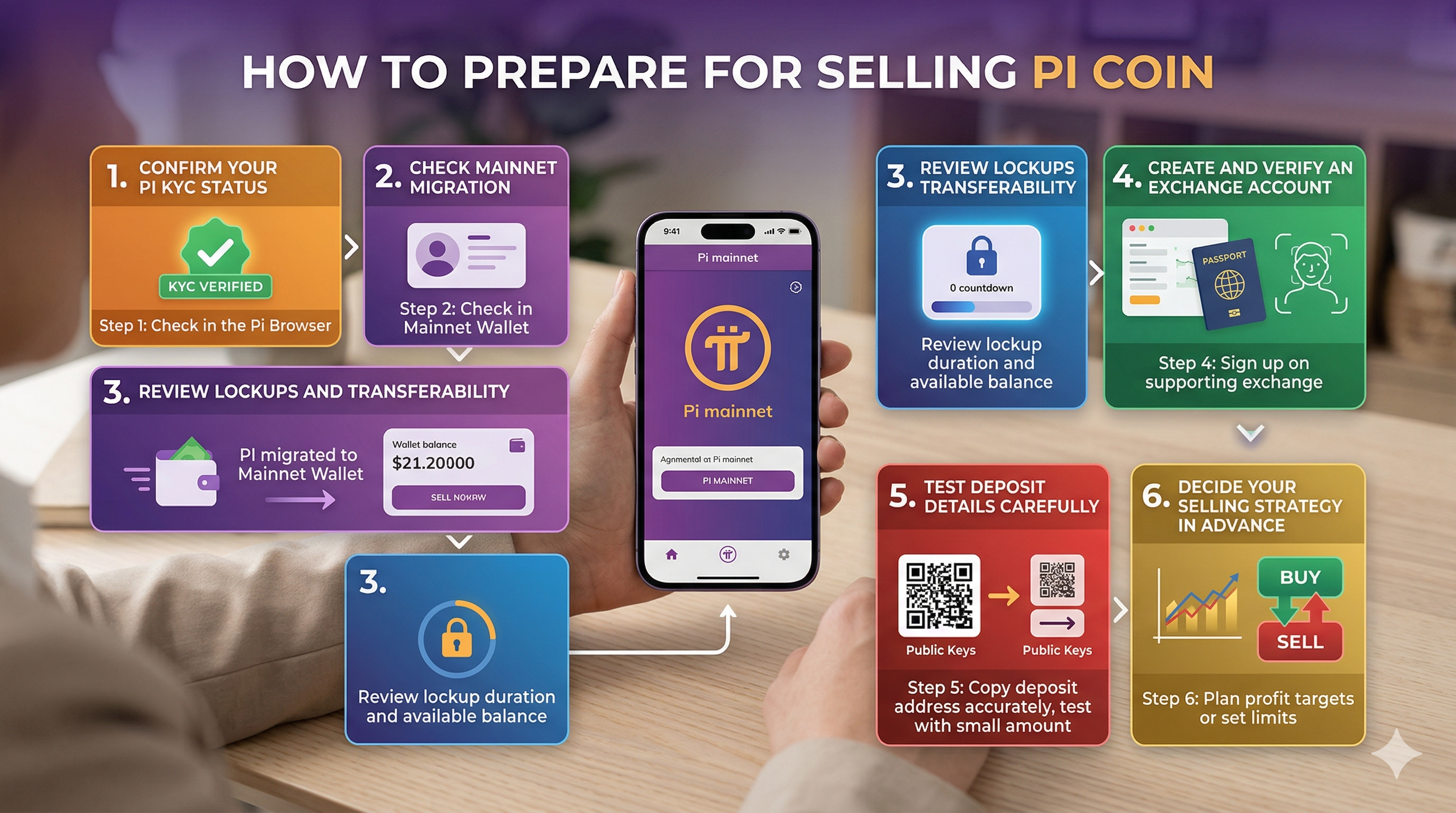
Before placing any sell order, the most important thing is preparation. Most problems people face while trying to sell PI happen before the exchange order itself, not during it. If your KYC is incomplete, your migration is pending, your wallet details are wrong, or you send PI to the wrong deposit address, the sale can fail or your coins can be lost. That is why preparation deserves more attention than the final click on the “sell” button.
1. Confirm Your Pi KYC Status
Pi Network requires identity verification for users who want to migrate to mainnet and use the open ecosystem. If your KYC is incomplete or still pending, you may not be able to move your PI out in a way that makes selling possible. MEXC’s step-by-step guide explicitly calls KYC the most important requirement for selling Pi Coin.
2. Check Mainnet Migration
A visible app balance does not always mean your PI is fully migrated. You need to verify that the amount you plan to sell has actually moved to the mainnet environment and is not still waiting in a queue or subject to lockup conditions. Pi’s official launch and anniversary posts both emphasize mainnet migration progress as a key milestone for the ecosystem.
3. Review Lockups and Transferability
Some PI may be locked based on your settings or network rules, which means it cannot be sold immediately even after migration. Before initiating a transfer, confirm the transferable amount rather than assuming your full balance is liquid. This simple check helps avoid frustration and mistaken expectations.
4. Create and Verify an Exchange Account
You will typically need an account on a centralized exchange that currently supports PI. That account may also require its own KYC before deposits, trading, or withdrawals are fully enabled. CoinGecko and CoinMarketCap both discuss exchange-based selling, and CoinGecko specifically lists centralized exchanges that have supported PI trading.
5. Test Deposit Details Carefully
Before sending a large amount of PI, confirm the deposit memo, network, and address format required by the exchange. A small test transfer is often the safest approach, especially for first-time sellers. This is not just a technical habit; it is a risk-control habit that protects against avoidable mistakes.
6. Decide Your Selling Strategy in Advance
The last stage of preparation is strategic. Choose to sell all your PI at present, sell bit by bit or hold to target price. In case the market is volatile, emotional decision making can be minimized with staged selling. It is not only a case of preparation in terms of eligibility, but it is also knowing what you intend to do before the market begins to move.
Where and How to Sell Pi Coin Legally
Once you are eligible and prepared, the actual selling process becomes much more straightforward. The legal and practical route for most users is to use a centralized exchange that supports PI in their jurisdiction and follow the platform’s own compliance procedures. CoinGecko’s updated guide says PI can be sold on centralized exchanges including Gate.io, Bitget, OKX, and MEXC, while CoinMarketCap Academy frames exchange trading as the core route after open mainnet.
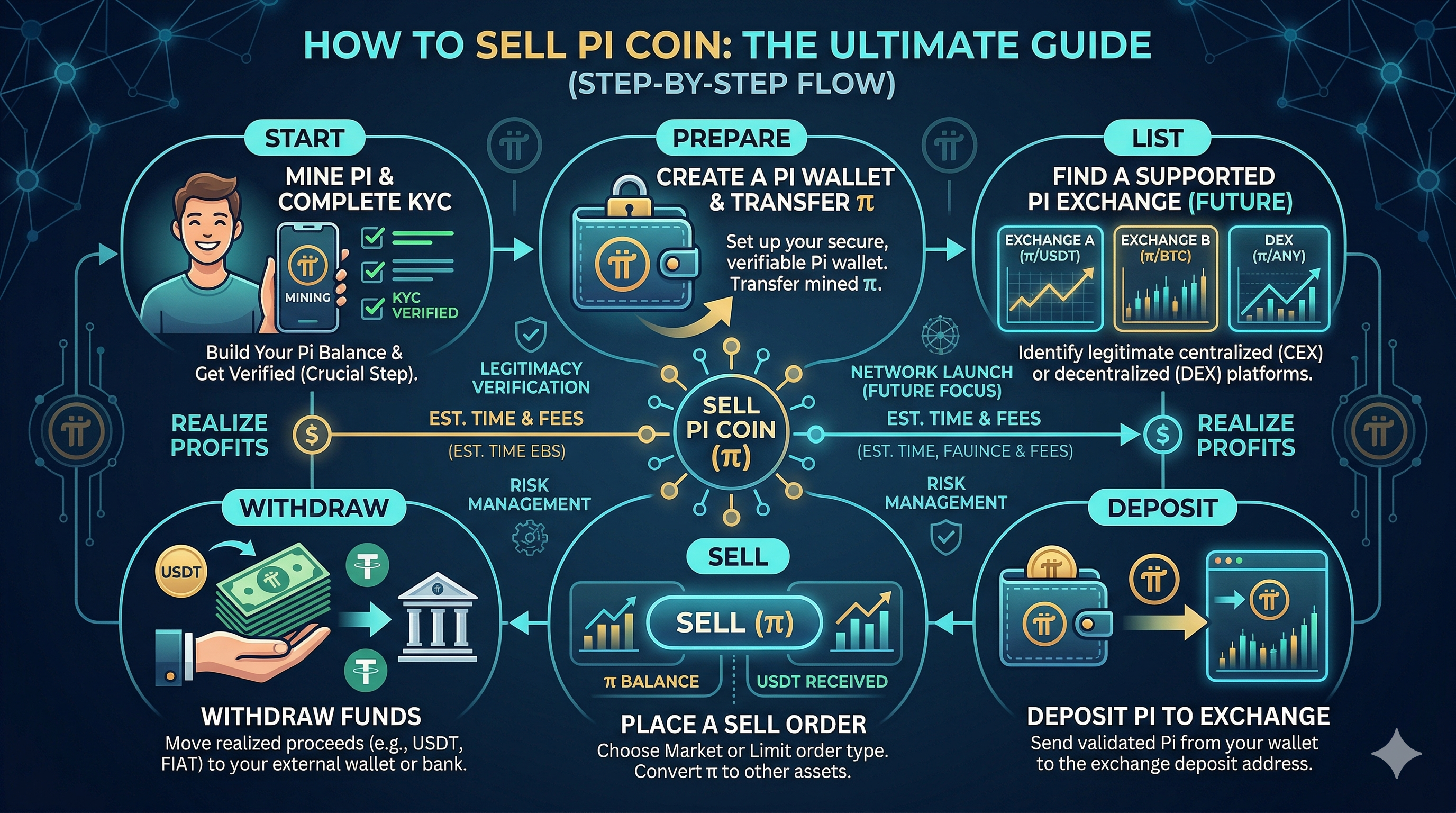
Here is the cleanest step-by-step process.
Step 1: Log in to a Supported Exchange
Choose an exchange that currently supports PI deposits and trading for your region. Make sure your account is fully verified and that deposits are open. Exchange support can change, so verify this on the platform itself before moving coins.
Step 2: Find the PI Deposit Address
Inside the exchange, go to the deposit page for PI and generate the deposit details. Read every note on minimum deposit size, memos, and supported network requirements. If anything is unclear, stop there and re-check before sending.
Step 3: Transfer PI From Your Pi Wallet
Initiate the transfer from your Pi wallet or transfer flow linked to your migrated mainnet balance. For safety, many users send a small test amount first. After the test deposit arrives successfully, they send the remaining amount.
Step 4: Choose a Trading Pair
Once the deposit credits, go to the spot market and choose the relevant pair, usually something like PI/USDT. The platform’s available pairs may differ, but stablecoin pairs are common because they make valuation easier and can be converted later into other assets or fiat routes where supported.
Step 5: Place a Market or Limit Sell Order
A market order sells immediately at the best available price in the order book, while a limit order lets you set your own price and wait for buyers. If liquidity is thin or volatility is high, a limit order may help protect you from a poor fill. If speed matters more than price precision, a market order may be simpler.
Step 6: Withdraw or Reposition the Proceeds
After the sale, your proceeds will typically be in USDT or another quoted asset. From there, you can keep them on the exchange, convert them into another cryptocurrency, or withdraw depending on what the platform and your region allow. This is the stage where fees, spreads, and withdrawal rules become important, so review them before finalizing your full exit.
Legally, the key principle is simple: use compliant platforms, complete the required identity checks, and follow local tax and reporting rules that apply to crypto trading in your country. The legality of selling PI depends not just on Pi Network itself, but on your exchange choice and jurisdiction.
Risks When Selling Pi
Selling Pi Coin is not just a technical process; it is also a risk event. The first risk is scam exposure. Because Pi has such a large retail user base, it attracts fake buyers, impersonators, and unofficial “cash-out” offers that promise better prices than exchanges. If someone asks you to transfer PI directly in exchange for off-platform payment, that should be treated with extreme caution. Reputable guides consistently steer users toward known exchanges rather than informal deals.
The second risk is price slippage and volatility. PI can move quickly, and a quoted price on a market page does not guarantee that a large order will execute at that exact level. Thin order books can lead to weaker execution, especially if many holders try to sell at once after migration waves or unlock events. CoinMarketCap’s reporting on PI token unlock pressure is relevant here because more circulating supply can weigh on price.
The third risk is operational error. Sending PI to the wrong deposit address, ignoring a required memo, or using an exchange that has paused PI deposits can result in delays or losses. This is why test transfers matter so much. Many crypto losses are not market losses; they are process losses caused by preventable mistakes.
The fourth threat is false expectations. Others wait to get unrealistic prices and fail to get viable options to exit and some panically sell without any strategies. The way to go is to plan ahead what you want to accomplish, get to know about present liquidity and make no emotion-driven decision based on the hype or panic.
The Future of Pi Network
Pi Network’s future will likely depend on whether it can convert a very large community into a durable on-chain economy. The Open Network launch was a major milestone because it connected Pi’s blockchain and user base to the outside world, but long-term value will require more than tradability. It will depend on ecosystem growth, developer activity, user retention, merchant or app usage, and how effectively the network manages supply and demand over time. Pi’s own anniversary update framed the first year of Open Network as a period of expanding connectivity and ecosystem progress.
For Pi Coin specifically, the future probably includes continued volatility. More exchange access and broader visibility can support adoption, but token unlocks and selling pressure from early holders can limit upside. That means Pi may continue to attract both long-term believers and short-term traders. A realistic outlook is that Pi’s success will be judged less by headlines and more by whether users actually keep building, spending, and transacting inside the ecosystem after the novelty of exchange trading fades.
For current holders, that creates a balanced conclusion. Pi is no longer just an app balance story; it is now a live-market asset. But being a live-market asset also means it must prove itself under real conditions, where liquidity, supply, trust, and utility matter every day.
Conclusion
If you are wondering how to sell Pi Coin, the answer is now much clearer than it was before Open Network launched. Eligible users can sell PI, but only after completing KYC, confirming mainnet migration, using a supported exchange, and following a careful transfer-and-sale process. Pi Coin value is real enough to track on market platforms, yet it remains volatile and highly sensitive to supply and sentiment. The smartest approach is to prepare thoroughly, use legal and verified platforms, and treat selling as a strategic decision rather than a rushed reaction to hype.
FAQs
Can I sell Pi Coin directly from the Pi app?
Not in the simple sense most beginners imagine. You usually need your PI to be migrated to mainnet and then transferred to a supported exchange before you can place a sell order. The app balance alone is not always the same as transferable PI.
Do I need KYC to sell Pi Coin?
Yes, in most cases KYC is essential. Pi Network uses identity verification as part of the path to mainnet migration, and exchange platforms usually require their own account verification for deposits, trading, or withdrawals.
Where can I sell Pi Coin?
Recent guides from CoinGecko and CoinMarketCap point to centralized exchanges as the main selling venue. CoinGecko specifically listed exchanges such as Gate.io, Bitget, OKX, and MEXC at the time of its latest update.
Is selling Pi Coin legal?
Selling PI through a compliant exchange can be legal, but legality depends on your local jurisdiction, the exchange’s licensing and compliance status, and your own tax or reporting obligations. Always check the rules that apply where you live.
What is the safest way to sell Pi Coin?
The safest route is to use a verified exchange account, confirm PI deposit support, send a small test transfer first, and avoid off-platform buyers or informal deals. Most safety problems come from scams or transfer mistakes, not from the sell button itself.
Should I sell all my Pi at once?
That depends on your goal and risk tolerance. Some users prefer staged selling so they are not forced to rely on one price level. If the market is volatile, selling in portions can reduce emotional pressure and execution risk.