

The Five-Fold Crunch: Why Bitcoin Mining Faces an Unprecedented Crisis Amid Soaring Power, Heat, and Slumping Markets
2026/06/07 10:00:00
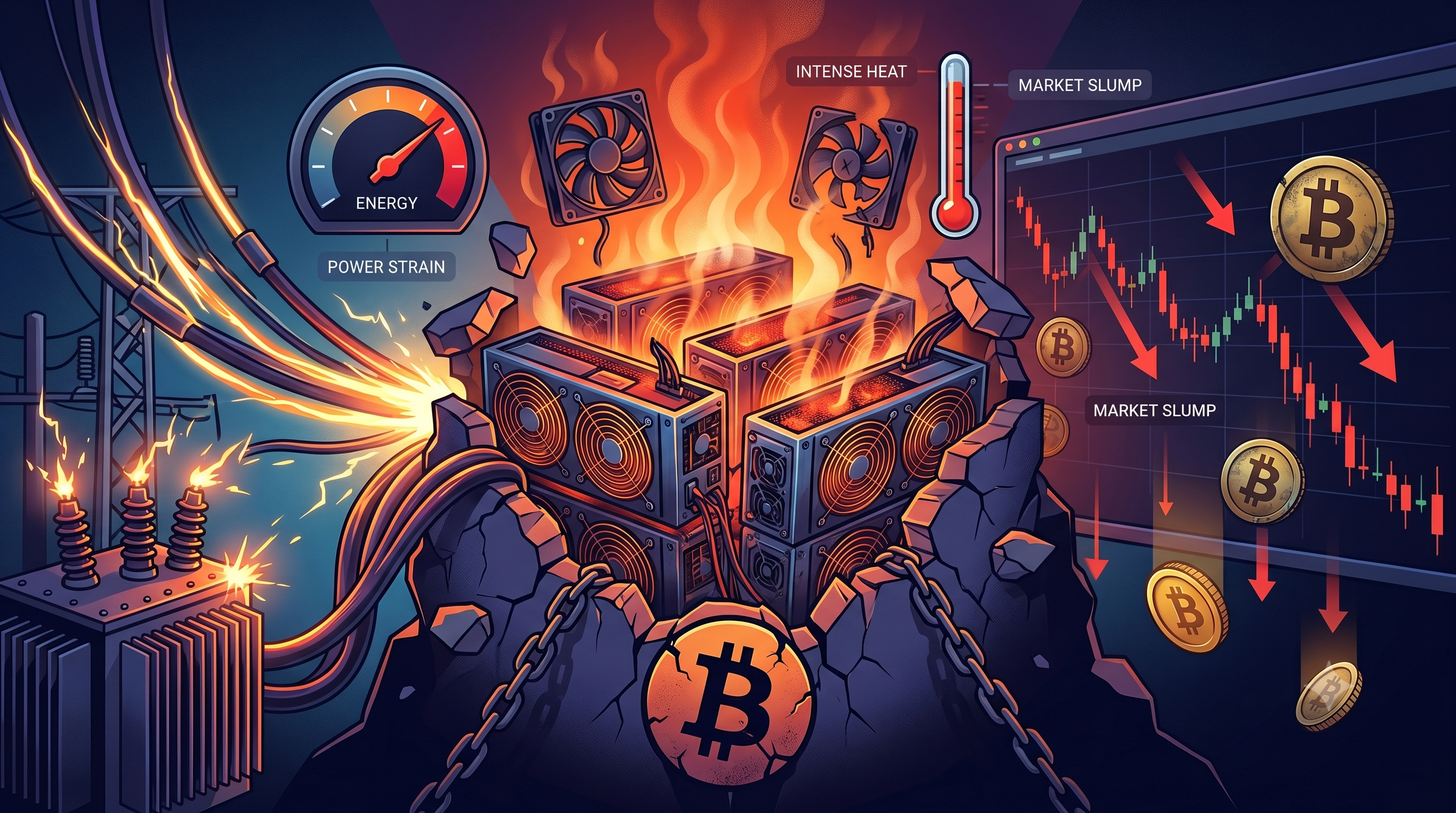
Bitcoin mining in 2026 faces a unique convergence of five major pressures: rising electricity costs, increasing heat-related expenses, record-high network competition, declining mining profitability, and softer market conditions, creating the most complex operational challenge the industry has faced since the post-halving era began.
Understanding the Mining Crisis
Bitcoin mining has always been a business defined by cycles, competition, and technological change. Yet the pressures confronting miners in 2026 stand apart from previous downturns because several adverse forces are unfolding simultaneously. Electricity prices remain elevated across many regions, cooling costs are rising as temperatures increase globally, network difficulty has reached record highs, mining revenue per unit of computational power has declined, and Bitcoin itself continues trading well below the peaks seen during the previous cycle. Together, these factors have created what many industry participants describe as the most challenging operating environment since the 2024 halving reduced block rewards from 6.25 BTC to 3.125 BTC.
Recent network data shows Bitcoin difficulty reaching a new all-time high near 139 trillion, while hashrate approaches the historic milestone of one zettahash per second, intensifying competition among miners for a shrinking pool of rewards. At the same time, miner revenue has weakened significantly despite continued investment in hardware and infrastructure. The result is a rapidly changing industry in which operational efficiency has become more important than ever. Companies that once relied primarily on scale are now being forced to rethink power sourcing, cooling systems, treasury management, and business diversification strategies. This environment is reshaping the economics of Bitcoin mining and raising important questions about which operators can survive the current cycle.
Record Network Difficulty Is Making Every Bitcoin Harder to Earn
The most immediate challenge confronting miners is the relentless increase in Bitcoin network difficulty. Difficulty is designed to adjust automatically every 2,016 blocks to maintain Bitcoin’s approximate ten-minute block interval. When more computational power joins the network, difficulty rises, requiring miners to perform more work for the same reward. During May 2026, Bitcoin difficulty climbed to approximately 138.96 trillion, establishing a new all-time high as the network's hashrate approached one zettahash per second. This milestone highlights the growing competitiveness of the mining ecosystem. For individual operators, rising difficulty means that even maintaining existing revenue levels requires continuous investment in more efficient machines and infrastructure. The challenge becomes even more significant because difficulty growth has persisted despite declining mining profitability.
Recent network reports show that hashrate is rising from roughly 948 EH/s to nearly 978 EH/s within weeks, indicating that new mining capacity continues entering the market even as margins compress. This dynamic creates a paradox. Operators must invest more capital to stay competitive while the economic return on that investment becomes increasingly uncertain. Readers tracking market metrics through the Bitcoin price page on KuCoin can observe how mining economics increasingly depend on the interaction between network growth and asset valuation. As competition intensifies, older ASIC models become economically obsolete faster than in previous cycles. Large industrial operators with access to newer hardware retain advantages, while smaller miners face shrinking rewards and longer payback periods, accelerating consolidation across the sector.
Hashprice Collapse Is Squeezing Margins Across the Industry
Difficulty growth alone would be manageable if mining revenue expanded proportionally. Instead, miners are facing a significant decline in hashprice, one of the industry's most important profitability metrics. Hashprice measures the estimated daily revenue generated by a unit of mining power and serves as a practical indicator of miner earnings. During May 2026, industry reports showed hashprice falling more than 13% from monthly highs as increasing difficulty and market weakness combined to reduce profitability. Separate reporting documented miner revenue dropping nearly 9.5% after difficulty adjustments increased competition for rewards. This decline creates substantial financial pressure because most mining expenses do not fall when revenue decreases. Electricity contracts, facility leases, staffing requirements, maintenance costs, and debt obligations remain largely fixed. Consequently, many operators are forced to liquidate portions of their Bitcoin holdings to sustain operations.
Market observers following Bitcoin market trends can see how reduced miner profitability often influences broader supply dynamics because miners become net sellers rather than long-term holders. Public mining companies are especially vulnerable because shareholders expect growth even during periods of declining margins. When hashprice remains weak for extended periods, companies must choose between raising additional capital, reducing operational scale, or exploring alternative revenue streams. The current environment demonstrates how profitability pressures can emerge even when network participation continues expanding. As more miners compete for rewards, the economic value generated by each unit of computational power becomes increasingly difficult to maintain.
Rising Electricity Costs Are Becoming the Industry’s Defining Variable
Electricity has always been the largest operating expense in Bitcoin mining, but its importance has intensified considerably since the 2024 halving. Industry estimates suggest that power expenses account for approximately 60% to 80% of total mining costs, making electricity pricing the single most important determinant of profitability. The challenge facing miners in 2026 is that many energy markets continue experiencing elevated pricing and volatility. Even small increases in electricity rates can dramatically alter profitability because mining facilities consume enormous amounts of power continuously. Network-wide energy consumption has reached unprecedented levels as the hashrate approaches one zettahash per second. Research estimates indicate that the Bitcoin network may now consume energy equivalent to that of entire countries, underscoring the scale of operational requirements involved.
For miners paying more than approximately $0.08 per kilowatt-hour, profitability has become increasingly difficult to sustain under current conditions. This reality is driving geographic shifts across the industry as operators seek access to cheaper power sources, including hydroelectric facilities, stranded energy resources, and long-term power purchase agreements. The trend also explains why many investors researching mining-related opportunities increasingly monitor energy markets alongside cryptocurrency prices.
Heat Waves Are Turning Cooling Into a Major Financial Burden
The mining industry's energy challenge extends beyond electricity consumption itself. Rising temperatures and more frequent heat waves are significantly increasing cooling expenses, creating a secondary cost pressure that many operators have underestimated. Mining hardware performs best within specific temperature ranges, and excessive heat can reduce efficiency, shorten equipment lifespan, and increase failure rates. To prevent these issues, operators must invest heavily in cooling infrastructure, including industrial ventilation systems, immersion cooling technologies, and advanced thermal management solutions. These systems consume additional power, effectively increasing total energy costs. As global temperatures rise across many mining regions, maintaining optimal operating conditions becomes increasingly expensive. Facilities located in traditionally favorable climates are also experiencing periods of elevated temperatures that require additional cooling capacity. This trend has important implications for mining economics because cooling expenses scale alongside hashrate growth. The more machines a facility operates, the greater the thermal load that must be managed.
Industry analyses emphasize that infrastructure costs, including cooling, maintenance, and facility operations, continue rising even as mining profitability declines. Consequently, miners face a situation where both primary and secondary energy-related expenses are increasing simultaneously. Some operators are responding by relocating to cooler climates or integrating renewable energy sources that can support cost-efficient cooling systems. Others are investing in immersion cooling technologies that improve efficiency while extending hardware lifespan. These developments illustrate how environmental conditions are becoming increasingly important competitive factors. The ability to manage heat effectively may determine whether mining facilities remain profitable as operational pressures continue intensifying across the industry.
Post-Halving Economics Continue to Reshape Mining Strategy
Although the 2024 Bitcoin halving occurred more than two years ago, its effects continue influencing mining economics throughout 2026. The halving reduced block rewards from 6.25 BTC to 3.125 BTC, permanently cutting the issuance of new Bitcoin available to miners. Historically, higher Bitcoin prices eventually offset reduced rewards. However, the current environment has complicated that relationship. Rising difficulty, elevated operational costs, and softer market conditions have limited the benefits miners typically expect during post-halving expansion periods. Industry research indicates that the effective cost of producing Bitcoin has increased substantially since the reward reduction, particularly for operators relying on older hardware or higher-cost energy sources. This shift has accelerated investment in next-generation ASIC miners capable of delivering significantly improved energy efficiency. At the same time, it has increased pressure on smaller operators that lack access to large-scale financing.
Many publicly traded mining companies have responded by diversifying their businesses into artificial intelligence infrastructure, high-performance computing, and data-center services. Reports from 2026 indicate that several major mining firms are actively pursuing these opportunities as a way to reduce dependence on mining revenue alone. Market participants following developments can observe how mining companies increasingly position themselves as broader digital infrastructure providers rather than pure Bitcoin producers. This evolution shows a fundamental reality: the post-halving environment rewards efficiency, diversification, and strategic flexibility more than simple scale. Companies that adapt successfully may emerge stronger, while those relying solely on traditional mining economics face growing uncertainty.
Institutional Expansion Is Intensifying Competitive Pressure
The competitive ecosystem of Bitcoin mining has changed dramatically as institutional participants continue expanding their operations despite declining profitability metrics. Large publicly traded miners and infrastructure-backed operators have access to financing options, long-term energy contracts, and capital markets that smaller competitors often cannot match. This advantage allows them to continue deploying new ASIC hardware even during periods of compressed margins. Reports show several major mining firms increasing capacity targets throughout 2026, contributing to the rapid growth in network hashrate despite falling hashprice and rising operational costs. The result is a market where scale increasingly determines survivability. Institutional operators can absorb temporary profitability declines while maintaining long-term expansion plans, creating additional pressure on independent miners and smaller facilities. This trend is accelerating consolidation across the sector as weaker participants either exit the market or become acquisition targets.
The economics are straightforward: larger operators can negotiate more favorable electricity agreements, secure discounted hardware purchases, and spread infrastructure costs across larger deployments. Institutional expansion introduces greater operational sophistication into the sector, with companies increasingly using data analytics, predictive maintenance systems, and advanced treasury strategies to optimize profitability. While these developments improve overall industry efficiency, they also raise the barriers to entry for new participants. Mining remains technically accessible, but achieving sustainable profitability has become significantly more challenging in an environment where large-scale operators continue strengthening their competitive advantages despite the difficult market backdrop.
Debt Burdens Are Creating Financial Stress Across Mining Companies
The rapid expansion of mining infrastructure during previous bull-market periods left many companies carrying substantial debt obligations that remain difficult to manage under current market conditions. During the years leading up to and following the 2024 halving, numerous miners financed equipment purchases, facility construction, and operational growth through loans and capital raises based on expectations of continued revenue expansion. The combination of rising difficulty, weaker hashprice, and elevated operating costs has complicated those assumptions. Revenue generated from mining activities is no longer sufficient for some operators to comfortably service debt while simultaneously funding growth initiatives. Industry analysts continue highlighting balance-sheet management as a critical factor influencing miner performance throughout 2026. Publicly available financial disclosures show that many companies remain focused on restructuring liabilities, extending repayment schedules, or securing alternative funding sources to maintain operational flexibility.
The challenge becomes particularly significant when companies hold debt linked to mining hardware whose economic value declines rapidly as newer, more efficient machines enter the market. Financial pressure often leads operators to sell portions of their Bitcoin reserves, defer infrastructure investments, or scale back expansion plans. These decisions can affect both individual company performance and broader mining-industry trends. While financially stronger firms may weather current conditions successfully, highly leveraged operators face greater vulnerability if profitability remains compressed. The debt issue, therefore, represents a crucial component of the broader five-fold crunch confronting the mining sector in 2026.
Hardware Efficiency Gains Are No Longer Offsetting Cost Inflation
Historically, improvements in ASIC technology have helped miners maintain profitability by delivering higher computational output while consuming less electricity. The latest generation of mining hardware continues to achieve meaningful efficiency gains, yet these improvements are increasingly being offset by rising operational expenses and heightened network competition. Manufacturers have introduced machines capable of producing substantially more terahashes per watt than models released only a few years ago. However, the financial benefits of upgrading equipment are becoming harder to realize because the entire industry is adopting similar technologies. When large numbers of operators deploy more efficient hardware simultaneously, the overall network hashrate increases, driving difficulty higher and reducing the relative advantage of any individual upgrade. This phenomenon helps explain why mining profitability has remained under pressure despite ongoing technological progress.
Industry observers note that capital expenditures required for large-scale hardware refreshes have increased significantly, particularly for companies seeking to remain competitive against institutional operators. The return-on-investment timeline for new equipment has therefore become more uncertain. The broader implication is that technological innovation alone is no longer sufficient to guarantee profitability. Mining companies must also manage energy costs, cooling requirements, financing obligations, and operational efficiency. Hardware remains a critical competitive factor, but its role has evolved from being a primary driver of profitability to one component within a much more complex operational equation. This move underscores the increasingly sophisticated nature of modern Bitcoin mining economics.
Geographic Migration Is Redefining Global Mining Hotspots
The search for lower operating costs is driving a significant geographic reshaping of the Bitcoin mining industry. As electricity prices, cooling expenses, and infrastructure requirements continue rising, miners are becoming increasingly selective about where they locate facilities. Regions offering abundant renewable energy, favorable climate conditions, and stable power infrastructure are attracting growing interest from operators seeking long-term sustainability. Hydroelectric-rich areas, locations with excess natural gas resources, and regions capable of supporting large-scale renewable energy projects have emerged as important destinations for mining investment. This migration reflects more than a simple effort to reduce costs. It represents a strategic response to the industry's evolving economics. Facilities located in cooler climates can reduce cooling expenditures, while access to low-cost power can significantly improve profit margins even when hashprice remains weak. Industry reports indicate that successful mining operations increasingly depend on securing competitive energy arrangements rather than merely deploying additional hardware.
The trend is also influencing infrastructure development, with some mining companies investing directly in energy generation projects to improve cost control and reduce exposure to electricity-market volatility. Readers exploring industry developments through KuCoin’s cryptocurrency insights can observe how geographic diversification is becoming a key business strategy. As mining economics continue changing, regional advantages play a larger role in determining competitiveness. Locations that combine affordable energy, favorable climate conditions, and supportive infrastructure are likely to attract increasing investment. The geographic redistribution of mining activity demonstrates how operational considerations are becoming just as important as technological innovation in shaping the industry's future.
AI Data Centers Are Emerging as a Strategic Alternative
One of the most significant developments in the mining industry during 2026 is the growing interest in artificial intelligence infrastructure. Several major mining companies have begun expanding into AI data-center operations and high-performance computing services as a means of diversifying revenue streams. This transition is driven by the recognition that mining facilities already possess many of the assets required for AI workloads, including access to large amounts of power, specialized infrastructure, cooling systems, and operational expertise in managing high-density computing environments. Reports from industry analysts indicate that companies pursuing AI-related opportunities are attracting considerable investor attention as markets evaluate alternative growth pathways beyond Bitcoin mining alone. The appeal of AI infrastructure lies partly in its potential to generate more predictable revenue than mining, which remains heavily dependent on Bitcoin price movements and network conditions.
Some operators view diversification as essential protection against future profitability cycles. Others see AI as a complementary business capable of utilizing existing infrastructure more efficiently. Market participants following digital asset trends through KuCoin can observe how the relationship between AI and crypto infrastructure continues evolving. While Bitcoin mining remains the core business for most operators, the growing overlap between computational infrastructure and AI services highlights broader changes within the technology sector. The emergence of AI data centers as a strategic alternative does not eliminate mining challenges, but it provides companies with additional options for navigating an increasingly complex operating environment. This diversification trend may become one of the defining characteristics of the industry's next phase of development.
Survival Increasingly Depends on Operational Excellence Rather Than Scale
The cumulative impact of rising power costs, increasing heat-related expenses, record difficulty levels, declining hashprice, and softer market conditions has fundamentally altered the competitive dynamics of Bitcoin mining. Scale remains important, but operational excellence has become the defining factor separating successful companies from struggling competitors. Efficient energy procurement, advanced cooling strategies, disciplined treasury management, prudent capital allocation, and technological adaptability now play central roles in determining profitability. The industry's current challenges demonstrate that mining is no longer simply a race to deploy the largest amount of computational power. Instead, it has evolved into a sophisticated infrastructure business requiring expertise across multiple disciplines.
Companies that can optimize every aspect of their operations are better positioned to withstand periods of compressed margins and heightened competition. Market developments suggest that the mining sector is entering a phase of greater maturity in which financial discipline and strategic flexibility carry increasing importance. While the five-fold crunch confronting miners is severe, it is also driving innovation, efficiency improvements, and business-model evolution throughout the sector. The companies that emerge strongest from this period are likely to be those capable of adapting to an ecosystem where profitability depends on far more than Bitcoin price appreciation alone. As mining continues evolving, operational excellence may ultimately prove to be the industry's most valuable resource.
Conclusion
Bitcoin mining in 2026 faces one of the most demanding operating environments in its history. Record network difficulty, declining hashprice, rising electricity costs, increasing cooling expenses, and persistent post-halving pressures have combined to create a five-fold crunch affecting operators across the industry. While these challenges are significant, they are also accelerating important transformations. Mining companies are pursuing greater efficiency, exploring new geographic opportunities, investing in next-generation infrastructure, and diversifying into adjacent sectors such as artificial intelligence.
The industry's future will likely be shaped not only by Bitcoin's price trajectory but also by the ability of operators to adapt to increasingly complex economic realities. As competition intensifies and margins remain under pressure, resilience, innovation, and disciplined execution will determine which companies thrive in the next phase of Bitcoin mining's evolution.
FAQs
-
Why is Bitcoin mining becoming less profitable even when the network keeps growing?
Bitcoin mining profitability depends on a combination of Bitcoin price, network difficulty, electricity costs, and transaction-fee revenue. During 2026, network hashrate and difficulty have continued reaching record levels, meaning miners must compete against a larger amount of computational power for the same block rewards. At the same time, operational expenses have remained elevated, reducing margins. Growth in network participation does not automatically translate into higher profits because rewards are shared among more competitors.
-
What is hashprice, and why do miners monitor it closely?
Hashprice measures the estimated revenue generated by a specific amount of mining power over a given period. It serves as one of the most important indicators of mining profitability because it reflects the combined effects of Bitcoin price, network difficulty, and transaction fees. When hashprice declines, miners earn less revenue from the same computational output, making operational efficiency increasingly important.
-
How does extreme heat affect Bitcoin mining operations?
Mining hardware generates substantial heat during operation and must remain within safe temperature ranges to maintain efficiency and reliability. Higher ambient temperatures increase cooling requirements, which raises electricity consumption and operating expenses. Excessive heat can also reduce equipment lifespan and increase maintenance costs, making thermal management a critical component of mining profitability.
-
Why are mining companies investing in AI infrastructure?
Many mining firms already operate large-scale facilities with significant power capacity and cooling infrastructure. These assets can often support artificial intelligence workloads and high-performance computing services. By expanding into AI infrastructure, companies can diversify revenue streams and reduce reliance on mining profitability, which is heavily influenced by Bitcoin market conditions.
-
Are smaller miners at a disadvantage compared to large operators?
Large operators typically benefit from economies of scale, access to financing, favorable power contracts, and discounted hardware purchases. These advantages can make it difficult for smaller miners to compete during periods of compressed profitability. However, smaller operators may still succeed if they secure low-cost energy, maintain efficient operations, and carefully manage expenses.
-
Could the current mining crisis improve the industry over time?
Historically, challenging market conditions have encouraged innovation and efficiency improvements across the mining sector. The current environment is pushing companies to adopt more advanced technologies, improve energy management, diversify business models, and optimize operations. While the transition may be difficult, these changes could contribute to a more resilient and sustainable mining industry in the long term.
Disclaimer: This content is for informational purposes only and does not constitute investment advice. Cryptocurrency investments carry risk. Please do your own research (DYOR).