

Analyzing the Current Inflation Rate 2026: Why the Official 2.4% Is Severely Distorted
2026/03/25 18:39:02
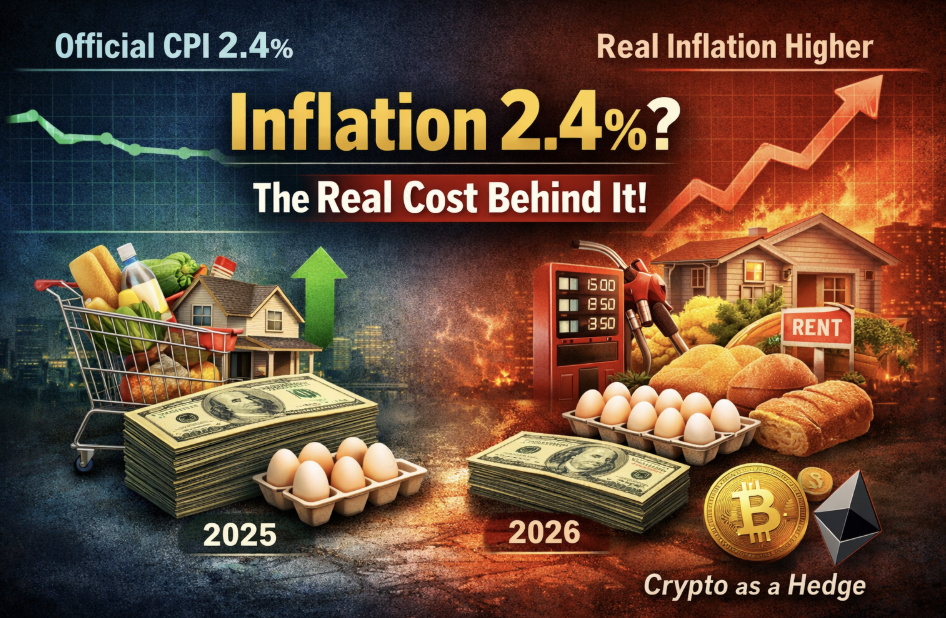
Inflation is often considered the heartbeat of an economy. Policymakers, investors, and households closely track its movements to make informed decisions. According to the U.S. Bureau of Labor Statistics, the official annual inflation rate in the U.S. held steady at 2.4% in February 2026, unchanged from January, and near the lowest level since May 2025.
On paper, this figure suggests price stability and a moderate cost-of-living increase. But for many households, the reality feels very different. The official number masks significant variations in housing, energy, food, and healthcare costs, creating a distorted view of real inflation.
For crypto investors, understanding inflation distortion is critical. True inflation influences purchasing power, interest rates, and the attractiveness of digital assets as a hedge against fiat currency depreciation. By the end of this article, readers will learn how official CPI metrics may mislead, why cryptocurrency can serve as an alternative store of value, and how to adjust trading strategies accordingly.
Hook
Did you know that while the official U.S. inflation rate remained at 2.4% in February 2026, natural gas prices surged 10.9% year-over-year, and fuel oil rose 6.2%? For households reliant on these energy sources, daily expenses may feel far higher than what the government reports. As assets like Bitcoin often outperform during periods of fiat currency weakening.
This raises a critical question: Is the official CPI truly reflective of the cost-of-living increases Americans are facing today?
Overview
-
What the official inflation rate represents and how it is calculated.
-
Why the reported CPI may not reflect real household costs.
-
Category-specific distortions in housing, energy, food, and consumer goods.
-
Real-life examples of how families experience inflation differently.
-
Implications for policymakers, investors, and consumers.
-
The impact of CPI distortions on cryptocurrency markets.
Thesis
The purpose of this article is to analyze the discrepancy between the official inflation rate and real consumer experiences, using official CPI data and sector-specific examples. By understanding these distortions, readers will be better equipped to interpret inflation data and make informed financial decisions. For crypto investors, understanding these distortions is critical to hedging risk, optimizing portfolio allocations, and timing trades effectively.
Understanding Inflation Distortion
What Is Inflation Distortion?
Inflation distortion occurs when official measures like the Consumer Price Index (CPI) understate or misrepresent the true rise in living costs. Key factors include:
-
Lagging housing costs measured via Owners’ Equivalent Rent (OER)
-
Smoothing of volatile energy prices
-
Deflation in specific categories, masking rising costs elsewhere
Shelter accounts for roughly 42% of CPI, yet actual home prices in 2025 rose ~15% YoY, while OER inflation only rose ~6%. This gap illustrates how CPI may understate the true inflation households experience.
Example: If a family’s income increases by 3% but their real expenses rise 5%, they are effectively losing purchasing power even if official inflation appears low.
What Is the Consumer Price Index (CPI)?
The Consumer Price Index (CPI) is a measure of the average change over time in the prices paid by urban consumers for a basket of goods and services. It is the most widely used indicator for inflation in the United States.
-
According to the U.S. Bureau of Labor Statistics, the CPI measures price changes for categories including housing, food, transportation, medical care, and recreation.
-
CPI is reported monthly and annually, with core CPI excluding food and energy to reduce volatility.
Real-Life Example:
A typical family spends about 40% of their budget on housing. If the CPI reports housing inflation at 3% based on owners’ equivalent rent (OER), but their actual mortgage payments or rent increase by 10%, the CPI underestimates their real cost increase.
How CPI Is Calculated
-
A basket of goods and services is selected, representing average consumer spending.
-
Prices are collected from thousands of retailers, service providers, and online sources.
-
Monthly and annual changes are computed to track inflation trends.
Limitations of CPI Calculation:
-
It uses OER for housing, which lags actual home price increases.
-
Core CPI excludes volatile energy and food prices, masking short-term shocks.
-
Some categories, like used cars or electronics, can experience deflation, which offsets inflation in essentials.
Real-World Distortion in Key Categories
Housing Costs
-
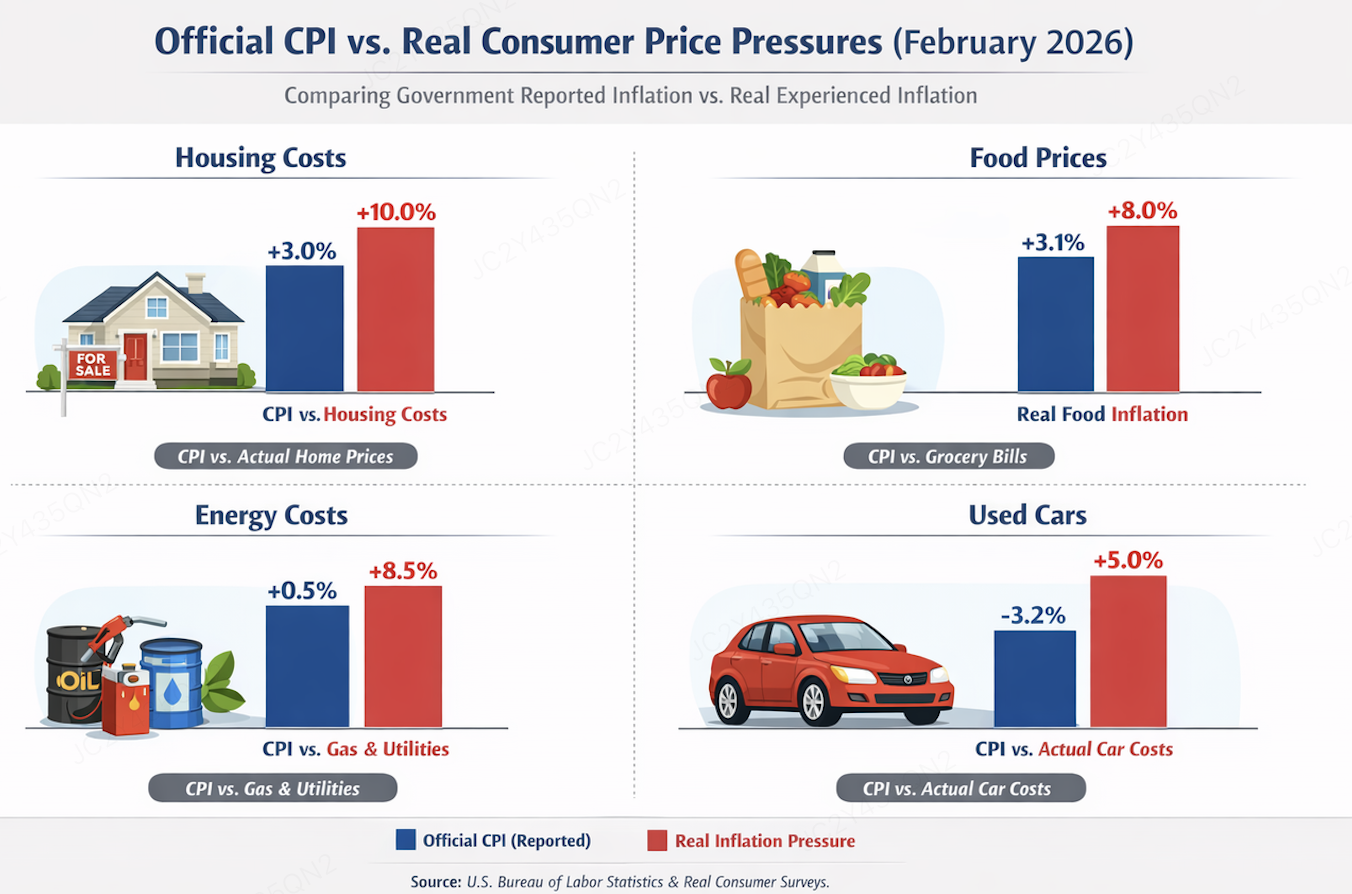
Shelter makes up about 42% of CPI weighting, yet CPI relies on owners’ equivalent rent rather than actual home prices.
-
Real estate markets often experience faster growth than OER. For example:
Example:
In 2025, median home prices rose 15% year-over-year, while OER-based CPI reported shelter inflation of only 3%. A family buying their first home experiences cost increases far above the official inflation rate.
Energy Prices
-
Energy is highly volatile. While CPI includes it, short-term spikes or dips are smoothed.
-
Example: Natural gas prices increased 10.9% YoY, fuel oil rose 6.2%, but the headline CPI showed only 2.4%.
For households heavily reliant on heating, cooking, or gasoline, the actual felt inflation is much higher than the reported figure.
Food Prices
While the official food inflation in February 2026 was 3.1% year-over-year (YoY), this number only tells part of the story. Localized price increases at grocery stores can far exceed this average, depending on supply chain disruptions, transportation costs, or regional market conditions.
A family in New York City might see grocery bills rise 8–10%, much higher than the reported 3.1% CPI. This illustrates how official inflation figures can underestimate the true cost of living, leaving households feeling the impact more acutely than government data suggests.
Example: How Inflation Reduces Purchasing Power
Let’s see how $100 in 2025 loses value in 2026 due to hidden inflation pressures in food prices.
Scenario: Eggs
In 2025, the average price of a dozen eggs was $3.00. With $100, a household could buy:
100 ÷ 3 = 33 dozen eggs
In 2026, food inflation and localized price increases pushed the average price of a dozen eggs to $3.50. With the same $100, a household can now buy:
100 ÷ 3.5 ≈ 28 dozen eggs
Impact: Even though the official CPI reports only 2.4% inflation, the real cost increase for essentials like food is higher. In this example, the household can buy 5 fewer dozen eggs with the same $100, showing how inflation erodes purchasing power.
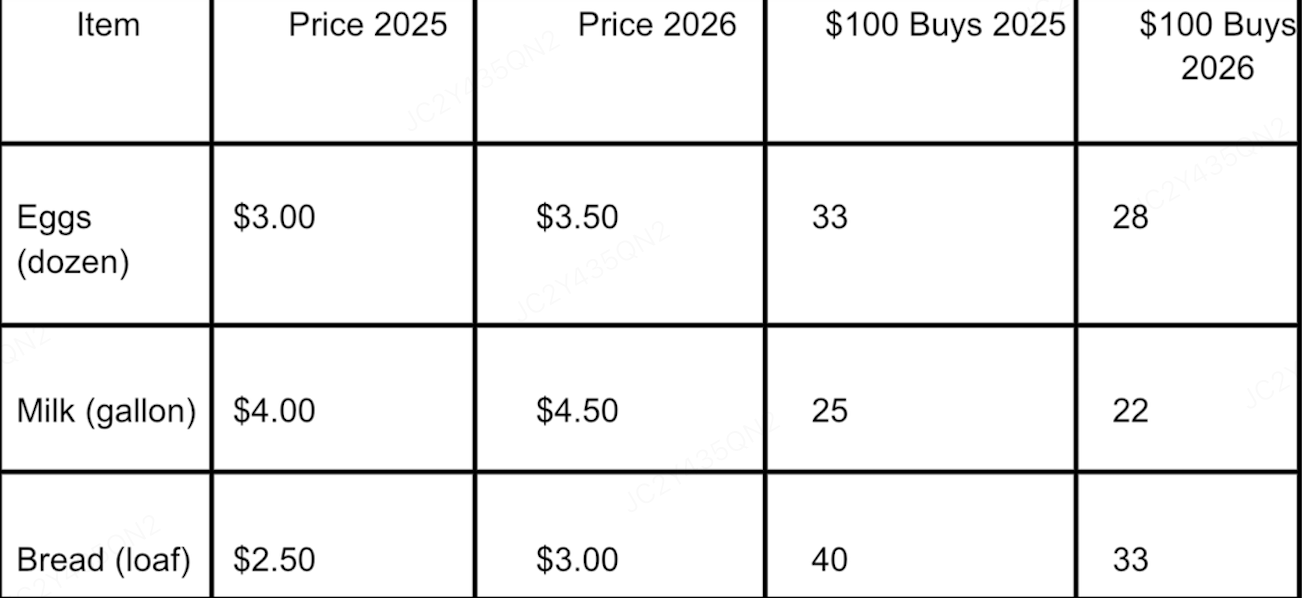
This table visualizes CPI distortion, showing that official 2.4% inflation underestimates the real impact on households.
Impact on Cryptocurrency Markets: Why Crypto Investors Care About Inflation Distortion
Inflation distortion has a direct impact on cryptocurrency markets, influencing investor behavior, trading strategies, and portfolio performance. For crypto investors, understanding how official inflation metrics may understate real-world price increases is essential for making informed investment decisions.
-
Protecting Purchasing Power & Managing Fiat Risk
Real inflation erodes the value of fiat currency, which can reduce purchasing power over time. When the official CPI underestimates inflation, crypto investors may not fully appreciate the risk to cash holdings.
Cryptocurrency as an inflation hedge: Digital assets like Bitcoin and stablecoins provide a store of value when fiat currency loses purchasing power.
Investment strategy: By including cryptocurrencies in their portfolios, investors can mitigate the effects of hidden inflation and preserve long-term wealth.
-
Driving Market Momentum
Historical data shows that crypto prices often rise when inflation expectations increase, as investors seek alternatives to cash and traditional financial assets.
Distortions in CPI caused by lagging housing costs, volatile energy prices, or deflation in specific sectors can lead to higher demand for decentralized assets.
As a result, cryptocurrencies like Ethereum and Bitcoin often experience upward momentum during periods of underestimated inflation.
-
Interest Rate Implications for Crypto Traders
Inflation distortion influences monetary policy, which directly affects crypto trading and market liquidity:
Misleadingly low inflation may lead the Federal Reserve to delay interest rate hikes, keeping borrowing costs low.
This encourages margin trading, leveraged crypto positions, and increased market activity.
Sudden spikes in real inflation can trigger rapid adjustments, creating volatility in cryptocurrency markets. With 24/7 markets on platforms like KuCoin, crypto investors can respond instantly to CPI changes and inflation surprises.
In Feb 2026, energy prices rebounded 0.5% while used cars and trucks declined -3.2%. For crypto investors, these distortions create uncertainty in fiat liquidity and market sentiment, often leading to increased interest in decentralized assets.
Advantages of Crypto in the Current Market
-
Hedge Against Inflation: Cryptocurrencies, particularly Bitcoin, are limited in supply, providing a hedge against rising prices in fiat currencies.
-
Portfolio Diversification: Crypto adds non-correlated assets to traditional investment portfolios, mitigating the impact of inflation distortions on purchasing power.
-
Liquidity During Volatility: Crypto markets operate 24/7, and platforms like KuCoin provide advanced tools and analytics to help investors navigate inflation-driven market shifts.
Analysts note that “as official CPI underestimates true inflation, digital assets offer a compelling store of value, particularly for long-term investors seeking protection from fiat currency erosion.”
Challenges and Considerations for Crypto Investors
Volatility Risk Crypto markets are inherently volatile; while inflation may drive demand, short-term price swings can be significant.
Regulatory Uncertainty Government policies reacting to CPI and inflation data can directly affect crypto exchanges, tax rules, and institutional adoption.
Correlation Misinterpretation Not all cryptocurrencies respond equally to inflation pressures; investors must analyze market trends and avoid assuming all digital assets act as perfect hedges.
Practical Takeaways
Recognize CPI limitations: The official inflation rate of 2.4% may underestimate real-world price increases, particularly in housing, energy, and food.
Use crypto strategically: Digital assets like Bitcoin, Ethereum, and stablecoins can help hedge against hidden inflation in fiat currencies.
Track multiple indicators: Monitor PPI, median CPI, and monthly inflation data to gain a more accurate picture of economic conditions.
Plan for higher inflation: Build portfolios assuming real inflation closer to 4–5% to better protect purchasing power.
Leverage trading tools: Platforms like KuCoin provide 24/7 access, advanced trading features, and staking options to help investors adapt to inflation-driven market changes.
Conclusion
Analyzing the current U.S. inflation rate of 2.4% in February 2026 reveals that the official figures significantly understate the real cost pressures faced by households. Key sectors like housing, energy, and food show much higher increases than what the Consumer Price Index reports, creating a distorted view of everyday expenses. For example, natural gas surged 10.9% year-over-year, fuel oil rose 6.2%, and housing costs, measured by actual home prices, increased far faster than the CPI’s shelter component.
This distortion has important implications for crypto investors. As fiat purchasing power erodes faster than official numbers suggest, digital assets like Bitcoin, Ethereum, and stablecoins provide a hedge against hidden inflation. Platforms like KuCoin enable investors to trade, stake, and diversify their holdings, protecting wealth against real-world inflation pressures that traditional measures may not capture.
By understanding the gap between official CPI data and real consumer expenses, investors can make informed financial decisions, adjust trading strategies, and use cryptocurrency as an effective inflation hedge. Leveraging exchanges like KuCoin allows users to act on these insights in real-time, navigating market shifts that arise from distorted inflation data.
The 2.4% official rate only tells part of the story. By analyzing detailed CPI components and sector-specific data, investors can see the true impact of inflation and use crypto strategically to safeguard their portfolios.
FAQs
Why does the official 2.4% inflation rate not reflect real costs?
The headline CPI understates real-world expenses in housing, energy, and food. While official inflation shows 2.4% for February 2026, actual costs for many households are higher. Crypto investors can hedge against these hidden costs using assets like Bitcoin or stablecoins on KuCoin.
How does inflation distortion affect crypto investors?
Understated inflation can mislead investors about fiat purchasing power. Crypto traders on platforms like KuCoin often increase exposure to decentralized assets to protect against real-world cost pressures.
Which sectors are causing CPI distortion in 2026?
Housing, energy, and certain consumer goods create the biggest gaps between official CPI and actual expenses. For example, natural gas rose 10.9% YoY while fuel oil increased 6.2%, much higher than the 2.4% headline rate. Investors may respond by allocating funds to crypto on KuCoin to hedge these inflationary pressures.
Can Bitcoin protect against the 2.4% CPI distortion?
Bitcoin’s capped supply makes it a potential hedge against hidden inflation. Platforms like KuCoin allow investors to trade Bitcoin and other cryptocurrencies to preserve purchasing power.
How should crypto traders respond to inflation surprises?
Traders can monitor CPI releases, energy prices, and housing cost trends. Using KuCoin’s trading and staking features, investors can adjust positions quickly to benefit from market volatility caused by inflation distortion.
Are stablecoins a reliable inflation hedge?
Stablecoins maintain value relative to fiat currency and can be used to protect against unexpected market swings caused by hidden inflation. KuCoin offers multiple stablecoin options for hedging purposes.
How does the February 2026 inflation example affect crypto sentiment?
In February, energy prices rebounded 0.5% while used cars and trucks fell -3.2%. This mismatch creates uncertainty in fiat liquidity, prompting many investors to shift toward crypto assets on KuCoin as a safer store of value.
How can I start hedging inflation using KuCoin? Identify your portfolio mix of Bitcoin, Ethereum, and stablecoins. Then, use KuCoin to trade, stake, or diversify holdings. This strategy helps mitigate the impact of hidden inflation on your purchasing power.
Disclaimer: The information provided on this page may originate from third-party sources and does not necessarily represent the views or opinions of KuCoin. This content is intended solely for general informational purposes and should not be considered as financial, investment, or professional advice. KuCoin does not guarantee the accuracy, completeness, or reliability of the information, and is not responsible for any errors, omissions, or outcomes resulting from its use. Investing in digital assets carries inherent risks. Please carefully evaluate your risk tolerance and financial situation before making any investment decisions. For further details, please consult our Terms of Use and Risk Disclosure