

HOOKR Token Surges 40x on Robinhood Chain: What Is Hookr.fun and Why Is It Rallying?
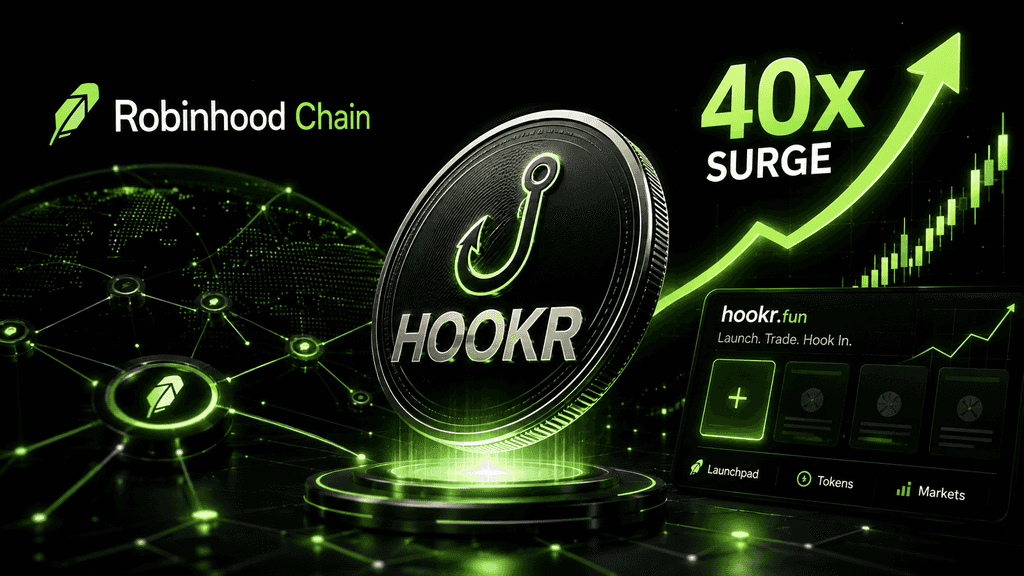
HOOKR Surges as Programmable Trading Gains Ground on Robinhood Chain
The HOOKR token has drawn attention across crypto markets in late August 2026 after recording substantial gains on Robinhood Chain. Trading data from multiple trackers shows the token moving from early levels near or below $0.001 toward peaks above $0.019–$0.020, producing multi-fold returns that some observers describe in the range of 40x from troughs. Market capitalization has hovered in the mid-to-high teens of millions of dollars, with 24-hour volumes frequently exceeding several million dollars and, at peaks, approaching or surpassing half the market cap. Fully circulating supply stands at one billion tokens, eliminating unlock overhang. The token powers Hookr.fun, a permissionless launchpad that lets creators compose custom Uniswap v4 hooks for new token markets.
This rally shows growing interest in programmable market mechanics on Robinhood Chain, a network that launched publicly in early July 2026 and initially saw heavy memecoin activity before expanding tokenized-stock volume. Hookr.fun differentiates itself by making the rules of each pool, anti-snipe protections, dynamic fees, burns, liquidity rewards, and deterministic pots the core product rather than a fixed template. Verified on-chain metrics, contract transparency, and recent centralized exchange futures listings have amplified visibility. The thesis is straightforward: HOOKR’s price action tracks real platform usage, fee-driven burns, and the appeal of inspectable, immutable market rules in a competitive launchpad environment.
Recent Price Action and Verified Market Metrics for HOOKR
HOOKR traded near $0.015–$0.017 on August 31, 2026, according to aggregators, after an all-time high around $0.02033 earlier that day. Twenty-four-hour gains have ranged from roughly 26 percent to over 60 percent in successive reports, with volume figures between $7 million and $10.5 million. Circulating and total supply both equal one billion tokens, so market capitalization and fully diluted valuation align closely, recently reported between approximately $15.6 million and $19.7 million. Holder counts have risen into the several-thousand range, and transfer activity has been elevated. Liquidity on the primary Uniswap v4 ETH pair has supported these flows. Earlier August data showed the token near $0.0013 with a sub-$2 million market cap, confirming the scale of the subsequent move. These figures come from public trackers and on-chain reads rather than project announcements alone. The combination of high turnover relative to market cap and full circulation has kept the market responsive to both platforms news and broader Robinhood Chain sentiment.
Trading venues include the native Uniswap v4 pool on Robinhood Chain (chain ID 4663) and more recent centralized listings such as LBank perpetual futures with leverage up to 20x. Spot pairs have also appeared on additional platforms. Burn totals visible on the project site have exceeded three million HOOKR permanently sent to the dead address through fee mechanisms. This reduction, while modest relative to total supply, contributes to the scarcity narrative that accompanies volume spikes. Price discovery remains concentrated on-chain, with the official contract 0x18E674231A58c239Dc7DaeDcffE15Ec3A24cff5c serving as the sole authoritative identifier. Traders monitoring these metrics note that volatility stays high, consistent with a young token whose primary utility is still expanding.
How Hookr.fun Structures Token Launches on Robinhood Chain
Hookr.fun operates as a Uniswap v4 hook launchpad and marketplace exclusively on Robinhood Chain. Creators select a token name, symbol, and image, then choose an ETH raise target or an instant-launch path. The platform supports two primary lanes: an Instant Launch that places fixed supply into a pool opening at a standardized FDV and an Auction Launch that uses continuous clearing mechanics with a graduation threshold. Supply is fixed at one billion tokens with no owner mint, pause, blacklist, or transfer tax functions. Liquidity that graduates into the Uniswap v4 position is locked by construction; the launchpad contract holds no withdrawal function. Metadata is permissionless and non-unique; the contract address plus chain ID constitutes the true identity of any token.
Fees and mechanics are set at launch and become immutable. Creators can designate up to four fee recipients and retain a configurable share of pool fees, defaulting to 50 percent and rising as high as 80 percent in some configurations. A flat creation fee applies. Once a pool is live, the attached hook, if any, executes inside every swap via the pool’s own callbacks. There is no external keeper, oracle, or off-chain trigger. This design aims to give both creators and traders full visibility into market rules before capital is committed. The platform maintains public contract addresses and release evidence on GitHub, allowing independent verification of the deployed code.
The Five Composable Hook Blocks That Define Market Rules
Each Hookr market can attach up to five composable blocks that run on every relevant swap. Anti-Snipe limits the size of early buys for a configurable number of blocks after graduation and adds a temporary extra LP fee; exact-output buys are blocked to prevent circumvention. Surge Fees scales the LP fee according to how much in-range depth a trade consumes, moving between a base and a ceiling set by the creator. Auto Burn sends a chosen share of actual buy output directly to the dead address inside the same transaction. LP Rewards donates an ETH-side share of buys to in-range liquidity providers. Nth-buy Pot accumulates an ETH-side share into a public pot; a deterministic on-chain counter advances at most once per pool per block, and the Nth qualifying buy claims the pot.
These blocks are inspectable before launch and fixed thereafter. Gas costs vary by block, roughly 120k–180k per swap depending on the combination, and are displayed in the builder interface. Cuts apply primarily to exact-input buys; sells pay only the base LP fee in most cases. On ETH-paired launches, a separate 0.3 percent protocol fee on the ETH side of buys and certain sells accrues to a burner contract. Anyone may collect accrued ETH into the burner, but only the designated owner can execute capped, rate-limited buybacks that purchase and burn HOOKR. HOOKR-paired launches support a narrower set of blocks and route 100 percent of quote-side fees to the creator while burning the token side of collections. The net effect is that market behavior becomes a first-class, verifiable product.
Fee Collection, Buyback Mechanics, and the HOOKR Burn Flywheel
Protocol fees collected on ETH-paired activity feed a transparent burn process. Accrued ETH sits in a burner contract that any participant can trigger for collection. The owner then executes buybacks subject to per-block caps and minimum-output checks; every HOOKR purchased in the same transaction is sent permanently to the dead address. On-chain reads have recorded cumulative burns exceeding three million tokens. HOOKR-paired markets do not pay the protocol fee, channeling value instead to creators and through token-side burns. This structure ties HOOKR demand directly to platform trading volume rather than to emission schedules or discretionary treasury actions.
Because total supply is fixed and already circulating, burns produce a measurable, if gradual, reduction in available tokens. The flywheel is visible: higher launch and trading activity generates more ETH fees, which in turn support larger or more frequent buybacks. The mechanism is permissionless for collection yet controlled for spending, balancing openness with risk management. Public dashboards and the project site surface the running burn total, allowing market participants to track the process without relying on off-chain claims.
Live Utilities: Lock Rewards and Launch Boost
Two utilities are currently live. Lock Rewards lets any wallet lock HOOKR for 30, 90, or 180 days, earning weighted shares of realized Launch Boost fees. Weights increase with longer commitments (1.00x, 1.15x, 1.25x). There is no deposit fee, no emissions, and no guaranteed yield; rewards derive solely from actual Boost activity and can be zero in low-volume periods. The principal remains non-transferable during the lock and is fully refundable afterward. Launch Boost allows creators to lock HOOKR to secure paid placement on a dedicated discovery rail.
A rounded 1 percent fee on Boost deposits routes to eligible Lock Rewards participants; when no eligible cohort exists, the fee is waived. These mechanisms create a closed loop in which creators pay for visibility and lockers share in the resulting fees. Higher tiers of HOOKR holdings unlock planned future features such as enhanced builder tools and proposal rights. The design avoids inflationary emissions, relying instead on real usage. Both utilities are documented on the project site and can be interacted with through the official interface after wallet connection to Robinhood Chain.
Robinhood Chain Context and the Broader Memecoin-to-Programmable Shift
Robinhood Chain went live to the public on July 1, 2026, as an Arbitrum-based Layer 2 intended to support tokenized equities and real-world assets. Early activity was dominated by memecoins, with daily DEX volume peaking above $500 million and tens of thousands of new tokens appearing in a single days. Tokenized stock volume later expanded, at times exceeding comparable venues on other chains when measured through memecoin pairs that locked equity liquidity. Total value locked and active addresses grew rapidly in the first weeks.
Hookr.fun entered this environment in early August with a focus on programmable rather than purely speculative launches. By making market rules composable and inspectable, the platform addresses a common criticism of identical bonding-curve or pool templates. The chain’s low fees during promotional periods and native Uniswap v4 deployment lowered the cost of experimentation. HOOKR’s price direction has tracked both the general rise in chain activity and the specific adoption of Hookr launches, of which more than 100 have been recorded with tens of thousands of trades.
Contract Transparency, Security Posture, and Verification Practices
All core contracts are published and live on Robinhood Chain. Key addresses include the HookrLaunchpad, HookrHook, HookrSwapRouter, and the HOOKR token itself. The GitHub repository contains source code, adversarial test suites, release evidence, and verification tooling. Releases follow a documented protocol of local testing, fork simulation, human review, and canary checks before promotion. The project states that contracts have undergone internal adversarial review but are not independently audited by a third party.
Users are repeatedly directed to verify the full contract address and chain ID rather than relying on tickers or social handles. The official site warns that the @hookrfun X account has been compromised at times and that all information should be confirmed through hookr.fun. Existing-token attachment remains gated, and experimental leveraged-hook contracts are marked deprecated with no markets created. This emphasis on on-chain verification and immutable parameters aims to reduce reliance on trust in the team after launch.
Launch Volume, Marketplace Royalties, and Creator Incentives
More than 100 tokens have been launched through Hookr, generating tens of thousands of trades across hundreds of unique traders. Creators can publish reusable hook blueprints to the marketplace and earn royalties when other launches adopt them. Royalties are funded from eligible ETH-side cuts; pure Auto-Burn hooks generate no royalty stream. Instant and Auction lanes give creators choice between speed and price discovery. HOOKR-paired launches open at fixed FDV levels denominated in HOOKR and route all quote fees to the creator.
These features create ongoing incentives beyond the initial launch. Blueprint authors continue to earn as long as their configurations remain popular. Locked liquidity and immutable rules reduce the risk of post-launch rug pulls of the classic variety. The combination has attracted both speculative memecoin creators and builders interested in more structured market designs. Public metrics on the site update with live chain reads, providing transparency into adoption.
Centralized Exchange Listings and Liquidity Expansion
In addition to the native Uniswap v4 pool, HOOKR has appeared on centralized venues (spot and futures). Futures leverage up to 20x has coincided with heightened volatility and volume. These listings expand accessibility for traders who prefer custodial interfaces while the majority of price discovery continues on-chain. Liquidity depth on the primary pair has grown alongside the market-cap expansion, supporting larger trades with manageable slippage under normal conditions.
The presence of futures markets introduces additional leverage-driven flows that can amplify both upward and downward moves. Spot listings on multiple platforms improve arbitrage opportunities and reduce single-venue dependency. Market participants monitoring order-book depth and funding rates treat these venues as secondary confirmation of on-chain momentum rather than primary drivers.
Risk Factors Specific to Early-Stage Programmable Launchpads
HOOKR and the tokens launched through Hookr.fun remain high-volatility assets. Liquidity, while improved, can still produce significant slippage during quick moves. Smart-contract risk exists despite published code and internal testing; the absence of a formal third-party audit is a material consideration. Social-account compromise has occurred, underscoring the need to rely exclusively on the official website and verified contract addresses. Broader Robinhood Chain activity can cool as quickly as it heated, affecting platform volume and therefore fee generation.
Regulatory clarity around tokenized assets and launchpad mechanics continues to evolve across jurisdictions. Creators and traders must treat every position as speculative. The immutable nature of hooks after launch means that poorly designed parameters cannot be adjusted later. These factors collectively require careful position sizing and independent verification of every claim.
Comparative Positioning Within the Launchpad Ecosystem
Most launchpads offer standardized bonding curves or instant pools with identical fees and opening dynamics. Hookr.fun differentiates by treating the Uniswap v4 hook as the product: creators choose and publish the exact rules that will govern trading. The marketplace for reusable blueprints adds a royalty layer absent from many competitors. Fixed supply, locked liquidity, and on-chain counter mechanics for pots further reduce certain classes of post-launch manipulation.
Adoption metrics, tokens launched, trades executed, and burns recorded provide measurable evidence of usage rather than relying solely on narrative. The platform’s focus on Robinhood Chain ties its fortunes to that network’s growth trajectory. Success depends on continued developer and trader interest in programmable markets rather than pure speculation. Early data shows both categories of activity occurring simultaneously.
From Token Utility to Broader Ecosystem Adoption
Additional utilities remain in design, including expanded staking, gamified seasons, curation tools, and proposal mechanisms for new hook blocks. An experimental leveraged-hook design exploring lending against pool liquidity has been deprecated for the first version, with no live markets. Existing token attachment is visible in the interface but not yet open for signing. Future growth will be measured by launch volume, blueprint reuse, fee generation, and the resulting burn rate.
HOOKR’s role as the medium for Boost deposits, lock rewards, and certain pair currencies creates structural demand linked to platform activity. Whether that demand sustains higher valuations depends on real usage continuing to expand. Market participants will track on-chain metrics, new listings, and the delivery of planned features for confirmation.
Conclusion
Anyone evaluating HOOKR should begin with the official site hookr.fun and the verified contract address on Robinhood Chain. Block explorers and the public GitHub repository allow direct inspection of code and transactions. Price and volume data from multiple independent aggregators provide cross-checks.
Wallet connection for interacting with locks or launches should occur only after network settings are confirmed. Position sizing must account for the possibility of rapid drawdowns. Continuous monitoring of burn totals, launch counts, and fee accrual offers the clearest real-time signal of platform health.
FAQs
What is the official contract address for the HOOKR token, and why does verification matter so much?
The authoritative HOOKR contract is 0x18E674231A58c239Dc7DaeDcffE15Ec3A24cff5c on Robinhood Chain (chain ID 4663). A ticker alone is insufficient because multiple tokens can share similar names. Always confirm the full address on a block explorer and through the official website before any transfer or swap. Social handles and unofficial links have been compromised in the past, making on-chain verification the only reliable method.
How do the five hook blocks actually execute during a trade?
Each selected block runs inside the Uniswap v4 pool’s own callbacks during the swap. There is no external keeper or oracle. Anti-Snipe, Surge Fees, Auto Burn, LP Rewards, and Nth-buy Pot apply according to the parameters fixed at launch. Exact-input buys typically trigger the cuts; sells pay the base LP fee. Gas costs and exact splits are visible in the builder before any transaction is signed.
Does HOOKR have an unlock schedule or team allocation that could create sell pressure?
Public documentation does not disclose a traditional team or investor vesting schedule. The entire one-billion-token supply is treated as circulating. Lock rewards involve voluntary user locks that return principal after the chosen period. No emissions or scheduled unlocks are described as part of the core tokenomics.
What drives the HOOKR burn mechanism, and how large have the burns been so far?
On ETH-paired launches, a 0.3 percent protocol fee on relevant ETH-side volume accrues to a burner contract. Collected ETH is used for capped buybacks that purchase HOOKR and send it permanently to the dead address. Cumulative burns visible on the project site have exceeded three million tokens. HOOKR-paired markets route value differently and burn the token side of fee collections.
Is the Nth-buy Pot random, or can participants calculate their odds?
The pot is deterministic. A public on-chain counter advances at most once per pool per block. The Nth qualifying buy, subject to a minimum size, claims the accumulated pot. Anyone can observe the counter and the parameters set at launch, removing randomness from the process.
Where can HOOKR be traded and what liquidity conditions should traders expect?
Primary liquidity remains on the Uniswap v4 ETH pair on Robinhood Chain. Centralized venues have added pairs too. Depth has improved with the rise in market capitalization, yet the market remains capable of sharp moves and elevated slippage during high-volatility periods. Always check current pool reserves and order-book depth before sizing a trade.
What is the status of leveraged hooks and existing-token attachment?
The first leveraged-hook design is marked deprecated; no markets were created under it, and the contracts should not be used. Attachment of custom hooks to already-trading tokens is visible as a future lane but remains closed for signing until the factory is fully deployed and verified.
🔥 KuCoin Offers A More Stable Option in A Volatile Market
If you worry about the frequent ups and downs in the market, and pursue a more stable option to earn money passively, KuCoin is the right place to come:
Simple Earn: Deposit and withdraw tokens anytime, earning stable returns.
Kucoin Earn: Earn stable profits with professional asset management.
Hold to Earn: Earn rewards by holding assets in Funding, Trading, Margin, Futures, Mining, and Unified Accounts.
Staking: Unlock the earning potential of on-chain assets.
Advanced Investments: Advanced Investments offer a variety of structured products to help your money grow in any market.
Shark Fin: Principal Protection and Guaranteed Gains
Dual Investment: Buy low and sell high with transparent return calculations.
Snowball: High yields, with price protection.
Discount Buy: Buy crypto at discount prices.
KCS Loyalty: Level up to enjoy exclusive perks by staking ≥ 1 KCS.
KuCoin Wealth: Discover future value and begin your smart investing journey.
KCS Benefits: Hold and stake KCS to access benefits across the platform.
KCS Staking 2.0: Participate in KCS on-chain governance to earn yield.
Disclaimer: This content is for informational purposes only and does not constitute investment advice. Cryptocurrency investments carry risk. Please do your own research (DYOR).