

Inside Meta’s Pre-Layoff Chaos: Big Tech’s AI Surveillance Shockwave
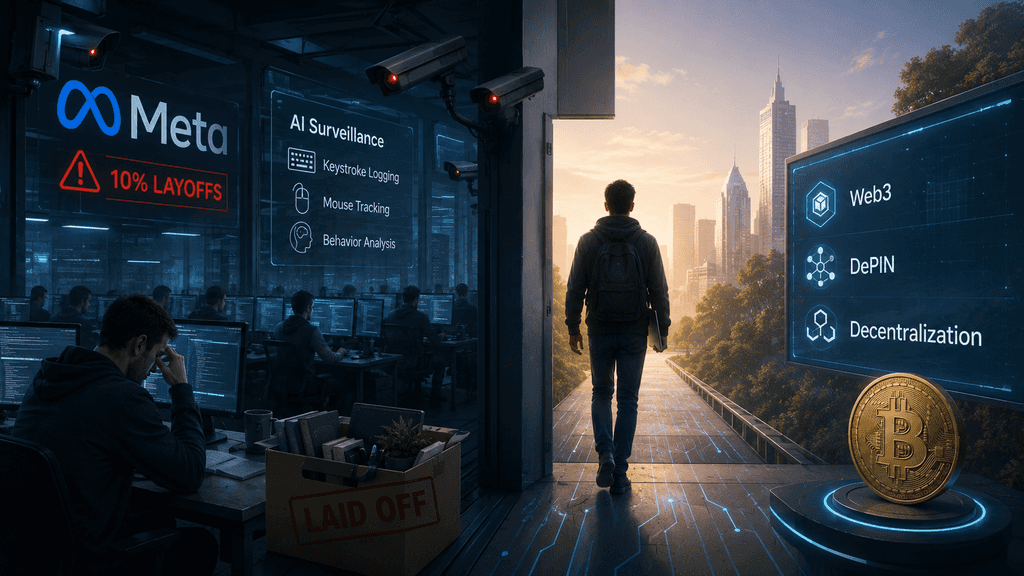
The Silicon Valley landscape is experiencing a massive corporate transformation as Meta undergoes a radical, AI-driven restructuring. Inside the company, employees are facing a toxic mix of extreme performance pressure, hyper-surveillance, and imminent job cuts. This systematic shift toward an automated corporate hierarchy has triggered unprecedented anxiety, completely upending the traditional tech workplace and forcing workers into a desperate fight for survival.
As we dive into the mechanics of this corporate upheaval, we will explore how Meta’s Pre-Layoff Chaos is fundamentally reshaping tech employment and driving a massive migration toward decentralized Web3 alternatives.
Key Takeaways
-
Imminent Downsizing: Meta is actively preparing to terminate approximately 10% of its global workforce, impacting roughly 8,000 employees as part of its aggressive pivot toward an "AI-native" operational model.
-
Aggressive AI CapEx: The company is diverting up to $135 billion into AI capital infrastructure, shifting resources away from human engineering teams to build automated systems.
-
Extremely Invasiveness Surveillance: Employees are being subjected to granular tracking software that logs keystrokes and mouse movements to harvest behavioral data for AI training models.
-
Radical Flattener Hierarchy: Traditional management structures are being dismantled, with experimental engineering organizations piloting a hyper-flat 50:1 employee-to-manager ratio.
-
Performance Metric Manipulation: Legacy performance metrics have been replaced, with employee evaluations now heavily weighted by AI tool adoption rather than standard job execution.
-
Web3 Migration Catalyst: The erosion of corporate trust and Restricted Stock Unit (RSU) volatility are accelerating a major tech talent migration toward Web3, DePIN, and decentralized platforms.
Inside Meta’s Pre-Layoff Chaos: Tracking the May 20 Timeline
The 10% Bloodbath: Why 8,000 Meta Employees Are on Notice
The current climate of uncertainty within the tech sector is reaching a boiling point. Meta is poised to execute a sweeping staff reduction affecting 10% of its global headcount. This corporate downsizing translates directly to roughly 8,000 professional roles being permanently deleted from the payroll.
Unlike previous, macroeconomically driven lay-offs, this specific reduction is surgical, aiming to clear out departments deemed redundant by advanced internal automation. Employees across various international offices have been placed on a tense, month-long notice period, a corporate strategy that has effectively frozen daily productivity and replaced it with a state of perpetual panic.
Capital Displacement: Tracking the $135B AI Infrastructure Spend
The financial catalyst behind this human displacement is a massive relocation of corporate capital. Meta's projected capital expenditure for the fiscal year has ballooned to an unprecedented $135 billion, with the vast majority earmarked exclusively for AI infrastructure, data center procurement, and raw computing power.
This staggering allocation represents a direct shift in spending: capital that once funded human-centric software engineering, product design, and middle management is being aggressively rechanneled into acquiring specialized hardware and advanced neural network processing capabilities. For the average engineer, this budget shift sends a clear, chilling message that human talent is no longer the primary asset in the eyes of executive leadership.
Blind Data Leak: Decoding the 83% Negative Employee Sentiment
The psychological fallout of this structural shift has spilled onto anonymous corporate forums. Recent data leaks originating from the verified professional network Blind paint a dark picture of internal morale. Analysis of internal communications and employee posts reveals that negative sentiment regarding the company's AI-focused direction has climbed to a historic 83%.
Historically, AI initiatives were viewed by staff as exciting, frontier engineering opportunities; however, the reality of the current strategy has completely inverted that perception. Discussions on these platforms are dominated by expressions of severe burnout, a profound sense of institutional betrayal, and a shared realization that the company's current operational model is fundamentally incompatible with long-term human employment.
The Panopticon: Meta’s Dystopian AI Surveillance Software
Keystroke Logging: How Superintelligence Labs Tracks Every Click
To facilitate this rapid transition to an automated ecosystem, Meta has deployed a highly invasive internal tracking framework. Developed secretly under the banner of its Superintelligence Labs, this proprietary software operates as an advanced, continuous telemetry network installed directly onto employee workstations.
The software utilizes low-level kernel drivers to execute real-time keystroke logging, charting every individual character typed, every system command executed, and the exact timestamp of every interaction. This is not a standard security measure designed to prevent data exfiltration; rather, it is a massive data-harvesting operation aimed at capturing the complex, intuitive workflows of highly skilled human professionals.
Training Your Replacement: The Trauma of Employee Behavior Harvesting
The true horror of this micro-tracking lies in how the collected data is actively utilized. The hyper-granular telemetry streams are fed directly into internal training pipelines for the company’s next-generation autonomous agents.
-
Task Emulation: The system logs how senior engineers debug code, resolve server exceptions, and optimize database queries.
-
Contextual Processing: The AI analyzes the linguistic patterns used by project managers to resolve disputes and align cross-functional teams.
-
Interface Navigation: The data captures how designers interact with complex internal software interfaces, mapping keyboard shortcuts and contextual UI patterns.
This operational framework has inflicted severe psychological trauma across the engineering staff. Workers are fully aware that by executing their daily responsibilities at a high level, they are generating the exact training data required to train the software models designed to replace them. It is a modern, digital manifestation of labor exploitation, where human intellect is harvested to build its own digital successor.
Micro-Surveillance: Mouse Movements as Corporate Performance Metrics
Beyond text input and system commands, the surveillance apparatus monitors the physical mechanics of computer usage. The software tracks mouse cursor trajectories, velocity changes, dwell times on specific UI elements, and precise click locations.
These spatial data points are processed through machine learning models to establish behavioral baselines for employee attentiveness and cognitive engagement. If an employee’s cursor movement deviates from the algorithmic norm, or if a prolonged pause is detected, the system automatically flags the activity as a lapse in productivity. This unrelenting micro-surveillance has turned the standard home office or corporate desk into a digital panopticon, where physical movement is hyper-analyzed to calculate a continuous corporate performance score.
The Death of Management: Structural Chaos in the "Year of Efficiency"
The 50:1 Ratio: Inside the Radically Flattened Engineering Org
The organizational architecture of Meta is being dismantled to achieve what leadership calls an "ultra-flat" operational state. In several experimental applied AI engineering divisions, traditional middle management has been almost entirely eliminated.
This experimental framework introduces an unprecedented 50:1 ratio, placing fifty cross-functional engineers under the supervision of a single human manager. Without the traditional layers of directors, engineering managers, and team leads, standard corporate guidance has vanished. Communication paths have become deeply fragmented, and employees are left to navigate complex software deployments with virtually zero human managerial support or strategic direction.
Automating Leadership: Andrew Bosworth’s Push for the "CEO Agent"
This radical flattening is a deliberate phase within a broader strategic roadmap championed by Chief Technology Officer Andrew Bosworth. Under the internal "AI For Work" directive, the executive vision aims to shift the role of human managers away from traditional people leadership and entirely toward algorithmic oversight.
To lead this charge, Meta’s research arms have initiated the active development of an executive-tier autonomous system known internally as the "CEO Agent." This specialized model is designed to autonomously parse vast corporate datasets, allocate engineering budgets, evaluate departmental velocity, and provide automated strategic recommendations directly to Mark Zuckerberg. By automating the foundational components of executive decision-making, Meta seeks to demonstrate that even high-level corporate leadership can be optimized through algorithmic scaling.
Culture Rating Crash: Why Meta Dropped to a 2.23 on Blind
The immediate casualty of this hyper-automated restructuring is the company's famous workplace culture. Once regarded as one of the world's most desirable employers, the internal atmosphere has deteriorated to an all-time low.
According to aggregate data pulled from verified employee reviews on Blind, Meta’s internal culture score has plummeted to an abysmal 2.23 out of a maximum 5.0. This represents a staggering 43% collapse in internal cultural satisfaction compared to historical baselines. The collaborative, open-source spirit that previously characterized the company's engineering triumphs has been completely extinguished, replaced by a cutthroat survivalist environment where peers view one another with deep suspicion and dread.
The AI-Native Divide: Performance Reviews as a Weapon
Bypassing Documentation: How Small AI-Driven Teams Bypassed 2025 Rules
A profound operational schism has emerged within the company, splitting the workforce into two distinct, clashing factions. On one side are the newly formed, hyper-agile "AI-Native" teams. These small, elite units have completely abandoned standard corporate workflows.
They do not author comprehensive product requirement documents, they do not participate in multi-week architecture reviews, and they completely bypass the formal documentation standards that governed the company as recently as 2025. Instead, these teams interface directly with advanced code-generation models, rapidly shipping rough, AI-generated prototypes directly to production environments. This high-velocity methodology allows them to showcase immediate, visual results directly to executive leadership, rendering traditional validation processes obsolete.
Legacy Workflows vs. AI Adoption: The New Corporate Caste System
This operational divergence has created a rigid corporate caste system that heavily penalizes traditional software engineering methodologies.
| Attribute | Legacy Engineering Teams | AI-Native Autonomous Units |
| Primary Workflow | Human code authorship, peer review, deep documentation | Algorithmic code generation, rapid prototyping, minimal docs |
| Velocity Metric | Rigorous security testing, long-term stability mapping | Instantaneous feature deployment, hyper-rapid iteration |
| Review Standing | Frequently penalized for slow velocity and low AI usage | Highly rewarded for aggressive automation and tool integration |
| Cultural Status | Outdated, targeted for immediate down-sizing | The favored future of the automated corporate structure |
Engineers who prioritize systems security, clean code architecture, and methodical testing find themselves marginalized. They are increasingly viewed by leadership as expensive, slow-moving liabilities who are holding back the company's automated transformation.
Job Security Elusion: Why Doing Your Core Job Is No Longer Enough
In this high-pressure ecosystem, fulfilling your core job description to a flawless standard is no longer a guarantee of professional survival. Meta’s HR infrastructure has overhauled its performance review frameworks to evaluate employees heavily on their active adoption of internal AI utilities.
An engineer who writes exceptional, bug-free code manually will score lower than an engineer who uses automated generators to produce vast quantities of software, even if that software requires extensive debugging later. Job security has become completely detached from traditional human competence; it is now entirely dependent on how effectively an employee conforms to the automated paradigm, turning the annual review process into an algorithmic weapon designed to filter out non-compliant staff.
Macro Implications: Big Tech RSU Volatility and Crypto Capital Flight
The Decentralization Argument: DePIN and Web3 as an Antidote to Big Tech
The structural instability and intense surveillance defining Meta’s Pre-Layoff Chaos are causing ripple effects far beyond Silicon Valley, triggering a major philosophical shift across the wider technology sector. Software developers and infrastructure engineers are rapidly losing faith in the centralized corporate model.
This widespread disillusionment is acting as a major demand driver for decentralized alternatives, specifically Web3 systems and Decentralized Physical Infrastructure Networks (DePIN). DePIN projects offer engineers a complete structural alternative: a network where compute power, storage, and application hosting are governed by trustless blockchain code rather than centralized corporate executives.
By transitioning to these decentralized ecosystems, developers can build open-source applications without handing their telemetry data over to corporate systems designed to automate them out of existence.
Talent Migration: Will Tech Layoffs Fuel the Next Crypto Bull Market?
As thousands of highly specialized engineers face termination from Meta and other mainstream tech giants, a massive talent migration toward the Web3 and cryptocurrency sectors is underway. This influx of elite human capital arrives at a critical moment for the digital asset industry.
The complex engineering challenges of the crypto space—such as scaling Layer-2 blockchains, implementing zero-knowledge proofs (ZKPs), and optimizing decentralized exchange (DEX) liquidity models—require the exact technical expertise currently being pushed out of Big Tech.
-
Advanced Cryptography: Senior infrastructure engineers are applying corporate-grade distributed systems design to public ledger networks.
-
Smart Contract Architecture: Full-stack developers are transitioning from legacy programming frameworks to secure Web3 languages like Solidity and Rust.
-
System Optimization: Data engineers are leaving centralized cloud platforms to architect high-performance, decentralized compute networks.
This massive injection of seasoned technical talent is heavily expected to spark a profound wave of decentralized product innovation, laying down the core infrastructure needed to fuel the next major cryptocurrency bull market.
Corporate Censorship vs. Blockchain Transparency in the AI Era
The aggressive centralization of AI models within massive corporate monopolies highlights a major societal risk: the absolute control over information flow and algorithmic bias by a tiny group of executives. Meta’s internal reliance on hidden data collection and opaque performance reviews mirrors how these companies manage their consumer-facing AI models.
In sharp contrast, the blockchain ecosystem offers a transparent framework for the AI age. By hosting AI model weights, training logs, and validation checkpoints on immutable, public ledgers, decentralized networks guarantee that data processing remains completely transparent, verifiable, and free from corporate censorship.
This intersection of artificial intelligence and blockchain technology represents the ultimate pushback against Big Tech's digital panopticon. It provides a protective layer where developers, content creators, and everyday users can fully verify that their data is being handled ethically, transparently, and securely.
Conclusion
The profound operational disruption defining Meta’s Pre-Layoff Chaos serves as a stark warning about the unchecked expansion of corporate automation and invasive workplace surveillance. By treating its highly skilled software engineers as raw training data for autonomous replacement agents, the tech giant has damaged internal trust and fundamentally broken the traditional Silicon Valley employment contract. However, this crisis is opening up massive opportunities for the broader Web3 ecosystem. As elite tech talent flees the corporate panopticon, the decentralized technology sector stands to gain a massive wave of human capital, accelerating the transition toward a more transparent, equitable, and decentralized digital economy.
FAQ
What is triggering the pre-layoff chaos inside Meta?
The current internal disruption is driven by Meta's aggressive, multi-billion dollar pivot toward an AI-native operational structure. By committing an unprecedented $135 billion to artificial intelligence capital expenditure, the company is actively dismantling traditional human engineering teams and middle management layers, replacing them with automated workflows ahead of an impending 10% global staff reduction.
How does Meta use keystroke logging to train its AI models?
Meta's Superintelligence Labs has secretly deployed specialized tracking software across employee workstations. This software records low-level telemetry, including real-time keystroke logs, mouse movements, and application interactions. This detailed data is fed directly into internal training pipelines to teach autonomous AI agents how to navigate software, write code, and replicate complex human workflows.
Is the tech layoff wave driving talent toward Web3 and Crypto?
Yes, the combination of aggressive corporate surveillance, structural instability, and tech stock option (RSU) volatility is accelerating a massive tech talent migration. Disillusioned engineers are increasingly moving away from centralized Silicon Valley giants toward Web3 platforms, DePIN networks, and decentralized applications, where data privacy, open-source code, and transparent blockchain architecture are fundamental principles.