

Security 101: Why Smart Contract Security Audits are Important in 2026
Introduction
Smart contracts have evolved from a niche blockchain innovation into the backbone of the modern Web3 economy. Today, they power decentralized finance (DeFi), NFTs, GameFi ecosystems, tokenized real-world assets (RWAs), and cross-chain infrastructure across multiple blockchain networks. As billions of dollars continue flowing through smart contract-based applications, security has become one of the most critical factors determining whether a crypto project can survive and grow sustainably.
In recent years, the crypto industry has witnessed several major smart contract exploits, flash loan attacks, bridge hacks, and governance manipulation incidents that collectively resulted in billions of dollars in losses. These incidents revealed that even innovative blockchain projects can collapse overnight if their smart contracts are poorly designed, insufficiently audited, or improperly maintained after deployment.
As blockchain adoption accelerates in 2026, smart contract security is no longer optional — it is a core requirement for developers, investors, institutions, and exchanges alike. Understanding common smart contract vulnerabilities and the importance of security audits can help users better evaluate project risks before investing in any decentralized application or crypto asset.
In this article, we explore the biggest smart contract security risks, how attackers exploit vulnerabilities, and why comprehensive security audits remain essential in protecting the future of the crypto ecosystem.
Top Smart Contract Security Risks
As the blockchain industry matures, smart contract attack vectors have also become increasingly sophisticated. Modern exploits are no longer limited to simple coding mistakes. Attackers now frequently target cross-chain bridges, oracle systems, governance mechanisms, liquidity pools, and Layer-2 infrastructure. According to multiple blockchain security reports published throughout 2025 and early 2026, smart contract exploits and protocol hacks continue to account for billions of dollars in annual crypto losses, highlighting the urgent need for proactive security practices, continuous auditing, and real-time monitoring systems.
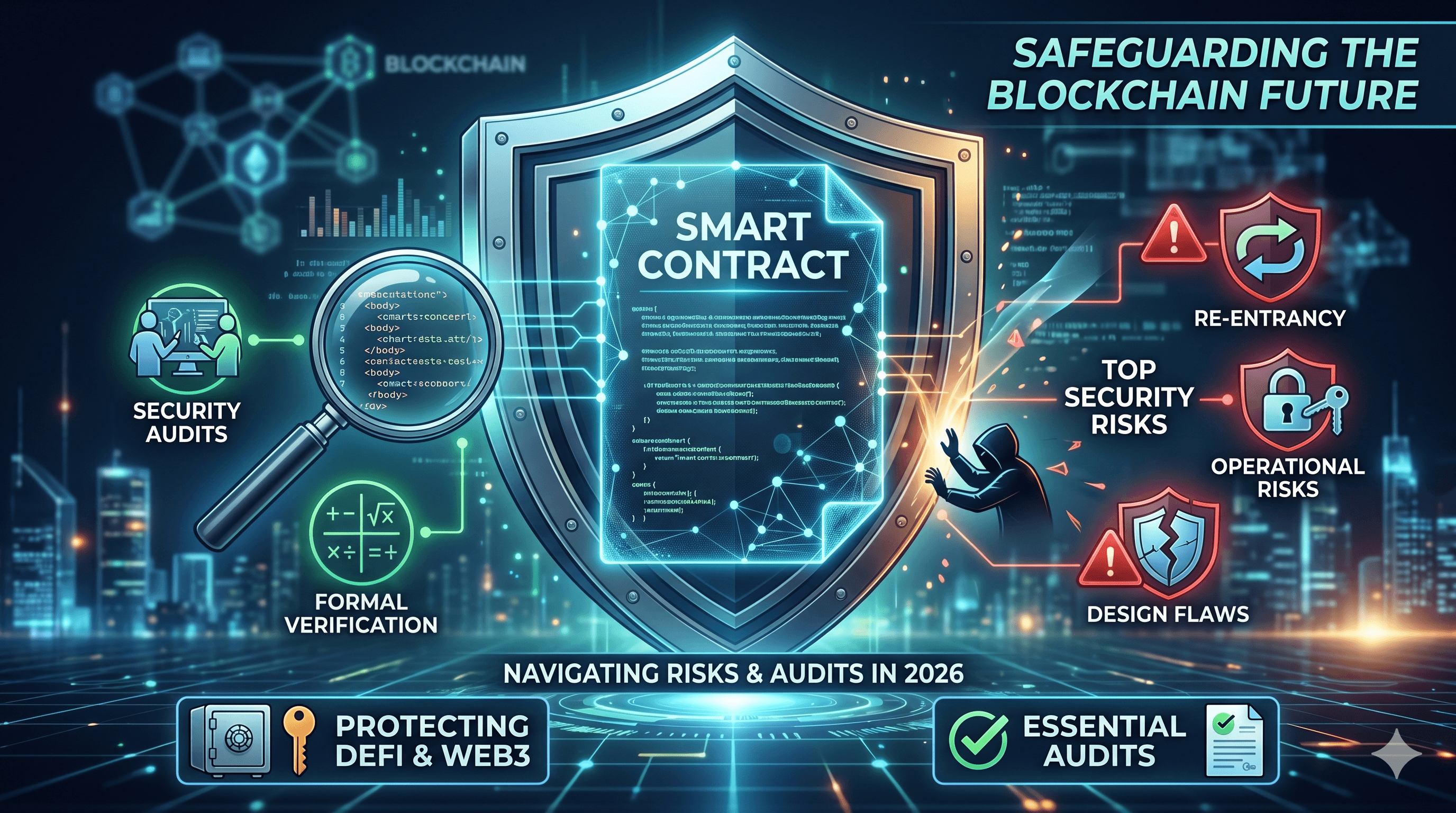
The top security risks fall into four categories:
1) Operational Risks
Operational Risks are authorization features that can be exploited when the platform’s governance is insufficient or flawed. Here are some of the most common operational risks found in smart contract platforms.
SuperUser Account of Privilege Management: Smart Contracts allow a single user or a set of users a privileged role to alter the function of the asset.
Black Listing and Burning Functions: Smart Contracts that allow privileged roles to blacklist addresses from accessing or using a functionality.
Ability to change Contract Logic: Smart contracts that allow privileged roles to make changes in the smart contract logic.
Self Destruct Functions: Smart contracts that implement a function that allows privileged roles to remove the token contract from the blockchain and destroy all the tokens created by the contract.
Minting Functions: Smart Contracts that implements a function that allows privileged roles to increase the circulating supply of the token or balance of a specific account.
2) Implementation Risks
Implementation risks are inherent risks that result in unwanted and unpredicted behavior from smart contracts. Here are some examples of the top implementation risks seen in smart contracts.
Unauthorized Transfers: Smart contracts contain functions that disregard standard authorization patterns for sending tokens from an account.
Incorrect Signature Implementation and Arithmetic: Smart contract functions that can result in unexpected contract states and account balances.
3) Re-Entrancy Attacks
Re-entrancy attacks remain one of the most dangerous smart contract vulnerabilities in the DeFi ecosystem. In this type of exploit, attackers repeatedly call a vulnerable smart contract function before the original transaction is finalized, allowing them to drain funds from the protocol. Although developers have become more aware of this issue since the infamous DAO exploit, re-entrancy vulnerabilities still appear in poorly designed DeFi protocols and newly launched projects.
Modern smart contract frameworks now include safeguards such as re-entrancy guards, checks-effects-interactions patterns, and stricter auditing standards. However, projects that prioritize rapid deployment over security testing remain vulnerable to these attacks.
4) Design Risks
Design risks are system features that hackers or tokens can exploit to manipulate smart contract behavior. Here are some of the most common examples of Design risks found in smart contracts.
Untrusted Control Flow: Smart contracts that execute functions on different smart contracts in order to trigger an event not designed in the original contract itself.
Transaction Order Dependence: Smart contracts that allow asynchronous transaction processing that can be exploited for profit.
Why Smart Contract Security Audits Are Important
The rapid growth of decentralized finance, NFTs, Layer-2 ecosystems, and tokenized assets has dramatically increased the demand for secure smart contract infrastructure. Today, launching a DeFi protocol has become significantly easier thanks to open-source development frameworks, AI-assisted coding tools, and modular blockchain infrastructure. However, easier deployment does not automatically guarantee secure code.
Even a minor vulnerability inside a smart contract can lead to catastrophic financial losses, permanent reputational damage, and the collapse of user confidence. Unlike traditional software systems, blockchain transactions are immutable, meaning exploited funds are often impossible to recover once stolen.
The DAO exploit remains one of the most historically significant examples of smart contract failure. Due to a vulnerability in the DAO’s Ethereum-based smart contract, attackers managed to drain approximately one-third of the protocol’s treasury, eventually contributing to the Ethereum and Ethereum Classic chain split. The incident demonstrated how a single coding oversight could reshape an entire blockchain ecosystem.
Since then, the industry has experienced numerous major security incidents involving DeFi lending protocols, bridges, stablecoins, and governance systems. These attacks accelerated the development of professional blockchain auditing firms and bug bounty programs focused on identifying vulnerabilities before deployment.
Modern smart contract audits typically involve multiple layers of analysis, including manual code review, automated vulnerability scanning, formal verification, economic attack simulations, and penetration testing. Many leading blockchain projects now conduct multiple independent audits before launching their protocols publicly.
For investors, reviewing a project’s audit reports has become an essential part of crypto due diligence. A transparent and thoroughly audited project generally demonstrates stronger operational maturity and a greater commitment to protecting user funds. However, investors should also understand that audits reduce risk but do not completely eliminate it, especially in rapidly evolving DeFi ecosystems.
Ultimately, strong smart contract security helps improve trust, encourages institutional adoption, and supports the long-term growth of the blockchain industry.
Conclusion
Smart contract security has become one of the most important pillars supporting the growth of the crypto industry. As blockchain technology expands into areas such as decentralized finance, gaming, AI infrastructure, tokenized real-world assets, and cross-chain interoperability, the potential impact of smart contract vulnerabilities continues to grow alongside it.
While smart contracts enable transparent and permissionless financial systems, they also introduce new technical risks that require constant attention from developers, auditors, and investors. A single exploit can result in massive financial losses, reduced user confidence, and long-term damage to an ecosystem’s reputation.
For investors, evaluating a project’s security practices should be just as important as analyzing its tokenomics, roadmap, or market potential. Reviewing audit reports, understanding protocol risks, and monitoring how projects respond to security issues can help users make more informed investment decisions in the fast-moving crypto market.
As the blockchain industry continues evolving in 2026 and beyond, stronger auditing standards, improved developer education, and more advanced security infrastructure will remain critical in building a safer and more resilient decentralized economy.
FAQs
What is a smart contract security audit?
A smart contract security audit is a comprehensive review of blockchain code conducted by cybersecurity professionals or blockchain auditing firms. The goal is to identify vulnerabilities, coding errors, and potential attack vectors before the smart contract is deployed or updated.
Can audited smart contracts still be hacked?
Yes. While audits significantly reduce security risks, no audit can guarantee complete protection. New attack methods, governance vulnerabilities, oracle manipulation, and integration risks may still expose audited protocols to exploits.
What are the most common smart contract vulnerabilities?
Some of the most common vulnerabilities include re-entrancy attacks, integer overflow and underflow bugs, oracle manipulation, access control issues, flash loan exploits, and transaction order dependence vulnerabilities.
Why are cross-chain bridges frequently targeted by hackers?
Cross-chain bridges often hold large amounts of locked assets and involve highly complex smart contract logic. Their architecture creates multiple potential attack surfaces, making them attractive targets for hackers seeking high-value exploits.
How can investors evaluate whether a crypto project is secure?
Investors can review third-party audit reports, verify whether the project has active bug bounty programs, assess team transparency, examine treasury management practices, and monitor how quickly the project responds to past security incidents.