

Why Do Bitcoin and Crypto Often Move With Nasdaq During Periods of Major Equity Issuance?

Introduction
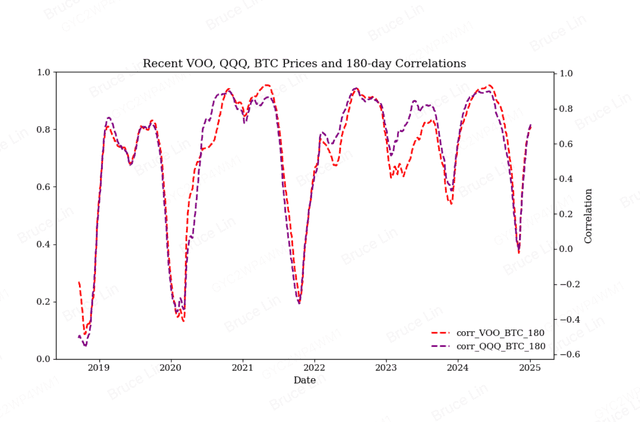
Bitcoin price often shows a high correlation with the Nasdaq 100. This represents a fundamental shift from Bitcoin's early days as an uncorrelated alternative asset to its current status as a mainstream risk instrument.
For investors who purchased Bitcoin expecting portfolio diversification, this development challenges the original investment thesis. The cryptocurrency that once moved independently of traditional markets now behaves like a leveraged tech stock, rising faster during rallies and falling harder during corrections. Understanding why this correlation intensifies during periods of major equity issuance requires examining the structural transformation of both markets.
The Structural Shift: From Alternative Asset to Risk-On Instrument
Bitcoin's correlation with equities was negligible between 2014 and 2019, hovering near zero and offering genuine diversification benefits . However, institutional adoption accelerated dramatically around 2020, fundamentally altering Bitcoin's market behavior. According to CME Group analysis, Bitcoin evolved from having no meaningful relationship with equities to displaying a largely positive correlation that has only strengthened over time .
By 2025, the correlation between Bitcoin and the Nasdaq 100 had more than doubled according to LSEG data . Academic research from the University of Texas at Dallas confirms this trajectory, showing BTC-QQQ correlations surging from mildly negative values in 2018 (-0.13) to over 0.80 by 2020, climbing to 0.89 in 2022, and settling around 0.76 in 2023-2024 . The inclusion of MicroStrategy (MSTR) in the Nasdaq 100 in December 2024 further amplified this linkage, with correlations reaching 0.87 in 2024 .
Why Equity Issuance Periods Amplify the Correlation
Major equity issuance events—whether IPOs, secondary offerings, or corporate treasury stock sales—create specific market dynamics that intensify Bitcoin-Nasdaq correlation through several interconnected mechanisms.
Shared Liquidity Pools and Institutional Rebalancing
The same institutional capital now drives both markets. Spot Bitcoin ETFs approved in 2024 opened floodgates for institutional money, bringing sophisticated investors who trade based on identical macroeconomic signals that drive equity markets . BlackRock's iShares Bitcoin Trust (IBIT) alone accumulated a record 806,700 BTC as of April 2026, absorbing $871 million in a single week during geopolitical turmoil .
When major equity issuance occurs—such as the $3.4 billion raised by crypto companies in U.S. stock markets in 2025, including Circle and Bullish's billion-dollar offerings —institutional portfolio managers must rebalance risk budgets across their entire allocation. These managers view Bitcoin through the same lens as technology stocks: an attractive allocation during optimism and a liability during risk-off environments .
Research from ChainCatcher explains that Bitcoin's pricing mechanism has shifted from independent asset supply-demand fluctuations to sharing deeper risk factors with tech stocks, including expansions or contractions in risk budgets and changes in global liquidity structures . During periods of major equity issuance, these risk budgets contract as capital is diverted to new offerings, creating synchronized selling pressure across both asset classes.
The ETF Feedback Loop
Spot Bitcoin ETFs have created a structural feedback loop that reinforces correlation with equities during capital-raising periods. ChainCatcher's analysis demonstrates that Bitcoin's price has almost synchronized with ETF net subscription rhythms since approval . During sustained net subscription phases, BTC prices exhibit stable upward slopes; during net redemptions or slowed inflows, prices enter high-level oscillations .
When major equity issuance occurs in traditional markets, the resulting liquidity drain affects ETF flows. Institutional investors managing multi-asset portfolios reduce exposure across risk assets simultaneously rather than rotating between them. This behavior contrasts with Bitcoin's pre-institutional era, when capital might flow from equities into crypto during stock market stress.
Corporate Treasury Dynamics and Dilution Concerns
The rise of "coin stocks"—companies holding Bitcoin as treasury reserves—creates direct linkage between equity issuance and crypto prices. MicroStrategy's inclusion in the Nasdaq 100 means that index-tracking funds now indirectly hold Bitcoin exposure, creating feedback loops where corporate Bitcoin holdings amplify linkages between the asset classes .
During periods of major equity issuance by these treasury companies, dilution concerns trigger volatility that spills into Bitcoin markets. Analysis of digital asset treasury (DAT) models reveals that continuous equity financing for Bitcoin acquisition causes actual value dilution for existing shareholders . When markets shift from admiring "total holdings" to examining "per-share value," downward corrections in these stocks drag Bitcoin sentiment .
The mechanics are straightforward: when a company like Strategy Inc. (formerly MicroStrategy) issues new shares to fund Bitcoin purchases, the resulting dilution can trigger selling in both the stock and Bitcoin. Conversely, when equity issuance is suspended due to market conditions, the "buy, buy, buy" narrative that supports both the stock and Bitcoin prices weakens simultaneously .
Macro Liquidity Sensitivity
Bitcoin's correlation with Nasdaq intensifies during equity issuance periods because both assets are now macro liquidity-sensitive instruments. Research reveals a strong correlation (up to 0.78) between Bitcoin's price and global M2 money supply growth, with global liquidity cycles accounting for approximately 41% of Bitcoin's price movements .
During major equity issuance events, liquidity is absorbed from the broader market. This liquidity drain disproportionately affects high-beta assets like Bitcoin and tech stocks. Tilburg University research confirms that Bitcoin shows strong co-movements with the Nasdaq relative to global liquidity, with both assets aligning closely with liquidity conditions .
The Federal Reserve's policy stance further amplifies this dynamic. In 2025, the Fed's tightening cycle contributed to a 15% decline in crypto market cap as higher interest rates dampened risk-on sentiment . When major equity issuance coincides with restrictive monetary policy, the combined liquidity squeeze hits Bitcoin and Nasdaq simultaneously.
Risk Appetite and Sector Rotation
Periods of major equity issuance often coincide with shifts in investor risk appetite. When technology companies issue stock aggressively, it signals market optimism that can support both tech stocks and crypto. However, when issuance is driven by necessity rather than opportunity, it indicates stress that triggers risk-off behavior affecting both asset classes.
In 2025, sector rotation dynamics became particularly evident. AI-driven equity gains and capital spending outperformed Bitcoin, which struggled to maintain momentum despite institutional inflows . This divergence underscores that during periods of intense equity issuance in specific sectors, capital competition can create temporary decoupling—or intensified correlation depending on whether the issuance is viewed as dilutive or accretive.
The Role of Algorithmic and Quantitative Trading
Quantitative funds now trade BTC-equity spread strategies that mechanically reinforce correlation. When spreads widen between Bitcoin and Nasdaq, algorithms buy the lagging asset and sell the leader, pulling them back together in a self-reinforcing loop . During periods of major equity issuance, these algorithms interpret the resulting price movements as signals to adjust positions across both markets simultaneously.
CME Group analysis found that Bitcoin's daily standard deviation runs roughly three to five times higher than the S&P 500, meaning BTC acts as a leveraged bet on the same risk-on/risk-off cycle . When equity issuance triggers a 2% drop in stocks, Bitcoin typically drops 6-10%, amplifying rather than diversifying risk .
Historical Context: When Correlation Breaks Down
High correlation feels permanent during equity issuance periods, but historical data shows it is anything but. Bitcoin's correlation with equities broke down completely at least three times in the past seven years: during May-June 2019 when BTC rallied 62% while equities fell 6.5% on halving anticipation; during Q4 2020-Q1 2021 when BTC gained 300% versus equities' 12% on institutional FOMO; and during 2023 when BTC recovered 147% versus equities' 26% on spot ETF speculation .
The pattern in each case was identical: a crypto-native catalyst overwhelmed the macro signal and pulled Bitcoin onto its own trajectory. However, during periods without such catalysts—such as major equity issuance windows when market attention focuses on traditional capital markets—Bitcoin lacks an independent narrative and follows equity movements.
Portfolio Implications for Investors
The record correlation between Bitcoin and Nasdaq during equity issuance periods demands fundamental reassessment of cryptocurrency allocation. Traditional portfolio construction frameworks that treated Bitcoin as an alternative asset with diversification benefits no longer apply when the cryptocurrency moves in near-perfect lockstep with stocks .
Investors must recognize that Bitcoin functions as a leveraged play on risk assets rather than a hedge against them. When equity markets rally, Bitcoin tends to outperform, amplifying gains. During corrections triggered by equity issuance dilution or risk-off sentiment, Bitcoin's declines typically exceed those of the broader market .
Position sizing becomes critical. A portfolio containing 60% stocks and 5% Bitcoin effectively has 65% exposure to the same risk factors, with the Bitcoin component likely to amplify overall volatility . During periods of major equity issuance, this concentration risk intensifies as both assets respond to the same liquidity constraints.
Should You Trade Bitcoin and Crypto on KuCoin?
For investors seeking exposure to Bitcoin's high-beta characteristics, KuCoin offers a comprehensive trading ecosystem with deep liquidity across spot and derivatives markets. The platform provides access to Bitcoin and over 700 cryptocurrencies, with advanced trading tools including futures, margin trading, and automated strategies.
KuCoin's institutional-grade infrastructure supports the same risk management frameworks that professional traders employ during periods of high correlation with traditional equities. The exchange offers real-time market data, sophisticated charting tools, and risk controls that help navigate the amplified volatility that occurs during major equity issuance periods.
Whether you view Bitcoin's correlation with Nasdaq as an opportunity for amplified returns or a risk requiring hedging, KuCoin provides the liquidity and tools to execute your strategy. The platform's 24/7 trading ensures you can respond to market movements as they happen, regardless of traditional market hours. New users can now register at KuCoin and get up to 11,000 USDT in New User Rewards.

Conclusion
Bitcoin's movement in tandem with Nasdaq during periods of major equity issuance reflects a fundamental structural transformation rather than a temporary anomaly. The institutional adoption that Bitcoin proponents long advocated for has arrived, but it has come with an unintended consequence: the very characteristics that made Bitcoin attractive as a portfolio diversifier have eroded as Wall Street's trading logic has permeated crypto markets .
Three structural forces drive this alignment: shared liquidity pipelines where Federal Reserve policy moves both markets simultaneously; overlapping investor bases where institutional portfolio managers rebalance risk assets collectively; and algorithmic trading strategies that mechanically reinforce correlation . During periods of major equity issuance, these forces intensify as capital is diverted, risk budgets are reassessed, and quantitative strategies amplify the resulting price movements.
For investors, the message is clear: Bitcoin can no longer be relied upon to provide uncorrelated returns or portfolio protection during equity market stress. Instead, it functions as a high-beta risk asset that amplifies rather than reduces portfolio volatility . This does not mean Bitcoin lacks investment merit—its historical returns and potential for continued appreciation remain compelling for risk-tolerant investors—but it requires a different framework for thinking about allocation.
The prudent approach involves reassessing Bitcoin positions with clear eyes about their true risk characteristics, particularly during periods of major equity issuance when correlation tends to spike. Investors seeking diversification should look elsewhere, while those comfortable with increased volatility may find Bitcoin's growth potential worth the additional risk. Understanding that Bitcoin now moves with stocks rather than against them is essential for making informed investment decisions in 2026's interconnected markets.
FAQs
Does Bitcoin always move with Nasdaq during equity issuance periods?
No, but the correlation has reached historically high levels of approximately 0.80-0.96 during recent periods . Correlation tends to spike during liquidity crises and fade during crypto-native catalysts. However, in the absence of Bitcoin-specific narratives, the asset typically tracks equity movements during major capital-raising events.
Why did Bitcoin's correlation with equities increase so dramatically?
Institutional adoption through spot Bitcoin ETFs, overlapping investor bases, and algorithmic trading strategies have structurally integrated Bitcoin into traditional risk-asset frameworks . The inclusion of MicroStrategy in the Nasdaq 100 in December 2024 further embedded Bitcoin volatility into equity indices .
How do Bitcoin ETFs affect correlation with stocks?
ETFs have transformed Bitcoin from an internally narrative-driven asset to an externally liquidity-driven one . Bitcoin prices now show significant correlation with ETF net inflows, and institutional investors manage these allocations alongside equity positions based on identical risk appetite and macroeconomic outlook .
Is Bitcoin still a safe haven during market stress?
Not in the way gold is. Bitcoin has traded as a risk-on asset correlated with equities for most of the post-2020 period, with brief exceptions during crypto-specific catalysts . During the April 2026 geopolitical tensions, Bitcoin sold off alongside equities while gold remained resilient .
What would break Bitcoin's correlation with Nasdaq?
A crypto-native catalyst—such as a halving event, regulatory breakthrough, or sovereign adoption announcement—could overwhelm macro signals and pull Bitcoin onto an independent trajectory . Historically, correlation breaks when Bitcoin has its own compelling narrative, but during periods dominated by traditional market events like major equity issuance, such catalysts are typically absent.