

What Is Cryptocurrency and How Does It Work? A 5-Minute Beginner’s Guide (2026 Edition)
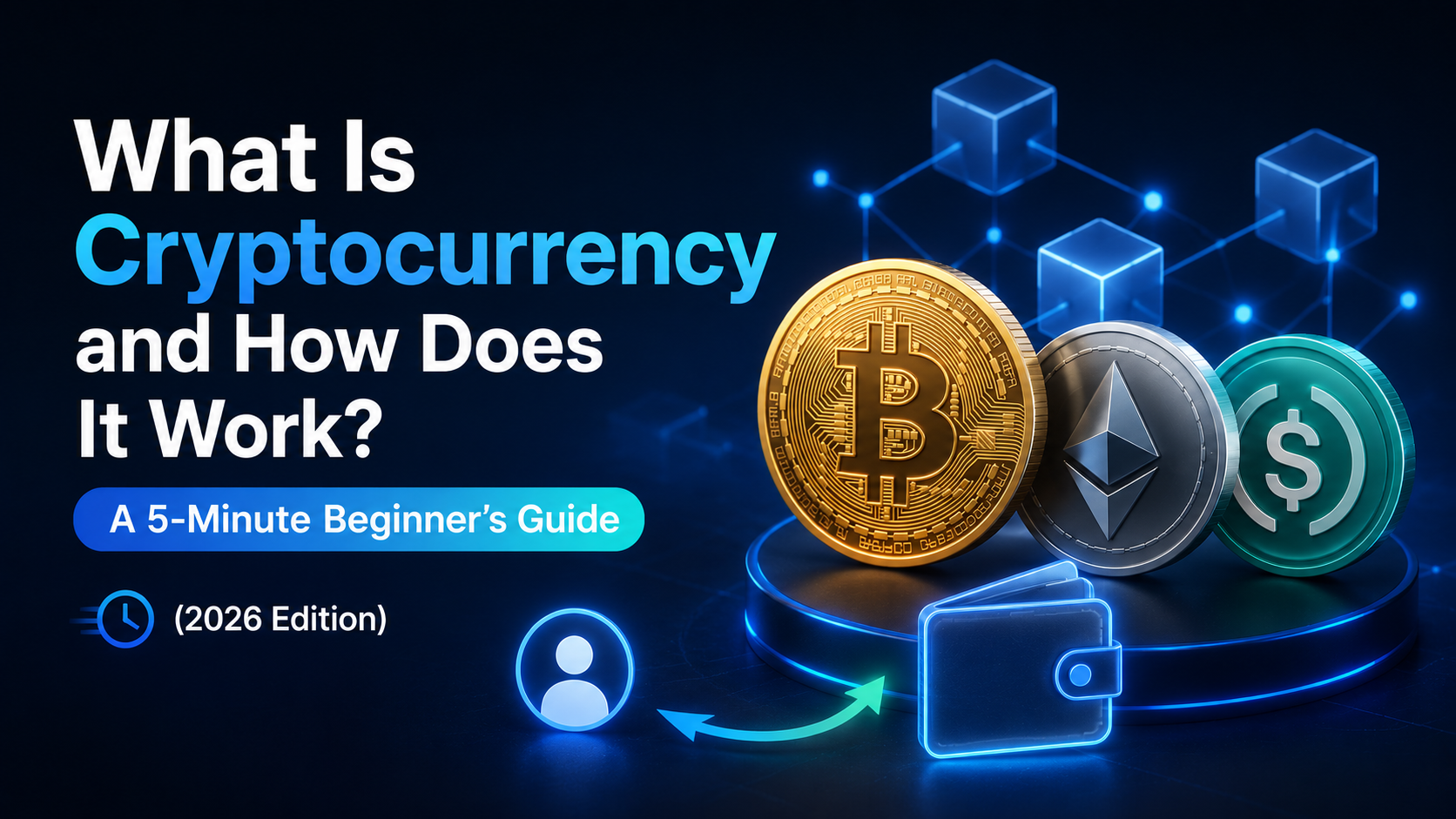
What exactly is cryptocurrency, and why is the entire financial world talking about it? Cryptocurrency is digital-only money that requires no central bank, government, or middleman to function, operating instead via a decentralized global computer network. For many beginners, trying to understand this ecosystem feels overwhelming due to complex technical terminology. However, breaking down the core concepts reveals that crypto is simply an internet-native ledger designed to guarantee true ownership of financial assets. By looking at how these assets are structured, how the network maintains its security, and what risks exist in the wild, you can fully grasp the foundation of crypto within five minutes.
Key Takeaways
-
Decentralization: Cryptocurrencies eliminate intermediaries like banks, giving individuals complete, direct ownership of their digital money.
-
Blockchain Security: Transactions are bundled into blocks and linked chronologically across a global peer-to-peer network, making the ledger virtually unalterable.
-
Diverse Asset Types: The market is anchored by Bitcoin (digital gold/value store), Ethereum (programmable infrastructure for smart contracts), and stablecoins (fiat-pegged assets for price predictability).
-
Modern Security Risks: Blockchain mechanics are highly secure, but ecosystem threats stem primarily from targeted social engineering and smart contract vulnerabilities.
What is Cryptocurrency and Why Does It Bypass Traditional Banks?
Cryptocurrency is a form of decentralized digital currency that allows individuals to transfer value directly to one another without the oversight of a financial intermediary. Traditional systems rely on institutions like commercial banks or payment processors to verify account balances, process transfers, and prevent fraud. This centralized control gives banks the authority to impose transaction limits, freeze accounts, and collect operational fees for routine services.
Cryptocurrencies remove this central authority entirely by utilizing peer-to-peer architecture. When you execute a transaction on a cryptocurrency network, the transaction is verified by a distributed network of computers located all over the world. This approach ensures that no single entity can alter the history of transactions, shut down the network, or deny an individual access to their funds. It provides absolute financial autonomy, turning money into an open-source utility available to anyone with an internet connection.
How Does a Blockchain Keep Your Money Secure?
A blockchain is a shared, immutable digital ledger that permanently records every single transaction occurring within a cryptocurrency network. Instead of storing data on a central server, the blockchain replicates its ledger across thousands of independent nodes globally. This structure completely prevents double-spending—the digital equivalent of counterfeiting where a user tries to spend the same digital coin twice.
To understand this without technical jargon, retail investors often use the "Shared Notebook" analogy popularized in community discussions on Reddit. Imagine a room of 100 people where everyone holds an identical notebook. When one person transfers a digital asset to another, they announce it to the room, and everyone records it in their respective notebooks simultaneously. If a malicious actor attempts to alter a transaction in an older block, the cryptographic signatures of all subsequent blocks would break. The rest of the network would compare their notebooks, notice the mismatch, and immediately reject the fraudulent change.
What do Everyday Investors Realistically Say About Crypto?
Everyday crypto investors on public forums like Reddit emphasize that beginners must look past the technical hype and understand the raw, functional reality of the market. While the underlying technology is revolutionary, public sentiment highlights that the user experience comes with a steep learning curve and a high concentration of speculative activity.
According to community consensus in top crypto forums, a massive portion of the market operates on the "Greater Fool" theory, where individuals buy highly volatile tokens solely in the hope of selling them to someone else for a higher price later. Experienced users often warn newcomers with a brutally honest description: "Imagine a cash app, but your account is completely unrecoverable if you lose your password, every transaction takes 15 minutes and costs a gas fee, and the value fluctuates wildly based on day-to-day internet memes." Understanding this dual reality—that crypto represents true financial freedom but behaves like a digital Wild West—is essential before risking any capital.
What is the Difference Between Bitcoin, Ethereum, and Stablecoins?
The cryptocurrency ecosystem comprises thousands of unique digital assets, but the vast majority of the market falls into three distinct categories based on their design and primary utility. Understanding these three pillars allows you to categorize almost any crypto project you encounter.
Bitcoin (BTC) as Digital Gold
Bitcoin was created in 2009 as the world's first decentralized cryptocurrency, designed explicitly to serve as a scarce digital alternative to fiat currencies. The Bitcoin protocol dictates that there will only ever be a maximum of 21 million Bitcoins in existence, creating hardcoded scarcity. Because its supply cannot be manipulated or inflated by governments, investors primarily utilize Bitcoin as a long-term store of value, drawing strong structural parallels to physical gold.
Ethereum (ETH) as a Global Programmable Infrastructure
Ethereum expanded on Bitcoin's foundational technology by introducing a programmable blockchain that supports smart contracts—self-executing digital agreements written directly into code. Instead of acting purely as digital money, Ethereum operates like a giant, decentralized software platform. Developers use Ethereum to build decentralized applications (dApps) that automate financial lending, legal agreements, and digital property ownership without needing a corporate manager or server host.
Stablecoins for Price Predictability
Stablecoins are digital currencies designed to maintain a stable valuation by pegging their price to traditional real-world assets, most commonly the US Dollar. Popular stablecoins like USDT and USDC use reserve assets to ensure that one digital token always equals one physical dollar. Stablecoins provide users with the transactional speed, global reach, and low costs of blockchain technology without forcing them to deal with the intense price volatility seen in traditional crypto assets.
| Asset Type | Primary Purpose | Volatility Level | Supply Limit |
| Bitcoin (BTC) | Store of Value / Digital Gold | High | Fixed at 21 Million |
| Ethereum (ETH) | Programmable Infrastructure / Smart Contracts | High | Dynamic Supply |
| Stablecoins (USDT/USDC) | Everyday Transactions / Price Stability | None (Pegged to Fiat) | Backed by Reserves |
How Sophisticated are Modern Cryptocurrency Security Risks?
While the underlying blockchain technology is incredibly secure against brute-force attacks, the applications, bridges, and human components built around it face significant security threats from highly targeted, professional hacking groups. The decentralized and irreversible nature of cryptocurrency transactions makes it a prime target for state-sponsored cybercriminals seeking massive capital hauls.
Based on an on-chain security study by TRM Labs published on April 30, 2026, North Korean hacking groups accounted for a staggering 76% of all global cryptocurrency hack losses through April 2026. This massive share of stolen value was driven by just two highly sophisticated incidents that netted approximately $577 million in total. The first was the Drift Protocol breach on April 1, 2026, which resulted in a $285 million loss. This attack involved three weeks of operational staging and months of coordinated social engineering to compromise the protocol's signers, allowing the hackers to execute the complete drain of funds in roughly 12 minutes.
The second major attack identified by TRM Labs occurred on April 18, 2026, when the KelpDAO bridge exploit targeted a single-verifier design flaw in a cross-chain bridge, leading to a loss of $292 million. These two incidents combined represented a mere 3% of the total number of crypto security incidents in early 2026, yet they made up more than three-quarters of the total value stolen across the entire ecosystem. This data underscores that modern crypto risks are rarely a failure of the base blockchain mechanics, but rather the result of targeted social engineering and smart contract vulnerabilities.
Should You Trade Cryptocurrency on KuCoin?
If you want to enter the digital asset market securely, choosing a highly liquid, compliant, and feature-rich global exchange is an absolute necessity. KuCoin provides a world-class trading environment that serves over 30 million users globally, offering deep market liquidity, institutional-grade security protocols, and competitive fee structures that maximize your capital efficiency.
Whether you are looking to purchase your very first fraction of Bitcoin, utilize stablecoins to avoid market volatility, or explore advanced programmable tokens, KuCoin offers intuitive tools tailored for both absolute beginners and professional market participants. By opening a KuCoin account, you gain access to spot trading markets, real-time portfolio analytics, and robust security integrations designed to defend your digital wealth from external threats.
Conclusion
Cryptocurrency represents a fundamental paradigm shift in how humanity defines, stores, and transfers financial value in the digital era. By removing centralized intermediaries like traditional banking corporations, blockchain networks grant individuals direct, unmediated custody over their own capital assets. Bitcoin offers an innovative solution to inflation through digital scarcity, Ethereum functions as a programmable foundation for the next generation of internet software, and stablecoins deliver predictable value for daily global commerce.
However, as the crypto space continues to mature, navigating structural security vulnerabilities requires choosing trusted gateways. The extreme precision of modern, state-sponsored cyber attacks highlights the necessity of relying on secure platforms. For anyone looking to explore this changing economic landscape safely, maintaining rigorous security practices, continuously building your technical knowledge, and utilizing a trusted global trading platform remain the most reliable ways to participate in the ongoing evolution of global finance.
FAQs
What happens if I send cryptocurrency to the wrong wallet address?
The transaction will be permanently lost because cryptocurrency networks are completely irreversible and lack any centralized customer support to issue refunds. You must double-check every character of the destination address or use QR codes before confirming any transfer.
Can a government completely shut down a cryptocurrency like Bitcoin?
No, a government cannot shut down a decentralized cryptocurrency because the ledger is copied across thousands of global computers rather than a central server. A nation can only restrict domestic access by banning local cryptocurrency exchanges, regulating bank transfers to crypto firms, or criminalizing mining operations.
Why do cryptocurrency prices fluctuate so drastically compared to regular money?
Cryptocurrency markets experience high volatility because they are relatively young financial assets with smaller overall market caps and no price-stabilization interventions from central banks. Prices are driven purely by public speculation, shifting market sentiment, regulatory announcements, and total supply and demand dynamics.
What is the exact difference between a public key and a private key?
A public key acts like your public email address or bank account number, which you can safely share with anyone so they can send you cryptocurrency funds. A private key acts like your secret digital password or signature; it gives you total control over the funds and must never be shared with anyone.
Do I have to buy a whole Bitcoin, or can I purchase a small fraction?
You do not have to buy a whole coin because all major cryptocurrencies are highly divisible into smaller units. For instance, a single Bitcoin can be divided down to eight decimal places, allowing you to purchase a fraction worth just a few dollars to start.