

Could Tokenized Equities Become Crypto’s Next Mega Narrative?
What Are Tokenized Equities? Understanding Blockchain-Based Stocks
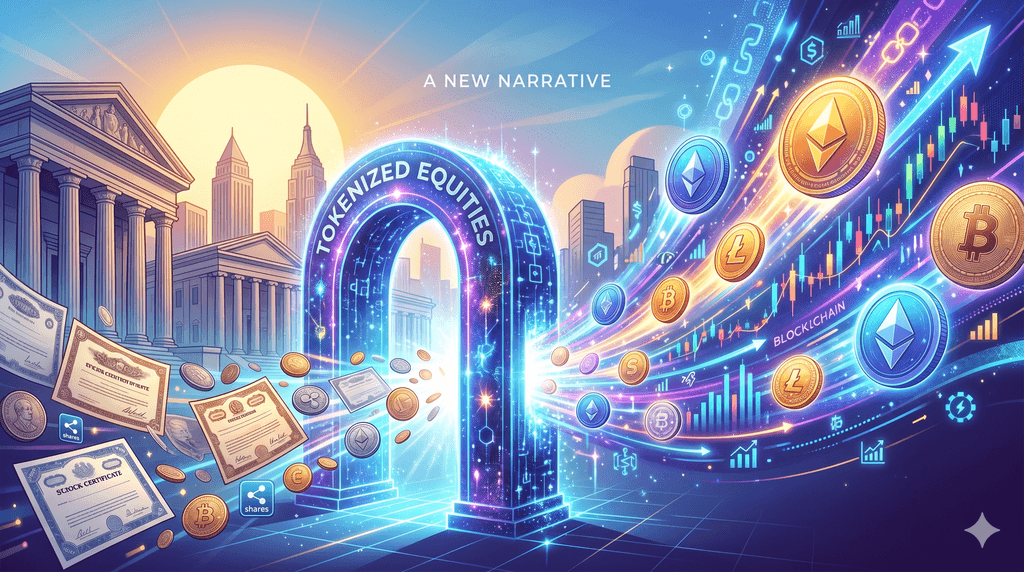
Tokenized equities are digital representations of traditional stocks and exchange-traded funds (ETFs) issued on blockchain networks. Unlike conventional shares, which exist only within the infrastructure of traditional exchanges and brokerage systems, tokenized equities exist as cryptographic tokens that can be traded, transferred, and stored independently. Each token either directly represents ownership of a real share held by a regulated custodian or tracks the value of the stock synthetically, allowing investors to gain exposure without physically holding the underlying security.
The creation of tokenized equities involves several components. Custodial tokens are backed one-to-one by actual shares held securely by regulated custodians, ensuring that each token reflects genuine ownership. Synthetic tokens, in contrast, use smart contracts and secure oracles to track the price movements of the underlying equity, enabling investors to replicate market exposure without holding the actual asset. Blockchain infrastructure records token ownership, manages transfers, and enforces rules automatically, facilitating near-instant settlement and reducing reliance on traditional intermediaries. Oracles provide real-time market data, ensuring token prices mirror the underlying stock, while maintaining transparency and decentralized verification.
Tokenized equities differ from traditional shares in several important ways. Fractional ownership allows investors to buy portions of high-value equities, making blue-chip stocks accessible to a broader audience. Global accessibility enables anyone with a compatible blockchain wallet to participate in trading, regardless of location or access to conventional brokerage accounts. These digital assets are also programmable, allowing integration with decentralized finance (DeFi) protocols for use cases such as lending, collateralization, and automated dividend distribution. Blockchain-based settlement improves efficiency, reducing trade finalization from days to potentially minutes, which enhances liquidity and minimizes counterparty risk. By bridging traditional finance with blockchain technology, tokenized equities create a new frontier in capital markets, offering accessibility, flexibility, and deeper integration within the crypto ecosystem.
How Market Adoption and Regulatory Developments Are Driving Tokenized Equities
The growth of tokenized equities is fueled by the interplay between market adoption and evolving regulatory frameworks. On the adoption side, both retail and institutional participation has expanded rapidly. Platforms like Kraken’s xStocks and Bitget Wallet now offer hundreds of tokenized stocks and ETFs, enabling investors to trade digital shares across borders at any time. This 24/7 accessibility attracts participants who previously faced limitations in traditional exchanges, creating a growing pool of market activity and accelerating liquidity. The integration of tokenized equities with decentralized finance protocols further enhances adoption, allowing digital stocks to serve as collateral, participate in lending protocols, or interact with synthetic derivatives. This composability provides flexibility and investment opportunities not available in conventional markets.
Regulatory developments are critical to sustaining this momentum. In the United States, the Securities and Exchange Commission (SEC) has explored frameworks, often referred to as “innovation exemptions,” to allow tokenized stocks to trade legally on crypto platforms while maintaining investor protections. These proposals aim to clarify trading rights, custody, and reporting requirements, which have historically hindered adoption. Major exchanges like the New York Stock Exchange are also investigating blockchain-based trading systems that complement existing infrastructure. Companies like Securitize and Computershare have developed compliant issuance and custody models that bridge traditional stock ownership with blockchain technology, providing a regulated path for tokenized equities.
Market adoption and regulatory progress are mutually reinforcing. As more participants engage with tokenized equities, regulators gain confidence in the ecosystem’s viability, which in turn encourages broader institutional and retail involvement. Early successes demonstrate tangible growth, with tokenized equities achieving meaningful transaction volumes and representing significant real-world value. This dynamic underscores why tokenized equities are transitioning from experimental assets to a mainstream segment of the crypto economy.
The Benefits and Challenges of Investing in Tokenized Equities
Tokenized equities offer a new way to invest in traditional stocks through blockchain technology, combining accessibility, efficiency, and innovation. However, like any emerging asset class, they come with both opportunities and risks that investors need to understand before participating. The following discussion explores the main advantages and challenges of investing in tokenized equities.
-
Fractional Ownership and Accessibility
Investing in tokenized equities offers a distinct advantage through fractional ownership, allowing investors to purchase smaller portions of expensive stocks. This democratizes access to high-value equities such as Amazon or Google, which might otherwise be out of reach for retail investors, and opens the door for broader participation in markets historically dominated by high-net-worth individuals or institutions.
-
Global Accessibility and 24/7 Trading
Tokenized equities can be traded around the clock on blockchain platforms, bypassing the traditional limitations of exchange hours and geographic restrictions. This continuous market access enhances liquidity, allows for more flexible portfolio management, and provides opportunities for investors worldwide to engage in trading without being constrained by local financial infrastructure.
-
Programmability and Integration with DeFi
Another major benefit is the programmability of tokenized stocks. These digital assets can be integrated with decentralized finance (DeFi) protocols, enabling applications such as lending, collateralized trading, and automated dividend distribution. This creates opportunities for innovative financial strategies that are not possible with traditional equities, while also improving efficiency through smart contract automation.
-
Faster Settlement and Operational Efficiency
Blockchain-based settlement reduces transaction times and operational friction compared to conventional clearing cycles. Trades that normally take several days to settle can be finalized in minutes, enhancing liquidity and reducing counterparty risk. This efficiency benefit is a strong incentive for both retail and institutional investors to adopt tokenized equities.
-
Regulatory and Legal Considerations
Despite these advantages, tokenized equities face regulatory challenges. The legal status of these digital securities is still evolving in many jurisdictions. Questions around shareholder rights, custody arrangements, and compliance with securities laws can complicate trading and issuance, and investors must navigate these uncertainties carefully.
-
Market Liquidity and Volatility Risks
Liquidity remains a concern, particularly for less popular tokenized equities. Limited trading activity can result in price slippage and higher volatility, which may affect both execution quality and investment returns. Investors need to be aware that smaller token markets can behave differently from highly liquid traditional equities.
-
Counterparty and Custodial Risks
Not all tokenized equities are fully backed by the underlying stocks. Synthetic or partially backed tokens introduce counterparty risk, as their value depends on the solvency and transparency of the issuer. Understanding the backing and governance of each tokenized equity is critical for informed investment decisions.
-
Institutional Adoption and Ecosystem Development
Finally, institutional adoption is still in its early stages. Without widespread integration by large financial institutions, challenges related to standardization, interoperability, and scalability may persist, potentially limiting the growth and stability of tokenized equity markets.
Tokenized equities combine accessibility, efficiency, and innovation, presenting new opportunities for investors. However, potential risks related to regulation, liquidity, counterparty exposure, and adoption must be carefully considered. Investors who understand these dynamics can make informed decisions in this rapidly evolving market.
Will Tokenized Equities Become Crypto’s Next Mega Narrative?
Tokenized equities are rapidly emerging as a transformative force in the crypto space, bridging the gap between traditional finance and blockchain innovation. Their potential to become crypto’s next mega narrative depends on a combination of adoption, regulatory clarity, technological infrastructure, and market education. Understanding how these factors interact is essential for investors and institutions looking to capitalize on this growing trend.
Early Adoption and Market Momentum Driving Tokenized Stocks
The adoption of tokenized equities across both retail and institutional platforms demonstrates early momentum and validates the concept of blockchain-based stock ownership. Investors are increasingly drawn to features like fractional ownership, which allows them to access high-value equities at a lower capital threshold, 24/7 trading, which eliminates the restrictions of traditional exchange hours, and global accessibility, enabling participation from virtually anywhere in the world. Platforms such as Kraken’s xStocks and Bitget Wallet have pioneered these offerings, creating a growing ecosystem of crypto stocks that blend the advantages of blockchain with traditional market value.
Regulatory Developments Enhancing Investor Confidence
Regulatory clarity is improving, particularly in the United States, where the Securities and Exchange Commission (SEC) has begun exploring innovation exemptions for tokenized equities. These frameworks aim to balance investor protection with market innovation, enabling blockchain-based equity trading to operate legally and securely. Additionally, firms like Securitize and Computershare provide compliant custody and issuance models, aligning tokenized stocks with established market standards. This regulatory progress reduces investor uncertainty, builds trust, and encourages broader adoption across institutional and retail participants.
Challenges and Risks Facing Tokenized Equities
Despite these promising trends, tokenized equities face several challenges. Legal and regulatory uncertainty remains a concern across different jurisdictions, limiting seamless global adoption. Market liquidity can be uneven, particularly for less-traded tokens, which may result in price slippage or volatility. Counterparty risks exist for synthetic or partially-backed tokenized stocks, requiring investors to understand the mechanisms and guarantees behind each token. Furthermore, widespread mainstream adoption will require scalable infrastructure, reliable settlement processes, and seamless integration with both retail and institutional investment ecosystems.
The Potential for Tokenized Equities to Redefine Investing
If these hurdles are successfully addressed, tokenized equities could fundamentally reshape how investors access and participate in global stock markets. By combining the economic value of traditional equities with the efficiency, transparency, and programmability of blockchain technology, these digital assets have the potential to create a new, highly liquid, and globally accessible market segment. Tokenized equities could drive adoption, enhance market liquidity, and enable innovative investment strategies, positioning them as a viable candidate for the next mega narrative in the crypto world.
A New Era for Crypto Stocks and Blockchain Investing
Tokenized equities are more than just a technological innovation; they represent a paradigm shift in investing. With growing adoption, regulatory support, and technological infrastructure, they are poised to redefine equity markets and investor behavior. For crypto investors and institutions, understanding the evolving landscape of tokenized equities is critical, as these digital stocks may soon play a central role in the future of both digital finance and traditional investing.
Conclusion
Tokenized equities represent a transformative intersection between traditional finance and blockchain technology, offering investors unprecedented access, flexibility, and efficiency. By enabling fractional ownership, 24/7 trading, and integration with decentralized finance protocols, they address many limitations of conventional equity markets. At the same time, challenges such as regulatory uncertainty, market liquidity, counterparty risk, and the pace of institutional adoption must be carefully considered.
Despite these obstacles, the momentum behind tokenized equities is undeniable. Regulatory developments, growing adoption on both retail and institutional platforms, and innovative use cases are steadily building confidence in the ecosystem. If these trends continue, tokenized equities have the potential to evolve into crypto’s next mega narrative, reshaping how global investors access, trade, and utilize equity markets. For investors, staying informed about this emerging asset class is not just prudent, it may be essential for participating in the next phase of financial innovation.
Frequently Asked Questions (FAQs)
-
What are tokenized equities and how do they work?
Tokenized equities are blockchain-based digital representations of traditional stocks or ETFs. Each token either represents actual shares held by a custodian or tracks stock prices synthetically using smart contracts and secure price oracles. They allow investors to trade, transfer, and settle equities on blockchain networks 24/7.
-
How can I invest in tokenized equities?
Investors can buy tokenized equities through crypto platforms and exchanges that support these digital stocks, such as Kraken’s xStocks or Bitget Wallet. You need a compatible blockchain wallet and, depending on the platform, may need to complete KYC verification. Fractional ownership allows investing with smaller capital amounts.
-
Are tokenized equities safe and regulated?
Tokenized equities operate under evolving regulatory frameworks. In the U.S., the SEC is exploring innovation exemptions to enable legal trading. Trusted platforms implement compliant custody and issuance models, but investors should always verify backing, transparency, and jurisdictional legality before investing.
-
What are the benefits of tokenized equities compared to traditional stocks?
Tokenized equities offer fractional ownership, global accessibility, 24/7 trading, faster settlement, and integration with DeFi protocols. They make high-value stocks accessible to more investors, improve liquidity, and enable programmable financial strategies that are impossible with traditional equities.
-
What risks should investors consider with tokenized equities?
Risks include regulatory uncertainty, limited liquidity for some tokens, counterparty risks for synthetic or partially backed tokens, and potential market volatility. Additionally, mainstream institutional adoption is still developing, which may affect scalability and standardization.
-
How are tokenized equities impacting the crypto and stock markets?
Tokenized equities bridge traditional financial markets with blockchain, attracting new retail and institutional participants. They enhance market liquidity, introduce innovative financial products, and create opportunities for cross-asset strategies, potentially reshaping investor behavior and global trading practices.
-
Could tokenized equities become crypto’s next mega narrative?
Yes, tokenized equities have the potential to become crypto’s next mega narrative. Their combination of traditional equity value with blockchain efficiency, global accessibility, regulatory compliance, and programmable features positions them as a transformative force in digital investing, similar to previous narratives like DeFi, NFTs, and stablecoins.
Disclaimer: This article is for informational purposes only and is not financial advice. Always do your own research before buying or trading crypto.