

Grayscale Fund Inflows and Outflows Over the Past Year: What the Numbers Reveal About Investor Rotation
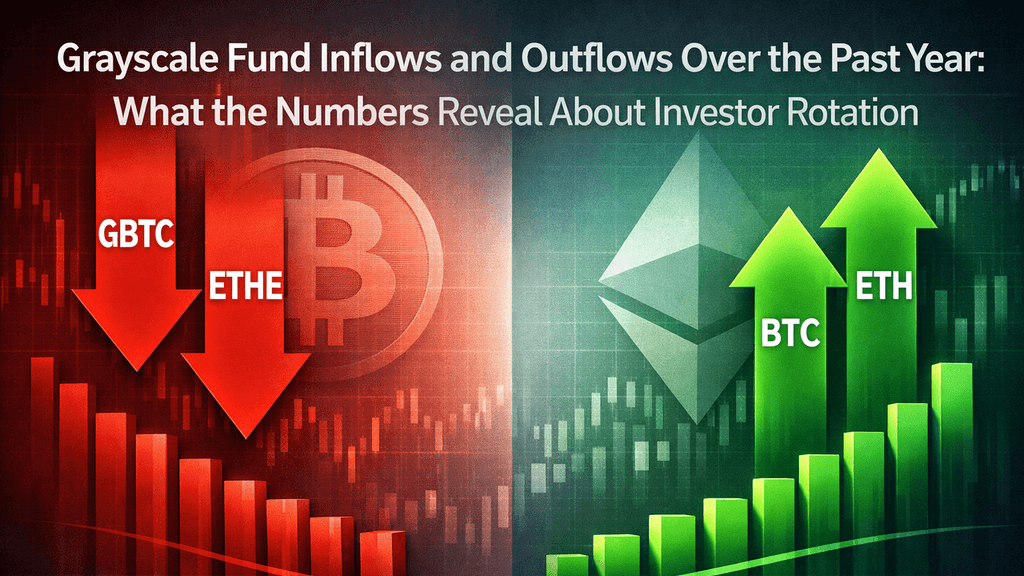
The crypto ETF market has become more competitive over the past year, and that shift is showing up clearly in fund-flow data. As investors compare fees, structure, and issuer positioning more closely, product design now matters almost as much as underlying asset exposure. That makes fund flows one of the most useful ways to understand where capital is moving and why.
Grayscale offers one of the clearest examples of that transition. Its legacy flagship products, especially the Grayscale Bitcoin Trust ETF (GBTC) and the Grayscale Ethereum Staking ETF (ETHE), continued to post large outflows, while newer lower-cost products such as the Grayscale Bitcoin Mini Trust ETF (BTC) and the Grayscale Ethereum Staking Mini ETF (ETH) attracted fresh assets. The result is a split picture that says less about fading demand for Bitcoin or Ethereum and more about how investors are choosing to access that exposure.
Hook
What does it mean when one of crypto’s best-known asset managers continues to attract money in some products while losing assets in others? That question sits at the center of Grayscale’s recent fund-flow story, and it helps explain how investor behavior has changed in a market where cost, structure, and competition matter more than they once did.
Overview
-
Over the last 12 months, Grayscale’s fund-flow picture has been mixed rather than uniform.
-
Legacy flagship products, especially GBTC and ETHE, continued to see heavy redemptions.
-
Newer lower-fee products such as BTC and ETH attracted meaningful inflows.
-
The result was a split business outcome: legacy products kept losing assets, while newer products gained traction in a more fee-sensitive market.
Thesis
This article explains Grayscale’s recent fund inflows and outflows, why the biggest redemptions came from older flagship products, why the mini funds became the firm’s main internal inflow bright spots, and what that shift says about the broader direction of crypto ETF competition.
Grayscale Fund Inflows and Outflows in a Changing Crypto ETF Market
To understand Grayscale fund inflows and outflows, it helps to start with the market structure. Grayscale was one of the most recognizable names in digital-asset investment products long before spot-style crypto ETFs became a normal part of the U.S. landscape. That early position gave the firm a major advantage for years. But once the market became more crowded, investors had more ways to get Bitcoin and Ethereum exposure, and fund flows began to show which products still looked attractive on price and structure.
As of September 30, 2025, GBTC had recorded roughly $25 billion in cumulative net outflows since its January 2024 ETF conversion, while ETHE had seen about $4.8 billion in cumulative net outflows since its July 2024 conversion. At the same time, Grayscale’s ETFs excluding GBTC and ETHE had attracted around $3.3 billion in cumulative net inflows since the start of 2024.
That split reveals the core issue:
-
Demand for Grayscale products did not disappear.
-
Newer funds continued to attract capital.
-
Even so, inflows into those newer funds remained much smaller than the outflows from the older flagship products.
One reason this matters so much is scale. GBTC and ETHE together represented about 70% of Grayscale’s AUM as of September 30, 2025, and those same products accounted for 88% of total revenue in the first nine months of 2025. These were not marginal outflows at the edge of the business. They were affecting the products that mattered most to Grayscale’s asset base and revenue mix.
There is also a product-design angle here. Grayscale’s official fund pages show that GBTC has operated with a listed ETF share creation and redemption program since January 11, 2024, while BTC is positioned as a separate Bitcoin mini trust ETF. In practical terms, investors are not only comparing access to the same asset class. They are also comparing pricing, wrapper design, and competitive positioning.
In simple terms, fund flows refer to the net movement of money into and out of a fund:
-
Positive flows suggest net buying or fresh allocations.
-
Negative flows suggest net redemptions or capital leaving.
For Grayscale, those signals became especially important because they showed not just whether investors still wanted crypto exposure, but which version of that exposure they were willing to pay for.
GBTC Outflows, ETHE Redemptions, and Crypto ETF Competition
Grayscale’s recent fund-flow story shows how quickly the crypto ETF market has changed.GBTC saw about $25 billion leave on a cumulative basis since conversion, including $3.3 billion during 2025 through September 30. ETHE also faced sustained redemptions, with around $4.8 billion in cumulative net outflows and roughly $1.2 billion leaving during 2025 through September 30.
This shift does not automatically mean investors turned negative on Bitcoin or Ethereum. A more plausible reading is that many investors remained interested in crypto exposure but became more selective about which product they used to get it. As the ETF market expanded, cost, structure, and issuer positioning became harder to ignore.
Key takeaways:
-
GBTC remained Grayscale’s biggest outflow product.
-
ETHE also experienced substantial redemptions.
-
Lower-fee products such as BTC and ETH gained investor interest.
-
Crypto ETF competition pushed investors to compare cost, structure, and issuer more closely.
The bigger story is not just outflows. It is investor rotation. Many investors still wanted Bitcoin and Ethereum exposure, but they became more selective about which fund they held. That made pricing and product design more important than ever in shaping asset flows across Grayscale’s lineup.
Grayscale Fund Flow Summary
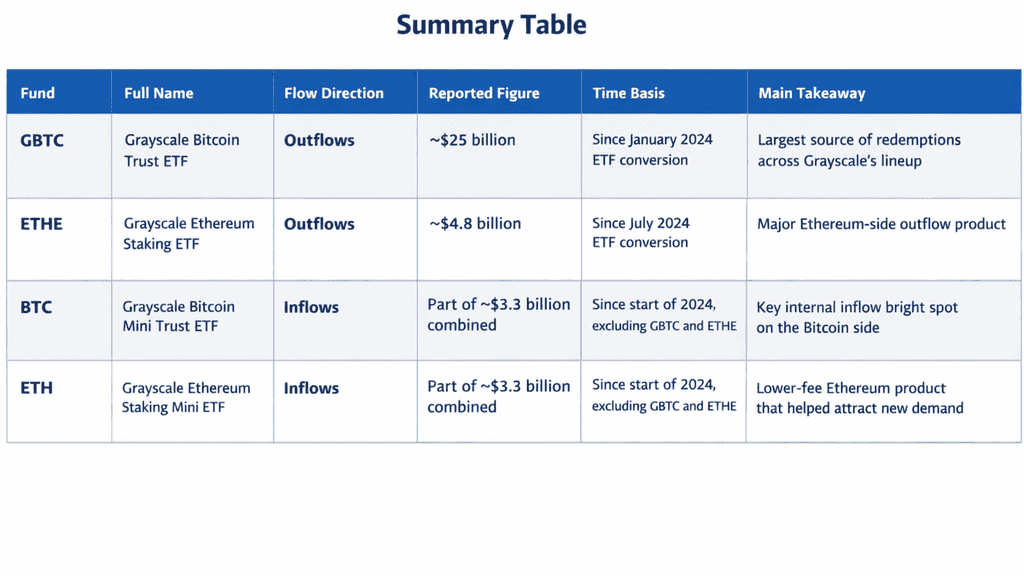
The table above shows the clearest pattern in Grayscale’s recent fund-flow story. Legacy flagship products such as GBTC and ETHE accounted for the largest outflows, while the lower-fee mini funds, BTC and ETH, emerged as the firm’s main internal inflow drivers. This split suggests that investor demand for crypto exposure did not disappear, but it became more selective. Rather than staying in older, higher-cost products, many investors appear to have shifted toward cheaper and more competitive alternatives. That is why Grayscale’s flow picture is best understood as a story of investor rotation, not a simple collapse in demand.
Challenges and Considerations
Fee Compression, Revenue Pressure, and Competitive Risk in Crypto ETFs
One of the biggest challenges in Grayscale’s flow story is that inflows into lower-fee mini funds do not fully offset the impact of outflows from flagship products. Because GBTC and ETHE historically represented a larger share of assets and revenue, money leaving those products creates more business pressure than money entering lower-fee replacements.
Here are the main challenges:
-
Not all inflows have the same economic value. Money moving into lower-fee products may support asset growth, but it does not necessarily replace the revenue lost from higher-fee flagship funds.
-
Large outflows can affect market perception. Heavy withdrawals from well-known products like GBTC and ETHE can create negative headlines even when some of that money is rotating into other crypto ETFs.
-
Competition is much stronger now. The crypto ETF market is more crowded, and investors have more choices across issuers and fee levels. Grayscale’s launch and promotion of BTC and ETH as lower-cost alternatives reflects that pressure.
-
Outflows can be misunderstood. Investors may see large outflows and assume demand for Bitcoin or Ethereum is weakening, even when money is simply moving into a competing ETF or a lower-cost fund. This is an inference supported by the simultaneous outflows from GBTC and ETHE and inflows into Grayscale’s mini products.
There are also a few practical points to keep in mind when analyzing this market:
-
Compare flows by product, not just by issuer.
-
Pay close attention to fees, because lower costs are influencing investor decisions.
-
Separate ETF competition from overall demand for crypto exposure.
Conclusion
Grayscale’s fund-flow picture is best understood as a split between legacy outflows and selective new-product inflows. GBTC remained the largest source of redemptions, ETHE also posted substantial cumulative outflows, and those legacy products continued to shape the overall narrative. At the same time, BTC and ETH emerged as Grayscale’s clearest internal growth products, drawing meaningful capital because they were better aligned with market demand for lower-cost exposure.
The most important takeaway is that investors did not simply walk away from Grayscale. They became more selective. They still wanted Bitcoin and Ethereum exposure, but increasingly chose products that looked cheaper, cleaner, and more competitive. That is why Grayscale’s recent fund-flow story matters beyond the company itself: it shows how crypto ETF competition now works.
Call to Action
Explore more market insights, analysis, and educational content on KuCoin to make smarter decisions in a fast-moving digital asset landscape
FAQs
What are Grayscale fund inflows and outflows?
Grayscale fund inflows and outflows refer to the net movement of money into and out of Grayscale’s investment products. Positive flows mean a fund received more new money than it lost, while negative flows mean redemptions or exits were greater than new allocations.
Which Grayscale fund had the biggest outflows?
GBTC recorded the largest outflows by a wide margin. Since its ETF conversion in January 2024, it has seen nearly $25 billion in cumulative net outflows, making it the biggest source of redemptions across Grayscale’s lineup.
How large were ETHE’s outflows?
ETHE posted roughly $4.8 billion in cumulative net outflows since its conversion in July 2024. That total includes about $1.2 billion in outflows during 2025 through September 30.
Which Grayscale products attracted inflows?
The strongest internal inflow performers were BTC and ETH, Grayscale’s lower-fee mini products. Excluding GBTC and ETHE, Grayscale’s ETFs brought in around $3.3 billion in cumulative inflows since the start of 2024, with most of that going into the mini funds.
Why did investors shift toward the mini funds?
Lower fees appear to be one of the main reasons. Grayscale’s product pages position BTC and ETH as lower-cost options, and both mini products carry a 0.15% fee. In a more competitive ETF market, lower-cost structures can be more attractive to investors comparing similar products.
Do outflows from GBTC mean investors are bearish on Bitcoin?
Not necessarily. Outflows from GBTC do not automatically signal bearish sentiment toward Bitcoin. In many cases, capital may be rotating from one Bitcoin ETF into competing products that offer lower fees or a different issuer profile. The fact that GBTC outflows happened alongside inflows into Grayscale’s mini funds supports that view.
What is the business impact of these flows on Grayscale?
The business impact is significant because the effect goes beyond headline asset totals. GBTC and ETHE accounted for about 70% of Grayscale’s assets under management and 88% of its revenue in the first nine months of 2025. That means outflows from these legacy products can have an outsized effect on the company’s financial performance.
What is the biggest takeaway from Grayscale fund inflows and outflows over the past year?
The clearest takeaway is that Grayscale is going through a transition. The company has faced heavy outflows from legacy products like GBTC and ETHE, while also seeing meaningful, though smaller, inflows into lower-fee alternatives. The broader trend suggests that in today’s market, pricing and product structure matter more than before.
Disclaimer: The information provided on this page may originate from third-party sources and does not necessarily represent the views or opinions of KuCoin. This content is intended solely for general informational purposes and should not be considered as financial, investment, or professional advice. KuCoin does not guarantee the accuracy, completeness, or reliability of the information, and is not responsible for any errors, omissions, or outcomes resulting from its use. Investing in digital assets carries inherent risks. Please carefully evaluate your risk tolerance and financial situation before making any investment decisions. For further details, please consult our Terms of Use and Risk Disclosure