

World Prediction Market Migrates from Solana to Robinhood Chain
2026/07/13 15:56:00
New Prediction Market Entrant Prioritizes Scale and Infrastructure Over Chain Loyalty
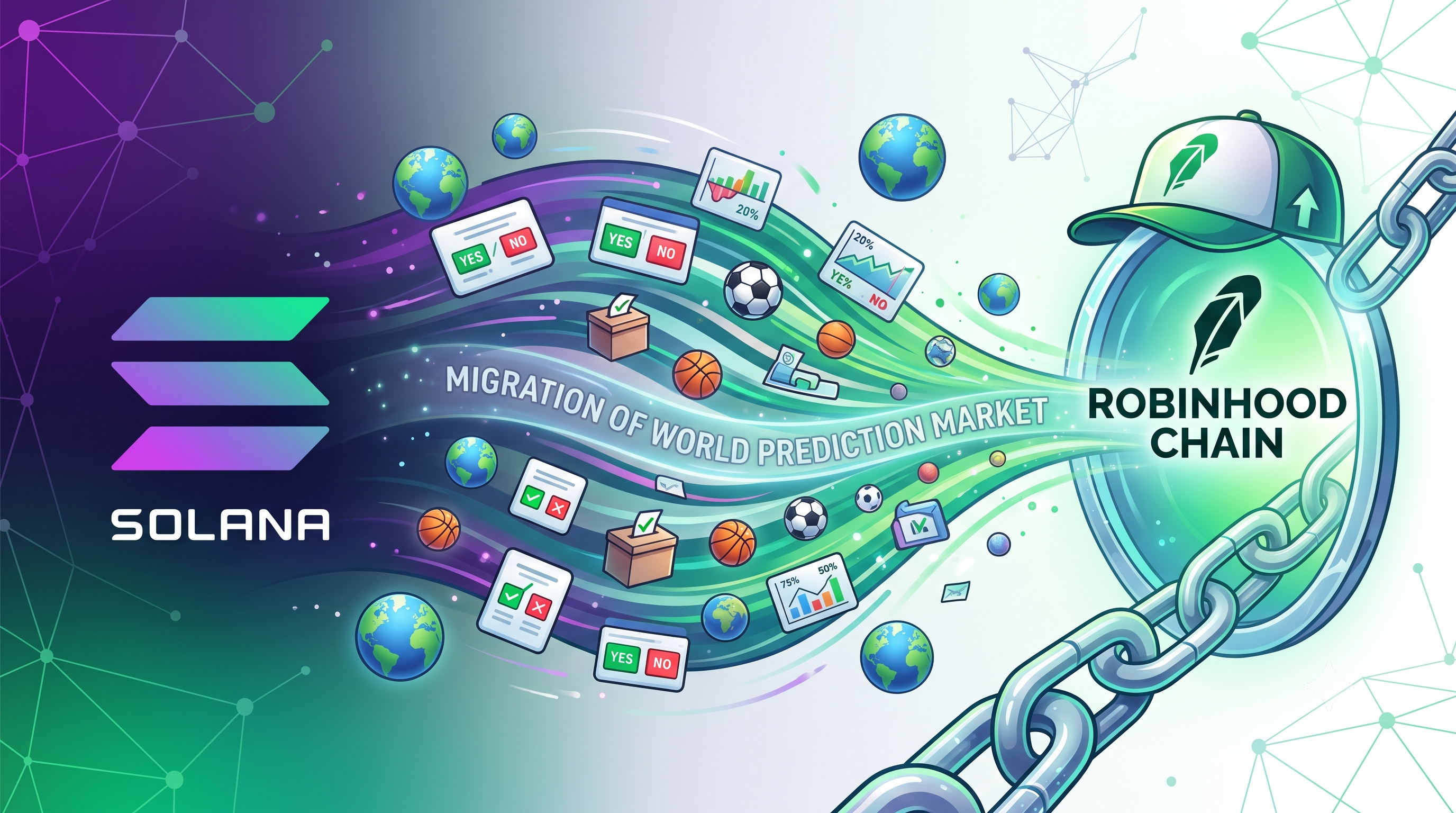
The decentralized prediction market platform World.xyz, which had launched on Solana just days earlier, announced on July 8, 2026, that it would migrate to Robinhood Chain. This pivot, framed by the team as the result of careful 24-hour deliberation, has drawn significant attention across crypto communities, showing the fluid nature of blockchain project strategies amid intensifying competition. Launched around July 1 and integrated directly into the Phantom wallet, World offered fully on-chain markets for cryptocurrency prices, the 2026 FIFA World Cup, and other events, leveraging Chainlink oracles and settling in a stablecoin.
The move occurs against a backdrop of explosive growth in the broader prediction markets sector, where platforms like Polymarket and Kalshi have seen combined monthly volumes surge into the tens of billions, driven by sports, politics, and crypto events. World’s migration underscores how new prediction market entrants are prioritizing access to established user bases and institutional-grade infrastructure over initial chain loyalty, potentially accelerating Robinhood Chain’s emergence as a hub for real-world asset and event-based trading while testing the portability of on-chain applications.
Rapid Launch and Early Traction on Solana
World.xyz entered the market with notable momentum, capitalizing on Solana’s high-speed, low-cost environment and Phantom wallet’s substantial user base exceeding 15 million monthly active users. The platform enabled non-custodial trading where users retained full control of funds, with automatic settlements powered by Chainlink data feeds. Markets quickly included short-term Bitcoin price predictions and major sporting events tied to the ongoing World Cup cycle, distinguishing it through seamless integration that replaced prior Kalshi offerings within Phantom. This setup allowed for efficient, on-chain resolution without manual claims, addressing common pain points in legacy prediction platforms. Early adoption reflected broader industry trends, with prediction markets achieving record volumes fueled by real-time event interest.
Solana’s ecosystem provided the technical backbone for quick deployment, yet the team’s swift reassessment points to strategic calculations around long-term scalability and distribution. Industry observers noted the launch’s alignment with Solana’s push into consumer applications, including its foundation’s endorsement. However, the announcement’s timing, mere days after mainnet activity, suggests underlying assessments of network fit beyond raw performance metrics. As prediction markets mature, with total volumes across major platforms surpassing hundreds of billions in notional value year-to-date in 2026, projects like World are evaluating not just throughput but alignment with broader financial infrastructures. This early shift illustrates the competitive pressure on new entrants to optimize for user acquisition channels that extend beyond native crypto audiences.
Robinhood Chain’s Emergence as a Competitive L2 Infrastructure
Robinhood Chain, an Arbitrum-based Ethereum Layer-2 that launched its public mainnet on July 1, 2026, positions itself as a turnkey environment for tokenized real-world assets, DeFi primitives, and institutional-standard applications. Built to institutional specifications with integrations from partners like Uniswap for liquidity, Chainlink for oracles, and others for lending and trading, the chain supports fast block times and ETH gas fees while targeting global accessibility. Robinhood’s nearly 28 million customers across multiple continents offer a massive potential on-ramp for on-chain activities, bridging traditional finance users with decentralized tools. The chain has already demonstrated early traction, with DEX volumes exceeding $500 million in 24 hours within its first week and TVL surpassing $100 million, much of it in lending protocols like Morpho.
This infrastructure aligns closely with prediction market needs, providing robust oracle support and settlement capabilities that complement World’s existing Chainlink dependency. Robinhood’s own emphasis on prediction markets as a high-growth revenue driver further strengthens the synergy, as the company has expanded its offerings through joint ventures and in-house platforms. For projects seeking distribution, the chain’s native wallet integrations and focus on 24/7 trading present compelling advantages over more specialized ecosystems. The migration decision highlights how L2s backed by traditional financial brands can rapidly attract builders by combining compliance-oriented design with permissionless innovation.
Implications for User Experience and Liquidity Portability
Transitioning a live prediction market involves redeploying contracts, updating frontends, ensuring oracle continuity, and facilitating liquidity or position bridging for users. World’s setup, with its Phantom integration and stablecoin settlements, would require careful user guidance to maintain seamless access post-migration. The absence of immediate on-chain evidence for the move as of July 9 has fueled speculation, yet the strategic intent appears focused on leveraging Robinhood’s user ecosystem for greater reach. Prediction market participants value liquidity depth and ease of entry; Robinhood Chain’s connections to broader retail audiences could enhance market participation beyond core crypto users.
Users accustomed to Solana’s speed may need to adapt to the new L2’s characteristics, though Arbitrum technology ensures competitive performance. This shift also raises considerations for open positions and ongoing World Cup-related markets, where timely resolution remains critical. The move could set a precedent for cross-chain flexibility, encouraging developers to view blockchains as modular rather than permanent homes. Enhanced accessibility through Robinhood’s platform may drive incremental volume growth, particularly as sports and event-driven betting continue dominating category activity.
Context of Prediction Market Industry Expansion in 2026
Prediction markets have evolved into a major financial vertical, with combined volumes across leading platforms reaching tens of billions monthly in 2026, outpacing many traditional sports betting benchmarks. Categories spanning sports (dominant on platforms like Kalshi), politics, cryptocurrency prices, and geopolitics attract diverse participants, from retail enthusiasts to institutional observers seeking crowd-sourced insights. World’s entry and subsequent pivot occur as the sector benefits from regulatory clarity in certain jurisdictions and technological advancements in oracles and settlements. Robinhood’s internal data positions prediction products as its fastest-growing revenue line, with significant contributions from event contracts.
This environment rewards platforms that can aggregate liquidity efficiently and offer intuitive interfaces. The industry’s growth journey, supported by billions in trading across events like elections and championships, underscores the value of infrastructure that lowers barriers for mainstream users. World’s migration may capitalize on these dynamics by aligning with an entity already invested in scaling such products globally. As volumes scale, factors like settlement reliability and cross-asset integration become differentiators, areas where Robinhood Chain’s design for tokenized assets provides natural extensions.
Dynamics Between Emerging Chains and Established Ecosystems
Solana’s strengths in speed and cost-efficiency powered World’s initial launch, yet Robinhood Chain’s backing introduces different competitive edges centered on distribution and regulatory alignment. The crypto landscape features intense rivalry among L1s and L2s, with projects frequently assessing trade-offs in user bases, developer tools, and capital efficiency. Reactions from Solana-aligned projects, including satirical responses from entities like Raydium and affirmations of commitment from others, reflect ecosystem pride but also the reality of builder mobility. Robinhood Chain’s rapid early metrics, including substantial DEX activity shortly after launch, demonstrate its capacity to attract interest.
For prediction markets specifically, the ability to draw non-crypto participants through familiar brokerage interfaces could prove decisive for volume leadership. This migration episode illustrates how announcements themselves generate visibility, even amid questions of execution timelines. Long-term, success will depend on delivering reliable markets that integrate with larger financial workflows, an area where Robinhood’s infrastructure investments position it favorably. Builders across DeFi continue exploring such opportunities to optimize for growth.
Role of Oracles and Settlement Innovations in Market Reliability
Chainlink’s continued support for World through the transition ensures data integrity for event outcomes, a foundational element for trust in prediction platforms. Reliable oracles mitigate disputes and enable automatic payouts, as seen in World’s Phantom-based model using stablecoin settlements. This technical continuity minimizes disruption risks during migration. In the wider industry, advancements in oracle networks have supported the scaling of high-volume markets by providing tamper-resistant inputs for diverse events. Prediction platforms increasingly differentiate through settlement speed and transparency, factors that influence user retention.
Robinhood Chain’s integrations with established providers align with these requirements, facilitating sophisticated market designs. Practical implementations demonstrate how such infrastructure supports not only sports and politics but also crypto-native predictions, creating interconnected liquidity pools. As the sector matures, these backend elements will determine which platforms capture lasting market share amid growing competition.
Market Sentiment and Community Reactions to the Announcement
The announcement made on July 8 generated an immediate and significant wave of engagement across various social media platforms. The original post associated with this announcement attracted millions of views and received thousands of replies, with many users interpreting the content through a humorous meme lens. Influential figures and projects within the Solana community responded with a mix of humor and reaffirmations of loyalty, which underscored the deep cultural attachments that exist within these ecosystems. The World project capitalized on this engagement by maintaining consistent messaging, which effectively amplified visibility for both itself and the Robinhood Chain. Such episodes serve to show the critical ways in which narrative and community dynamics can influence the direction and development of projects within the cryptocurrency space.
Despite the presence of skepticism due to the limited technical details that have been released thus far, the considerable attention generated by this announcement has the potential to translate into genuine user interest once the specifics of the migration become more solidified. The broader sentiment prevailing in prediction markets remains notably positive, buoyed by record levels of activity and increasing mainstream integration. This particular event contributes to ongoing discussions surrounding chain portability and strategic pivots, providing valuable case study material for developers who are weighing their options within various ecosystems.
Potential for Tokenized Assets and Hybrid Finance Models
Robinhood Chain’s strategic emphasis on tokenized stocks and real-world assets opens up a multitude of opportunities for prediction markets to broaden their scope into hybrid instruments. This innovative approach effectively blends traditional finance exposure with the dynamic nature of on-chain betting. Currently, stock tokens and various lending products are already operational on the chain, providing users with collateral and yield avenues that have the potential to significantly enhance the utility of prediction markets. This convergence of traditional and decentralized finance appeals to a diverse range of users who are actively seeking diversified exposure within unified platforms that cater to their financial needs.
Numerous industry examples illustrate a growing interest in markets that are intricately tied to macroeconomic indicators and asset prices. These are critical areas where tokenized infrastructure can provide seamless data and efficient settlement layers, thereby facilitating smoother transactions. The migration of the world could serve as a pioneering effort, leading to deeper integrations that allow users to place bets on the performance of tokenized equity or on correlated events that may impact market dynamics. Such groundbreaking innovations are in perfect alignment with Robinhood’s ambitious vision for 24/7 global markets, which has the potential to attract capital from both crypto enthusiasts and traditional market participants alike.
Technical Considerations for Cross-Chain Transitions
Executing a full migration is a complex process that necessitates well-coordinated efforts across various components, including smart contracts, frontend updates, wallet support, and comprehensive user education. These elements are crucial to preserving liquidity and maintaining open interest throughout the transition. The lightweight and non-custodial design of World significantly aids in enhancing portability; however, the tasks of bridging assets and ensuring that oracle feeds remain uninterrupted demand precise and meticulous execution. Early-stage projects often encounter heightened scrutiny during such significant moves, particularly concerning transparency and the clarity of their operations.
In the prediction market space, the values of uptime and fairness are paramount, making it essential for smooth transitions to occur in order to uphold credibility and trust among users. Lessons learned from previous cross-chain initiatives highlight the importance of thorough testing and clear communication strategies to minimize user friction and confusion during transitions. The compatibility of Robinhood Chain with the Ethereum Virtual Machine (EVM) simplifies the process of redeploying Solidity-based contracts, providing notable technical advantages that can facilitate smoother operations. Successfully navigating these challenges could serve to validate and reinforce modular development practices across various blockchains, ultimately contributing to a more robust and interconnected ecosystem.
Growth Prospects for Robinhood Chain in the DeFi Ecosystem
Robinhood Chain is steadily strengthening its position in the competitive Layer-2 ecosystem by recording early milestones in total value locked (TVL) and trading activity. Unlike many emerging networks, it benefits from direct access to Robinhood's large retail user base, giving decentralized finance (DeFi) applications a significant distribution advantage. This growing ecosystem is being reinforced through strategic partnerships and an expanding suite of products, including lending services, perpetual futures trading, and other financial tools designed to attract both developers and users.
For World, migrating to Robinhood Chain creates an opportunity to expand beyond its initial launch on Solana and reach a broader audience. The chain's emphasis on user accessibility and real-world financial applications aligns closely with the growing demand for decentralized prediction markets. As adoption increases, key indicators such as active wallet growth, trading volume, and sustained liquidity will determine the platform's long-term success while further diversifying global on-chain financial services.
Strategic Positioning in a Maturing Crypto Market
World’s decision showcases a strategic and calculated positioning within a rapidly evolving industry where user acquisition and robust infrastructure partnerships are increasingly pivotal in driving successful outcomes. By forming an alliance with Robinhood, the platform significantly enhances its exposure to a vast and regulated customer base that is keenly interested in a wide array of diverse financial products and services. This approach stands in stark contrast to strategies that are purely crypto-native, as it offers a hybrid pathway that may resonate more effectively with the changing demographics of participants in the market.
The expansion of the prediction sector, which is bolstered by ongoing technological advancements and regulatory progress, tends to reward projects that demonstrate adaptability and responsiveness to market changes. Furthermore, the ongoing events surrounding the World Cup and the dynamic nature of the crypto market serve as timely catalysts that can drive increased trading volume. Builders who are vigilant in monitoring these developments can gain valuable insights into how to effectively balance innovative approaches with practical channels for growth and expansion.
Prospect for On-Chain Prediction Markets and Ecosystem Competition
The migration, whether it is fully realized in the near future or serves as a strategic signal for the industry, significantly contributes to ongoing conversations and discussions about blockchain interoperability and the agility of various projects within the ecosystem. As prediction markets continue to integrate further with traditional finance rails, it is likely that platforms demonstrating strong execution and operational efficiency will emerge as leaders in this evolving landscape. The direction of Robinhood Chain, when combined with World’s specialized offerings, may have a considerable influence on how new entrants in the market approach their chain selection processes.
The sustained growth of the industry as a whole depends heavily on the establishment of reliable infrastructure, the development of innovative market designs, and the promotion of broad accessibility for all users. Careful monitoring of subsequent technical updates and performance data will help clarify the long-term impact of this migration on the industry. These ongoing developments serve to reinforce the vitality of the sector and its potential for continued expansion and growth in the future.
Analyzing Volume Trends and Economic Impact
The economic footprint of prediction markets has seen a remarkable expansion in recent times, with projections indicating that volumes for the year 2026 are on a journey to achieve substantial multiples compared to previous years. This growth reflects a significant increase in engagement across various types of events, showcasing the evolving landscape of this market. The pivot of World occurs as numerous platforms compete vigorously for market share in this high-activity environment, where the principle of liquidity begetting more liquidity is increasingly evident. Early activity metrics from Robinhood Chain indicate a promising capacity to support a meaningful depth of trading, which is crucial for the sustainability of such markets.
The economic implications of these developments are profound, as they include the potential for broader financial inclusion through accessible betting mechanisms that cater to a wider audience. Additionally, the generation of valuable data for market insights is a critical aspect of this evolution. Projects that are able to effectively harness and leverage distribution networks are positioned to capture a disproportionate amount of value in this competitive landscape. This case serves as a prime example of the adaptive strategies that are being employed within the rapidly evolving and competitive verticals of the cryptocurrency space.
Conclusion
World.xyz’s recent announcement regarding its migration from the Solana blockchain to the Robinhood Chain signifies a significant and noteworthy development within the rapidly evolving and dynamic prediction market sector. This transition not only emphasizes the importance of user reach and engagement but also highlights the critical need for infrastructure synergy and strategic flexibility in an increasingly competitive landscape. Although specific technical execution details are still pending and have yet to be disclosed, this strategic move underscores broader industry shifts toward hybrid models that effectively connect decentralized innovation with established financial platforms and traditional market mechanisms.
As the prediction market industry continues to scale and grow, characterized by robust trading volumes and a diverse array of applications, such pivotal decisions will undoubtedly shape competitive landscapes and create new opportunities for users and stakeholders alike. It is essential for stakeholders to closely monitor on-chain progress, as well as relevant platform metrics, to gain further clarity on the potential outcomes and implications of this migration. This ongoing evolution within the sector reflects the adaptability and responsiveness of market participants to the changing demands and expectations of users in this innovative space.
FAQs
What prompted World.xyz to migrate its prediction market so soon after launching on Solana?
The team cited careful deliberation over 24 hours leading to the decision, thanking the Solana ecosystem while shifting focus to Robinhood Chain’s infrastructure and user base. No specific technical shortcomings on Solana were mentioned, suggesting strategic factors like access to Robinhood’s millions of customers and alignment with the chain’s RWA and DeFi focus played key roles. This rapid assessment reflects the dynamic environment where projects evaluate distribution potential shortly after deployment.
How does Robinhood Chain differ from Solana in supporting prediction markets?
Robinhood Chain, as an Arbitrum L2, emphasizes institutional standards, tokenized assets, and integrations suitable for hybrid finance, with native connections to Robinhood’s retail users. It supports EVM environments and partners like Chainlink, facilitating oracle-dependent applications. Solana offered high throughput ideal for initial launch, but Robinhood provides broader mainstream on-ramps and DeFi primitives like lending that could enhance collateral options for betting. Early activity on the new chain indicates growing liquidity pools relevant for market depth.
What technical steps are likely involved in migrating World’s markets?
Redeploying smart contracts on the new chain, updating oracles if needed (though Chainlink support continues), bridging any liquidity, and revising wallet and frontend integrations represent core requirements. Users may need guidance on asset transfers and new interfaces to maintain positions. Automatic settlement features would require verification for continuity. Such processes test cross-chain capabilities and user experience design in decentralized applications. Detailed timelines have not yet been shared publicly.
How might this affect users currently trading on World via Phantom wallet?
Participants would likely transition to updated access methods supporting Robinhood Chain, potentially involving bridging steps and familiarizing with new wallet experiences. Open positions in active markets, such as World Cup outcomes, need careful handling to avoid disruptions. The non-custodial nature preserves user control, but education on changes will be important for retention. Enhanced reach through Robinhood could ultimately benefit liquidity and market variety.
What role do prediction markets play in Robinhood’s overall strategy?
Robinhood has identified prediction products as its fastest-growing revenue segment, with significant volumes from event contracts and expansions via joint ventures. The Chain supports this by providing on-chain infrastructure for innovation alongside traditional offerings. Integration opportunities with tokenized assets and global users align with ambitions for comprehensive financial platforms. This focus complements World’s specialized capabilities.
Are there risks associated with the migration announcement?
Speculation around intent, potential delays in technical rollout, and community reactions introduce short-term uncertainty. Users should verify updates directly from official channels and consider general crypto risks like market volatility. Lack of immediate on-chain proof has led to varied interpretations, emphasizing the need for due diligence. Broader sector growth provides context for long-term potential.
How does this fit into 2026 prediction market trends?
The sector continues rapid expansion with massive volumes driven by sports, politics, and crypto events. New platforms and chains vie for position by leveraging user bases and technology. World’s move exemplifies adaptability in the pursuit of scale, contributing to the diversification of hosting options beyond dominant players.
What should interested traders monitor next regarding World and Robinhood Chain?
On-chain activity on Robinhood Chain explorers, official timelines for contract deployments and bridging, platform updates via social channels, and volume metrics post-transition offer key signals. Broader ecosystem developments, including liquidity growth and new market listings, will indicate progress. Staying informed through credible sources supports informed engagement.
Disclaimer: This content is for informational purposes only and does not constitute investment advice. Cryptocurrency investments carry risk. Please do your own research (DYOR).