

What Is Open USD? Visa, Stripe & BlackRock-Backed Stablecoin Set to Rival USDC in 2026
2026/07/16 17:33:00
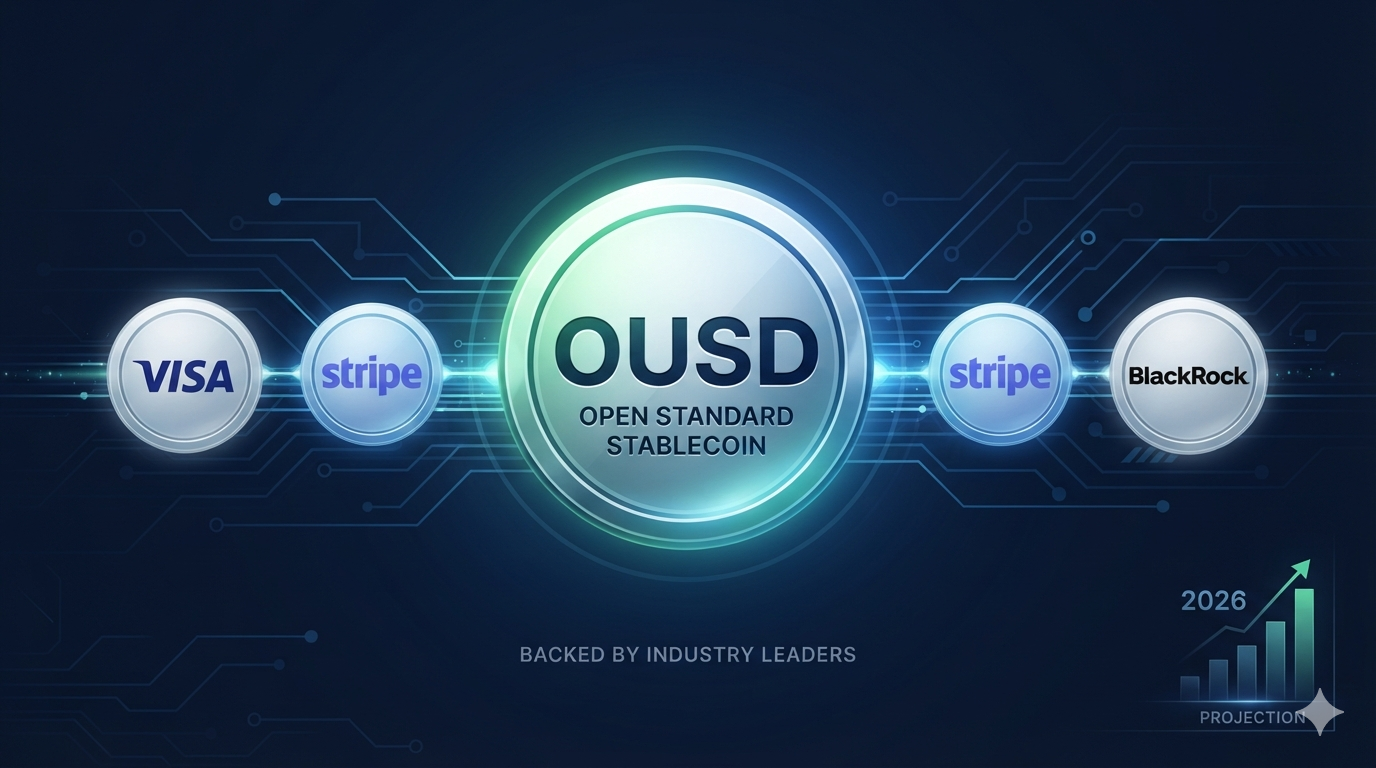
On June 30, 2026, a notable alliance of traditional financial institutions, fintech leaders, and technology corporations gained significant attention in the cryptocurrency industry. A newly formed independent consortium named Open Standard officially unveiled Open USD (OUSD), a next-generation, US dollar-backed stablecoin designed to enhance global payments infrastructure.
Supported by major entities like Visa, Stripe, and BlackRock, Open USD represents a strategic institutional entry into the stablecoin economy, positioned to directly challenge the multi-year dominance of Circle's USDC and Tether's USDT. The announcement of OUSD has brought new competition to the tokenized cash ecosystem, and its projected rollout over the course of 2026 is poised to facilitate a migration of institutional capital. As blockchain technology integrates deeper into mainstream enterprise operations, stablecoins are evolving from simple trading tools into key components of modern financial networks.
Key Takeaways
-
Managed by Open Standard, OUSD is backed by over 140 financial and tech giants, including Visa, Stripe, and BlackRock.
-
OUSD inverts traditional stablecoin models by distributing nearly all Treasury interest yields directly back to its enterprise partners.
-
Unlike Meta’s failed Libra, OUSD complies strictly as a 1:1 USD-pegged payment stablecoin under the U.S. GENIUS Act.
-
The yield-sharing model poses a direct structural threat to Circle's corporate base, causing an initial 17% stock drop.
-
OUSD is scheduled to launch later in 2026, deploying natively across high-performance networks like Solana and Base.
What Is Open USD (OUSD)?
At its core, Open USD (OUSD) is a regulated, 1:1 dollar-backed stablecoin managed by Open Standard, an independent consortium of enterprise entities. Unlike legacy stablecoin issuers operating as single centralized firms, Open Standard functions as a shared, member-owned utility network. The primary objective of Open USD is to mitigate frictionless hurdles, overhead costs, and counterparty risks that have traditionally deterred conservative corporations from adopting digital currencies.
To maintain stability and compliance, every unit of Open USD is fully collateralized by short-term US Treasury bills and liquid cash deposits. This reserve structure enables 24/7 minting and redemption for enterprise participants. The initiative is led by interim CEO Zach Abrams, a prominent figure in Web3 infrastructure who previously co-founded Bridge, the stablecoin payment network acquired by Stripe for $1.1 billion in 2025. Under this leadership, Open USD is structured to bridge institutional finance with global e-commerce rails.
The Alliance Behind Open Standard
What provides Open USD with strong market potential is the scale of its initial participants. Rather than relying solely on organic crypto-native adoption, OUSD aims to enter the market with a collaborative ecosystem comprising over 140 corporations across global payments.
The consortium spans four major sectors, creating an interconnected network framework:
Payment Networks & Fintech: Visa, Stripe, Mastercard, American Express, and Western Union form the initial integration network, exploring ways to align OUSD with modern merchant infrastructure.
Financial Institutions & Banking: BlackRock, BNY, Standard Chartered, BBVA, and DBS are positioned to manage custody, asset services, and banking rails for the underlying reserves. BlackRock’s involvement supports institutional-grade liquidity oversight.
E-Commerce & Technology Platforms: Google, Shopify, and DoorDash offer potential real-world utility by evaluating OUSD integration into consumer applications and digital checkouts.
Crypto Infrastructure Partners: Industry participants including KuCoin, Coinbase, Solana, and Fireblocks provide the blockchain rails, infrastructure, and technical security frameworks required to support token velocity.
To analyze why Open USD poses a competitive challenge to incumbents like Circle and Tether, one must look at its alternative economic model. This mechanism, known in financial circles as 'sharing the float,' alters the incentive structure of the stablecoin industry.
The Established Model of Legacy Issuers
Historically, issuing stablecoins has been an highly profitable business. When market participants acquire large volumes of USDC or USDT, the issuer places those fiat deposits into yield-bearing assets, predominantly short-term US Treasury bills. With global interest rates remaining elevated, these reserves generate significant annualized passive income. Under this established model, the stablecoin issuers retain the interest profit, while the merchants, payment networks, and fintech enterprises driving transactional adoption do not directly participate in the yield.
The Open USD Model: Incentivized Co-Ownership
Open USD proposes a different economic structure. Under the Open Standard framework, nearly all interest income generated by the underlying treasury reserves is distributed back to the partner enterprises that drive the token’s velocity and distribution network. Open Standard intends to retain only a minimal management fee to cover network operations and cryptographic security.
This architecture creates a strong financial incentive. For major digital commerce platforms or payment networks, utilization of legacy stablecoins involves bypassing potential reserve revenue. Conversely, routing volume through Open USD allows these networks to recapture a portion of that annualized yield. By aligning financial incentives with its institutional participants, Open USD introduces a compelling commercial case that challenges traditional single-issuer models.
Technical Architecture: Multi-Chain Deployment and Scalability
From a technical perspective, Open USD is structured to align with the requirements of modern digital commerce, prioritizing transaction throughput, predictable fee structures, and near-instant settlement finality.
Native Deployment Across High-Performance Networks
Open USD is planned to launch natively on selected high-performance networks, with Solana serving as an initial base layer. By utilizing Solana’s parallel processing architecture and lower transaction costs, OUSD is positioned to facilitate high-throughput cryptographic settlement.
Following the initial phase, Open Standard intends to expand native issuance to prominent Ethereum Layer-2 networks, such as Base and Arbitrum, providing developers across Web3 ecosystems with direct access to the stablecoin without the security dependencies of third-party token bridges.
Enterprise Integration Infrastructure
To support enterprise adoption, Open USD incorporates several operational and technical features:
-
Zero-Fee Minting & Redemption Framework: Eligible corporate participants can convert fiat currency to OUSD and vice-versa without protocol-level fees, lowering capital mobility costs.
-
Standardized API Integrations: Utilizing developer frameworks derived from Stripe’s ecosystem infrastructure, companies can integrate OUSD payment capabilities into legacy platforms through streamlined API calls.
-
Institutional Security Management: In collaboration with infrastructure providers like Fireblocks, OUSD leverages Multi-Party Computation (MPC) protocols to enhance key management security and mitigate risks associated with core treasury custody.
For industry observers, the infrastructure of Open USD may draw comparisons to Meta's 2019 Libra (later Diem) initiative, which attempted to leverage a large corporate consortium to launch a digital currency but was ultimately halted by global regulatory opposition.
However, Open USD operates under a fundamentally distinct regulatory and structural design, addressing the specific friction points that led to Libra’s cancellation.
Structural Alignment with the U.S. GENIUS Act
The regulatory landscape for digital assets has evolved significantly since 2019. The passage of the federal GENIUS Act in the United States established the first comprehensive federal framework specifically regulating fiat-referenced payment stablecoins. Open USD has been architected to conform with these updated statutory boundaries. Rather than navigating regulatory ambiguity, Open Standard operates within a defined prudential perimeter, ensuring that its issuance, reserve management, and operational compliance align with federal agency guidelines.
Mitigation of Sovereign Currency and Monetary Risks
A primary factor in Libra's regulatory rejection was its initial design to back the token with a weighted basket of multiple international fiat currencies and sovereign bonds, which central banks perceived as a potential challenge to national monetary sovereignty. Open USD avoids this geopolitical friction by structuring its asset as a strict 1:1, U.S. dollar-denominated payment stablecoin. Rather than attempting to establish an alternative monetary standard, OUSD tokenizes the existing domestic currency, utilizing short-term U.S. Treasuries to support compliance and integration within the traditional financial system.
What This Means for USDC and USDT
The introduction of Open USD has accelerated competition within the digital asset markets, adjusting the expectations for incumbent stablecoin models. Following the disclosure of the Open Standard consortium, Circle’s public equity valuation experienced an initial contraction of up to 17% in a single day, reflecting market repricing of competitive risks within the tokenized dollar sector.
The Competitive Pressures on Circle (USDC)
Circle has established a strong market positioning based on regulatory transparency, making USDC a dominant asset for institutional applications. However, Open USD introduces a direct challenge to Circle’s business model by targeting its corporate user base with the 'shared float' mechanism. Because Circle's primary revenue stream is derived from retaining reserve yields, replicating this revenue-sharing model presents structural earnings challenges. While platforms like Stripe and Shopify provide Open USD with integrated distribution networks, the actual rate of corporate substitution away from USDC will depend on the depth of Circle’s multi-year network integration and on-chain liquidity infrastructure.
The Geopolitical Moat of Tether (USDT)
Tether (USDT) maintains its primary market share within the global crypto-native trading ecosystem, particularly across international jurisdictions and emerging markets. Operating largely outside of domestic U.S. banking structures, Tether remains insulated from immediate operational mandates under the regulatory framework of the GENIUS Act.
Over the longer term, as Open USD implements its institutional-grade compliance and zero-fee redemption features across international venues, it may compete for institutional capital and algorithmic trading desks that prioritize strict federal regulatory clearance; however, USDT's deeply entrenched trading volume and offshore liquidity pairs remain significant barriers to new entrants.
As next-generation assets like Open USD (OUSD) develop their multi-chain roadmaps, market participants are monitoring potential shifts in digital asset liquidity. The introduction of institutional-backed stablecoins may drive shifts in trading volume, creating new arbitrage and hedging opportunities across global crypto markets.
As a global cryptocurrency exchange, KuCoin provides a robust trading and infrastructure environment for managing digital dollar equivalents:
-
Established Stablecoin Liquidity: KuCoin facilitates significant trading volume across mainstream stablecoin pairs, allowing users to efficiently reallocate capital between USDT, USDC, and other compliant assets based on market conditions.
-
KuCoin Earn Integration: Users can optimize asset productivity via KuCoin Earn, which offers access to flexible savings, structured financial alternatives, and lending protocols designed for traditional and emerging stablecoin assets.
-
Automated Trading Architecture: Traders can deploy KuCoin's built-in trading bots and advanced developer APIs to capture market volatility driven by shifting dynamics within the stablecoin economy.
Maintaining operational flexibility on comprehensive platforms like KuCoin ensures that market participants remain equipped to respond to new asset deployments and institutional trends as they materialize.
Conclusion
Open USD (OUSD) represents a significant development in the integration of traditional financial architecture and public blockchain infrastructure. By convening a large corporate framework under the Open Standard consortium and exploring a 'shared float' economic model, the project introduces a competitive approach to current stablecoin issuance.
While legacy assets like Circle's USDC and Tether's USDT have established deep, resilient liquidity within crypto-native markets and institutional applications over the last decade, Open USD enters the landscape with strategic alignments across global payments networks and digital commerce infrastructures. As the market progresses throughout 2026, competition within the tokenized fiat sector is expected to accelerate, potentially driving further regulatory clarity and corporate capital deployment into the Web3 ecosystem.
FAQs
What is the core economic difference between Open USD (OUSD) and legacy stablecoins?
Unlike Circle and Tether, which retain 100% of the interest earned on reserve assets, Open USD introduces a "shared float" model that distributes nearly all Treasury reserve yields back to the enterprises driving the token's distribution and usage.
Is Open USD (OUSD) currently available for retail trading or staking on exchanges?
No. While its infrastructure is being actively covered by research venues, OUSD is currently in its pre-deployment phase. Official exchange listings, spot trading pairs, and retail financial products are expected to roll out later in 2026.
How does Open USD avoid the regulatory issues that shut down Meta's Libra?
Libra attempted to create an alternative global currency backed by a basket of international fiats. OUSD avoids this by structuring itself as a strict 1:1 U.S. dollar-pegged asset fully compliant with the federal GENIUS Act framework.
Will Open USD completely replace Circle's USDC in mainstream e-commerce?
Unlikely in the short term. While OUSD has built-in distribution via Stripe and Shopify, USDC possesses a multi-year head start with deep, institutional-grade on-chain liquidity networks that present a significant competitive barrier to new entrants.
Does multi-chain deployment mean OUSD liquidity will be fragmented?
Initially, yes. Native issuance on Solana and Layer-2s like Base avoids bridge vulnerabilities, but naturally splits liquidity. The network's maturity will depend on how effectively institutional market makers pool order books across different chains.
Disclaimer
The information provided on this page may originate from third-party sources and does not necessarily represent the views or opinions of KuCoin. This content is intended solely for general informational purposes and should not be considered financial, investment, or professional advice. KuCoin does not guarantee the accuracy, completeness, or reliability of the information, and is not responsible for any errors, omissions, or outcomes resulting from its use. Investing in digital assets carries inherent risks. Please carefully evaluate your risk tolerance and financial situation before making any investment decisions. For further details, please consult KuCoin’s Terms of Use and Risk Disclosure.