

What Is MemeFi? Why Traders Pair Memecoins With Tokenized Stocks
Introduction
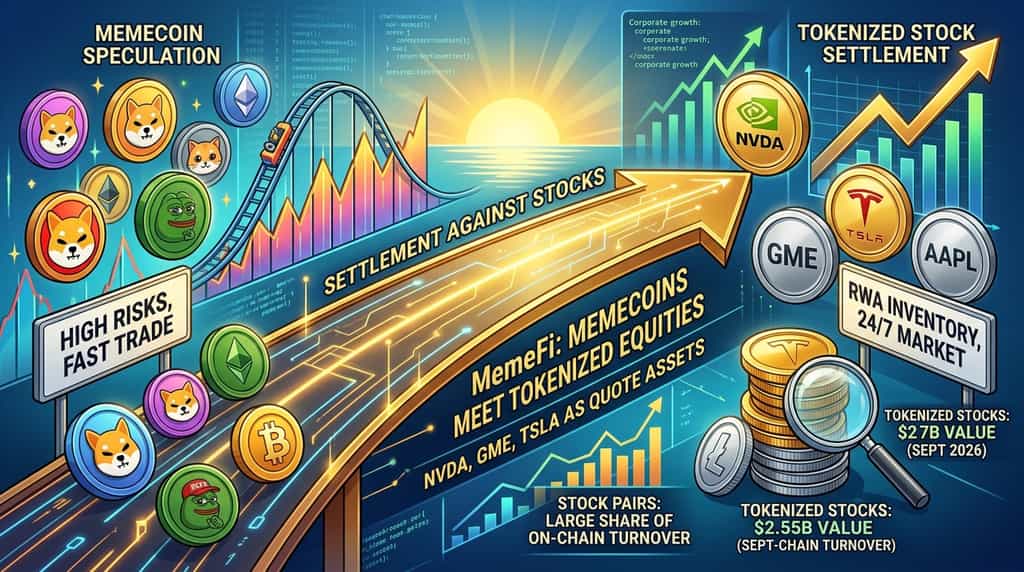
Can a joke coin settle against NVIDIA instead of a stablecoin? That is the trade now running across launchpads and DEX pools. MemeFi is the practice of pairing memecoins with tokenized stocks so the equity token — not USDT or SOL — becomes the quote asset. Buying the meme requires depositing the stock token. Selling it returns the stock token. The meme’s dollar price then depends on both the pool ratio and the underlying share price.
Traders use the structure for 24/7 speculation, after-hours gaps, and liquidity-farming fees. According to CoinMarketCap data cited in early September 2026, the tokenized stock market held about $2.55 billion in value with more than one million holders. Bitquery research dated September 10, 2026 found that meme-and-stock pairs already accounted for a large share of that on-chain turnover.
What Is MemeFi and How Does a Stock-Paired Memecoin Work?
MemeFi is a market structure, not a single token. A memecoin trades in an automated market maker against a tokenized equity such as NVDA, GME, TSLA, or AAPL. The stock token is the settlement asset. If you buy the meme, you pay with the stock token. If you sell the meme, you receive the stock token.
The dollar price of the meme therefore has two moving parts. First is the pool ratio between the meme and the stock token. Second is the market price of the tokenized stock itself. If tokenized NVIDIA rises and the AI/NVDA ratio stays flat, the meme’s dollar value still rises. That dual beta is the core product.
The same mechanic pulls stock tokens into AMM reserves. Each buy of the meme locks more equity tokens in the pool. With limited on-chain float, large MEME/STOCK pools can absorb a material share of available supply. Pool-level readings around September 1, 2026 showed that paired markets held a sizable slice of several stock-token floats, including NVIDIA-linked tokens.
This is different from a stock-themed ticker that still quotes in USDC. Theme alone does not create inventory demand for the equity token. Settlement against the stock token does.
Why Are Traders Pairing Memecoins With Tokenized Stocks?
Traders pair the two assets because the structure creates demand for stock tokens, extra volatility after cash markets close, and fee income for liquidity providers.
Tokenized equities already trade when Nasdaq and NYSE are shut. CoinGecko volume on the largest tokenized names showed about $1.01 billion of weekend turnover across a Labor Day weekend in early September 2026, nearly matching a Friday session. Meme pairs amplify that after-hours tape. When the cash market is closed, the stock token can gap in the pool even if the listed share has not printed a new official close.
The second reason is forced inventory. A trader who wants the meme must first hold or acquire the quote stock. That flow can move tokens into wallets and pools that would otherwise sit idle. Bitquery’s September 10, 2026 on-chain review of five launchpads found $5.97 billion traded across 148,782 coins in 31 days, with meme pairs representing 38.5% of tokenized stock volume in that sample.
The third reason is narrative leverage. GameStop-style attention already lives in crypto culture. Pairing a meme with GME, AMC, NVDA, or HIMS attaches that attention to an asset that also tracks a listed company. The result is a two-sided bet: company news plus meme flow.
Launchpads followed the demand. Pump.fun announced Custom Pairs on September 9, 2026, allowing new tokens to quote against tokenized stocks, majors, and metals through partners such as xStocks and Sunrise. Raydium LaunchLab opened similar quote-asset choice days earlier. Robinhood Chain and BNB Chain already hosted deep MEME/STOCK books.
How Do MemeFi Pools Change the Price of Tokenized Stocks?
Large meme pools can tighten available float and push the on-chain stock token away from the cash-market print.
When buyers keep purchasing the meme with the equity token, reserves of that token rise inside the AMM. If issuance is capped or redemption is slow, the remaining free float shrinks. Early-September pool data showed multi-name concentration: NVIDIA-linked pairs absorbed roughly a quarter of that token’s on-chain supply in one snapshot, while some smaller names had even higher shares locked in a single meme pool.
The price impact shows up most after the U.S. cash session. One widely cited example on Robinhood Chain saw an AMC-linked token jump from about $2.5 to $18 after the listed market closed, opening a wide gap versus the underlying share. Gaps can close when traditional markets reopen and arbitrage or issuer redemption returns. They can also persist if liquidity is thin or redemptions are restricted.
Issuers and venues do not all behave the same. According to CoinMarketCap figures reported for the week before September 10, 2026, bStocks held about 26% of tokenized-stock value but produced about 88% of on-chain trading volume, while Ondo held a larger share of value with much lower turnover. High-turnover venues are where meme pairs can move the tokenized print fastest.
Traders should treat the stock token as a separate instrument. It may track the listed share closely during U.S. hours and diverge overnight, on weekends, and around meme-driven squeezes.
Which Chains and Platforms Host MemeFi Markets?
MemeFi liquidity is concentrated on a few venues rather than spread evenly across every RWA issuer.
Robinhood Chain popularized stock-quoted memes after its mid-2026 mainnet. Incrypted reporting on September 9, 2026 put one day’s meme-and-stock volume on that chain at $217 million — more than trading in the RWA tokens themselves on the same day. Names such as Artificial Inu quoted against tokenized NVIDIA became the template.
BNB Chain hosts bStocks and launchpad pairs that treat U.S. names as quote assets. Solana added the same design through xStocks, Sunrise, Backpack Securities issuance, and Pump.fun Custom Pairs. Ethereum and other L2s hold large tokenized books, but meme-pair volume has been louder on the chains that made custom quote assets a default launch feature.
Asortino’s tokenized stocks and ETF dashboard updated September 10, 2026 put the combined tokenized stocks-and-ETFs market near $2.99 billion across 18 chains, with BNB Chain, Ethereum, and Solana as the largest venues. That is the inventory layer. MemeFi is the speculative layer sitting on top of it.
Not every tokenized stock is a good quote asset. Depth, redemption rules, oracle quality, and weekend spreads differ by issuer. A liquid NVDA or SPY-style token behaves differently from a thin small-cap name with little redeemable float.
What Risks Come With Pairing Memecoins and Tokenized Equities?
The main risks are gap risk, inventory lock, issuer and legal risk, and the usual memecoin failure rate.
Gap risk is first. The meme’s dollar price can move because the stock token moved, because the pool ratio moved, or because both moved at once. After-hours spikes can reverse when cash markets open. A position that looks profitable in USD overnight can shrink when the stock token mean-reverts.
Inventory lock is second. Stock tokens sitting in a meme pool are not sitting in a lending market or a redeemable vault. If a large share of float is trapped in one pair, exiting either side can become expensive. Thin names are worse. A pool that holds half of a small tokenized float can dictate the on-chain price.
Issuer and legal risk is third. Tokenized stocks are not always direct legal shares. Rights to dividends, voting, and redemption depend on the issuer, the wrapper, and the user’s jurisdiction. A meme pair does not upgrade those rights. It only changes how the wrapper is used.
Memecoin risk remains last and largest. Bitquery’s 31-day sample showed most buyers did not finish ahead, and wallets that sold coins they never bought extracted hundreds of millions of dollars. Pairing against NVIDIA does not make the joke coin a claim on NVIDIA cash flows.
Smart-contract, bridge, and oracle risk apply on every chain that lists these pairs. Custom quote assets add routing complexity: many interfaces buy the stock token in the background before they fill the meme trade.
Beyond the Headlines: What KuCoin 5.0 Means for You
Market news moves fast — but where you act on it matters just as much. This October, KuCoin launches KuCoin 5.0, transforming KuCoin into a rebuilt platform. Here's what actually changes for you:
-
One account for everything. Older platforms split your money across separate "spot," "margin," and "futures" accounts and expected you to understand why. KuCoin 5.0's unified account removes that entirely — deposit once, and everything is simply there.
-
Stocks, indices, and commodities. KuCoin 5.0 expands beyond crypto into global markets. When crypto chops sideways and equities rally (or the reverse), you rotate in minutes instead of opening a brokerage account and waiting days for fiat rails.
-
Real-world assets (RWA). Tokenized exposure to traditional assets like commodities, right inside your crypto account. One of the fastest-growing segments in global finance is no longer reserved for institutions — you access it from the same balance you trade with.
-
Earn while you learn. Not ready to trade? KCUSD lets your stablecoins earn daily, auto-compounding interest. The lowest-stress way to put your idle deposit to work for 4% yield.
-
An AI assistant in plain language. Ask questions, get market context, understand what you're looking at — built into the platform, no jargon required.
-
An app that doesn't overwhelm. Faster, cleaner, and consistent — intuitive from the first tap, not after a tutorial.
-
Safety you can check, not just trust. A MiCAR-licensed EU entity, Proof of Reserves you can verify yourself, and internationally certified security (SOC 2 Type II, ISO 27001:2022).
Create your account in minutes — and start on the platform built for where crypto is going, not where it's been.
Conclusion
MemeFi pairs a memecoin with a tokenized stock so the equity token becomes the quote asset. The meme’s dollar price then tracks both pool flow and the stock token. That design creates demand for on-chain equities, after-hours volatility, and fee opportunities for liquidity providers.
The market is no longer a one-off experiment. CoinMarketCap put tokenized-stock value near $2.55 billion in early September 2026, with more than one million holders. Bitquery measured billions of dollars of meme-pair turnover in a single month. Pump.fun, Raydium, Robinhood Chain, and BNB Chain all opened custom stock quotes.
The same structure concentrates float, widens weekend gaps, and leaves most meme buyers underwater. Tokenized NVIDIA in a pool is not a shareholder claim. It is inventory for a speculative pair.
Traders who engage should separate three prices, size for gaps, and use liquid venues such as KuCoin for the assets they can actually exit. MemeFi explains why stocks and memes now share an order book. It does not remove the need to treat each side as a distinct risk.
FAQs
Does a stock-paired memecoin give you shareholder rights?
No. The meme is a separate token. Any economic rights attach only to the tokenized-stock wrapper, and those rights depend on the issuer and your jurisdiction.
Why can a tokenized stock trade far from the listed share after hours?
Cash markets are closed, so the on-chain token is priced by pool inventory and overnight flow. Weekend and holiday sessions can print large gaps until the listed market reopens.
Is MemeFi the same as an RWA token?
No. An RWA token represents a wrapped real-world asset. MemeFi is a trading design that uses that wrapper as the quote asset for a memecoin.
Can liquidity providers earn fees in the stock token?
Yes, in pools and launchpads that pay fees in the quote asset. Those fees arrive in the tokenized stock, which still carries price, gap, and issuer risk.
Do most traders profit from new stock-quoted memes?
Available launchpad data does not support that. Bitquery’s September 2026 sample of five launchpads found that only a minority of buyers finished ahead over a 31-day window.
Disclaimer: This article is for informational purposes only and does not constitute financial, legal, or investment advice. Always conduct your own research before interacting with digital assets.