

The Hidden Price of Simplicity: Risks and Costs of Crypto ETFs in 2026
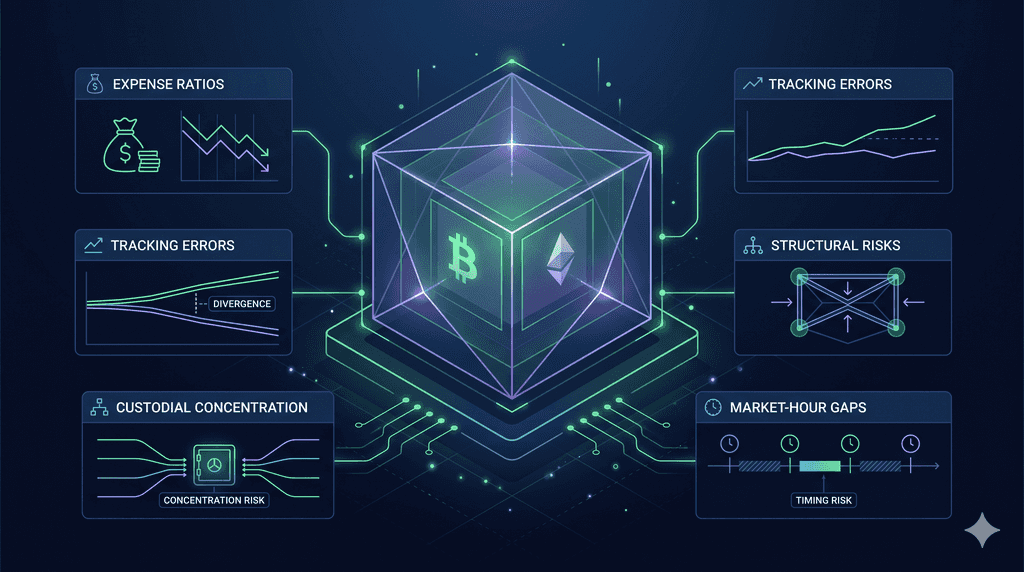
The rapid growth of the cryptocurrency ETF market has successfully bridged the gap between traditional finance and digital assets. By April 2026, the advancement of the CLARITY Act has signaled a near-certain legal framework for these investment vehicles, positioning them as a staple in retirement accounts and institutional portfolios. However, the convenience of a brokerage-wrapped asset comes with specific financial and structural trade-offs that are often overlooked during periods of market enthusiasm.
While these products offer a simplified entry point, they introduce a layer of intermediation that carries its own set of burdens. Investors are essentially paying for a service, custody, compliance, and reporting, and that service has a price that extends beyond the visible expense ratio.
To make an informed decision in the current high-interest environment, it is essential to evaluate the Total Cost of Ownership and the inherent structural vulnerabilities of the ETF wrapper compared to direct asset ownership.
Key Takeaways
-
Compounding Fee Drag: Annual management fees between 0.12% and 0.25% erode total returns over time, costing thousands in potential gains compared to zero-fee self-custody.
-
The Staking Gap: Liquid reserve requirements force ETFs to keep 20-30% of assets unproductive, meaning investors miss a significant portion of native staking rewards.
-
Market-Hour Exposure: ETFs only trade during traditional banking hours. This gap prevents investors from reacting to weekend price swings or geopolitical shocks.
-
Custodial Concentration: A few institutional giants hold the majority of ETF assets. This creates a single point of failure where one security breach affects the entire market.
-
Zero On-Chain Utility: ETF shares are strictly for price exposure. You cannot use them to participate in governance, claim airdrops, or interact with decentralized applications.
Expense Ratios and the Compounding Drag
The early wave of crypto ETF competition has resulted in a permanent race to the bottom for management fees. By April 2026, the industry has standardized expense ratios between 0.12% and 0.25% for major spot Bitcoin and Ethereum products. While these figures appear negligible compared to the 1.5% to 2% fees seen in early 2024, the mathematical reality of compounding ensures that even these smaller costs act as a persistent drag on long-term wealth.
The Race to the Bottom
The 2026 fee landscape is dominated by heavyweights like the Grayscale Bitcoin Mini Trust (0.15%) and Morgan Stanley’s MSBT (0.14%), which have forced competitors like BlackRock and Fidelity to keep their rates capped at 0.25%. Under the CLARITY Act, these fees must be transparently disclosed, yet many investors overlook the Simplicity Tax they are paying for the convenience of a brokerage account. In a market where Bitcoin is trading at six figures, a 0.25% fee translates to hundreds of dollars per year per coin, deducted regardless of whether the market moves up or down.
Compounding Erosion Over Time
The real danger of an expense ratio lies in its ability to reduce the principal available for future growth. Consider a $100,000 investment in a Bitcoin ETF with a 0.25% fee. Over a ten-year period, assuming no price appreciation, you would pay $2,500 in management fees.
However, when you factor in the historical growth rates of digital assets, that $2,500 is capital that never had the chance to compound. If that same $100,000 were held in a self-custody wallet, every dollar of growth would remain in your portfolio. Over several decades, this minor fee can result in a final balance that is significantly lower than a direct ownership model.
The Passive Management Trade-Off
For many, the annual fee is a justifiable expense for the removal of technical risk. The custodian handles the complex security requirements of the GENIUS Act, provides institutional-grade cold storage, and issues a clean 1099-B for tax season. However, for the long-term HODLer, this passive convenience creates a structural disadvantage. In the 2026 economy, where energy costs and inflation are rising, every basis point of yield matters. Moving from an ETF to direct ownership is often viewed as a "graduation" step for investors who want to eliminate this persistent drag on their performance.
The Staking Gap: Ethereum ETF’s Hidden Cost?
The introduction of staking-integrated Ethereum ETFs in early 2026 was hailed as a breakthrough for passive income. However, for investors focused on maximizing returns, these products carry a significant hidden cost known as the Staking Gap. This gap is the spread between the rewards generated by the Ethereum network and the actual yield that reaches an ETF holder’s account. In April 2026, this difference often represents a 20% to 40% reduction in potential income compared to holding and staking the asset directly.
The Liquidity Buffer Requirement
The primary driver of the Staking Gap is the need for immediate liquidity. Ethereum requires an unbonding period for staked assets, which can range from 9 to 50 days depending on network congestion. Because an ETF must be able to fulfill daily redemption orders from shareholders, it cannot lock 100% of its Ethereum in the consensus layer.
Current filings for products like BlackRock's ETHB and Grayscale’s ETHE show that these funds typically only stake between 70% and 90% of their total holdings. The remaining portion stays in liquid cold storage, acting as a non-productive cash-like buffer. This means that even if the Ethereum network is paying a 3.3% gross yield, the fund as a whole only generates rewards on a portion of its assets, automatically diluting the effective yield for every shareholder.
Tiered Fee Structures
Management fees are only the first layer of cost in a staking-enabled ETF. Beyond the standard 0.15% to 0.25% sponsor fee, these products often include a separate Staking Fee to cover the costs of validator operations and institutional custody.
The "Gross-to-Net" Spread: Major issuers typically take a 15% to 20% cut of the gross staking rewards before they are distributed.
Cash vs. Asset Distributions: Some ETFs sell their earned ETH for US dollars to distribute cash dividends. This process incurs additional slippage and transaction costs, further widening the gap compared to a native staker who earns and compounds in ETH directly.
Yield Comparison: Native vs. ETF
| Metric | Native Staking (Direct) | Staking-Integrated ETF |
| Gross Network Yield | ~3.1% – 3.3% | ~3.1% – 3.3% |
| Asset Utilization | 100% Staked | 70% – 90% Staked |
| Staking/Sponsor Fee | ~0.0% – 0.1% (Pool Fee) | ~0.25% + 18% of Rewards |
| Final Net Yield | ~3.1% – 3.2% | ~1.9% – 2.5% |
The result is a structural disadvantage for the buy-and-hold investor. While the ETF wrapper offers institutional-grade safety and simpler tax reporting, it essentially charges a premium that strips away a large portion of the blockchain’s native productivity. For those with a long-term horizon, the cumulative loss of these rewards can be just as damaging as the price volatility itself.
Structural Risks: Liquidity Gaps and Tracking Error
One of the most persistent risks in the 2026 market is the friction between a 24/7 global asset and a five-day-a-week financial wrapper. While digital assets never stop trading, the institutional capital that supports ETFs increasingly punches a 9-to-5 timecard. This mismatch creates structural vulnerabilities that can leave ETF investors exposed during the most critical moments of price discovery.
The Weekend Gap and Geopolitical Shocks
The Weekend Gap is no longer a theoretical concern but a recurring source of volatility. In 2026, data from BridgePort indicates that when New York desks close on Friday afternoon, displayed liquidity in the crypto market drops by over 5%, and trading spreads widen by an average of 11%.
The Saturday Trap: If a significant geopolitical event occurs on a Saturday, such as the recent tensions in the Strait of Hormuz, ETF holders are functionally paralyzed. They must watch the spot price react in real-time on global exchanges like KuCoin while their brokerage positions remain frozen until Monday morning.
The Monday Catch-up: This lead to the Monday Gap effect, where ETFs aggressively re-price the moment US liquidity providers log back in. This often results in "slippage" where the opening price is significantly worse than the weekend’s average, preventing investors from exiting at favorable levels.
Tracking Error: The Delta Between NAV and Spot
Tracking error occurs when the price of an ETF share deviates from the actual Net Asset Value (NAV) of the underlying Bitcoin or Ethereum. In 2026, this is frequently caused by traditional settlement frictions.
Settlement Clocks: Unlike the near-instant finality of the blockchain, ETFs operate on a legacy clearing clock. Research from IDEAS/RePEc shows that failures-to-deliver (FTDs) in the ETF market act as a buffer that delays price parity. This means your ETF might not reflect a 5% surge in Bitcoin’s price immediately, especially during periods of high lending constraints.
Premium and Discount Volatility: During extreme market stress, like the Nomura-predicted currency shifts of early Q2, the gap between an ETF's market price and its underlying assets can widen. Investors might find themselves buying at a premium during a rally or, more dangerously, selling at a discount during a panic.
By opting for the ETF wrapper, you are essentially trading agility for administration. In a stable market, this trade-off is often invisible. However, in the 2026 landscape of rapid energy shifts and macro-uncertainty, the safety of a regulated fund can quickly become a liquidity trap when the underlying market refuses to wait for the opening bell.
Systemic Risks: The Custodial Concentration Problem?
The defining irony of the 2026 digital asset market is that assets built for decentralization are now overwhelmingly stored in a handful of centralized vaults. While the CLARITY Act has established the most robust security standards in financial history, it has inadvertently encouraged a flight to quality that has concentrated the majority of ETF-held Bitcoin and Ethereum into just three or four institutional hubs. This concentration creates a systemic vulnerability that regulators and investors alike are beginning to view as a single point of failure.
The Golden Key Monopoly
By April 2026, the custodial landscape has reached a state of extreme consolidation. Data from recent SEC filings indicates that BNY Mellon now commands an 83% market share in US spot crypto ETP administration, while Coinbase Custody remains the primary guardian for over 80% of the leading Bitcoin and Ethereum ETFs.
When a single entity holds the Golden Keys for hundreds of billions of dollars in assets across dozens of different fund providers, the risk of a security breach or operational failure becomes systemic. A compromise at one of these mega-custodians wouldn't just affect one fund, it could trigger a liquidity freeze across the entire ETF ecosystem.
Under the CLARITY Act, the government has the authority to freeze assets during periods of national economic emergency. Because these assets are held in a centralized, regulated environment, ETF shares are far easier to "lock down" than self-custodied assets. This creates a policy risk that most institutional investors are only now beginning to model.
Counterparty Fragility in the 2026 Macro Environment
As the energy crisis and Nomura’s inflation warnings continue to stress the banking sector, the financial health of the custodian itself becomes a factor. In previous cycles, investors only worried about the price of Bitcoin; in 2026, ETF investors must also worry about the solvency and operational resilience of their custodian.
Although SEC-mandated coverage standards require crime and theft insurance, these policies often have caps. In the event of a $10 billion systemic breach, the insurance pool might only cover a fraction of the total loss, leaving shareholders as unsecured creditors in a complex legal battle.
Despite the presence of SOC2 Type II audits, the black box nature of institutional cold storage means that shareholders have no way to verify on-chain that their specific assets are not being "rehypothecated" or used in complex lending schemes behind the scenes.
"The true cost of the ETF model isn't the 0.2% fee, it’s the surrender of the blockchain's primary innovation: the removal of the middleman. In 2026, the middleman has returned, and he has grown larger than ever before." — Institutional Digital Asset Report, Q2 2026
By choosing the ETF route, investors are betting on the stability of the traditional financial system to protect their digital wealth. In a stable environment, this is a winning bet. However, in a world of geopolitical supply shocks and currency devaluations, the concentration of so much digital power in so few hands represents the most significant structural risk of the current cycle.
Comparison Table: Total Cost of Ownership
| Cost/Risk Factor | Spot Crypto ETF (2026) | Direct Ownership (Self-Custody) |
| Annual Expense Ratio | 0.12% – 0.25% | 0.00% ($0) |
| Yield Capture (ETH) | ~2.1% – 2.6% (Diluted) | ~3.8% – 4.2% (Full) |
| Opportunity Cost (Yield) | ~$1,500 – $2,000 missed per year | $0 (Maximized productivity) |
| Transaction Fees | Brokerage commission/spreads | Network gas and exchange fees |
| Tax Compliance | Automated 1099-B | GENIUS Act tracking |
| Security Costs | Included in management fee | One-time hardware wallet/MPC cost |
| Trading Availability | Limited (6.5 hours/day) | Full (24/7/365) |
Breaking Down the Economic Gap
The data reveals a stark difference in capital efficiency. For a passive Bitcoin holder, the ETF is a relatively low-cost vehicle, with the primary expense being the annual management fee. However, for an Ethereum investor, the Staking Gap creates a massive drag. Missing out on nearly 2% of annual yield due to fund liquidity requirements means that over a five-year period, an ETF holder could effectively lose 10% of their potential total return compared to a direct staker.
The Convenience Premium
The primary reason investors accept these higher costs is the reduction of administrative friction. Under the current GENIUS Act guidelines, direct owners must meticulously document every on-chain move to satisfy IRS forensic requirements. An ETF investor avoids this entirely, receiving a single, consolidated tax form. Many high-net-worth individuals view the Yield Gap not as a loss, but as an insurance premium paid to avoid the complexities of digital asset tax reporting and personal security management.
Liquidity vs. Sovereignty
Accessibility also plays a role in the TCO. While an ETF is easy to buy within a retirement account, its limited trading hours can lead to slippage costs during weekend volatility. A direct owner can move assets to an exchange at 2:00 AM on a Sunday to react to a market-moving event, whereas an ETF investor is forced to wait for the Monday morning Gap Open, which often results in a significantly worse execution price.
Mitigating ETF Risks through KuCoin Strategic Tools
Hedging Weekend Volatility with Futures
Geopolitical events and energy supply shifts do not pause for the weekend. When the NYSE and NASDAQ are closed, ETF investors are unable to adjust their positions.
Using KuCoin Futures, you can open a short position in Hedge Mode to protect your ETF holdings against a Saturday or Sunday price drop. This allows you to lock in a price level without needing to sell your long-term brokerage assets.
Bridging the Staking Gap via KuCoin Earn
As established in earlier sections, Ethereum ETFs often underperform the native network yield due to liquidity reserve requirements.
KuCoin Earn provides a direct path to capture the full 4.2% Ethereum dividend. Unlike an ETF, KuCoin does not require a 30% liquid buffer, meaning every token you deposit works to its full potential.
For those concerned about Nomura-predicted volatility, this structured product offers principal protection. You can earn a yield that exceeds the "diluted" ETF rate while keeping your initial investment safe from extreme price floor breaches.
Conclusion
The institutional adoption of cryptocurrency via ETFs has streamlined access for millions, yet this convenience is far from free. The true cost of an ETF manifests in the rewards you forgo and the strategic trades you cannot execute during a weekend market shift. While the ETF model offers a shield against technical complexities and regulatory ambiguity, it imposes a structural barrier between the investor and the underlying asset's full potential.
Navigating the current digital economy requires a clear-eyed assessment of these trade-offs. Successful participants must weigh the Simplicity Tax of the ETF against the Responsibility Premium of direct ownership. By integrating institutional wrappers for long-term stability with active management tools on platforms like KuCoin for high-performance utility, investors can build a resilient portfolio that captures the best of both financial worlds.
FAQs
Is a Bitcoin ETF safer than a hardware wallet in 2026?
It is safer from user error like losing a seed phrase, but it is more vulnerable to institutional failures and regulatory freezes.
Why do I earn less interest in an Ethereum ETF?
The ETF must keep roughly 20-30% of its ETH liquid to handle daily sell orders, meaning that portion cannot be staked to earn rewards.
What is Tracking Error in a crypto ETF?
Tracking error occurs when the price of the ETF shares deviates from the actual value of the Bitcoin or Ethereum held in the vault, often due to fees or liquidity issues during market opens.
Can I get liquidated in a Spot ETF?
No, a Spot ETF is not a leveraged product. However, your brokerage account may have its own margin rules if you use borrowed funds to buy the ETF.
How does the GENIUS Act affect ETF taxes?
The GENIUS Act requires strict reporting for all digital assets. ETFs make this easier because the brokerage handles the 1099-B, whereas direct owners must track every on-chain move themselves.
Disclaimer:This content is for informational purposes only and does not constitute investment advice. Cryptocurrency investments carry risk. Please do your own research (DYOR).