

PMI Index: How It Shapes the Macro Economy and Why Markets Watch It Closely
A single economic release can shift expectations for growth, inflation, interest rates, and financial markets within minutes. One of the clearest examples is the PMI index. Short for Purchasing Managers’ Index, PMI is one of the fastest and most widely followed indicators of business activity in the global economy.
Economists use it to gauge whether expansion is gaining traction or losing momentum. Central banks watch it for clues about inflation pressure and demand conditions. Investors use it to reprice stocks, bonds, currencies, commodities, and other risk assets. Even the crypto market often reacts when PMI readings materially change the outlook for rates, liquidity, and risk appetite.
By the end of this article, you will understand what the PMI index measures, how it is constructed, why it matters so much in macroeconomics, and how far-reaching its impact can be across the broader economy. You will also see why PMI is powerful, where its limits begin, and how to interpret it with more context instead of treating it as a standalone signal.
Hook
How can a short monthly survey of purchasing managers move global markets and reshape the conversation around the economy? Because those managers often see turning points before official data does.
Overview
This article covers the meaning of the PMI index, the way PMI surveys work, the difference between manufacturing and services PMI, and the reason the 50 level matters. It then explains how PMI affects GDP expectations, employment, inflation, monetary policy, investor sentiment, and liquidity-sensitive assets such as cryptocurrency. Finally, it looks at the benefits of PMI, the common mistakes people make when reading it, and the challenges that come with relying on survey-based data.
Thesis
The PMI index is one of the most valuable early indicators in macroeconomics because it connects real business conditions to broader trends in growth, inflation, employment, central bank policy, and market pricing.
Introduction to the PMI Index
What the PMI Index Means in Economic Analysis
The PMI index, or Purchasing Managers’ Index, is a monthly survey-based indicator that tracks whether business conditions are improving, staying the same, or deteriorating compared with the previous month. The survey is usually sent to purchasing managers and supply chain executives because they sit close to the front line of business activity. They see incoming orders, supplier bottlenecks, production plans, staffing needs, and inventory changes before many of those shifts show up in official economic reports.
PMI is commonly published in three forms:
-
Manufacturing PMI
-
Services PMI
-
Composite PMI, which combines both manufacturing and services
The headline reading is centered on a simple benchmark:
-
Above 50 indicates expansion
-
Below 50 indicates contraction
-
Exactly 50 indicates little or no change
That threshold makes PMI easy to read, but the real value is in what sits underneath the number. A PMI survey usually asks whether conditions have improved, stayed the same, or worsened in areas such as:
-
new orders
-
output or production
-
employment
-
supplier delivery times
-
inventories
-
input prices
-
output prices in some versions
The responses are converted into a diffusion index. That means PMI does not measure exact output or revenue. Instead, it measures how widespread improvement or deterioration is across surveyed firms. This is why PMI is best understood as a momentum indicator rather than a full accounting of the economy.
What makes PMI so influential is timing. Official data such as GDP is released later and revised over time. PMI arrives faster and often captures turning points earlier. That speed gives it real power in macro analysis.
Understanding the PMI 50 Level and Market Momentum
The 50 level is the most important reference point in the PMI index because it gives a quick snapshot of whether business activity is expanding or contracting. A reading above 50 generally signals growth in business conditions compared with the previous month, while a reading below 50 points to contraction. A reading of exactly 50 suggests little to no change.
That simple threshold is one reason PMI is so widely followed by economists, investors, and policymakers. It offers an immediate sense of whether the economy is gaining momentum or losing steam. Still, the headline number alone does not tell the full story. The direction of movement matters just as much as the level itself.
For example:
-
A move from 52 to 55 suggests expansion is strengthening
-
A move from 58 to 53 still indicates expansion, but at a slower pace
-
A rise from 45 to 48 still reflects contraction, though the pace of decline is easing
-
A fall from 50 to 47 may point to a meaningful loss of momentum
This is why PMI is often interpreted as both a level indicator and a momentum indicator. Markets do not just look at whether the reading is above or below 50. They also pay attention to whether the index is rising or falling, whether it beats or misses expectations, and whether the underlying components are improving or weakening.
The chart below uses recent US Manufacturing PMI data to show how readings move around the 50 threshold, which separates expansion from contraction in economic activity.
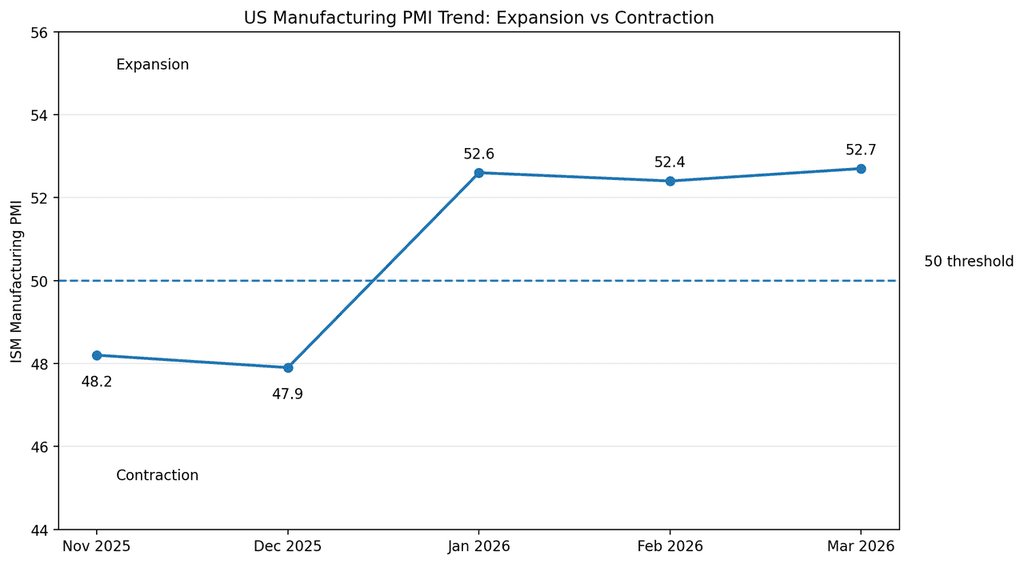
Recent US Manufacturing PMI data shows readings below 50 signal contraction, while readings above 50 indicate expansion.
The most useful way to read PMI is in context. A single monthly reading can be informative, but a trend over several months is usually more meaningful. When PMI moves steadily higher, it can suggest improving demand, stronger production, and healthier business sentiment. When it trends lower, it may indicate softer orders, slower activity, and growing caution among firms.
Manufacturing PMI vs Services PMI
Manufacturing PMI tends to get a lot of attention because manufacturing is cyclical and often reacts quickly to changes in demand, trade, and inventory conditions. It can be especially useful during turning points in the business cycle.
Service PMI is often just as important, and in many modern economies it can matter more. Service sectors usually account for a larger share of employment and output. In a service-led economy, a weak manufacturing reading does not always mean the whole economy is in trouble if the services side remains resilient.
This is why composite PMI can be a useful broader measure. It blends signals from manufacturing and services to create a more balanced view of business activity across the economy.
Impact of the PMI Index on the Macro Economy and Cryptocurrency
How PMI Influences Growth, Inflation, Rates, and Market Sentiment
The influence of PMI on the macro economy is broad, even though the impact is mostly indirect. PMI does not create economic expansion or contraction on its own. What it does is shape expectations. Those expectations then influence policymaking, investment decisions, corporate behavior, and market pricing.
PMI and Economic Growth
PMI is widely used as a near-term gauge of growth momentum. If businesses report stronger new orders, rising output, and improving activity, analysts often infer that GDP growth may be accelerating. If firms report weaker orders, lower production, and falling activity, that can signal a slowing economy.
This matters because growth expectations drive a huge part of macro analysis. Equity markets care because stronger growth may support revenue and earnings. Credit markets care because slower growth may weaken borrowers. Policymakers care because growth affects labor demand, tax revenues, financial stability, and confidence.
In many cases, PMI acts as an early warning system. Persistent weakness in new orders, for example, can foreshadow softer production and weaker investment later on.
PMI and the Labor Market
Employment decisions usually lag demand conditions, but not by much. If firms see a fuller pipeline of orders and stronger business activity, they are more likely to hire. If they see weakening demand and thinner margins, they may slow hiring or cut staff.
That is why the employment component inside PMI surveys can be useful. It often gives an early signal about labor market conditions before official payroll data catches up. It does not replace hard employment statistics, but it adds context around what businesses are likely to do next.
PMI and Inflation Pressure
PMI is also closely watched for inflation signals. Many PMI surveys include data on input costs, selling prices, and supplier delivery times. These components can tell markets whether inflation pressure is building inside the business sector.
This is one reason bond markets respond to PMI. Investors try to infer whether stronger activity means hotter inflation and higher rates, or whether weaker activity increases the odds of disinflation and easier policy.
PMI and Central Bank Expectations
Central banks do not base decisions on PMI alone, but they pay close attention to it because it arrives early and covers a wide range of business conditions. If PMI shows robust activity, persistent price pressures, and supply constraints, policymakers may see less urgency to ease monetary policy. If PMI weakens and pricing pressure fades, the case for lower rates can strengthen.
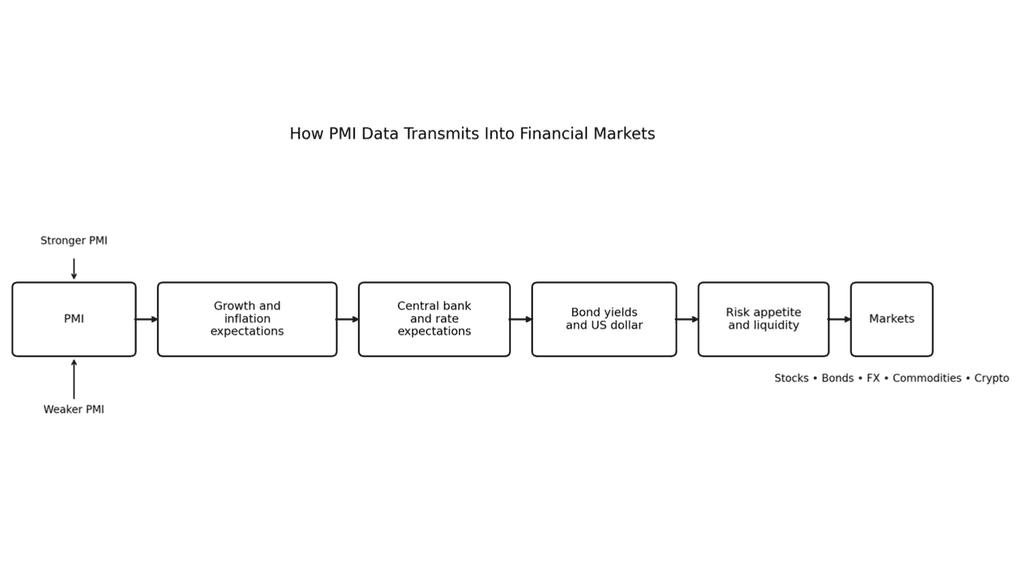
That creates a powerful transmission channel:
-
PMI changes expectations about growth and inflation.
-
Those expectations change assumptions about central bank policy.
-
Those policy expectations then affect yields, currencies, financial conditions, and asset valuations.
This is why a PMI release can move markets so quickly, especially when the reading is meaningfully above or below consensus expectations.
PMI and Financial Markets
PMI can influence multiple asset classes at the same time.
Equities: A stronger PMI may boost cyclical sectors if growth is improving, but it can also hurt valuations if it pushes rate expectations higher.
Bonds: Strong PMI data can lift bond yields if markets think rates may stay higher for longer. Weak PMI can pull yields lower if investors expect slowing growth or easier policy.
Currencies: A country with stronger PMI data may see support for its currency if the market expects better growth or tighter monetary policy.
Commodities: Stronger PMI readings can support industrial commodities if investors expect higher demand.
Risk assets: Broader market sentiment can improve or weaken based on how PMI changes the narrative around growth and liquidity.
The flowchart below shows how PMI data can move through the macro system, shaping expectations for growth, inflation, interest rates, liquidity, and financial markets.
How the PMI Index Affects Bitcoin and the Crypto Market
-
PMI and crypto market relevance: PMI does not directly track blockchain adoption, network activity, or digital asset demand, but it still matters because cryptocurrencies increasingly trade within a broader macro environment.
-
Why Bitcoin reacts to PMI: Bitcoin and other major cryptocurrencies often respond to the same forces that move growth-sensitive and liquidity-sensitive assets across global markets.
-
Macro transmission chain: The relationship usually works like this: PMI -> growth and inflation expectations -> interest rate expectations -> bond yields and US dollar strength -> risk appetite and liquidity -> crypto market reaction.
-
When PMI is stronger than expected: A stronger PMI reading may signal firmer economic growth and more persistent inflation pressure, which can reduce expectations for rate cuts and tighten financial conditions.
-
Potential downside for crypto: In that environment, a stronger US dollar and higher yields can put pressure on Bitcoin and other digital assets, especially when investors are treating crypto as a higher-risk asset class.
-
When PMI is weaker than expected: A weaker PMI reading can point to slowing growth, but the market reaction depends on how investors interpret that slowdown.
-
Bullish scenario for crypto: If weaker PMI increases expectations for policy easing and improves the outlook for liquidity, crypto prices may benefit.
-
Bearish scenario for crypto: If weaker PMI signals a deeper economic slowdown and causes investors to move away from risk, digital assets may also decline.
How PMI Helps Predict Economic Trends
The PMI index remains one of the most important leading indicators in macroeconomics because it gives an early view of business activity before much of the official data is released. It helps economists, investors, and policymakers understand whether momentum is improving, weakening, or starting to shift.
-
It arrives quickly: One of PMI’s biggest strengths is speed. Markets do not want to wait for slower economic reports, especially during periods of volatility or policy uncertainty. PMI provides a timely monthly snapshot of business conditions before many official releases become available.
-
It helps identify turning points: PMI is especially valuable during changes in the economic cycle. Early recovery, slowing growth, disinflation, reflation, and recession concerns often appear in PMI before they become obvious in lagging indicators. That is why analysts watch it so closely when trying to spot major shifts in momentum.
-
It reflects real business conditions: Unlike consumer sentiment surveys or backward-looking macro reports, PMI captures how businesses are operating in real time. Companies report what they are actually seeing in orders, production, hiring, inventories, and supplier conditions. That gives PMI a practical link to the real economy.
-
It offers cross-sector insight: PMI can show whether economic momentum is broad-based or concentrated in a narrow area. A strong composite reading supported by new orders and employment sends a different signal from a headline rise driven by only one component. This makes PMI more useful than a single top-line number alone.
-
It connects micro activity to macro trends: PMI begins with company-level responses, but those responses scale into larger macro effects. Stronger orders can lead to higher production, stronger hiring, more spending, and potentially more inflation pressure. In turn, those changes can influence central bank policy and broader market expectations.
-
It helps explain market pricing: In a market shaped by macro narratives, PMI helps explain why stocks, bonds, currencies, commodities, and crypto can move together or diverge. It can support the case for stronger growth, weaker demand, defensive positioning, or a liquidity-driven rally. For crypto investors in particular, PMI can help clarify whether the broader macro backdrop is becoming more supportive or more restrictive.
Challenges and Considerations
PMI is highly useful, but it is not infallible. Misreading it can lead to poor conclusions.
It Is a Survey, Not a Full Measurement of Output
PMI is based on responses, not hard production totals or sales figures. That means it is excellent for understanding direction and breadth, but less precise in measuring the scale of economic change. A reading of 52 does not tell you exactly how strong growth is in percentage terms. It simply suggests that more firms are seeing improvement than deterioration.
One Month Can Be Noisy
Markets sometimes overreact to a single release. Temporary supply disruptions, weather effects, holidays, or short-lived shifts in sentiment can all distort one month’s reading. Trends over several months often provide a better signal than one isolated number.
The Headline Can Hide Important Weakness or Strength
A stable or rising headline PMI does not always mean the economy is broadly healthy. The composition matters. A reading supported by slower supplier deliveries may have a different meaning from one supported by stronger new orders and employment. Looking beneath the surface can reveal a more accurate picture.
Manufacturing Does Not Equal the Whole Economy
Manufacturing PMI often gets disproportionate attention because it is cyclical and market-sensitive. But in many economies, services account for a much larger share of output and jobs. A soft manufacturing reading does not necessarily imply broad economic weakness if the service sector remains firm.
Market Reactions Depend on Context
A strong PMI is not automatically bullish. If inflation is already elevated, stronger activity may raise fears of tighter policy and hurt risk assets. Likewise, a weak PMI is not automatically bearish if markets believe it brings forward rate cuts and improves liquidity. Interpretation depends on the broader macro environment.
Crypto Traders Need to Avoid Linear Thinking
For crypto participants, the biggest mistake is treating PMI as a direct price signal. It is not. PMI influences crypto indirectly through rates, liquidity, dollar strength, and risk sentiment. At times, crypto-specific developments such as ETF flows, regulation, network upgrades, exchange events, or large positioning shifts can overshadow macro releases.
PMI Works Best With Other Indicators
The best way to use PMI is in combination with other data points, such as:
-
inflation readings
-
labor market data
-
retail sales
-
industrial production
-
credit conditions
-
central bank guidance
-
consumer spending trends
This broader framework reduces the chance of building a macro view on one imperfect number.
Conclusion
The PMI index remains one of the most influential indicators in macroeconomics because it offers an early look at the health of business activity and the direction of economic momentum. It tracks whether firms are seeing stronger demand, slower orders, tighter supply chains, changing hiring conditions, and rising or easing price pressure. Those signals matter because they feed directly into broader expectations around GDP growth, employment, inflation, and monetary policy.
Its impact is far-reaching because markets, central banks, businesses, and analysts all use it to interpret the cycle in real time. Stocks can react to shifting growth expectations. Bonds can reprice around inflation and interest rate assumptions. Currencies can move on relative strength and policy divergence. Crypto can respond through changes in liquidity conditions and risk appetite.
PMI is not a complete map of the economy, and it should never be treated as a standalone answer. But as a fast-moving pulse check on economic conditions, few indicators match its usefulness. For anyone trying to understand the macro economy, PMI remains one of the clearest and most practical signals to watch.
Call to Action
To explore the crypto market further, visit KuCoin to check its trading platform, market tools, and educational resources. You can also create an account, browse the spot market, or read more through the KuCoin Learn section to stay updated on digital asset trends and market developments.
FAQs
What does PMI stand for?
PMI stands for Purchasing Managers’ Index. It is a survey-based measure of business conditions in sectors such as manufacturing and services.
What does a PMI reading above 50 mean?
A reading above 50 generally means business activity is expanding compared with the previous month.
What does a PMI reading below 50 mean?
A reading below 50 usually signals contraction, meaning more firms are reporting worsening conditions than improving ones.
Why is PMI considered a leading indicator?
PMI is considered a leading indicator because it often reflects turning points in demand, output, employment, and pricing before official macro data fully captures them.
What is the difference between manufacturing PMI and services PMI?
Manufacturing PMI focuses on factory activity, orders, production, and supply conditions, while services PMI measures business activity in service-based sectors such as finance, hospitality, transport, and business services.
Why do financial markets react to PMI releases?
Markets react to PMI because it can change expectations for growth, inflation, central bank policy, corporate earnings, bond yields, and overall risk sentiment.
Does PMI affect cryptocurrency prices?
Indirectly, yes. PMI can affect crypto by shifting expectations around interest rates, liquidity, the dollar, and investor appetite for risk assets.
Disclaimer: The information provided on this page may originate from third-party sources and does not necessarily represent the views or opinions of KuCoin. This content is intended solely for general informational purposes and should not be considered as financial, investment, or professional advice. KuCoin does not guarantee the accuracy, completeness, or reliability of the information, and is not responsible for any errors, omissions, or outcomes resulting from its use. Investing in digital assets carries inherent risks. Please carefully evaluate your risk tolerance and financial situation before making any investment decisions. For further details, please consult our Terms of Use and Risk Disclosure