

Heima (HEI) Price Prediction 2026: Can It Break Above $0.27?
2026/08/06 17:50:00
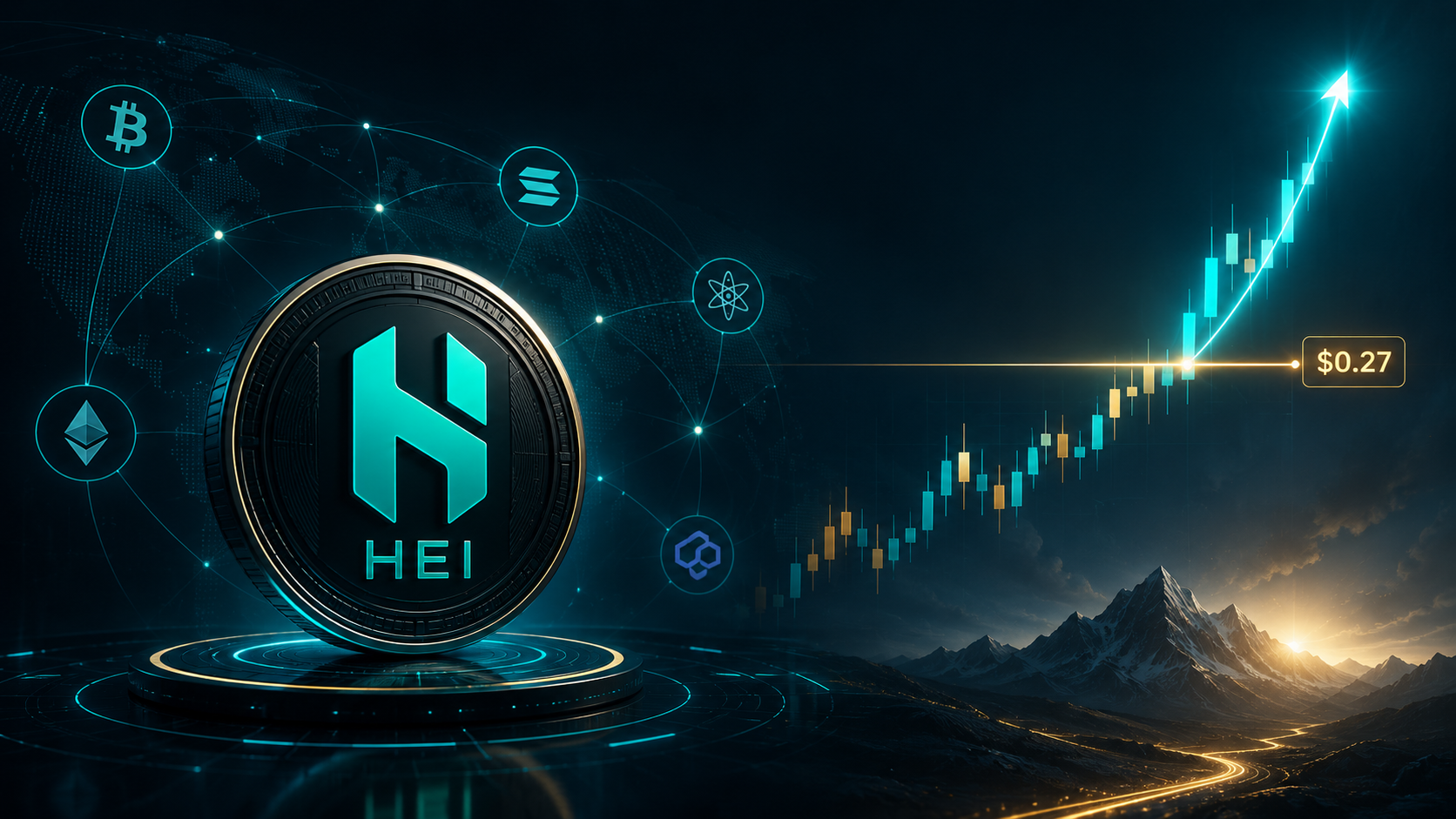
Heima’s HEI token has turned a previously hypothetical price target into a live market test. After spending much of late July near $0.08–$0.10, HEI surged through $0.27 and briefly traded above $0.40 on August 6. CoinGecko recorded an intraday range of approximately $0.14–$0.47, while trading activity expanded dramatically. The move means the more useful question is no longer simply whether HEI can break above $0.27, but whether it can convert that breakout into lasting support.
The rally has several narratives behind it: the rollout of AgentKeys, Heima’s wider push into AI-agent infrastructure, a completed 16.5 million HEI token burn, and renewed interest in smaller AI and chain-abstraction projects. Yet a rapid price increase does not automatically establish a sustainable trend. This HEI price prediction examines the token’s market structure, valuation, ecosystem adoption, supply dynamics and major risks to determine whether $0.27 can become a foundation rather than another temporary spike.
What Is Heima and Why Is HEI Gaining Attention?
Heima is a chain-abstraction infrastructure project designed to simplify trading and asset management across multiple blockchains. Instead of requiring users to switch wallets, bridge tokens manually and maintain separate gas balances, Heima aims to provide a unified Omni Account through which users can interact with supported networks. Its intent-based system allows a user to specify an outcome, such as swapping one token for another, while the protocol determines the route, liquidity source and execution steps behind the scenes.
The project began as Litentry, which focused more heavily on decentralized identity aggregation. Its rebranding to Heima was approved through decentralized governance and represented a broader strategic shift toward chain abstraction, cross-chain execution and programmable automation. The LIT-to-HEI token transition was completed in 2025, including support from major exchanges.
Heima’s infrastructure now combines four main components:
-
A Substrate-based Layer 1 coordination network
-
Omni Accounts for unified cross-chain identity
-
An Omni Executor for routing and fulfilling user intents
-
An Agent Hub for automated trading, staking and other workflows
HEI is positioned as the economic coordination asset connecting these components. According to Heima’s documentation, it supports governance, gas-abstraction settlement and cross-chain liquidity. Users may not need to hold HEI directly because fees can be sponsored or paid with other assets, but HEI can still be used in the background to compensate intent fillers and settle activity on the network.
HEI Price History and the Road to $0.27
HEI’s 2026 price history demonstrates why forecasts based on a single recent candle can be misleading. CoinGecko data show that the token traded near $0.08 at the end of July. It closed around $0.0867 on August 3, rose to approximately $0.1285 on August 4 and then closed near $0.266 on August 5. On August 6, the market moved even faster, with prices temporarily climbing above $0.40.
The breakout was accompanied by an exceptional increase in turnover. At one point on August 6, reported 24-hour volume exceeded $300 million, compared with a circulating market capitalization of roughly $35 million. That volume-to-market-cap relationship indicates intense speculation and rapid token rotation. It improves liquidity during the rally, but it can also signal that the market is moving faster than the underlying project fundamentals.
| Price zone | Market interpretation | What HEI needs |
| $0.10–$0.14 | Former accumulation and recovery area | Must hold during a deep correction |
| $0.18–$0.22 | Intermediate breakout zone | Buyers must defend it if momentum fades |
| $0.27 | Main breakout pivot | Weekly acceptance above it would strengthen the trend |
| $0.35–$0.47 | Current momentum zone | Requires sustained volume and orderly consolidation |
| $0.60 and above | Expansion scenario | Needs adoption growth and a supportive altcoin market |
Despite the dramatic advance, HEI remains below its historical peak. CoinGecko places its all-time high near $1.25, reached in February 2025. Therefore, a move above $0.27 is significant within the 2026 chart, but it does not yet represent full price discovery.
Why $0.27 Is the Key Level for HEI
The $0.27 level matters because it was close to HEI’s August 5 closing price after the token doubled from the previous day. It therefore marks the transition between the original breakout and the second phase of the rally. When an asset rises rapidly, the first major closing level often becomes an important reference point during the next pullback.
A sustainable breakout does not require HEI to remain above $0.27 every hour. Volatile tokens frequently retest their breakout zones. What matters is whether sellers can push HEI decisively back into its former range, or whether buyers consistently appear around $0.27 and turn resistance into support.
The valuation at that level is also relatively easy to understand. With approximately 81.4 million HEI in circulation, a price of $0.27 implies a circulating market capitalization of about $22 million. A price of $0.40 implies roughly $32.6 million, while $0.60 would produce a market cap close to $48.8 million. These figures do not make the targets either cheap or expensive on their own, but they allow investors to compare the required valuation with the project’s actual usage.
| HEI price | Approximate market cap | Increase from $0.27 |
| $0.27 | $22.0 million | — |
| $0.35 | $28.5 million | 29.60% |
| $0.40 | $32.6 million | 48.10% |
| $0.50 | $40.7 million | 85.20% |
| $0.60 | $48.8 million | 122.20% |
HEI Technical Analysis for 2026
The Breakout Structure
HEI’s August move clearly changed its short-term market structure. The token escaped a range that had largely contained it below $0.12 during the final days of July, then accelerated through $0.20 and $0.27. The combination of higher prices and rising volume is more constructive than a low-volume bounce because it shows that new market participants entered during the move.
However, vertical rallies create limited support between major price levels. HEI moved from approximately $0.13 to more than $0.40 too quickly for a long period of price discovery to occur. That makes the chart vulnerable to large intraday reversals, particularly if short-term traders begin taking profits.
Confirmation and Invalidation
A bullish continuation would ideally involve a period of consolidation above $0.27 rather than another immediate vertical advance. During that consolidation, volume should decline gradually while price remains stable. A later breakout accompanied by renewed volume would provide stronger confirmation that buyers are willing to accumulate at higher valuations.
By contrast, repeated daily closes below $0.27 would weaken the breakout. A decline below $0.20 would suggest that the market had rejected much of the August move, while a return toward $0.10–$0.14 would indicate a nearly complete retracement.
| Indicator | Constructive signal | Warning signal |
| Price structure | Higher lows above $0.27 | Repeated closes below $0.20 |
| Trading volume | Cools during consolidation, returns on rallies | Remains extreme while price stops rising |
| Momentum | Gradual reset without a deep price collapse | Persistent bearish divergence |
| Volatility | Daily ranges begin narrowing | Large upper wicks and accelerating sell-offs |
| Market depth | Stronger bids around major support | Sharp slippage during ordinary selling |
Technical indicators such as RSI and MACD can help evaluate momentum, but they should not be treated as independent predictions. After a triple-digit rally, an overbought reading is expected. The more meaningful test is whether HEI can reset its momentum while retaining a substantial portion of the price gain.
The Biggest Catalysts That Could Push HEI Higher
AgentKeys and the AI-Agent Narrative
AgentKeys is one of the clearest reasons Heima has attracted renewed attention. It is designed as an identity and credential-management layer for AI agents. Each agent can receive scoped API credentials, an audit trail and an independent revocation mechanism, reducing the need to share one set of human credentials across multiple automated systems. The product is currently presented as an early-alpha system with support for MCP-compatible agents and development environments.
AgentKeys matters to HEI because it expands Heima’s addressable market beyond cross-chain trading. Rather than competing only as another interoperability protocol, Heima is attempting to provide infrastructure for an “agentic economy” in which software agents hold identities, manage credentials and execute verifiable actions. The 2026 roadmap includes AgentKeys development, agent memory and tighter integration with automated execution.
The risk is that product attention does not necessarily translate into token demand. AgentKeys currently emphasizes conventional payment options and a wallet-free experience. For HEI to benefit over the long term, successful AgentKeys activity must create meaningful settlement, auditing, staking or coordination demand on the Heima network.
Wildmeta and Automated Trading
Wildmeta is positioned as Heima’s gateway to agentic trading. The roadmap describes agent wallets that can execute strategies on behalf of users and, later, interpret strategies written in natural language. A successful product could connect AI agents with Heima’s existing Omni Accounts and cross-chain routing infrastructure.
This combination is potentially valuable because automated strategies often need access to several chains, liquidity venues and data sources. Heima says its developer infrastructure includes token data APIs, route optimization, TEE and SMPC-based security, and cross-chain execution across networks including Ethereum, BNB Chain, Solana and Base.
Broader Market Liquidity
Even strong product execution may not protect HEI from a weak crypto market. Smaller tokens tend to depend heavily on risk appetite, exchange liquidity and capital rotation away from Bitcoin and large-cap assets. A favorable altcoin environment would make it easier for HEI to maintain higher valuations, while a broad market sell-off could overwhelm project-specific catalysts.
Can the HEI Token Burn Support the Price?
In July 2026, the Heima community completed a governance process that removed approximately 16.5 million HEI from the ecosystem allocation. Reported circulating supply fell from roughly 97.8 million to approximately 81.3 million tokens. The burn reduced the amount of potential future supply and demonstrated that the governance system could execute a major token-economic decision.
A burn can improve supply conditions, but it does not create demand by itself. Its effect depends on where the tokens came from and whether the market had expected them to enter circulation. Burning locked ecosystem tokens can reduce future dilution and potential selling pressure, which is different from buying liquid tokens from the market and immediately removing them.
The basic mechanism is straightforward:
-
Fewer tokens remain available or scheduled for distribution.
-
The same market capitalization corresponds to a higher price per token.
-
The benefit persists only if demand remains stable or increases.
The burn therefore strengthens HEI’s supply narrative, but it should not be used as the sole justification for a bullish price prediction. If user activity, developer integrations and token utility do not grow, scarcity alone may not support a permanently higher valuation.
Heima’s Fundamentals Could Decide the 2026 Trend
Heima’s official website reports more than 52,000 users and approximately 7.13 million total transactions. It also promotes a case study involving PumpX, where Heima’s infrastructure was used to add cross-chain payments, unified pricing and abstracted gas management. These figures provide evidence of network activity, although investors should still distinguish between cumulative usage, test activity and recurring economically meaningful transactions.
The most important fundamental question is whether ecosystem growth produces demand for HEI. The token is used for governance, underlying gas settlement and cross-chain liquidity coordination. Yet Heima intentionally hides the token from ordinary users by allowing intent fillers to sponsor gas and by accepting other supported assets for payments. That design improves the user experience, but it makes HEI’s value-capture mechanism less visible.
Investors should track operational data instead of relying only on announcements:
| Fundamental metric | Why it matters |
| Recurring active users | Shows whether product adoption survives incentive campaigns |
| Cross-chain transaction value | Measures economic use rather than simple transaction count |
| AgentKeys active teams | Tests demand for AI credential infrastructure |
| Wildmeta funded wallets | Indicates whether automated strategies attract real capital |
| DEX and wallet integrations | Expands distribution and potential fee generation |
| HEI staking and settlement activity | Demonstrates direct token utility |
| Developer activity | Shows whether third parties are building on the infrastructure |
| Network revenue or fees | Helps connect adoption with sustainable token economics |
A healthy long-term trend would combine growing product adoption with stronger HEI utility. If product usage increases while token demand remains flat, the protocol may succeed technologically without producing the same degree of appreciation for HEI holders.
HEI Price Prediction 2026: Three Possible Scenarios
Because HEI has already moved above the original $0.27 target, the following scenarios focus on where the token could stabilize later in 2026. They are conditional ranges, not guaranteed outcomes.
Bearish Scenario: HEI Returns to Its Former Range
The bearish case assumes that the August rally was driven primarily by short-term speculation. Once volume declines and traders take profits, HEI fails to defend $0.27 and then loses $0.20. If the broader crypto market also weakens, a return toward $0.08–$0.16 would be possible.
This outcome would not necessarily mean that Heima had failed as a project. It would instead show that the token price moved too far ahead of measurable adoption. Product delays, weak AgentKeys usage, insufficient Wildmeta activity or limited HEI value capture would make this scenario more likely.
Base Case: The Market Consolidates Around $0.18–$0.32
The base case assumes that Heima continues delivering products but requires time to build recurring demand. HEI gives back part of its vertical gain, finds support above its former July range and trades around $0.18–$0.32 through much of the remaining year.
Under this scenario, $0.27 becomes a recurring pivot rather than permanent support. The token may move above and below it as the market responds to product releases, exchange flows and wider altcoin sentiment. This would be less exciting than an uninterrupted rally but potentially healthier for longer-term price formation.
Bullish Scenario: HEI Holds Above $0.27 and Targets $0.60
The bullish scenario requires more than speculative volume. AgentKeys would need to attract active development teams, Wildmeta would need to demonstrate real automated-trading usage, and Heima’s cross-chain infrastructure would need to gain additional integrations.
If those developments occur while the altcoin market remains supportive, HEI could establish support around $0.27–$0.35 and trade toward $0.50–$0.60. At $0.60, the circulating market capitalization would remain below $50 million based on the currently reported supply, but the market would need evidence that Heima deserves that valuation.
What Could Stop HEI From Holding Above $0.27?
The greatest immediate risk is the speed of the rally. HEI’s reported 24-hour turnover temporarily became several times larger than its market capitalization. This can attract momentum traders, but it also means positions may reverse quickly when volume leaves. The gap between HEI’s intraday low and high on August 6 illustrates the degree of volatility investors are accepting.
Longer-term risks include:
-
Execution risk: AgentKeys and Wildmeta may develop more slowly than the roadmap suggests.
-
Adoption risk: Developers may prefer established account-abstraction, bridge or intent protocols.
-
Value-capture risk: Heima products may grow without creating proportional HEI demand.
-
Security risk: Cross-chain routing, agent credentials, TEEs and automated wallets create complex attack surfaces.
-
Liquidity risk: A relatively small market capitalization can lead to sharp slippage and unstable pricing.
-
Narrative risk: Interest in AI-agent tokens could rotate into a different sector.
-
Market risk: A Bitcoin-led correction could reduce liquidity across smaller altcoins.
Investors should also differentiate between a momentary move above $0.27 and durable acceptance above it. A token can cross a resistance level during a high-volume spike and still close the month far below that price.
Is HEI a Good Crypto to Watch in 2026?
HEI deserves attention because Heima sits at the intersection of several important crypto narratives: chain abstraction, intent-based trading, cross-chain liquidity and AI-agent infrastructure. Its relatively small capitalization creates substantial upside sensitivity if product adoption improves. The token burn also reduced future supply and removed part of the ecosystem allocation.
At the same time, HEI remains a speculative asset. The recent price move has advanced far more quickly than investors can verify long-term AgentKeys or Wildmeta adoption. Reported trading volume is unusually high relative to the token’s capitalization, and the product-to-token value relationship is still developing.
HEI may therefore be more appropriate for a high-risk watchlist than for investors seeking predictable cash flow or low volatility. The most constructive signal would not be another one-day doubling. It would be several months of stable usage growth, deeper liquidity and a clear increase in the amount of HEI required for governance, staking, settlement or liquidity coordination.
Final Verdict: Can HEI Stay Above $0.27?
HEI has already answered the first version of the question by breaking through $0.27. The harder test is whether that price can become support after the initial excitement fades. The August rally had genuine catalysts, including AgentKeys, Heima’s AI-agent roadmap and reduced token supply, but its extreme speed also raises the probability of a sharp correction.
The most balanced 2026 outlook places HEI between $0.18 and $0.32 after volatility cools. A sustained range above $0.35 and a move toward $0.60 would require measurable adoption, not only announcements and trading momentum. Conversely, losing $0.20 after a failed retest of $0.27 would expose the token to a much deeper reversal.
Ultimately, HEI’s future will depend on whether Heima can turn chain abstraction and AI-agent infrastructure into recurring economic activity. A short-term breakout is controlled by liquidity. A lasting revaluation must be supported by users, developers, settlement demand and credible token value capture.
|
KuCoin is celebrating its 9th anniversary with a special platform campaign filled with exclusive rewards, trading activities, and limited-time offers. Don’t miss the chance to participate and enjoy the benefits as the exchange marks nine years of growth and innovation. Visit the official campaign page now:
|
FAQs
Is Heima the same project as Litentry?
Heima is the evolved and rebranded version of Litentry. Litentry originally concentrated on decentralized identity and privacy, while Heima expanded the project’s scope to chain abstraction, cross-chain asset management and automated execution. The rebranding was approved through community governance, and exchanges subsequently supported the migration from LIT to HEI.
On which networks is HEI available?
Heima documentation states that HEI is deployed across the Heima network, Ethereum and BNB Chain. The official web application provides bridging functionality between these environments. Users should confirm the supported network and verify the official contract address before transferring or purchasing HEI because similarly named assets and unsupported networks can lead to permanent losses.
Do users need HEI to pay transaction fees?
Ordinary users are not always required to hold HEI directly. Heima’s gas-abstraction model allows intent fillers to sponsor gas and enables users to pay with supported tokens. HEI still functions as the underlying network gas and settlement asset, meaning it can remain part of the transaction’s backend economics even when the user never sees or manually acquires it.
How often should an HEI price prediction be updated?
An HEI forecast should be reassessed after major product releases, token-supply changes, exchange events or decisive breaks of important support and resistance levels. Because HEI can move by triple-digit percentages within a short period, annual forecasts may become obsolete quickly. Investors should treat price targets as conditional scenarios and update the assumptions whenever market structure or project adoption changes materially.
What should investors monitor before buying HEI?
The most useful indicators include spot volume, order-book depth, active Omni Accounts, cross-chain transaction value, AgentKeys adoption, Wildmeta usage, staking participation and developer integrations. Investors should also monitor Bitcoin and the broader altcoin market. A rising HEI price supported by recurring users and network activity is generally more credible than a rally driven almost entirely by temporary exchange volume.
Disclaimer: This article is for informational purposes only and does not constitute financial advice. Cryptocurrency prices are highly volatile, and readers should conduct independent research before making investment decisions.