

Elon Musk Says AI Could Surpass Humanity by 2031—What It Means for Bitcoin and Crypto
2026/07/27 11:10:00
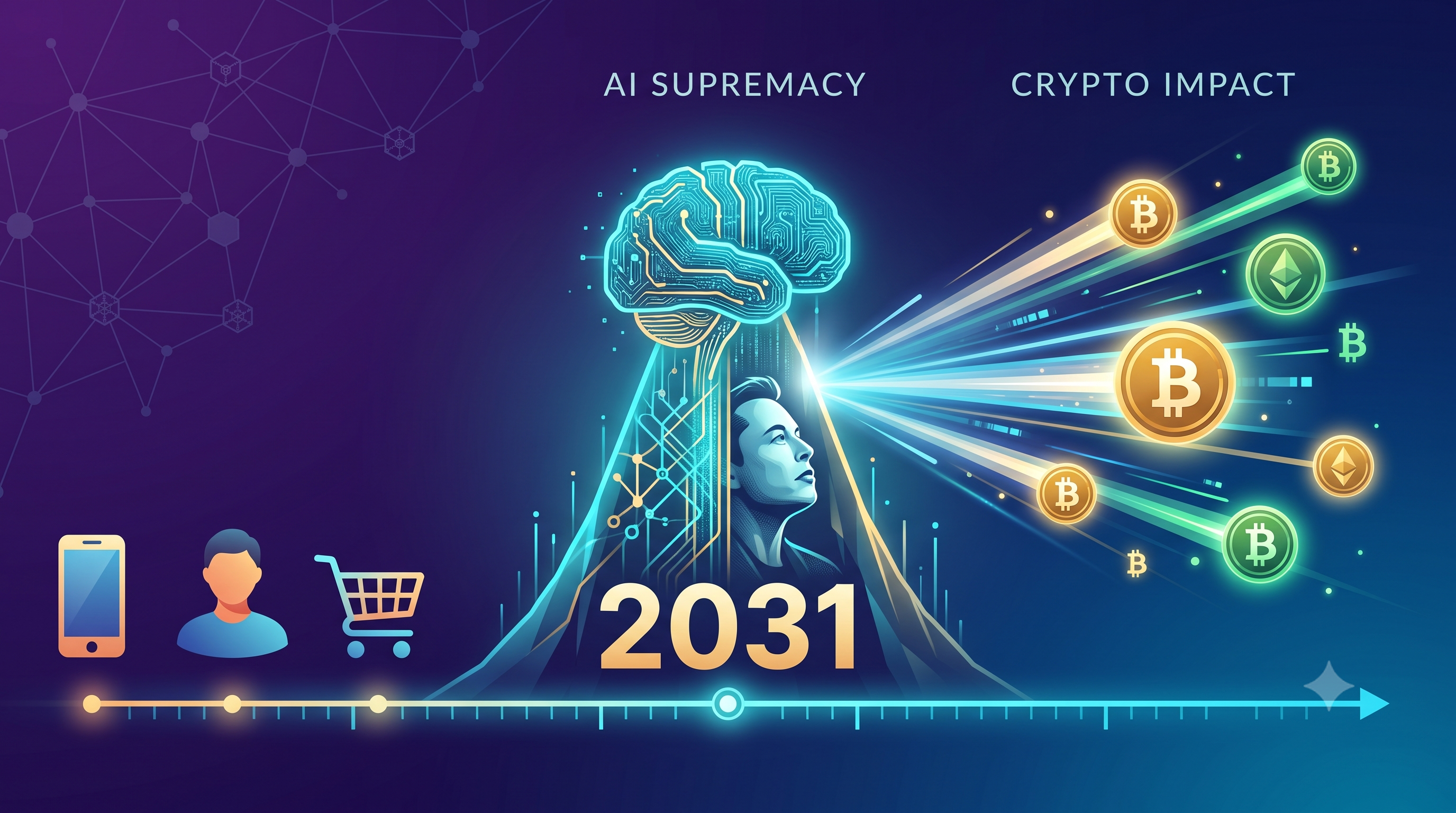
Elon Musk has offered one of his most aggressive artificial intelligence forecasts yet. In a July 2026 interview with The Economist, he argued that AI could exceed the combined intelligence of humanity within roughly five years. He also described a longer-term future in which AI and robotics create such abundant production that work becomes optional and money loses much of its current importance. The year 2031 is an inference from his five-year estimate, not a date he formally guaranteed.
For crypto investors, the prediction raises a difficult pair of questions. Could the transition toward automation strengthen Bitcoin as governments respond to labor disruption with larger transfers and more expansive fiscal policy? Or would a genuine age of abundance weaken the economic importance of scarce monetary assets?
The answer may depend less on the final destination than on the turbulent path between today’s human-led economy and a future increasingly operated by software and machines.
Key Takeaways
-
Musk’s five-year timeline is an aggressive possibility, not an accepted industry consensus or a measurable promise that AI will surpass humanity by 2031.
-
AI could reduce the cost of many digital and physical services, but production abundance would not automatically produce equal access or eliminate scarcity.
-
Bitcoin may gain relevance during an unstable transition marked by labor displacement, fiscal experimentation and distrust of centralized monetary systems.
-
Stablecoins and programmable payment networks may be better suited than volatile assets for routine transactions between autonomous AI agents.
-
DePIN projects could benefit from rising demand for compute, storage, connectivity and energy, but only when their networks attract real users rather than token-driven speculation.
What Did Elon Musk Actually Say?
Musk’s argument contains two separate forecasts that are often compressed into one dramatic headline.
The first concerns intelligence. He said AI systems could surpass the sum of all human intelligence within about five years. That is more ambitious than predicting that a model will beat a professional programmer, pass difficult examinations or automate a collection of office tasks. It implies that machine systems could collectively possess more reasoning, analysis and problem-solving capacity than humanity as a whole.
The second forecast concerns the economy. Musk described a world in which advanced AI performs cognitive work while robots perform physical work, allowing society to produce goods and services at extraordinary scale. In that scenario, employment would no longer be necessary for survival, and money could become less central because many basic needs would be cheap or widely available.
He has framed the possible distribution mechanism as “universal high income,” a more expansive idea than a safety-net payment designed only to prevent poverty. This does not mean Musk predicted that every currency will disappear on a particular day in 2036. The ten-year reference is a rough technological and economic horizon. Money could become less important for obtaining standardized goods while remaining essential for allocating scarce land, energy, computing power and unique experiences.
Musk also acknowledged that the outcome is not guaranteed. He has placed the risk of a catastrophic AI outcome above zero while arguing that stopping global development is probably unrealistic. His proposed response emphasizes cooperation and safety reviews among leading AI laboratories, with government intervention when companies fail to address serious risks. Reuters reported that he called for frontier-model peer review among competing AI developers before major releases.
Could AI Really Surpass Humanity by 2031?
The strongest evidence for Musk’s optimism is the speed at which AI systems are becoming capable of completing longer and more complicated tasks.
METR evaluates frontier agents by estimating the length of a task, measured in human expert working time, that a model can complete at a specified success rate. Its research shows a steep historical increase in these task-completion horizons, particularly for software and research-oriented work. METR also cautions that the metric applies to its task distribution and should not be interpreted as a universal measure of how long an AI can operate reliably in every real-world setting.
That distinction matters. Intelligence is not a single score. A model may be superhuman at pattern recognition while remaining unreliable at long-term planning. It may produce strong code yet fail when requirements are ambiguous, tools break or the environment changes unexpectedly.
Passing benchmarks also does not prove that a system has judgment, social understanding or the ability to coordinate physical activity across an economy.
| Concept | Practical meaning |
| Narrow superhuman performance | AI exceeds people in a defined task such as coding, forecasting or scientific classification. |
| Artificial general intelligence | AI performs at or above human level across a wide range of cognitive tasks. |
| Superintelligence | AI’s overall reasoning and innovation capabilities greatly exceed those of individual humans or humanity collectively. |
Musk’s statement is closest to the third category. There is no universally accepted test for it, making the 2031 forecast hard to verify in advance or even immediately after the alleged threshold is crossed.
There are also physical constraints. Scaling AI requires chips, electricity, cooling, networking and data centers. Turning digital intelligence into an abundance economy additionally requires reliable robotics, factories, logistics and energy infrastructure.
Software can be copied at negligible marginal cost; houses, food and electricity cannot. Even dramatic progress in models may therefore arrive years before equivalent progress in the physical economy.
The most defensible interpretation is that Musk’s timeline is plausible enough to shape investment and policy, but far too uncertain to serve as a base-case forecast. Markets may price the possibility long before society knows whether it is correct.
How AI Could Make Work Optional
For work to become optional, AI must do more than improve office productivity. It must replace or dramatically augment both cognitive and physical labor.
Cognitive automation is advancing first. Models can already assist with programming, customer support, document analysis, marketing, design and research. Yet exposure does not mean immediate job elimination.
The International Labour Organization’s global index emphasizes that generative AI is more likely to transform many occupations by changing tasks and working conditions than to erase every exposed job at once. It also warns that the effects will vary by occupation, sector and country.
Physical automation is harder. A digital agent can draft a supply plan, but robots still need to move materials, repair equipment, build housing and operate safely around people. Musk’s abundance forecast therefore depends on AI and robotics advancing together.
A simplified transition might look like this:
-
AI lowers the cost of knowledge work, coordination and design.
-
Robots lower the cost of manufacturing, logistics and services.
-
Productivity rises faster than demand for human labor in some sectors.
-
Wage income becomes less reliable as the main distribution mechanism.
-
Governments or new ownership models redistribute part of machine-produced output.
-
Work shifts from economic necessity toward status, creativity, community and personal purpose.
The fifth step is political rather than technological. Machines can produce wealth without determining who owns it.
If the models, robots, energy systems and factories belong to a small number of firms, society could experience higher output alongside deeper inequality. Universal high income would require taxation, public ownership, broad capital participation or another distribution mechanism.
Would Money Really Become Less Important?
Money performs three basic functions: it acts as a medium of exchange, a unit of account and a store of value.
AI could reduce the need to accumulate money for certain purchases if the cost of those products falls sharply. Digital education, routine legal documents, entertainment, basic software and some forms of advice could become extremely cheap when generated on demand.
Physical automation could eventually push down the cost of manufactured goods and services as well. But this does not imply the end of scarcity. Some resources are limited by nature, location or social preference rather than labor costs.
| Costs AI may reduce sharply | Resources likely to remain scarce |
| Standardized digital content | Prime urban land |
| Routine software and analysis | Energy and advanced compute |
| Basic remote education | Rare minerals and specialized chips |
| Automated customer support | Human attention and trusted relationships |
| Some mass-produced goods | Status, unique art and exclusive experiences |
Scarce resources still require allocation. The mechanism could be money, credits, queues, political decisions, platform access or reputation scores. Eliminating money does not eliminate power; it may simply move power into another allocation system.
There is also a distribution problem. Imagine robots making food and housing more efficiently while the ownership of those robots remains concentrated. Production costs could fall without access becoming universal. In such a system, money might remain crucial because people would still need purchasing power to claim the output.
A more realistic outcome is that money becomes less important for basic consumption but remains important for scarce assets and personal choice. The composition of wealth may change. Energy rights, compute access, land and ownership in productive systems could matter more than traditional wages, while monetary instruments continue to coordinate exchange.
Why Bitcoin Could Benefit During the Transition
The strongest bullish case for Bitcoin may not be a completed post-scarcity economy. It may be the unstable transition toward one.
Rapid automation could disrupt employment faster than tax systems, education and welfare institutions can adapt. Governments may respond with income support, industrial subsidies, AI infrastructure spending and expanded public investment.
Depending on how these programs are financed, investors could become more concerned about sovereign debt, political control over money or the long-term purchasing power of fiat currencies.
Bitcoin offers a monetary system whose issuance and transaction validation are not controlled by one central authority. Its original design proposed direct electronic transfers without relying on a financial institution to validate every payment.
That structure could appeal to investors for three reasons.
First, predictable issuance provides a contrast with politically adjustable monetary systems. Second, independently verifiable digital ownership may become more valuable as AI makes ordinary digital content almost infinitely reproducible. Third, Bitcoin can move across borders without requiring the sender and receiver to share the same bank or technology platform.
None of these qualities guarantees a higher price. Bitcoin remains volatile, and a fixed supply is valuable only when demand persists. It cannot distribute the gains from automation, retrain displaced workers or produce physical goods. Regulation could also become stricter if governments view self-custodied assets as competing with official distribution systems.
Investors assessing whether the AI narrative is affecting the market should separate philosophical arguments from observable behavior. Changes in the Bitcoin price and market data can be compared with fiscal announcements, employment data, interest-rate expectations and AI investment cycles rather than attributed to one futuristic prediction.
Does an Age of Abundance Weaken Bitcoin’s Case?
Bitcoin’s monetary story is built around scarcity. A genuine abundance economy therefore creates a paradox: why would society need a scarce digital asset if AI can provide almost everything people want?
The bullish answer is that abundance will never be complete. Even if ordinary products become inexpensive, land, energy, high-performance computing, network priority and social status will remain limited. People will still need a way to store and transfer claims on those resources.
Bitcoin could serve as a neutral reserve asset in a world where governments and technology platforms issue competing forms of digital money.
There is also a governance argument. An advanced AI may be able to analyze or attack institutions, but it cannot unilaterally change Bitcoin’s monetary rules without persuading or overpowering the network’s participants. The system’s value could therefore come partly from predictable coordination rather than physical scarcity alone.
The bearish answer is equally serious. If food, housing, transport and digital services become nearly free, households may have less reason to accumulate monetary wealth. AI agents could prefer stable units for accounting and payments, while governments distribute access through central bank money, public credits or platform-based entitlements.
Bitcoin might remain a collectible or reserve asset without becoming the main currency of machine commerce.
Its future role will depend on which scarcities matter most. If the dominant scarce resources are electricity and compute, the winning unit may be one closely connected to those resources. If the dominant concern is political neutrality and resistance to discretionary monetary policy, Bitcoin’s case becomes stronger.
AI Agents, Stablecoins and Machine Payments
Autonomous AI agents create a more immediate crypto use case than the distant idea of money disappearing.
Agents may need to purchase data, rent compute, call paid APIs, subscribe to software or pay other agents. These transactions could be small, frequent and global, making manual card entry and monthly invoicing inefficient.
Stablecoins are well suited to this environment because they combine blockchain programmability with a relatively stable unit of account. The Bank for International Settlements recognizes that stablecoins demonstrate the potential for faster, programmable payments, while also warning that current designs raise questions about redemption, financial integrity and the consistency of money.
Working prototypes already illustrate the concept. Coinbase’s x402 documentation describes an HTTP-based protocol that allows software and AI agents to make automatic stablecoin payments for API access and online services.
This does not prove that x402 or any specific chain will dominate machine payments, but it shows that the use case is moving beyond theory. Crypto is not guaranteed to win. Banks, card networks and cloud providers can build their own agent-payment systems.
Blockchain’s strongest advantage is composability: an agent can interact with a wallet, contract and service according to public rules. Its biggest disadvantage is responsibility. A compromised agent with signing authority can lose money quickly, while irreversible settlement limits recourse.
Where DePIN and AI Crypto Projects Fit
AI’s physical requirements create another crypto opportunity. Training and operating models require compute, storage, bandwidth, data and energy.
Decentralized physical infrastructure networks, or DePIN, use token incentives to coordinate independently owned resources and make them available through a shared network.
The investment thesis is straightforward. If demand for AI infrastructure grows faster than centralized providers can supply it, decentralized networks could monetize idle GPUs, storage devices, wireless capacity or energy assets. Traders comparing projects can use a broader DePIN market overview as a starting point, but sector membership alone says little about actual adoption.
A credible project should answer several questions:
-
Does the network supply a resource that customers genuinely need?
-
Can its cost, latency and reliability compete with conventional providers?
-
Is the token required for coordination or merely attached to the product?
-
Does revenue come from external users or from token emissions?
-
Can the network meet data-security and enterprise-service requirements?
AI enthusiasm often lifts many related tokens at once. Reviewing AI-focused spot markets can reveal whether a move reflects broad sector rotation or a project-specific catalyst. That distinction matters because a rising narrative can temporarily hide weak economics.
DePIN’s strongest argument is not that decentralization is always cheaper. It is that open incentives may unlock fragmented resources and reduce dependence on a few cloud or hardware providers.
The model succeeds only when the network delivers a service that people purchase after incentives are reduced.
The Biggest Risks to the AI-Crypto Narrative
The first risk is timing. AI may advance rapidly while robotics, energy infrastructure and regulation move slowly. A model that can write complex software does not automatically create a robot capable of safely repairing a power grid.
Musk’s five- and ten-year horizons could prove directionally correct but much too compressed.
The second risk is concentration. Frontier AI requires capital, chips and data centers at a scale that may strengthen large corporations. The main economic gains could flow to semiconductor companies, cloud platforms and model developers rather than decentralized networks. Crypto projects can benefit from the story without capturing the revenue.
The third risk is regulation. An AI agent that can hold and transfer assets raises questions about legal identity, authorization, anti-money-laundering controls, sanctions and liability. A person or organization will usually remain responsible for the agent’s actions, even when the software operates autonomously.
Security is another major concern. Agents can be manipulated through prompt injection, malicious data, compromised tools and flawed instructions. Giving them access to wallets expands the consequences of an error from incorrect text to direct financial loss.
Finally, the sector is vulnerable to narrative bubbles. A project can describe itself as an AI-agent network, machine-payment protocol or decentralized compute marketplace without demonstrating customers, revenue or technical advantage.
Investors should distinguish exposure to a popular theme from ownership of a productive network.
What Crypto Investors Should Watch Next
The most useful signals will come from measurable adoption rather than increasingly dramatic forecasts:
-
Long-horizon AI performance: Can agents complete complicated real-world projects reliably, not merely score well on short benchmarks?
-
Robotics deployment: Are machines producing measurable value in factories, logistics, construction and services?
-
Labor and fiscal policy: Do governments introduce large-scale income support, AI taxes or public ownership structures?
-
Machine-payment activity: Are agents making recurring onchain payments for data, compute and software?
-
DePIN revenue: Are decentralized networks attracting customers after accounting for token subsidies?
-
Bitcoin’s macro behavior: Does BTC respond to automation-driven fiscal expansion as a scarce asset, or trade mainly as a high-risk technology investment?
Three broad outcomes are possible.
In a crypto-positive scenario, AI agents adopt stablecoins and open networks, DePIN earns real revenue and concerns about fiscal expansion strengthen Bitcoin.
In a mixed scenario, AI develops quickly but banks and large platforms control most payments and infrastructure.
In a crypto-negative scenario, automation improves productivity without creating meaningful demand for decentralized assets.
Conclusion
Musk’s prediction is not a reliable countdown to 2031. It is a high-impact scenario that forces investors to think about how intelligence, labor and money could change together.
Bitcoin may benefit most during the transition, when automation creates political and monetary uncertainty but scarcity still shapes everyday life. Stablecoins may provide the practical transaction layer for autonomous agents, while DePIN networks compete to supply compute, storage and energy. Yet none of these outcomes follows automatically from AI progress.
The largest crypto opportunity may emerge before money becomes less important: during the uneven shift from a human-led economy to one increasingly coordinated by machines.
🔥 Join KuCoin 9th Anniversary Trading CampaignKuCoin is celebrating its 9th anniversary with a special platform campaign filled with exclusive rewards, trading activities, and limited-time offers. Don’t miss the chance to participate and enjoy the benefits as the exchange marks nine years of growth and innovation. Visit the official campaign page now:
|

FAQs
Did Elon Musk Directly Recommend Bitcoin in the Interview?
No. Musk’s reported comments focused on AI capabilities, robotics, employment, safety and the future role of money. The potential effects on Bitcoin and crypto are analytical interpretations of his economic vision rather than a direct endorsement, investment recommendation or BTC price prediction.
What Is Universal High Income?
Universal high income is Musk’s idea that AI and robotics could create enough productivity to give most people access to a high standard of living. Unlike universal basic income, which generally provides a minimum financial safety net, universal high income assumes automation will produce significantly greater economic abundance.
Can an AI Legally Own Cryptocurrency?
AI systems are generally treated as software rather than independent legal persons, so cryptocurrency used by an AI agent would normally remain under the ownership or responsibility of an individual, company, decentralized organization or smart-contract structure. Legal liability would depend on the jurisdiction, custody arrangement and authorization granted to the agent.
Would AI Agents Use Bitcoin or Stablecoins?
Stablecoins may be more practical for routine machine payments because they provide relatively stable pricing for API access, data and subscriptions. Bitcoin may be more suitable for neutral settlement, reserves or permissionless transfers, meaning AI agents could use both assets for different economic purposes.
Does AI Progress Make Every AI-Related Token Valuable?
No. An AI-related token creates lasting value only when its network provides a useful product, attracts genuine customers and connects demand to the token’s utility or economics. Strong market narratives may increase attention temporarily, but they cannot replace adoption, revenue and sustainable token design.
Disclaimer: This article is for informational purposes only and does not constitute financial or investment advice. Cryptocurrency investments carry significant risk. Always conduct your own research before trading.