

Can Ordinary Crypto Users Use AI Agents for Quantitative Trading in 2026?
2026/04/17 09:54:02
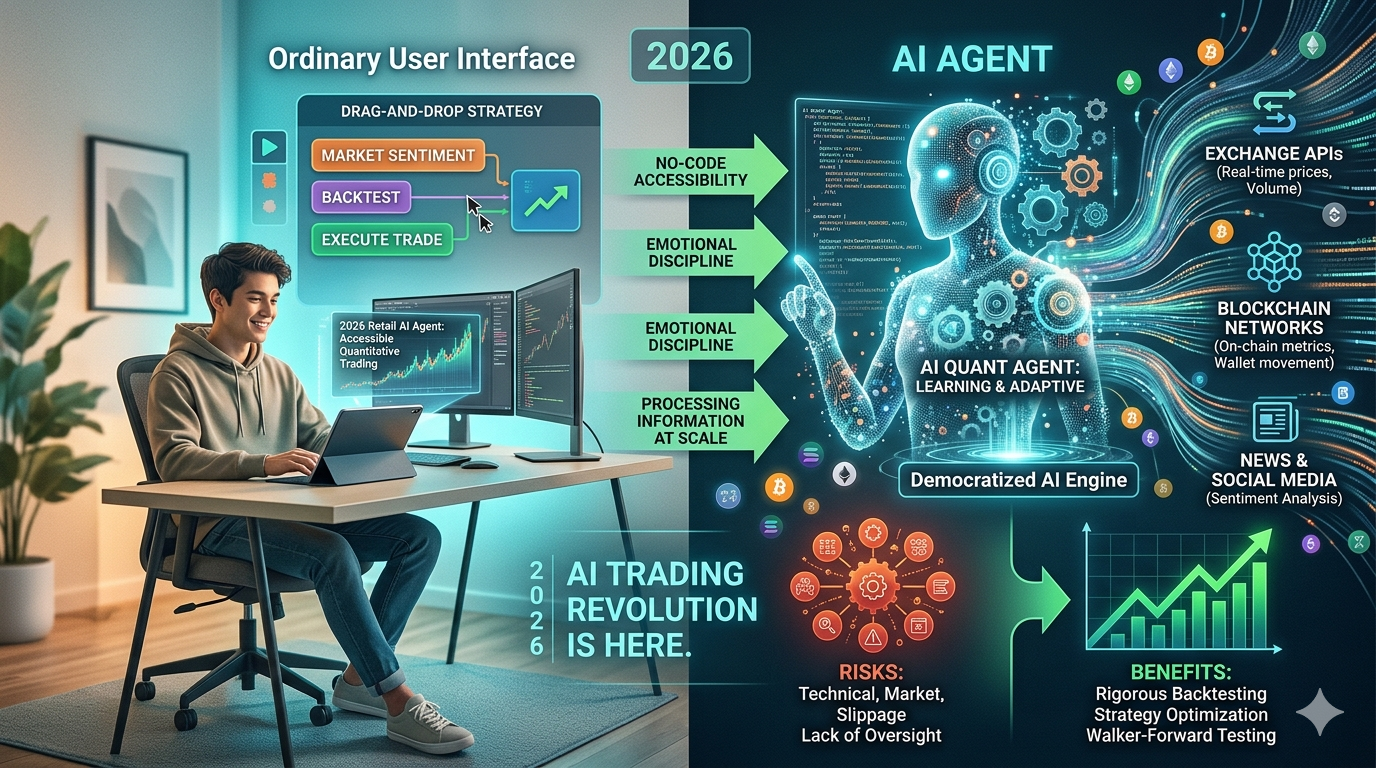
Introduction: The AI Trading Revolution Is Here
Can regular people actually use AI agents to trade crypto in 2026, or is this still reserved for hedge funds and technical experts?
The landscape of cryptocurrency trading has undergone a dramatic transformation in recent years. What was once the exclusive domain of institutional traders and quant firms with massive computational resources is now becoming increasingly accessible to ordinary crypto users. AI agents for quantitative trading have evolved from complex, inaccessible systems into user-friendly tools that anyone with basic crypto knowledge can potentially use.
This shift raises critical questions for the millions of individual crypto investors worldwide. What exactly are AI trading agents? How do they work? Can they genuinely improve trading outcomes for regular users? What are the risks and limitations? This comprehensive guide examines the current state of AI-powered trading for ordinary users in 2026.
Cryptocurrency markets operate around the clock, with prices moving rapidly in response to news, regulatory announcements, and shifting market sentiment. This constant activity creates both opportunities and challenges that differ dramatically from traditional financial markets. The emergence of AI trading tools represents a fundamental shift in how individual investors can participate in these markets.
Understanding AI Agents in Crypto Trading
What Are AI Trading Agents?
AI trading agents are software systems that use artificial intelligence and machine learning algorithms to analyze market data, identify trading opportunities, and execute trades automatically. These systems can process vast amounts of information far faster than human traders, including price movements, volume data, social media sentiment, news headlines, and on-chain metrics.
In the context of cryptocurrency, AI agents typically operate by connecting to exchange APIs, monitoring multiple markets simultaneously, and executing trades based on predefined strategies or learned patterns. The sophistication of these systems varies widely, from simple bots that follow basic technical indicators to advanced AI models that adapt their strategies based on evolving market conditions.
The key distinction between traditional algorithmic trading and AI-powered trading lies in the system’s ability to learn and adapt. While conventional bots follow rigid rules, AI agents can identify patterns that humans might miss and adjust their approaches based on new data. This adaptive capability makes them particularly valuable in the highly volatile cryptocurrency markets, where conditions can change rapidly.
Machine learning models analyze historical price data to identify recurring patterns that might predict future price movements. These models can process thousands of variables simultaneously, identifying correlations that would be impossible for human traders to detect. Natural language processing systems scan news articles and social media posts to gauge market sentiment, providing early warning of potential price movements.
How Do AI Trading Agents Work?
The functioning of AI trading agents involves several interconnected components working together to analyze markets and execute trades.
Data Collection forms the foundation of any AI trading system. Agents gather information from multiple sources, including exchange APIs providing real-time price and volume data, blockchain networks offering on-chain metrics like wallet movements and transaction volumes, news sources and social media platforms monitoring sentiment, and technical analysis indicators computed from historical price data.
The data collection process operates continuously, maintaining up-to-date information across all monitored markets. Exchange APIs provide the most current pricing and volume data, while blockchain networks reveal wallet activities that might indicate accumulation or distribution by large players.
Analysis Phase processes collected data using various AI techniques. Machine learning models identify patterns in historical data that might predict future price movements. Natural language processing systems analyze news and social media to gauge market sentiment. Deep learning models can recognize complex patterns in price charts that human traders might overlook.
Strategy Execution represents the final component, where the AI agent implements trading decisions based on its analysis. This includes executing trades through exchange APIs, managing portfolio allocations, setting stop-loss and take-profit levels, and adjusting strategies based on performance feedback.
The Current State of AI Trading in 2026
Accessibility for Ordinary Users
The accessibility of AI trading tools has improved dramatically in 2026, with multiple options available for users without extensive technical backgrounds.
No-code platforms have emerged as game-changers for non-technical users. These services provide visual interfaces where users can create and customize trading strategies without writing any code. Drag-and-drop functionality allows users to combine technical indicators, set conditions, and define execution rules through intuitive interfaces.
The no-code movement has fundamentally changed who can access sophisticated trading tools. What previously required programming expertise now requires only basic understanding of trading concepts and the ability to navigate web interfaces.
Cloud-based AI trading services eliminate the need for users to maintain their own computing infrastructure. These services run AI models on remote servers, delivering results to users through web dashboards or mobile apps. Users simply configure their preferences and fund their accounts, with the service handling all computational aspects.
Integration with popular exchanges has streamlined the setup process. Most major cryptocurrency exchanges now offer API access that integrates seamlessly with AI trading platforms, allowing users to connect their accounts and start trading within minutes.
| Type | Best For | Risk Level |
| Copy Trading | Beginners wanting to learn from experts | Medium |
| Signal Generators | Users who want human final say | Low-Medium |
| Fully Automated Bots | Busy users who cannot monitor markets | Medium-High |
| Portfolio Management AI | Long-term investors | Low-Medium |
Types of AI Trading Tools Available
The market offers diverse AI trading solutions catering to different user needs.
Copy trading platforms allow users to follow the strategies of successful traders, including those who use AI systems. This provides a middle ground between fully manual trading and running one’s own AI agent.
AI signal generators analyze markets and provide trading recommendations without executing trades automatically. Users receive notifications about potential opportunities and can choose whether to act on them.
Fully automated AI trading bots execute trades autonomously based on user-defined parameters. These systems can operate continuously without user intervention, making them suitable for users who cannot monitor markets constantly.
Portfolio management AI systems focus on optimizing overall portfolio performance rather than individual trade execution. These tools can rebalance portfolios, suggest diversification strategies, and identify tax-loss harvesting opportunities.
Benefits of AI Trading for Regular Users
Removing Emotional Bias
One of the most significant advantages of AI trading systems is their ability to eliminate emotional decision-making from trading. Human traders frequently fall victim to psychological biases that can devastate their portfolios.
Fear and greed drive many poor trading decisions. When prices drop sharply, panic selling locks in losses. When prices rise, greed leads to buying at peaks. AI systems execute trades based on data and predetermined rules rather than emotional reactions, maintaining consistency regardless of market conditions.
The psychological challenges of trading affect even experienced traders. After a series of losses, fear might cause a trader to exit positions prematurely, missing subsequent recoveries. After profits, overconfidence might lead to oversized positions. AI systems immune to these emotional fluctuations maintain consistent approaches throughout market cycles.
The 24/7 nature of cryptocurrency markets creates challenges for human traders who need sleep and cannot monitor positions continuously. AI agents operate around the clock, capitalizing on opportunities regardless of time zone or hour.
Processing Information at Scale
The volume of information available in cryptocurrency markets exceeds what any human can process effectively. AI systems excel at analyzing massive datasets quickly and identifying meaningful patterns.
Human traders face inherent limitations in information processing. They can realistically monitor a handful of markets simultaneously, analyzing perhaps a dozen indicators across those markets. Cryptocurrency markets contain thousands of assets, with hundreds of data points for each.
AI systems overcome these limitations through parallel processing capabilities. They can monitor every traded cryptocurrency simultaneously, analyzing technical indicators, on-chain metrics, social sentiment, and news across all markets.
Multiple timeframe analysis becomes possible with AI, examining minute-by-minute movements alongside daily and weekly trends simultaneously. This comprehensive view identifies opportunities that might be invisible when focusing on a single timeframe.
Cross-market analysis spanning numerous cryptocurrency pairs reveals correlations and arbitrage opportunities. When Bitcoin moves, altcoins often follow; identifying these correlations enables positioning ahead of moves.
Backtesting and Optimization
AI trading platforms enable rigorous backtesting that would be impossible for individual traders to perform manually. This capability allows users to evaluate strategies using historical data before risking real capital.
Strategy optimization through backtesting identifies parameters that would have produced the best historical results. While past performance does not guarantee future results, this optimization helps refine strategies and identify potential weaknesses.
Scenario testing allows users to evaluate how strategies would have performed during specific historical events, such as market crashes or bull runs. Understanding behavior during various conditions helps users set realistic expectations.
Walk-forward testing validates strategies by testing on out-of-sample data, reducing the risk of overfitting to historical patterns that will not repeat in the future.
Risks and Limitations
Technical Risks
Despite their sophistication, AI trading systems carry significant technical risks that users must understand and manage.
System failures can occur due to software bugs, hardware problems, or connectivity issues. Even brief downtime can result in missed opportunities or unfavorable executions. When AI systems depend on continuous data feeds, any interruption might cause missed trades.
API failures between trading platforms and exchanges can interrupt automated trading. Rate limiting prevents excessive requests, authentication issues might prevent connections entirely, and exchange maintenance periods might temporarily disable API access.
Strategy failures represent perhaps the most significant technical risk. Markets evolve, and strategies that worked previously may stop working. AI systems can continue executing losing strategies indefinitely unless humans intervene.
Market Risks
The cryptocurrency market itself presents challenges that affect all participants, including AI trading systems.
Liquidity concerns can result in poor execution prices, particularly for smaller altcoins. AI systems might identify trades but find unable to execute at desired prices due to insufficient market depth.
Slippage between expected and actual execution prices can significantly impact strategy performance, especially during volatile periods. High-frequency AI strategies are particularly vulnerable to this issue.
Black swan events such as sudden regulatory announcements or technical failures can create market conditions that no AI system can predict or handle gracefully.
User Understanding Risks
Perhaps the most underappreciated risks involve user understanding and expectations.
Overconfidence in AI systems leads many users to trust automated trading without adequate oversight. The complex nature of these systems makes it difficult for users to understand when they are malfunctioning.
Lack of monitoring creates dangerous situations where failing strategies continue losing money undetected. Regular review of AI trading performance remains essential.
Inappropriate strategy selection occurs when users choose AI tools that do not match their risk tolerance or investment goals. Aggressive strategies that might suit wealthy investors could devastate smaller accounts.
Choosing the Right AI Trading Approach
Assessing Your Needs
Selecting appropriate AI trading tools requires honest assessment of your situation and requirements.
| Factor | Consideration |
| Time | Can you monitor markets daily? |
| Technical Skill | Comfortable with APIs or prefer no-code? |
| Capital | Starting amount and risk capacity |
| Risk Tolerance | Conservative or aggressive investor? |
Time availability influences tool selection and active traders might prefer semi-automated systems, while those who cannot monitor markets need fully automated solutions. Technical comfort level determines whether no-code platforms suffice.
Investment capital affects both strategy selection and platform choice. Some AI services have minimum investment requirements, while others cater to smaller accounts. Risk tolerance should guide strategy aggressiveness.
Platform Evaluation Criteria
Selecting AI trading platforms requires evaluating multiple dimensions beyond marketing claims.
Security measures deserve thorough investigation, as these systems require access to trading accounts and often hold significant value. Look for robust security practices, insurance coverage, and clean track records.
Transparency about strategy functioning helps users understand what their AI is doing and why. Systems that provide clear explanations allow better oversight than black-box approaches.
Performance reporting should be comprehensive and verifiable. Look for platforms that provide detailed statistics, including both wins and losses.
Fee structures vary significantly across platforms and can dramatically impact net returns. Understand all costs, including platform subscriptions and transaction fees.
Getting Started with AI Trading
Recommended Approach for Beginners
Users new to AI trading should proceed gradually, building understanding and confidence before committing significant capital.
Start with paper trading or simulation modes that many platforms offer. These allow experimentation with strategies and platform features without risking real money. Use this phase to understand how different settings affect outcomes.
Begin with modest capital once ready to trade live. This limits potential losses while providing real market experience. Expect to make mistakes; better to make them with small amounts than large ones.
Maintain manual oversight during the learning phase. Monitor AI decisions and evaluate whether they align with your expectations. Gradually reduce intervention as confidence develops.
Document everything during the learning process. Track decisions, outcomes, and lessons learned. This documentation proves invaluable for improving approaches over time.
Common Mistakes to Avoid
Several common errors derail new AI trading users and should be actively prevented.
Ignoring backtest results that seem too good to be true usually indicates overfitting. Approach exceptional historical results with appropriate skepticism.
Neglecting risk management creates catastrophic potential. Ensure stop-losses, position sizing limits, and other protective measures are properly configured.
Chasing performance leads to constant strategy switching that typically destroys returns. Commit to testing strategies thoroughly before making changes.
Failing to diversify across AI strategies or platforms concentrates risk unnecessarily. Multiple approaches provide protection against any single system failing.
Conclusion
AI agents for quantitative cryptocurrency trading have evolved from exclusive institutional tools into accessible resources for ordinary users in 2026. The democratization of these technologies offers genuine benefits, including emotional discipline, information processing at scale, and rigorous backtesting capabilities. These advantages can potentially improve trading outcomes for users who approach AI tools with appropriate understanding.
However, significant risks accompany these opportunities. Technical failures, market uncertainties, and user comprehension gaps can all lead to losses. Successful AI trading requires more than simply connecting a bot and expecting profits. Users must understand how their chosen systems work, maintain appropriate oversight, and manage risks actively.
The path forward involves gradual engagement, starting with education and small-scale experimentation before committing significant resources. Those who approach AI trading with realistic expectations, proper risk management, and continuous learning can potentially benefit from this technological transformation.
FAQs
Can beginners use AI trading bots?
Yes, many platforms specifically design their interfaces for users without technical backgrounds. However, beginners should start with small amounts and maintain oversight as they learn.
Are AI trading profits guaranteed?
No, AI trading does not guarantee profits. While these systems can remove emotional biases, they remain subject to market risks, technical failures, and strategy obsolescence.
How much does AI trading cost?
Costs vary widely, ranging from free services to premium subscriptions costing hundreds of dollars monthly. Most platforms also charge transaction fees.
Do I need coding knowledge to use AI trading tools?
No, many platforms specifically target non-technical users with visual interfaces and pre-built strategies.
Can AI trading work for all cryptocurrencies?
AI trading works best for cryptocurrencies with sufficient liquidity and data availability. Major assets like Bitcoin and Ethereum have extensive data and deep markets.
How much capital do I need to start AI trading?
Requirements vary by platform, with some allowing starts under $100 while others require thousands.
Is AI trading legal?
AI trading itself is legal in most jurisdictions. However, specific regulations may apply depending on your location.
What happens if the AI makes a bad trade?
AI systems will make losing trades, just as human traders do. Proper configuration of risk management limits the damage from any single losing trade.