

Bitcoin in Trump Accounts: Everything You Need to Know About the President's Proposal
2026/07/07 17:05:00
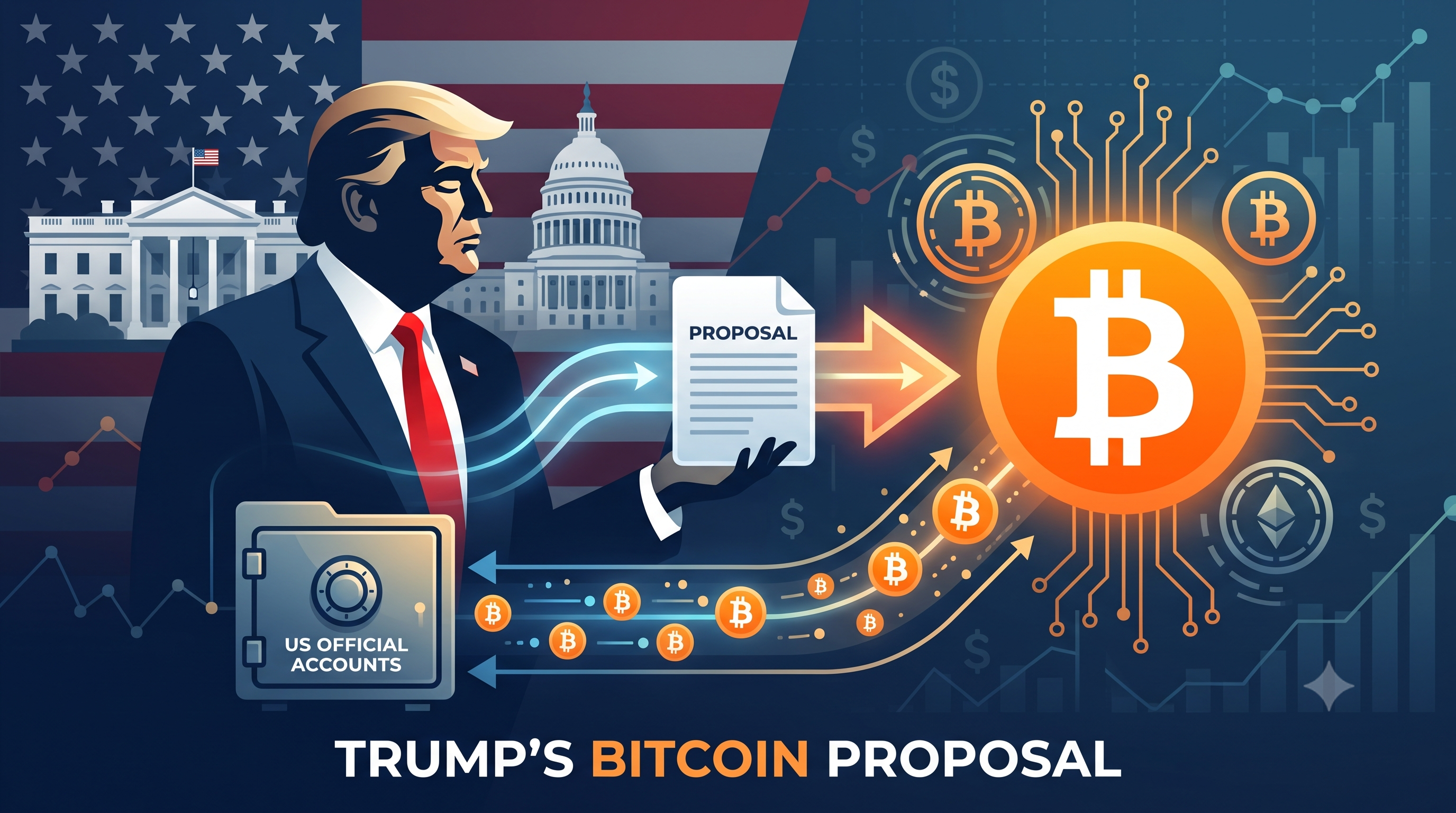
In early July 2026, a casual three-word phrase sent immediate shockwaves through the global cryptocurrency market: "It Might Happen." Uttered by President Donald Trump during a highly anticipated economic press briefing, this brief comment was not just passing political rhetoric or off-the-cuff posturing. It was a direct, calculated response to a reporter's question about whether Bitcoin would eventually be permitted as an official investment option in the newly launched, federally backed "Trump Accounts" for minors.
For the cryptocurrency industry, the implications of this potential policy shift are nothing short of staggering. For years, the crypto community has championed the idea of institutional adoption—celebrating when Wall Street asset managers launched Spot ETFs, or when major publicly traded corporations added Bitcoin to their corporate treasuries. However, integrating Bitcoin into a federally subsidized youth savings program bridges the gap between institutional wealth and everyday Main Street American families.
We are potentially looking at a scenario where billions of dollars of government-subsidized capital could be funneled directly into the Bitcoin ecosystem. This is not just about a temporary spike in trading volume; it is about permanently altering the financial foundation of the next generation. If this policy materializes, it could act as the ultimate catalyst for a macroeconomic super-cycle, embedding Bitcoin into the fabric of American retirement and savings culture.
In this comprehensive guide, we will break down exactly what the Trump Accounts are, explore the anatomy of the President's viral statement, analyze how a Bitcoin integration would technically function, and dissect why this development is the most significant bullish indicator the crypto market has seen this decade.
What Exactly Are "Trump Accounts"? A Deep Dive
To fully grasp the magnitude of a potential Bitcoin integration, it is crucial to first understand the baseline mechanics, purpose, and scale of the "Trump Accounts" program, which officially rolled out to the public on July 4, 2026.
Designed as a sweeping federal initiative aimed at combating wealth inequality and promoting early financial literacy, this program provides a tax-advantaged savings and investment vehicle for American minors. It is arguably the most ambitious domestic economic policy of the administration’s second term, designed to ensure that every child has a financial head start in life.
Core Mechanics of the Savings Program:
-
Universal Eligibility: The accounts are available to any United States citizen under the age of 18 who holds a valid Social Security Number. There are no income caps preventing middle- or upper-class families from participating, making it a truly universal program.
-
The Federal Seed Grant: The most aggressive and widely discussed feature of the program is the direct government stimulus. For children born between January 1, 2025, and December 31, 2028, the federal government directly deposits a one-time, $1,000 "seed fund" into their newly opened account.
-
Tax-Advantaged Growth: Similar to a Roth IRA, the funds within these accounts grow completely tax-free. As long as the capital and its yields are not withdrawn before the child turns 18, all capital gains taxes are legally bypassed.
-
Massive Scale and Adoption: As of mid-2026, over 6 million accounts have already been applied for and approved, highlighting the immense popularity and immediate cultural penetration of the initiative.
Currently, the architecture of the Trump Accounts is firmly rooted in traditional finance (TradFi). Parents or legal guardians act as the custodial managers of these accounts. They are required to direct the $1,000 seed money—along with any subsequent personal deposits they choose to make over the years—into a pre-approved, highly regulated menu of traditional financial assets. This includes low-cost S&P 500 index funds, target-date funds, and Treasury bond ETFs.
Historically, highly volatile alternative assets have been strictly excluded from these types of government-sponsored conversations. The potential inclusion of Bitcoin represents a massive paradigm shift in how the government views "safe" long-term wealth accumulation for the next generation.
"It Might Happen": The Anatomy of Trump's Viral Statement
To understand why the market reacted so violently to this news, we must look at the context in which the statement was made. The viral moment occurred during a televised economic town hall in Ohio. A financial reporter, noting the administration's recent friendly overtures to the cryptocurrency mining sector, posed a specific hypothetical: Would the administration ever consider letting parents allocate their children's government-funded $1,000 seed money into Bitcoin?
Trump's response was characteristically unscripted but highly revealing. He stated: "It Might Happen. We are looking at a lot of very innovative things right now, and Bitcoin, frankly, is showing a lot of strength. People love it. We want the best returns for these kids."
Within seconds of the broadcast, that soundbite was clipped and circulated across crypto-focused social media platforms. The market reaction was instantaneous. Bitcoin's spot price printed a massive green candle, surging past major resistance levels as algorithmic trading bots and retail investors alike priced in the sheer possibility of this event.
But why take this seriously? Understanding the gravity of this statement requires looking at the deep intersection of modern US politics and the crypto sector. The Trump administration in 2026 has aggressively positioned the United States as a global hub for digital asset innovation. We have seen a steady wave of deregulation, the appointment of pro-crypto regulators, and a general embrace of blockchain technology as a strategic national interest.
Furthermore, there is a distinct personal and familial tie to the industry. Recent financial disclosures from the summer of 2026 revealed that the Trump family's associated cryptocurrency ventures—including decentralized finance (DeFi) platforms, licensing deals, and various token holdings—generated over $1 billion in profit over the preceding year.
While political critics and ethics watchdogs have eagerly pointed out potential conflicts of interest, for the cryptocurrency market, it signals something much more important: the highest levels of the US government possess a deep, native understanding of digital assets. They are financially and ideologically aligned with the industry's success. This makes the inclusion of Bitcoin in a national savings program a realistic, actionable policy objective rather than a mere political pipe dream.
How a Bitcoin Investment Option Would Actually Work
If the administration manages to push this initiative through, the operational mechanics of integrating a decentralized, cryptographically secured bearer asset into a highly regulated, federally monitored savings program will be remarkably complex. The government must balance innovation with consumer protection.
The Custody Question: Who Holds the Keys?
The most pressing technical hurdle in this integration is custody. "Not your keys, not your coins" is the mantra of the hardcore crypto enthusiast, but the federal government will absolutely not expect millions of parents to manage private keys, write down 24-word seed phrases, or safely store hardware wallets for their toddlers. The risk of user error and lost funds would be a political disaster.
Instead, the integration would almost certainly rely on the existing, highly successful Bitcoin Spot ETF infrastructure that was aggressively popularized back in 2024. Rather than purchasing physical, on-chain Bitcoin, parents would be granted the ability to allocate a percentage of the Trump Account funds into government-approved, SEC-regulated ETFs like BlackRock's IBIT or Fidelity's FBTC.
This hybrid approach bridges the gap perfectly. It completely removes the risk of lost seed phrases while ensuring that the underlying asset is securely held by institutional-grade custodians like Coinbase Custody. For the end-user (the parent), buying Bitcoin for their child would feel exactly the same as buying a share of an S&P 500 index fund on a traditional brokerage app.
Setting Allocation Limits
It is highly unlikely that the government would allow a parent to place 100% of the child's $1,000 seed grant into Bitcoin. To mitigate risk and appease traditional financial regulators, the program would likely introduce allocation caps. For instance, a policy might dictate that a maximum of 10% to 20% of the portfolio can be exposed to digital assets, forcing diversification while still allowing the child to benefit from Bitcoin's asymmetric upside.
Tax-Free Crypto Wealth: The Math Behind the 18-Year HODL
The most explosive and culturally significant aspect of this proposal is the tax advantage. Bitcoin has historically been the best-performing financial asset of the last decade, but realizing those astronomical gains triggers significant capital gains taxes, heavily cutting into an investor's true profit. If Bitcoin is formally approved for Trump Accounts, it would be shielded within a tax-deferred or tax-free wrapper. Let’s run the math to understand the sheer power of this setup.
Historically, Bitcoin has averaged an annualized return that far outpaces the traditional stock market. Even if we use highly conservative metrics for Bitcoin's future growth—assuming a diminishing rate of return as its market cap grows and stabilizes—an annualized return of 15% to 20% over a nearly two-decade period yields mind-bending results. Imagine a parent who takes $200 (20% of the $1,000 government seed) and allocates it to a Bitcoin ETF the day their child is born. If that parent also decides to manually deposit an additional $50 a month into that Bitcoin allocation over the next 18 years, they are effectively utilizing a relentless Dollar Cost Averaging (DCA) strategy.
-
Total principal invested over 18 years: $11,000.
-
Assuming a conservative 15% annualized return in the crypto market.
-
The final balance at age 18: Over $55,000.
Now, imagine if Bitcoin continues to exhibit its historic volatility and upside, achieving a 25% annualized return. That same $50 a month turns into over $150,000.
Because this wealth is generated inside the Trump Account wrapper, upon turning 18, that young adult inherits this massive sum completely tax-free. They can use it to pay for college without taking on crippling student loans, use it as a down payment on a first home, or simply let it continue to compound into their retirement. The generational wealth gap could be fundamentally altered by simply granting access to hard-capped digital scarcity.
The Bull Case: Why This is a Game-Changer for Bitcoin's Price
For cryptocurrency investors, traders, and institutional whales, the prospect of Bitcoin entering the Trump Accounts is pure, unadulterated rocket fuel for a bull market. The bullish thesis breaks down into two main categories: immediate market liquidity and long-term generational adoption.
The Immediate Liquidity Shock
Let us look at the raw numbers. As previously mentioned, there are already over 6 million active accounts applied for in the system.
-
Total current applications: 6,000,000 accounts.
-
Government seed per account: $1,000.
-
Total seed capital in the system: $6 Billion.
If the policy is approved tomorrow, and even a highly conservative 10% of that capital is directed into Bitcoin by crypto-friendly parents exploring the new feature, that equals $600 Million in sudden, unconditional buy pressure directly from federal stimulus money.
However, the seed money is just the beginning. The true power lies in the recurring deposits. If millions of parents set up a $20, $50, or $100 monthly auto-deposit into the Bitcoin allocation of their child's account, it creates a relentless, price-agnostic DCA machine. These buyers do not care if Bitcoin is in a bear market, if moving averages are crossing, or if macroeconomic indicators look bleak; their automatic deposits will continuously sweep Bitcoin off the open market month after month, year after year. This creates a permanent, unshakeable price floor for the asset.
The Generational Shift and Mass Adoption
Beyond the immediate pump in spot price, this policy would permanently institutionalize the "Bitcoin Standard" in American culture. By explicitly allowing Bitcoin in a youth savings program alongside Treasury bonds and the S&P 500, the United States government would be unequivocally validating it as a pristine collateral asset. A whole generation of Americans—Generation Alpha—would grow up checking their portfolios and seeing Bitcoin as a normal, foundational pillar of traditional finance. The stigma of "internet magic money" or "shadow currency" would be eradicated instantly.
When these children turn 18, they will not need to be convinced to buy Bitcoin; they will have been raised on a Bitcoin standard. Their understanding of digital scarcity will be deeply ingrained, ensuring that the next generation of capital allocators defaults to crypto-native solutions.
Global Ramifications: Will Other Nations Copy the Playbook?
Bitcoin does not exist in a vacuum; it operates on a global, decentralized ledger. If the United States government effectively begins subsidizing Bitcoin purchases for its youth, the geopolitical game theory kicks in immediately. No sovereign nation wants to be left behind in the race for the ultimate scarce digital asset. If the US signals that Bitcoin is a legitimate tool for building generational wealth, allied nations in Europe, as well as economic rivals in Asia and the Middle East, will be forced to respond.
We could see a domino effect where sovereign wealth funds, national pension programs, and other state-sponsored savings initiatives globally begin adding Bitcoin allocations simply as a defensive hedge against the US dollar’s crypto strategy. A policy shift inside the "Trump Accounts" could very well trigger a global sovereign FOMO (Fear Of Missing Out) race, locking up massive percentages of Bitcoin's total 21 million supply and sending the price into the millions per coin.
Roadblocks and Controversies: Will the Government Actually Allow It?
Despite the euphoria rippling through crypto Twitter and the bullish projections from Wall Street analysts, the road to actual legislative implementation is fraught with severe regulatory and political hurdles. Investors must temper their expectations with a dose of reality.
Bipartisan Pushback on Taxpayer Risk
First, there is fierce bipartisan pushback brewing in Congress. Traditional lawmakers on both sides of the aisle have expressed deep discomfort with the idea of allowing taxpayer-funded stimulus money to be channeled into an asset class they still view as highly speculative.
Critics, led by staunch anti-crypto advocates in the Senate, argue that a federally backed children's fund should prioritize capital preservation and stability above all else. The narrative is simple and politically potent: The government should not be funding crypto gambling accounts for toddlers. Overcoming this narrative will require intense lobbying from the crypto industry and a masterful public relations campaign from the administration.
The Volatility Dilemma
Secondly, the sheer volatility of Bitcoin remains a sticking point for the traditional financial advisory sector. While crypto-natives deeply understand the four-year halving cycles and easily stomach 60% drawdowns as an unavoidable part of the journey to new all-time highs, traditional regulators operate differently.
Regulators fear the political fallout if a severe crypto market crash drastically reduces the nominal fiat value of millions of children's accounts right before a midterm election cycle. The optics of millions of kids "losing" their savings on the blockchain would be devastating. The administration will have to scientifically prove that an 18-year time horizon effectively neutralizes Bitcoin's short-term volatility, ensuring that long-term holders always come out ahead.
Final Thoughts: Preparing for the Ultimate Mass Adoption
Whether the "Trump Accounts" officially roll out a Bitcoin investment option next month, next year, or face delays until the end of the decade, the overarching takeaway remains profoundly bullish.
The fact that the sitting President of the United States is openly entertaining the idea of integrating Bitcoin into a national youth savings program proves that the war for legitimacy is over. Bitcoin has won. The transition from a misunderstood cypherpunk experiment in 2009 to a federally discussed savings asset for American children in 2026 marks the final, undeniable stage of mass adoption.
Cryptocurrency investors, traders, and builders should closely monitor the upcoming congressional budget debates and SEC hearings in early 2027. Any formal legislative steps toward making this proposal a reality will likely trigger a supply shock and a wave of retail FOMO unlike anything the financial markets have ever witnessed.
Frequently Asked Questions (FAQs)
Can parents transfer their own existing Bitcoin from a personal wallet into a Trump Account?
No. Based on the current framework and legislative discussions, parents cannot make "in-kind" transfers of existing crypto assets from personal hardware wallets or exchanges into a Trump Account. The accounts must be funded strictly with fiat currency (USD), which can then theoretically be used to purchase approved Bitcoin investment products (like ETFs) within the platform's walled garden.
Will other major cryptocurrencies like Ethereum, Solana, or XRP be included in the program?
President Trump's hint explicitly and exclusively referenced Bitcoin. Given the Securities and Exchange Commission's (SEC) historical stance on categorizing Bitcoin uniquely as a digital commodity (while casting regulatory doubt on the security status of other tokens), it is highly unlikely that altcoins or smart contract platforms will be considered for inclusion in a federal youth savings program anytime in the near future.
What happens to the Bitcoin if the broader crypto market crashes before the child turns 18?
As with any investment in a self-directed portfolio, the account holder bears the market risk. If the value of the Bitcoin allocation drops, the total account balance drops. However, proponents of the integration argue that the mandatory 18-year lockup period naturally hedges against Bitcoin's notorious short-term volatility, effectively forcing a long-term holding strategy that, historically, has always yielded significant profits.
Are there any fees associated with buying Bitcoin through the Trump Accounts?
While the government does not charge a fee to open or maintain the account itself, the underlying investment vehicles will have costs. If the integration utilizes Bitcoin Spot ETFs, parents will be subject to the standard expense ratios (typically ranging from 0.15% to 0.25%) charged by the asset managers like BlackRock or Fidelity, which are automatically deducted from the fund's performance.
When will an official decision be made regarding the Bitcoin integration?
There is no hard, legislative timeline in place. While the President has indicated an openness to the idea, implementing it requires a complex web of regulatory approvals from agencies like the SEC and potential congressional oversight. Wall Street analysts and political insiders suggest that the earliest we might see concrete, actionable draft proposals for this integration would be during the spring 2027 legislative sessions.
Disclaimer: This content is for informational purposes only and does not constitute investment advice. Cryptocurrency investments carry risk. Please do your own research (DYOR).