

How to Earn CFX with KuCoin (Complete Guide 2026)
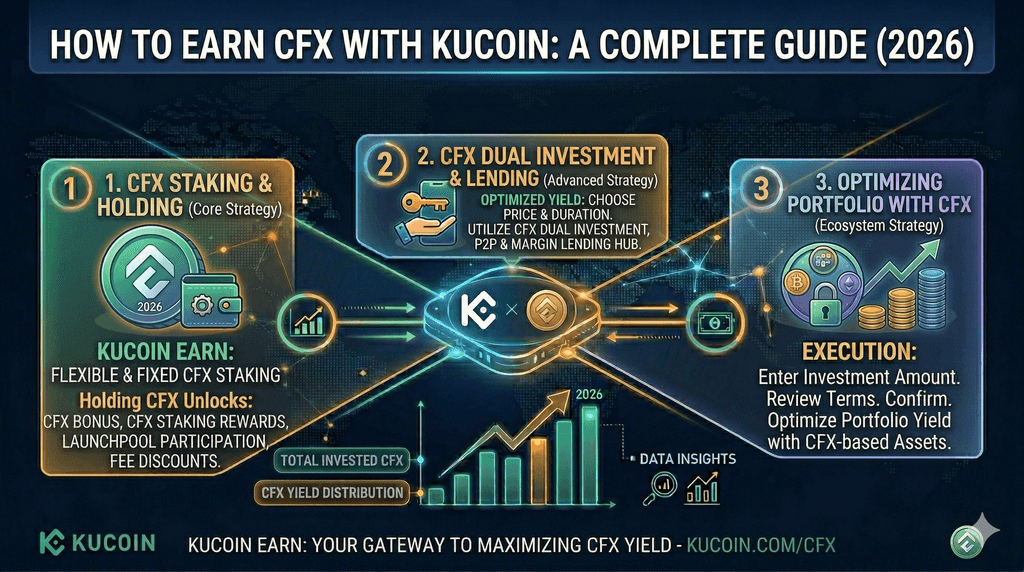
With Conflux (CFX) trading at low levels but offering yield opportunities via KuCoin’s Earn products, staking programs, and reward campaigns, there are multiple methods to earn extra CFX. However, understanding the mechanics, calculating realistic yields, and timing are essential to maximize gains and choose the best approach.
Concept of Conflux
Conflux (CFX) is the native cryptocurrency of the Conflux Network, a high-performance, layer-1 blockchain that combines proof-of-work and tree-graph consensus to achieve scalability without compromising decentralization. CFX serves multiple functions within the ecosystem: it is used for transaction fees, network security through staking, governance participation, and incentivizing developers and users.
The Conflux Network aims to provide fast, low-cost, and scalable infrastructure for decentralized applications (dApps), DeFi projects, and tokenized assets, positioning itself as a competitive alternative to Ethereum and other smart contract platforms. In essence, CFX is both the utility and governance token of a blockchain designed for real-world applications and mass adoption, rewarding participants who contribute to the network’s security and functionality.
Overview: What Earning Opportunities Exist for CFX on KuCoin
In 2026, KuCoin remains one of the major venues where traders and holders of CFX can pursue income beyond simple price appreciation. Before examining methods, it’s important to recognize Conflux’s current trading environment. According to live market data, Conflux (CFX) is trading around $0.05 – $0.06 USD with a circulating supply of over 5.1 billion tokens. Its price has fallen significantly from historic levels, which presents a context where earning yield (instead of pure speculation) becomes appealing for many holders.
Earning CFX on KuCoin can be broken into three broad categories: staking and KuCoin Earn products, reward campaigns and competitions, and strategic trading/income generation techniques. Each method has different timelines, risk profiles, and yield dynamics. Importantly, KuCoin’s ecosystem includes features beyond simple spot trading, such as passive yield products that can generate rewards periodically, which expands the ways you can put CFX to work.
From a journalistic angle, many long‑term holders are approaching CFX not as a volatile bet on price, but as a token that can pay yield. Yet, success depends on choosing the right products, understanding payout mechanics, and calculating returns versus market movements. That calculation is the backbone of truly “earning” CFX rather than merely holding it.
KuCoin Earn: The Primary Yield Engine for CFX Holders
One of the most talked‑about pathways for earning on KuCoin is KuCoin Earn, a suite of passive income products designed to generate rewards on crypto holdings. According to industry summaries, KuCoin Earn bundles tools like staking, promotions, and fixed/flexible products that let users earn yield on assets held with the exchange.
For CFX specifically, Earn can offer opportunities depending on whether the token is featured in current promotions. Products under the Earn umbrella typically include:
-
Fixed Staking – Lock CFX for a defined period (e.g., 30–90 days) and earn a fixed APY.
-
Flexible Products – Earn without locking funds permanently; withdrawals may be possible at any time (but rates fluctuate).
-
Promotional Campaigns – Time‑limited promotions with elevated APYs or bonus yield.
The key point is that Earn products have varying durations and rate structures. For example, a 30‑day fixed product might advertise an APR of 5 – 10 % for CFX, while flexible products could be lower but with more liquidity.
From an analytical perspective, you need to compute expected return based on duration and APR. Suppose a 60‑day fixed CFX product offers a 6 % APY. The approximate yield over 60 days (using simple interest for clarity) would be:
If you choose a 60-day fixed staking product for CFX with an annual yield of 6%, the expected earnings over that period would be just under 1% of your balance. For example, if you have 1,000 CFX tokens valued at $0.055 each, staking them for 60 days would generate roughly 9 to 10 CFX in rewards.
This approach allows your holdings to earn passive income while remaining locked for the staking period, giving you a clearer idea of what to expect without relying on complicated calculations. This shows that, in realistic terms, yields can be meaningful over time if products are available continuously. Importantly, Earn rates and availability vary week to week, and users must check the KuCoin platform to see whether CFX itself is supported in current Earn campaigns.
Staking CFX on KuCoin: How It Works and Yield Prospects
Staking represents one of the most direct ways to earn yield with a token. For Conflux (CFX), staking essentially involves locking tokens to support network operations, and receiving rewards in return. While on KuCoin you may not do network-level staking directly, the exchange offers a custodial staking approach where your locked CFX is aggregated with others and rewards distributed periodically.
The mechanics on KuCoin generally follow these steps:
-
Hold CFX in Your KuCoin Account – Deposit your tokens into the KuCoin wallet.
-
Subscribe to a Staking or Earn Product – Choose a fixed/flexible staking opportunity involving CFX.
-
Lock Tokens for Duration – Depending on the product, funds may be locked for a set period.
-
Collect Rewards Daily or Monthly – Earnings are issued at intervals.
Staking products usually detail an estimated) APY. If a staking option says 7% APY, you can use that to approximate earnings relative to your token balance. For example, with 2,000 CFX at 7% APY held for 90 days:
If you stake 2,000 CFX tokens in a product offering a 7% annual yield for 90 days, your expected earnings over that period would be approximately 34 to 35 CFX.
This means that by simply locking your tokens in the staking program for three months, you can earn additional CFX without needing to trade or actively manage your holdings.
Again, this is a simplified approximation, actual payouts may differ due to compounding and product rules.
What makes staking interesting is that it doesn’t require you to trade or time markets, you keep CFX idle and get compensated for it. But the catch is that you must choose periods where the yield is high enough to justify locking funds given possible price swings. It’s worth checking KuCoin’s Earn interface regularly, as featured assets in staking change and rates adjust according to market conditions and demand.
Trading Reward Campaigns: Win CFX By Engaging with the Market
KuCoin frequently runs reward campaigns and competitions that distribute CFX tokens as prizes. These activities are typically time‑limited and encourage users to trade, learn, or engage with specific markets. While not a passive yield, they are a way to earn extra CFX without holding tokens long‑term.
Historically, KuCoin has run campaigns where users could compete for a share of large CFX pools by achieving trading volume targets or answering quizzes. For example, past promotions offered pools of hundreds of thousands of CFX to users who traded or completed tasks during the campaign period.
A typical trading competition might work like this:
-
Time window – The campaign runs from X date to Y date.
-
Requirement – Users must execute a certain volume of CFX/USDT trades.
-
Leaderboard– Top volume traders share the reward pool.
-
Reward Distribution – CFX is distributed proportionally according to performance.
From a strategic perspective, reward campaigns can produce high relative gains if your trading volume is significant and you are already active. But calculating whether you profit requires comparing the trading fees incurred versus the expected share of rewards.
For instance, if a reward pool is 100,000 CFX and 1,000 traders participate, the slice you receive depends on your relative volume. If you represent 1% of the total qualifying volume:
Your Reward} = 100,000 × 1% = 1,000 CFX
However, fees (spot fees, taker/maker fees) reduce net earnings. Traders should analyze:
-
Expected fee costs based on volume tiers.
-
Liquidity in the CFX/USDT market.
-
Volatility during the campaign window.
Campaigns are often publicized on KuCoin’s promotion pages and social channels, so watching those feeds closely can uncover opportunities.
Soft Staking and Flexible Yield Products on KuCoin
In contrast to fixed staking, some platforms offer soft or flexible staking, where funds are not strictly locked, and users can withdraw at any time. KuCoin has history with “Soft Staking” on other assets, allowing holders to earn while preserving liquidity.
If such flexible products ever support CFX, they will let you:
-
Earn yield while keeping the ability to trade or withdraw quickly.
-
Avoid lock‑in periods that fixed products require.
Flexible products usually offer lower yields than fixed ones because liquidity risk is less. To calculate expected earnings, use the same method from earlier sections but adjust for lower APY. For example, at 3 % APY over 180 days:
Yield ≈ 1000 × 3% / 365 × 180 ≈ 14.8 CFX
Flexibility versus yield trade‑offs are essential for planning. If price volatility is a concern, flexible earning may suit active participants.
Always check the KuCoin Earn dashboard to see what flexible and fixed options are currently available for CFX.
Yield Calculation: How to Compare Earning Methods for CFX
Evaluating different avenues requires disciplined analysis. Let’s compare three hypothetical scenarios using consistent starting capital: 1,000 CFX.
A. Fixed Staking (60 days at 6% APY)
Yield ~ 9.9 CFX (As calculated above)
B. Flexible Product (180 days at 3 % APY)
Yield ~ 14.8 CFX
C. Trading Campaign Reward (Variable)
Suppose a campaign offers 50,000 CFX and you capture 0.5 % of volume share:
50,000 × 0.5% = 250 CFX
However, if trading fees are ~0.1% per trade and you execute $10,000 worth of trades, fees cost:
10000 × 0.1% = 10 USDT (≈ 200 CFX @ $0.05)
Net reward ~ 250 − 200 = ~50 CFX earned
This simple calculation shows that reward campaigns can outperform yield products, but they require active engagement and careful cost analysis.
Key metrics to track:
-
APR/APY offered
-
Duration
-
Fees incurred
-
Price movement during lock period
-
Liquidity and market depth
This type of calculation helps you choose the best strategy rather than chase headline APY numbers.
Real‑World Example: Setting an Earning Strategy for CFX
Imagine you have 2,000 CFX and a moderately bullish view on Conflux, but you want to earn while holding:
Step 1: Part into Yield Products
-
1,000 CFX into a 60‑day fixed staking earning ~6 % APY
Estimated ~19.8 CFX
-
500 CFX into flexible product at ~3 % APY for liquidity
Estimated ~7.4 CFX over 180 days
Step 2: Engage in a Trading Campaign
-
Use 500 CFX worth of trading volume on a campaign, aiming for a small slice of reward
Suppose net earning ~25 CFX after fees
Total Estimated CFX Earned
19.8 + 7.4 + 25 = 52.2 CFX
That’s an approximate 2.6 % yield relative to total holdings over the respective periods, plus exposure to price movement.
All calculations assume no extreme price movement, actual returns may vary.
Tips to Maximize CFX Earnings on KuCoin
To optimize results:
-
Monitor KuCoin Earn regularly for CFX featuring in promotions.
-
Track campaign announcements, trading competitions can be lucrative.
-
Time your staking entries during periods of higher APY.
-
Calculate fees carefully when competing in trading‑targeted rewards.
-
Use live market data, CFX’s price and liquidity dynamics affect returns.
Advanced participants may combine strategies: split capital across yield products and active campaigns.
FAQs
-
Can I stake CFX directly on KuCoin?
Yes, through KuCoin Earn products that allow staking or fixed deposits if available for CFX.
-
Are CFX campaigns available every week?
Campaigns vary; KuCoin runs rotating reward campaigns, but there’s no guarantee of CFX‑specific ones every week. Check promotional pages.
-
How realistic are yields?
High APY offers are often short‑term or tied to conditions. Always calculate expected yields vs. lock‑in periods.
-
Do I need large amounts of CFX to earn?
Not necessarily, many products accept low minimums, but fees and rewards scale with size.
-
What is CFX’s price now?
Live data shows Conflux trading near ~0.05 USD, reflecting market volatility and long‑term decline from past highs.
Disclaimer
This content is for informational purposes only and does not constitute investment advice. Cryptocurrency investments carry risk. Please do your own research (DYOR).