

AI Storage Chip Stocks: Have They Peaked or Is It Time to Buy the Dip?
2026/08/07 11:26:00
Introduction
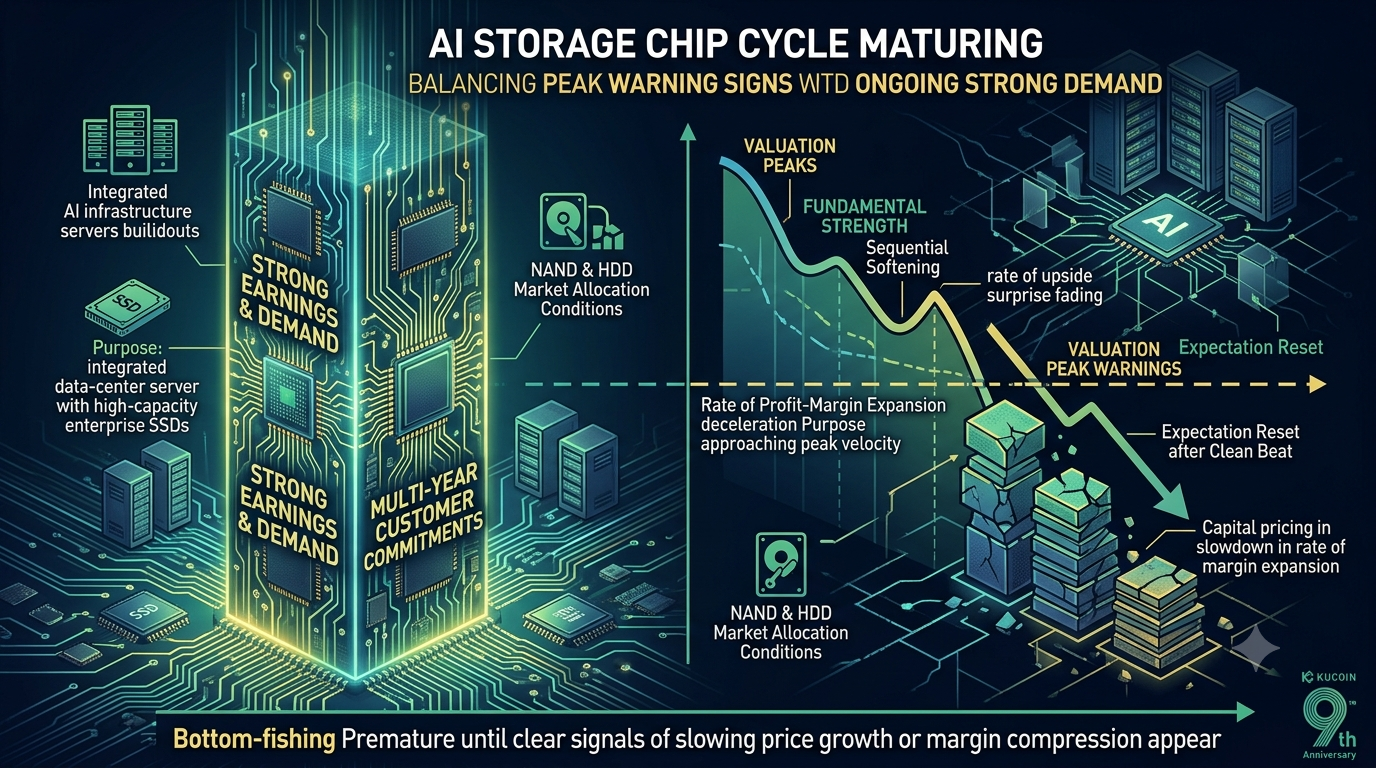
Have AI storage chips already peaked after their explosive run, or does the recent pullback in names like SanDisk, Western Digital, SK Hynix, and Micron signal a buying opportunity? The short answer is that valuation peaks are emerging while fundamental peaks have not yet been confirmed. Strong recent earnings from SanDisk and Western Digital delivered massive revenue and margin gains driven by AI data-center demand, yet both stocks sold off sharply because guidance failed to exceed already lofty expectations.
Capital is now pricing in a slowdown in the rate of profit-margin expansion even as absolute demand and pricing power remain robust. Full all-in bottom-fishing is premature until clear signals of slowing price growth or margin compression appear.
What Do the Latest SanDisk and Western Digital Earnings Reveal About AI Storage Demand?
SanDisk and Western Digital’s fiscal fourth-quarter 2026 results, reported after the close on August 5, confirmed that AI-driven demand for storage remains exceptionally strong. SanDisk posted revenue of $8.97 billion, a 372% year-over-year surge and a sequential jump of 51%. Non-GAAP gross margin hit 84.6%, and non-GAAP EPS came in at $39.25, well above expectations. The company also authorized an additional $14 billion share-repurchase program. Data-center revenue more than doubled sequentially to $2.98 billion, reflecting rapid adoption of enterprise SSDs for AI inference and data lakes.
Western Digital delivered similarly robust numbers. Fourth-quarter revenue reached $3.75 billion, up 44% year-over-year. Adjusted EPS of $3.56 beat consensus and more than doubled from the prior year. Cloud revenue, which accounts for roughly 89% of the total, rose 43% year-over-year to $3.3 billion, supported by higher-capacity nearline hard drives and favorable pricing. Exabyte shipments increased 22% year-over-year to 231. Gross margins expanded significantly, reaching the mid-50% range on a non-GAAP basis.
Both companies highlighted multi-year customer commitments and continued allocation conditions in the NAND and hard-drive markets. SanDisk noted that more than half of its fiscal 2027 bits and roughly two-thirds of fiscal 2028 bits are already under long-term agreements backed by substantial financial guarantees. These results underscore that AI infrastructure buildouts continue to absorb available supply at elevated prices.
Why Did Storage Chip Stocks Fall After Strong Earnings?
The sharp post-earnings declines in SanDisk, Western Digital, and the broader storage sector occurred because guidance, while solid, did not exceed already elevated market expectations. Markets had priced in continued acceleration of both revenue and margins. When the companies delivered excellent absolute numbers but “only” in-line or modestly better forward outlooks, investors treated the results as a disappointment. In short, the sell-off was an expectation reset rather than a deterioration in current fundamentals.
This reaction marks the first clear valuation-peak warning signal for the AI storage complex. Revenue itself has not peaked—SanDisk guided first-quarter fiscal 2027 revenue to $10.3–$10.8 billion—yet the rate of upside surprise that previously powered multiple expansion appears to be fading. Capital is beginning to trade the idea that AI storage profit-margin expansion is approaching its peak velocity even while absolute profits remain high.
What Are the Next Warning Signs to Watch for a Fundamental Peak?
Investors should monitor three sequential indicators that historically mark the transition from expansion to maturation in memory cycles. The first is a clear slowdown in the rate of storage-price increases. Industry data from mid-2026 still pointed to further sequential gains in DRAM and NAND pricing through the second half of the year, but any deceleration would be meaningful.
The second is a peak and subsequent decline in gross margins across the major producers. SanDisk’s 84.6% non-GAAP gross margin and Western Digital’s mid-50% levels represent extraordinary levels reached after rapid climbs from the 40–50% range a year earlier. A sustained sequential drop would confirm that pricing power is normalizing. The third is any downward revision of cloud-provider or hyperscaler order forecasts for 2027 and beyond. Multi-year commitments currently provide visibility, but any softening in those bookings would signal demand digestion.
Until at least one of these signals materializes, the fundamental cycle remains intact even if valuations have become more demanding.
How Does the NVIDIA Margin Trajectory Offer a Historical Parallel?
NVIDIA’s experience during the early AI boom supplies a useful template. As large-language-model training created a structural shortage of GPU compute, NVIDIA’s gross margins climbed from the low-40% range to a peak near 78% in the April 2024 quarter. After that peak, margins stabilized in the mid-to-high 70% range for an extended period. The stock, which had risen more than tenfold in roughly a year, entered a prolonged sideways consolidation. Subsequent margin recovery never pushed beyond the prior high, and the share-price trajectory flattened relative to the earlier parabolic phase even as absolute profits continued to grow.
AI storage names have followed a similar path. Gross margins across leading memory and storage suppliers have risen from roughly 50% to the 70–80% zone over the past year. Stock prices in many cases multiplied by ten times or more on the combination of improving fundamentals and speculative capital inflows. Future upside is therefore unlikely to replicate the prior magnitude of returns. A sustained period of margin plateau or modest compression would more closely resemble NVIDIA’s post-peak consolidation phase and could eventually create more attractive entry points for aggressive capital.
Is It Time to Buy the Dip in AI Storage Chip Stocks?
Aggressive all-in bottom-fishing is not yet warranted. Valuation has begun to show peak characteristics, but the underlying supply-demand imbalance, multi-year customer contracts, and elevated pricing environment have not yet peaked. Memory market forecasts issued in recent months continue to project substantial further growth into 2027, driven by agentic AI, inference workloads, and data-center expansion. Bits remain on allocation, and capacity additions lag demand.
Investors seeking exposure can consider gradual accumulation on weakness rather than concentrated bets. Monitoring the three warning signs outlined earlier—price-growth deceleration, margin compression, and order revisions—provides a clearer framework for identifying a more definitive cycle top. Until those signals appear, the sector remains in a high-profit but high-valuation phase where upside is more measured and volatility is elevated.
How to Trade AI Storage Chip Related Opportunities on KuCoin?
KuCoin offers a straightforward way to gain exposure to the AI storage theme through listed tokens, perpetual futures, and related blockchain infrastructure assets that benefit from the same data-center and high-performance computing trends. Users can open an account, complete identity verification, deposit funds via fiat or crypto, and access spot markets or leveraged products tied to semiconductor and AI narratives. Risk-management tools such as stop-loss orders and position sizing calculators help navigate the volatility typical of this sector. Always review the latest listings and conduct independent research before trading.
Join KuCoin 9th Anniversary Trading Campaign
Now you can trade such trending stock assets on KuCoin, including Nvidia, AMD, SK Hynix, SNDK, and others.
KuCoin is celebrating its 9th anniversary with a special platform campaign filled with exclusive rewards, trading activities, and limited-time offers. Don’t miss the chance to participate and enjoy the benefits as the exchange marks nine years of growth and innovation. Visit the official campaign page now:

Conclusion
Recent earnings from SanDisk and Western Digital reaffirm that AI storage demand remains powerful, with revenue growth measured in hundreds of percent and gross margins at multi-year highs. The subsequent stock declines, however, highlight that markets are now focused on the pace of further upside rather than absolute strength. This marks an early valuation-peak signal even while fundamental peaks in pricing, margins, and orders have not yet arrived.
Historical parallels with NVIDIA’s margin trajectory suggest that once margins stabilize near current elevated levels, share-price appreciation is likely to moderate. Aggressive bottom-fishing therefore appears premature; patient monitoring of price growth, margins, and hyperscaler orders offers a clearer path to identifying more favorable entry points. The AI storage cycle is maturing but has not yet rolled over.
FAQs
What is driving the current strength in AI storage chip demand?
AI training and inference workloads require massive amounts of high-bandwidth memory, enterprise SSDs, and high-capacity hard drives, creating a structural shortage that has lifted prices and margins across the sector.
How long are current multi-year supply agreements expected to last?
Leading suppliers have secured commitments covering a majority of 2027 production and a substantial portion of 2028 production, providing several years of visibility under current conditions.
Are memory prices still expected to rise in the second half of 2026?
Industry checks and analyst reports from mid-2026 indicated further sequential increases were likely, though the magnitude of those gains is under closer scrutiny after recent earnings reactions.
Why did storage stocks fall despite beating earnings estimates?
Guidance failed to exceed already optimistic consensus expectations, prompting investors to reduce positions that had been priced for continued acceleration rather than solid but more normalized growth.
What should investors watch most closely for signs of a cycle peak?
A slowdown in sequential memory-price gains, a sustained decline in gross margins at major producers, and any material downward revision of cloud-provider storage orders would be the clearest indicators that fundamentals are turning.