

Ethereum Developers Target Privacy Changes in Hegotá: Frame Transactions and FOCIL Explained
2026/08/18 17:00:00
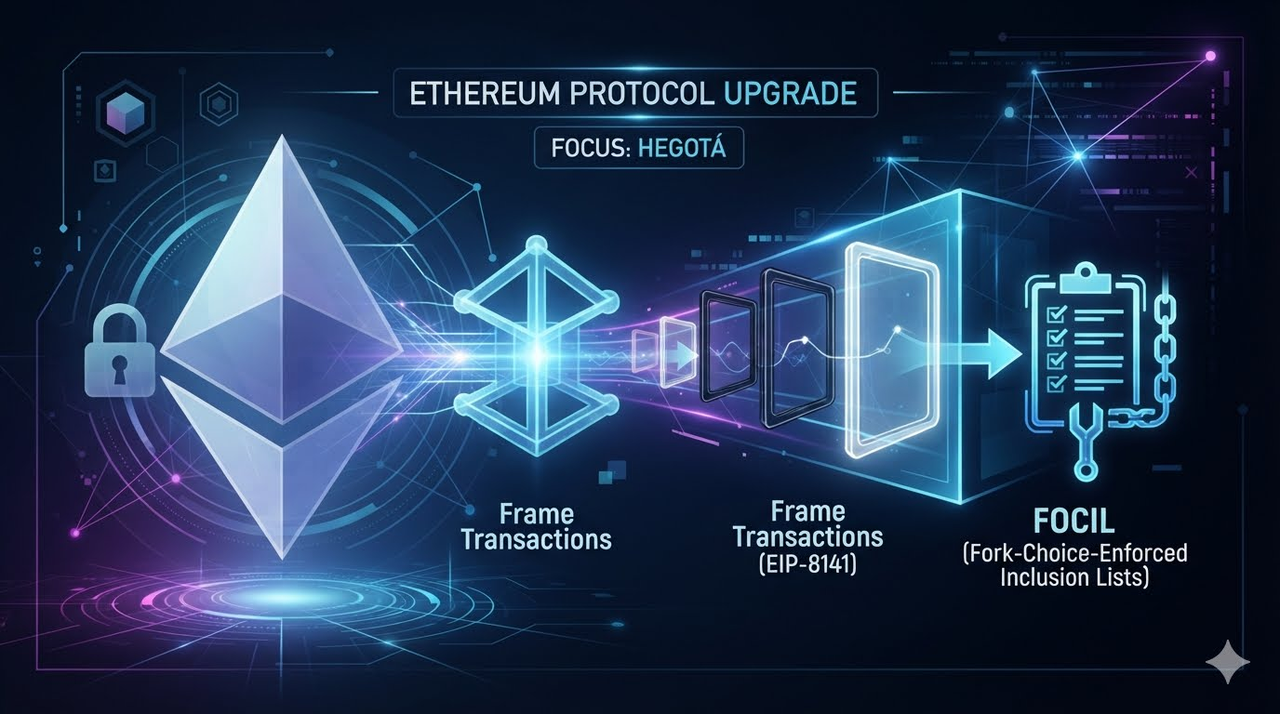
The Ethereum network is approaching a critical architectural transition. For years, the development roadmap focused heavily on scalability via Layer 2 rollups and data availability optimizations. However, as the network matures, two threats have emerged at the base layer: systemic transaction censorship by centralized entities and the technical frailty of privacy-preserving applications.
To address these challenges, Ethereum core developers are prioritizing a suite of core privacy and censorship-resistance upgrades for the upcoming Hegotá hard fork. The protocol architecture team is centering its long-term strategy on two major pillars: Fork-Choice Enforced Inclusion Lists (FOCIL) and Frame Transactions. Together, these proposals aim to embed native privacy primitives and robust neutrality directly into Ethereum Layer 1, shifting the network away from its current reliance on flawed, third-party workarounds.
Understanding Ethereum’s Current Roadmap and Timeline
Ethereum’s upgrade schedule is divided into distinct, sequential milestones. Before the implementation of the Hegotá hard fork, the network must undergo the Glamsterdam upgrade.
The Two-Step Upgrade Path
-
The Glamsterdam Upgrade: Slated for mainnet deployment, Glamsterdam focuses primarily on Layer 1 execution efficiency, optimizing storage gas costs, and laying the groundwork for algorithmic Proposer-Builder Separation (ePBS). Development has progressed across dedicated devnets and the Platåberget testnet.
-
The Hegotá Upgrade: Planned for production, Hegotá represents Ethereum’s dedicated pivot toward base-layer privacy and censorship resistance. It seeks to re-engineer how accounts validate transactions and how blocks are constructed by the consensus layer.
The 66-EIP Scramble
The primary challenge facing the Hegotá upgrade is its massive scope. There are currently 66 Ethereum Improvement Proposals (EIPs) competing for inclusion in the hard fork. Because client teams cannot safely implement, test, and audit dozens of major consensus alterations simultaneously, the scope must be drastically narrowed.
Core developers have established a strict timeline to manage this bottleneck. The protocol architecture team initiated a formal evaluation process to review competing account abstraction and transaction-framing models. Core execution client teams must submit their finalized preference and priority rankings. This data will allow developers to filter out non-essential proposals and freeze the Hegotá feature set, ensuring a stable development path.
Deep Dive into FOCIL (EIP-7805)
To understand the necessity of Fork-Choice Enforced Inclusion Lists (FOCIL), formulated under EIP-7805, one must examine the current vulnerabilities in Ethereum's block production pipeline.
The Problem: How Block Builders Control the Gateways
Under the current MEV-Boost architecture, block production is highly centralized. Instead of individual validators constructing blocks, they outsource this task to specialized entities known as block builders. A tiny cohort of dominant builders controls the vast majority of Ethereum block construction.
Because these builders operate as single points of control, they are highly susceptible to regulatory compliance demands and external coercion. Consequently, these builders routinely censor transactions interacting with sanctioned smart contracts, privacy pools, or specific decentralized applications. If a builder decides to exclude a valid, gas-paying transaction, that transaction can be delayed for multiple slots until a non-censoring builder wins a block auction.
What is FOCIL and How Does It Work?
FOCIL fundamentally alters the balance of power by stripping block builders of their authority over transaction selection. It introduces a decentralized protocol mechanic that forces builders to include specific transactions.
-
Validator Committee Selection: For every single slot, the Ethereum protocol algorithmically selects a pseudo-random committee of independent validators scattered globally.
-
Inclusion List Generation: This committee monitors the local mempool and aggregates a shared list of valid, pending transactions that have been waiting for inclusion.
-
Fork-Choice Enforcement: This inclusion list is directly tied to Ethereum’s fork-choice rule—the core software logic that determines the valid head of the blockchain.
If a dominant block builder constructs a block and deliberately omits or censors any transaction present on the FOCIL inclusion list, the network's attesting nodes will recognize the omission. Consequently, the fork-choice rule will dictate that the block is invalid. The entire network will reject the block, the builder will lose their profit, and the slot will be skipped.
Why FOCIL is the Only Guaranteed Upgrade for Hegotá
Among the 66 competing proposals under review for Hegotá, FOCIL holds a unique status. It is currently the only upgrade that core developers have formally pre-confirmed for the hard fork. This guaranteed status reflects the consensus within the Ethereum community that protocol-level neutrality is a non-negotiable requirement for the survival of a decentralized public ledger.
Demystifying Frame Transactions (EIP-8141): The New Era of Programmable Account Logic
While FOCIL guarantees that transactions cannot be blocked from entering a block, Frame Transactions—introduced via EIP-8141—re-architect how those transactions are constructed and processed by accounts.
The Core Challenge: Why Privacy Protocols Fail Without Native Support
Existing privacy protocols on Ethereum, such as traditional zero-knowledge mixers or emerging privacy pools, suffer from a fundamental design flaw at the user-interface layer. When a user wishes to withdraw funds from a privacy pool to a clean, unlinked address, that new address inherently possesses zero Ether to pay for the required network gas fees.
To circumvent this, privacy networks must rely on third-party intermediaries known as "relayers." The user signs a payload off-chain, and the relayer submits the transaction to the network, advancing the gas fee in exchange for a premium deducted from the withdrawn assets. This introduces severe systemic vulnerabilities:
-
Metadata Leakage: Relayers can log user IP addresses, transaction timings, and communication data, systematically de-anonymizing the privacy layer.
-
Centralization and Costs: Relayers operate as centralized entities that charge high fees, creating economic and structural friction for users.
Mechanics of EIP-8141: What Are "Frames"?
EIP-8141 solves the relayer dilemma by replacing Ethereum’s rigid, monolithic transaction format with a decomposed, highly programmable structure composed of distinct "frames."
A frame is a self-contained execution unit with its own validation logic. Under EIP-8141, a single transaction can bundle multiple frames together. This enables complete Gas Fee Abstraction. A privacy pool or a decentralized application can natively construct a transaction where one frame handles the user's private state change, while a separate, decoupled frame explicitly instructs the privacy pool’s smart contract to pay the network validator for the gas fees directly. By enabling the smart contract to sponsor the transaction within the same atomic execution block, EIP-8141 cuts out external relayers, preserving user metadata and lowering costs.
The Trio Companion Proposals: Keyed Nonces and Recent Roots
Frame Transactions do not operate in a vacuum. To function reliably at scale without degrading network performance, EIP-8141 requires the support of three companion proposals currently undergoing rigorous technical review:
Keyed Nonces (EIP-8250): Currently, every Ethereum account relies on a single, sequential counter (a nonce) to prevent transaction replay attacks. If a user submits a private transaction that experiences processing delays, every subsequent transaction from that account is blocked—a phenomenon known as head-of-line blocking. EIP-8250 introduces independent, key-based nonces. This allows a user to run multiple parallel transaction streams simultaneously, ensuring a delayed private transaction does not freeze their standard wallet operations.
Recent Roots (EIP-8272): Zero-knowledge privacy tools require users to generate cryptographic proofs based on a specific snapshot of the blockchain's state root. On a high-throughput network, the state root changes every 12 seconds. If a root updates while a user is generating a proof, the transaction fails. EIP-8272 allows transactions to declare validity based on an array of recent state roots, preventing race conditions and transaction failures.
Transaction Assertions (EIP-7906): This proposal allows wallets to append explicit conditional assertions to a payload. It ensures that if a malicious node attempts to alter or front-run a frame transaction in the mempool, the assertion fails, immediately canceling the execution to protect the user's funds.
Comparative Analysis: How Hegotá Reengineers the Ethereum Layer 1 Landscape
The technical changes introduced in the Hegotá roadmap represent a fundamental re-engineering of Ethereum's execution environment. The table below outlines how the base layer will change once these upgrades transition from proposal to mainnet reality.
| Metrics | Current Ethereum State | Post-Hegotá State (2027) |
| Transaction Inclusion Authority | Highly centralized; dictated by a small group of profit-maximizing block builders. | Decentralized; enforced by a rotating validator committee via FOCIL. |
| Privacy Gas Sponsorship | Dependent on third-party relayers; exposes user IP addresses and metadata. | Native gas abstraction via EIP-8141; smart contracts pay gas securely within frames. |
| Account Sequencing & Nonces | Monolithic sequential nonces; prone to head-of-line blocking across the account. | Concurrent, multi-channel processing enabled via Keyed Nonces (EIP-8250). |
| Censorship Outcomes | Censored transactions face indefinite delays until a neutral builder appears. | Blocks that omit transactions from the inclusion list are rejected by the fork-choice rule. |
| Proof-State Validity | Highly fragile; state root mismatches cause frequent zero-knowledge transaction failures. | Flexible validation against recent historical states via Recent Roots (EIP-8272). |
Market Implications: What Hegotá Means for Users, Investors, and the Privacy Sector
The realization of the Hegotá upgrade will trigger structural shifts across the broader cryptocurrency ecosystem, altering the utility of Layer 1 assets and changing how privacy software is designed.
Impact on General Users and Retail Investors
It is important to clarify a common misconception: the Hegotá upgrade will not turn Ethereum into an inherently dark, untraceable blockchain like Monero. Standard transactions—such as sending ETH or swapping tokens on a decentralized exchange—will remain transparent on the public ledger.
Instead, Hegotá provides the underlying infrastructure required for privacy to exist as an opt-in, highly performant service. Retail users will gain the ability to interact with compliant privacy pools with the same speed, reliability, and low cost as a standard transaction, eliminating the complex configuration and high fee overhead associated with legacy privacy tools.
Re-engineering the Privacy and Account Abstraction Sectors
For developers and protocols operating in the Zero-Knowledge (ZK) and Account Abstraction (AA) sectors, Hegotá fundamentally lowers the barrier to entry. By moving transaction formatting (EIP-8141) and inclusion guarantees (FOCIL) into the core protocol layer, privacy applications will no longer need to build, maintain, and secure complex off-chain relayer networks.
This allows developers to focus on building on-chain identity systems, compliant privacy pools, and advanced cryptographic validation tools. Consequently, infrastructure projects focused on modular account abstraction and decentralized identity are likely to see their underlying technical utilities re-baselined.
Conclusion
The development work surrounding Frame Transactions and Fork-Choice Enforced Inclusion Lists marks a clear philosophical shift for Ethereum core developers. After prioritizing throughput and scale for several years, the core development community is actively returning to the foundational cypherpunk tenets of the network: decentralized neutrality, censorship resistance, and consumer privacy protection.
As the Ethereum core architecture team moves closer to the Hegotá hard fork, the immediate focus shifts to the technical triage occurring behind the scenes. The upcoming client team decisions will dictate exactly which companion EIPs survive the culling of the 66-proposal list. Traders, developers, and ecosystem participants should closely monitor execution client repositories and core developer consensus calls as the definitive technical blueprint for Ethereum’s private future takes its final shape.
FAQs
Will the Hegotá upgrade make all Ethereum transactions private?
No. Standard transactions remain completely public. Hegotá simply provides the protocol-level infrastructure—like Frame Transactions—allowing developers to build seamless, opt-in privacy pools that users can choose to utilize natively.
What is the main difference between FOCIL and current inclusion lists?
Current inclusion lists are easily bypassed by block builders. FOCIL enforces inclusion lists directly through the network's fork-choice rule, meaning blocks that censor listed transactions are completely rejected by validators.
How does EIP-8141 eliminate third-party relayers?
EIP-8141 introduces programmable "frames," allowing smart contracts or privacy pools to natively sponsor and pay gas fees for a user's transaction within the same atomic execution, cutting out middleman relayers entirely.
When will the Hegotá hard fork go live on the mainnet?
The Hegotá upgrade is tentatively planned for production in 2027. It will follow the Glamsterdam upgrade, which is currently slated for deployment in the fourth quarter of 2026.
What are Keyed Nonces (EIP-8250) and why are they needed?
Traditional accounts process transactions sequentially. If one stalls, all subsequent ones freeze. EIP-8250 introduces multiple parallel transaction streams, ensuring a delayed private transaction does not block your standard wallet activities.
KuCoin Offers A More Stable Option in A Volatile Market
If you worry about the frequent ups and downs in the market, and pursue a more stable option to earn money passively, KuCoin is the right place to come:
Simple Earn: Deposit and withdraw tokens anytime, earning stable returns.
Kucoin Earn: Earn stable profits with professional asset management.
Hold to Earn: Earn rewards by holding assets in Funding, Trading, Margin, Futures, Mining, and Unified Accounts.
Staking: Unlock the earning potential of on-chain assets.
Advanced Investments: Advanced Investments offer a variety of structured products to help your money grow in any market.
Shark Fin: Principal Protection and Guaranteed Gains
Dual Investment: Buy low and sell high with transparent return calculations.
Snowball: High yields, with price protection.
Discount Buy: Buy crypto at discount prices.
KCS Loyalty: Level up to enjoy exclusive perks by staking ≥ 1 KCS.
KuCoin Wealth: Discover future value and begin your smart investing journey.
KCS Benefits: Hold and stake KCS to access benefits across the platform.
KCS Staking 2.0: Participate in KCS on-chain governance to earn yield.
Disclaimer
The information provided on this page may originate from third-party sources and does not necessarily represent the views or opinions of KuCoin. This content is intended solely for general informational purposes and should not be considered financial, investment, or professional advice. KuCoin does not guarantee the accuracy, completeness, or reliability of the information, and is not responsible for any errors, omissions, or outcomes resulting from its use. Investing in digital assets carries inherent risks. Please carefully evaluate your risk tolerance and financial situation before making any investment decisions. For further details, please consult KuCoin’s Terms of Use and Risk Disclosure.