

What Is a Quantum-Resistant Algorithm and Why It Matters for Cryptocurrencies
2026/03/28 17:30:20

The cryptocurrency landscape has experienced unprecedented growth over the past decade, attracting millions of users, traders, and institutional investors. Alongside this growth, security has become a critical concern, with blockchain networks and wallets relying heavily on classical cryptography like ECDSA and RSA. These systems, while secure against today’s computers, could be compromised by the rise of quantum computing, a technology capable of solving complex mathematical problems exponentially faster than traditional computers.
Quantum computers pose a real threat to digital assets, as they could potentially derive private keys from public blockchain information, putting billions of dollars of cryptocurrency at risk. To address this looming challenge, researchers and developers are turning to quantum-resistant algorithms, also known as post-quantum cryptography (PQC). These algorithms are designed to withstand attacks from quantum computers by relying on mathematical problems that quantum machines cannot solve efficiently.
By reading this article, you will gain a deep understanding of quantum-resistant algorithms, how they enhance the security of cryptocurrencies, the trade-offs they introduce in performance and scalability, and the practical steps exchanges, developers, and investors can take to prepare for a quantum-secure future.
Hook
Imagine a future where a single quantum computer could unlock every Bitcoin wallet in seconds. Scary? That’s why quantum-resistant algorithms are emerging as the next critical layer of security for the cryptocurrency world.
Overview
This article explores the fundamentals of quantum-resistant algorithms, the vulnerabilities of current blockchain systems, the impact of adopting PQC on network security and performance, and practical recommendations for cryptocurrency stakeholders. Key points include:
-
Understanding quantum-resistant algorithms and the types of cryptography they replace.
-
Identifying vulnerabilities in Bitcoin, Ethereum, and other blockchain networks.
-
Evaluating the impact of PQC adoption on security, scalability, and investor confidence.
-
Examining advantages, challenges, and trade-offs of implementing PQC.
-
Practical guidance for developers, and investors to prepare for quantum-safe networks.
Thesis
Quantum-resistant algorithms are no longer just theoretical; they are becoming essential for the long-term sustainability and trust of the cryptocurrency ecosystem. While their implementation introduces technical and operational challenges, the protection they offer against emerging quantum threats ensures that blockchain networks, wallets, and DeFi platforms remain secure, resilient, and future-proof.
Introduction to Quantum-Resistant Algorithms
What Is a Quantum-Resistant Algorithm?
A quantum-resistant algorithm, also called post-quantum cryptography (PQC), is a type of encryption designed to withstand attacks from quantum computers. Unlike classical computers, quantum computers can solve certain mathematical problems like factoring large numbers or solving discrete logarithms exponentially faster. These are the core problems behind widely used cryptography, such as:
-
ECDSA (Elliptic Curve Digital Signature Algorithm) – used in Bitcoin, Ethereum, and many other cryptocurrencies.
-
RSA – commonly used in traditional digital communications.
Quantum-resistant algorithms replace these with encryption based on mathematical problems quantum computers cannot solve efficiently, such as:
-
Lattice-based cryptography
-
Hash-based signatures
-
Multivariate polynomial systems
These algorithms aim to protect digital assets, transactions, and blockchain networks from being compromised once large-scale quantum computers become available.
Unlike traditional cryptography, quantum-resistant systems rely on complex mathematical problems such as lattice-based or hash-based constructions that are currently considered infeasible for quantum computers to solve efficiently.
Traditional Vulnerabilities
Most cryptocurrencies rely on elliptic curve cryptography, which exposes public keys once transactions are made. This creates a potential attack surface where quantum computers could reverse-engineer private keys, compromising wallet security and user funds.
Impact of Quantum-Resistant Algorithms on Cryptocurrency
Quantum-resistant algorithms are becoming essential for strengthening blockchain security, addressing vulnerabilities that could emerge as quantum computing technology advances. Traditional cryptography, such as ECDSA and RSA, is secure against conventional computers but may become vulnerable once large-scale quantum machines are capable of deriving private keys from public blockchain data. Without protective measures, wallets, transactions, and even entire blockchain networks could be compromised, putting billions of dollars of digital assets at risk.
The adoption of post-quantum cryptography (PQC) provides several key benefits for cryptocurrencies:
-
Enhanced Network Security: By preventing quantum-based key extraction attacks, PQC ensures that blockchain networks, wallets, and decentralized finance (DeFi) platforms remain resilient against future threats. This proactive approach helps maintain the integrity of transactions and overall system reliability.
-
Real-World Implementations: BTQ Technologies has demonstrated how integrating ML-DSA, a post-quantum standard, can create a quantum-safe version of Bitcoin. This protects against mempool-based attacks and secures private keys, offering a practical example of PQC strengthening network resilience. Similarly, KuCoinhas experimented with a post-quantum cryptography gateway using ML-KEM and Dilithium algorithms to secure Web3 connections and reduce vulnerabilities in exchange infrastructure.
-
Market Stability and Investor Confidence: Quantum-resistant algorithms contribute to long-term trust in the cryptocurrency ecosystem. By addressing potential quantum threats, they reduce the risk of disruptions that could impact user funds or destabilize trading platforms. As a result, investors and users gain confidence in the security of their digital assets.
The industry is witnessing a critical shift: blockchain systems are moving from quantum-vulnerable to quantum-resilient designs. This transition not only protects individual networks but strengthens the entire cryptocurrency ecosystem. Hybrid cryptographic approaches, combining classical and quantum-resistant methods, are being explored to ensure smooth upgrades without affecting performance. As these practices become standard, PQC adoption is likely to set new benchmarks for security, wallet management, and decentralized finance operations, preparing cryptocurrencies for the era of quantum computing while safeguarding assets and maintaining trust across markets.
Performance and Scalability Trade-offs
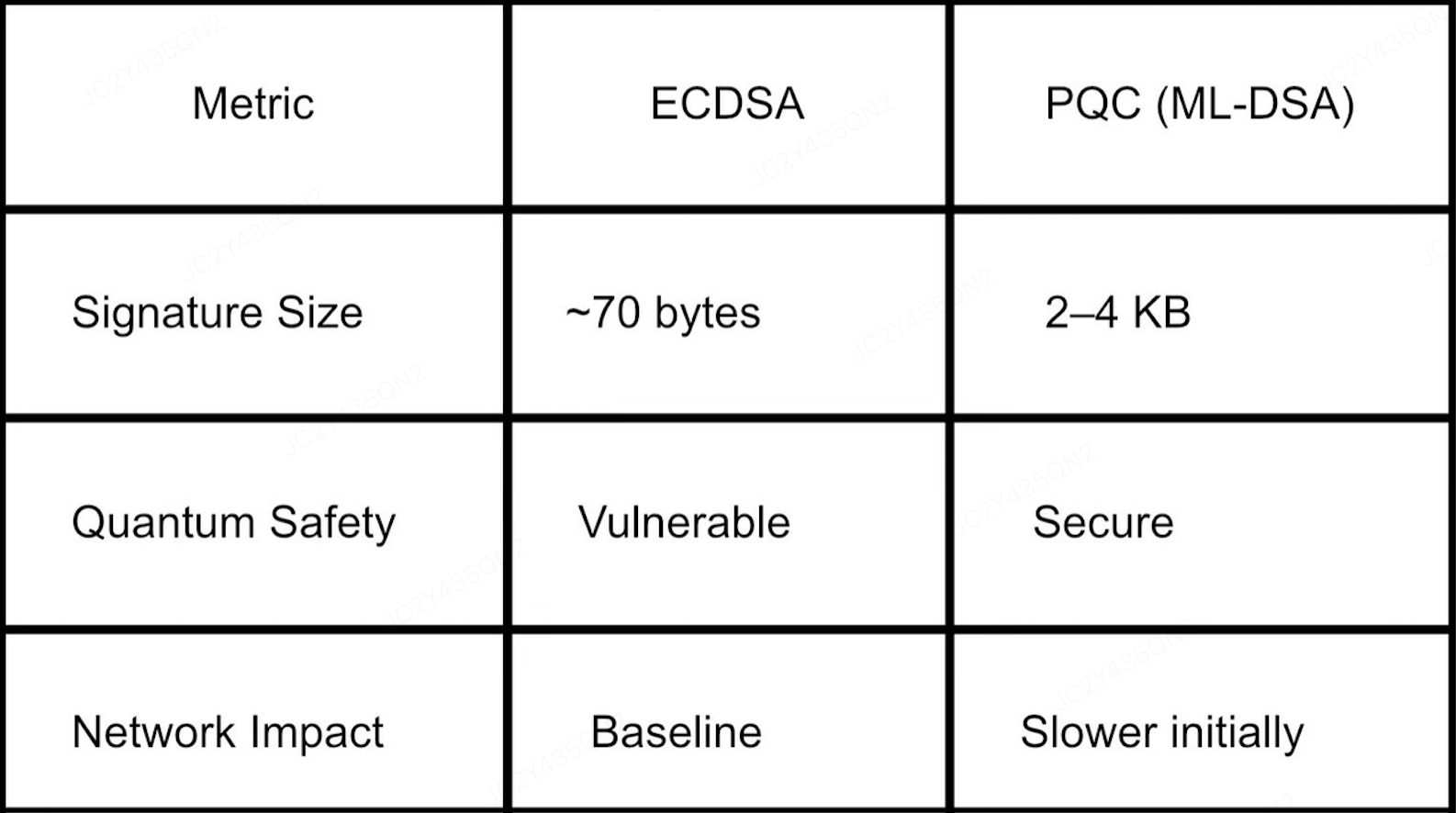
Despite their advantages, quantum-resistant algorithms introduce technical challenges.
-
Signature sizes increase significantly (from ~70 bytes in ECDSA to 2–4 KB in PQC systems)
-
Transaction throughput may decrease
-
Network fees could rise due to larger data sizes
Projects like Quantum Resistant Ledger (QRL) are addressing these issues through optimization techniques such as signature aggregation and efficient hash-based schemes (e.g., XMSS).
Additionally, Ethereum developers are exploring hybrid cryptographic upgrades, combining classical and quantum-resistant methods to ensure a smoother transition without disrupting the network.
Quantum-resistant algorithms are becoming essential for the future of cryptocurrencies. While they introduce short-term trade-offs in performance, they provide long-term protection against emerging quantum threats ensuring the sustainability, security, and trust of blockchain ecosystems.
Advantages of Quantum-Resistant Algorithms in the Current Market
Long-Term Security and Investor Confidence Benefits
Quantum-resistant algorithms offer cryptocurrencies unmatched protection against emerging quantum threats, ensuring wallets, signatures, and DeFi protocols remain secure well beyond 2030. Key benefits include unbreakable defense via modern post-quantum standards like ML-KEM and ML-DSA, preventing “harvest now, decrypt later” attacks on on-chain data, and enabling crypto-agility for seamless upgrades without network interruptions.
-
Future-Proof Security: Protects large-scale cryptocurrency holdings, including Bitcoin, from potential Shor’s algorithm exploits. Quantum-safe prototypes, such as BTQ’s implementation of Bitcoin, demonstrate how high-value assets can remain secure for long-term trading and holding.
-
Enhanced Market Trust: Adoption of quantum-resistant algorithms boosts investor confidence, stabilizing markets by mitigating exposure to quantum-based threats. This trust encourages participation from both retail and institutional investors.
-
Competitive Edge: Exchanges and platforms integrating PQC solutions, such as PQC gateways, reduce vulnerabilities and latency risks, attracting institutional traders and offering a secure environment for large-scale transactions.
Roussy Newton of BTQ notes, “Production-ready post-quantum cryptography protects Bitcoin’s entire value,” highlighting real-world pilots like QRL’s XMSS blockchain, which demonstrate zero-compromise security. Ethereum’s post-quantum roadmap illustrates scalable DeFi resilience, ensuring that smart contracts and decentralized applications remain protected as quantum computing evolves.
Challenges and Considerations
Performance Overhead and Migration Risks in Post-Quantum Blockchain
Quantum-resistant algorithms introduce significant hurdles for cryptocurrency adoption, including bloated key and signature sizes such as ML-DSA’s 2–4 KB versus ECDSA’s compact 70 bytes which inflate transaction volumes, reduce network throughput by 20–50%, and increase fees on platforms like Bitcoin and Ethereum.
-
Computational Demands: Verification latency can surge dramatically, placing strain on mining pools and exchanges during peak trading periods, as seen in PQC gateway proof-of-concept implementations.
-
Hard Fork Complexities: Upgrading protocols to quantum-resistant standards requires consensus-driven forks, which can risk chain splits or user errors during address migrations. A significant portion of funds may need immediate migration to fresh PQC-enabled addresses.
-
Interoperability Issues: Hybrid transitions may fragment wallets and decentralized applications, complicating cross-chain trading and integration.
Investor Precautions:
-
Diversify into native PQC projects such as QRL with XMSS-based security.
-
Rotate exposed keys preemptively to avoid quantum vulnerabilities.
-
Monitor updates from standards bodies and post-quantum blockchain roadmaps for Ethereum and other major networks.
-
Use aggregation techniques or Layer-2 solutions to mitigate size and throughput penalties.
-
Favor mining pools or exchanges that adapt incentives for quantum-safe infrastructure, ensuring long-term resilience is prioritized over short-term yields.
Conclusion
Quantum-resistant algorithms, or post-quantum cryptography (PQC), are becoming an essential part of the cryptocurrency ecosystem. They protect wallets, signatures, and blockchain networks from the emerging threat of quantum computing, which could otherwise compromise traditional cryptography like ECDSA used in Bitcoin and Ethereum.
While implementing PQC introduces challenges such as larger signature sizes, slower transaction speeds, and the need for protocol upgrades, the benefits long-term security, investor confidence, and resilience of decentralized finance far outweigh the drawbacks.
KuCoin always regards the security of user assets and data as its primary responsibility. Through comprehensive exploration from trading platforms to the blockchain ecosystem the goal is not only to enhance internal security technology but also to accumulate best practices for the industry in implementing PQC. By working with partners and users, KuCoin aims to build a digital asset ecosystem that can confidently face the next computing era.
Because true security comes from a reverence for the future and actions that begin at our feet, adopting quantum-resistant solutions today ensures that cryptocurrencies remain secure, trustworthy, and future-proof, safeguarding both assets and the integrity of blockchain networks.
Frequently Asked Questions (FAQ) About Quantum-Resistant Algorithms and Cryptocurrencies
What are quantum-resistant algorithms?
Quantum-resistant algorithms, also called post-quantum cryptography (PQC), are encryption methods designed to resist attacks from quantum computers. Unlike traditional cryptography such as ECDSA or RSA, these algorithms rely on mathematical problems that quantum computers cannot solve efficiently, helping to keep wallets and blockchain networks secure.
Why do cryptocurrencies need quantum-resistant algorithms?
Cryptocurrencies need quantum-resistant algorithms because quantum computers have the potential to derive private keys from public blockchain data. This could put digital assets on networks like Bitcoin and Ethereum at risk, making PQC essential to protect funds, transactions, and decentralized applications from future quantum threats.
Which cryptocurrencies are most vulnerable to quantum attacks?
Cryptocurrencies that rely on classical cryptography, including Bitcoin and Ethereum, are most vulnerable. Once quantum computers reach sufficient power, any exposed public keys could allow attackers to access wallets unless quantum-resistant algorithms are adopted.
What types of quantum-resistant algorithms are available?
There are several types of quantum-resistant algorithms, including lattice-based cryptography such as ML-KEM, hash-based signatures like XMSS, and multivariate polynomial systems. These methods are currently considered secure against known quantum computing attacks.
Have any exchanges or blockchain platforms adopted quantum-resistant algorithms?
Yes, some exchanges and projects are exploring PQC. KuCoin, for example, launched a proof-of-concept ML-KEM/Dilithium gateway to enhance Web3 security. Similarly, Quantum Resistant Ledger (QRL) implements XMSS hash-based signatures to provide long-term blockchain security.
When will major cryptocurrencies like Bitcoin adopt quantum-resistant algorithms?
Full-scale adoption is still experimental. Developers are testing hybrid solutions that combine classical and quantum-resistant methods. While some discussions suggest potential pilot implementations around 2026, there is no confirmed hard fork schedule yet.
Can quantum computers actually steal cryptocurrency funds today?
Currently, quantum computers are not powerful enough to compromise modern cryptocurrencies. The threat is potential and future-focused, but preparing with quantum-resistant algorithms now can prevent “harvest now, decrypt later” attacks once quantum computing becomes more advanced.
Disclaimer: The information provided on this page may originate from third-party sources and does not necessarily represent the views or opinions of KuCoin. This content is intended solely for general informational purposes and should not be considered as financial, investment, or professional advice. KuCoin does not guarantee the accuracy, completeness, or reliability of the information, and is not responsible for any errors, omissions, or outcomes resulting from its use. Investing in digital assets carries inherent risks. Please carefully evaluate your risk tolerance and financial situation before making any investment decisions. For further details, please consult our Terms of Use and Risk Disclosure