

What If SBF Hadn’t Sold? His $200K Cursor Investment Is Now Worth $3 Billion
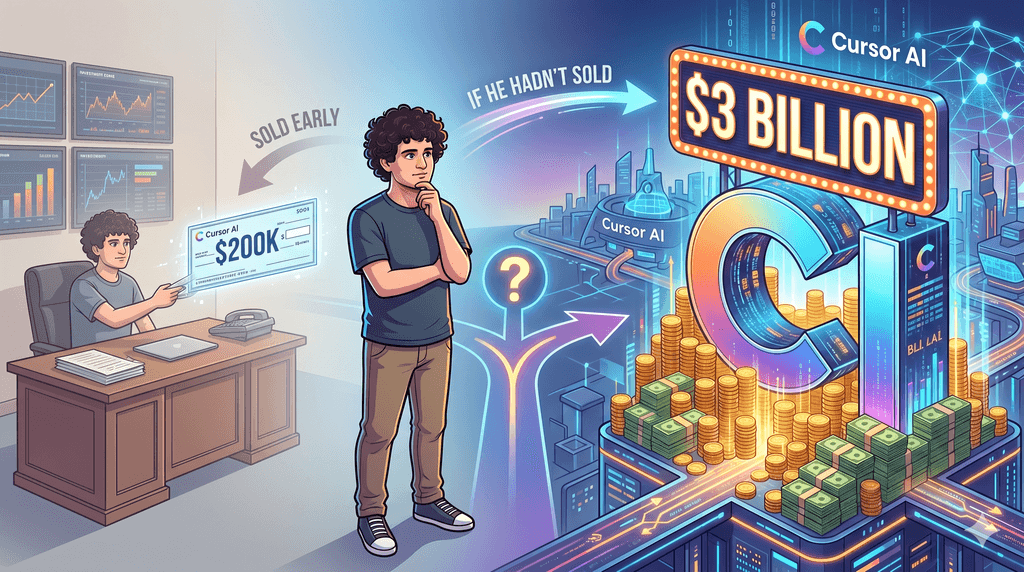
Did Sam Bankman-Fried (SBF) actually have the greatest "eye" for tech in history, or was he just the world’s luckiest reckless spender? As of April 2026, the answer to that question is worth a staggering $3 billion—at least in the case of a single AI startup called Cursor.
In 2022, SBF’s Alameda Research funneled a seemingly minor $200,000 into a pre-seed round for Anysphere, the developer behind the AI coding tool Cursor, securing a 5% equity stake. Had the FTX bankruptcy estate not liquidated those shares at cost for a measly $200,000 in early 2023, that position would now be worth $3 billion following SpaceX’s recent $60 billion valuation of the company. This isn't just a story of "what if"; it is a stark illustration of how the intersection of AI and crypto is minting the next generation of unicorns, and how the forced liquidations of the FTX era represent one of the largest missed "HODLs" in financial history.
Key Takeaways
-
The $3 Billion "Oops": SBF's 5% stake in Cursor (Anysphere), bought for $200k, would be worth $3 billion today based on SpaceX’s $60 billion valuation.
-
Forced Liquidation: The FTX estate sold the shares back to the founders at the original purchase price ($200k) in 2023 to raise immediate cash for creditors.
-
The AI-Crypto Boom: Cursor’s meteoric rise is driven by its integration into the developer workflow and its recent partnership with SpaceX for next-gen AI coding.
-
Opportunity Cost: The total "missed" value of SBF’s early-stage portfolio—including Anthropic and Solana—is now estimated to exceed $114 billion.
-
Creditor Impact: While FTX creditors are being repaid 100%+ in cash, they missed out on the parabolic gains of the assets SBF originally picked.
The $200,000 Bet That Became a $3 Billion Ghost
The FTX bankruptcy estate surrendered a 5% stake in Cursor for just $200,000 in 2023, missing out on a 15,000x return that would be worth $3 billion today.
In April 2022, Alameda Research co-invested $400,000 alongside Heroic Ventures into a fledgling startup called Anysphere. Alameda’s portion was $200,000, which granted them approximately 5% of the company's equity. At the time, Cursor was barely a blip on the radar—a niche AI tool for developers. However, following the FTX collapse in November 2022, the bankruptcy estate, led by Sullivan & Cromwell, began a "fire sale" of private equity assets to build a cash pile for creditor distributions.
According to court filings from April 2026, the estate offloaded the Anysphere stake back to the founders or early investors in 2023 at its original cost. Today, with SpaceX announcing a letter of intent to acquire Cursor for $60 billion (or pay a $10 billion collaboration fee), that 5% stake has theoretically reached a value of $3 billion.
Why the Estate Sold Early
The primary mandate of a bankruptcy estate is liquidity and risk mitigation, not venture capital speculation. In 2023, the future of AI was still speculative to many liquidators, and the "crypto winter" made every dollar of immediate cash precious. By selling at cost, the estate avoided the risk of the startup failing, but in doing so, it signed away one of the most profitable trades in the history of the venture industry.
Cursor’s Rise: From Niche Tool to $60 Billion Powerhouse
Cursor's valuation skyrocketed from $29 billion in late 2025 to $60 billion in April 2026, fueled by its dominance in AI-assisted programming and a landmark SpaceX partnership.
The reason for the massive jump in value lies in Cursor's evolution from a simple fork of VS Code to the industry standard for "AI-native" development. By 2026, Cursor had successfully integrated frontier models like Gemini 3.1 Pro and Claude 4.6 Sonnet into a seamless environment where the AI doesn't just suggest code—it understands the entire repository context.
The SpaceX Catalyst
The most recent valuation spike was triggered by SpaceX’s April 2026 announcement. Elon Musk’s aerospace giant enters a partnership to use Cursor’s technology for mission-critical software development. The deal includes:
-
Acquisition Rights: SpaceX holds an option to buy the company for $60 billion later this year.
-
Collaboration Fees: If the acquisition doesn't proceed, SpaceX will pay $10 billion in fees to continue using the proprietary tech.
This "de-risks" Cursor's future, effectively setting a floor on its valuation and highlighting the massive demand for specialized AI in high-stakes engineering.
The "SBF Portfolio" Paradox: Genius or Just Large?
SBF’s early-stage investments in Anthropic, Solana, and Cursor suggest a high "hit rate," but his success was financed by the illegal use of customer deposits.
It is tempting to look at these numbers—$3 billion from Cursor, $80 billion from Anthropic, and billions from Solana—and conclude that Sam Bankman-Fried was a visionary. However, the 2026 market perspective is more nuanced. Analysts argue that SBF’s "vision" was simply the result of having an effectively infinite pool of "free" capital (customer funds) to spray across every high-potential tech sector.
The Hidden Gains of the FTX Portfolio
If the FTX estate had "diamond handed" its top holdings, the total value would be staggering:
-
Anthropic: A $500 million investment would now be worth over $82 billion.
-
Solana (SOL): Tokens bought at $8 are now trading near all-time highs in 2026, representing a 20x+ gain from the lows.
-
Sui (Mysten Labs): A $100 million stake is now valued at roughly $800 million.
The irony of the 2026 crypto landscape is that while SBF sits in prison, the projects he backed are the very ones powering the current bull market. The $114 billion "hypothetical" value of the FTX portfolio is nearly ten times what was owed to customers at the time of the crash.
How AI and Crypto Convergence is Driving the 2026 Bull Market
The explosion of "AI-Crypto" projects has become the dominant narrative of 2026, with Cursor acting as the bridge between traditional software development and decentralized computing.
In the current market, we are seeing a massive shift where AI tools are no longer just software—they are becoming the primary users of the blockchain. Cursor’s success is a signal that the tools used to build the internet are becoming as valuable as the platforms themselves.
The Shift to "Agentic" Development
In 2026, the trend is moving toward "Agentic" workflows. Developers are using Cursor to write smart contracts that are then audited by other AI agents and deployed to chains like Solana or Ethereum automatically. This efficiency has compressed the development cycle from months to days, leading to a flood of new decentralized applications (dApps) that are more robust and secure than those seen in the 2021 cycle.
| Asset Type | 2022 Entry Price | 2026 Est. Value | Growth Factor |
| Cursor (Equity) | $200,000 | $3,000,000,000 | 15,000x |
| Anthropic (Equity) | $500 Million | $82.3 Billion | 165x |
| Solana (SOL) | ~$8.00 | ~$180.00 | 22.5x |
| Sui (Team Stake) | $100 Million | $800 Million | 8x |
The Legal Battle Over "Solvency" in 2026
SBF’s legal team is using the astronomical rise of these "sold-too-early" assets to argue for a retrial, claiming FTX was never truly insolvent.
As of April 2026, SBF has submitted a 102-page appellate brief seeking to vacate his 25-year sentence. A central pillar of his defense is the "Advice of Counsel" argument, but a growing secondary narrative is the "solvency" of the exchange. His lawyers argue that the bankruptcy estate’s mismanagement—specifically selling assets like the Cursor stake at cost—created a false impression of a total loss.
The Creditor Dilemma
While most creditors are being repaid 100% of their 2022 dollar-value claims plus interest, there is a lingering sense of resentment. If the estate had held the Cursor, Anthropic, and Solana positions, every FTX user could have potentially received a 5x or 10x return on their original deposits. Instead, the "excess" billions are being diverted to preferred shareholders and legal fees, which have topped $1 billion as of this month.
Should You Trade AI-Linked Tokens on KuCoin?
The story of SBF’s missed $3 billion windfall in Cursor highlights one undeniable truth: the intersection of AI and blockchain is where the most explosive growth is happening in 2026. While you can't buy private equity in Cursor easily, the "AI-Crypto" sector on KuCoin is currently seeing record-breaking volume as traders look for the "next Cursor."
Projects involving decentralized GPU rendering, AI data labeling, and automated trading agents are currently dominating the top gainers list. By trading on KuCoin, you gain access to the same high-alpha opportunities that venture capitalists target, but with the liquidity of a global exchange. With Bitcoin and Ethereum ETFs stabilizing the "blue chip" market, the real excitement—and the potential for 100x gains—has shifted to the AI infrastructure layer. Are you ready to find the next investment that turns $200,000 into $3 billion?
How to Buy/Trade AI and Crypto Tokens on KuCoin
-
Register or Log In: Go to the KuCoin website or app and set up your account. Ensure your KYC is updated to access all trading features.
-
Deposit Funds: Transfer USDT, BTC, or ETH into your KuCoin Trading Account.
-
Search for AI Tokens: Use the "Markets" tab and search for the "AI" category or specific tickers like FET, RNDR, or newer 2026 AI-native protocols.
-
Execute Your Trade: Choose between a "Limit Order" to set your price or a "Market Order" for instant execution.
-
Secure Your Assets: Once your trade is complete, consider moving your long-term "HODL" positions to a secure wallet or use KuCoin Earn for passive yield.
Conclusion
The revelation that a $200,000 investment in Cursor could have been worth $3 billion is a haunting reminder of the volatility and opportunity within the tech sector. For the FTX bankruptcy estate, the decision to sell was a matter of legal protocol and risk management; for Sam Bankman-Fried, it is another chapter in a legacy defined by "what could have been."
As we move through the second quarter of 2026, the focus has shifted from the wreckage of the 2022 collapse to the massive technological leap powered by artificial intelligence. The Cursor story proves that the "smart money" of the previous cycle wasn't always wrong about the technology—they were just wrong about the ethics and the risk management required to hold onto it. For modern investors, the lesson is clear: identifying high-conviction tech early is only half the battle; the other half is ensuring you are trading on a platform and within a regulatory framework that allows you to actually keep the gains you realize. Whether SBF is a "visionary" or a "villain," his $3 billion ghost will continue to haunt the crypto markets for years to come.
FAQs
Is there a Cursor (Anysphere) token I can buy?
No, Cursor is a private company owned by Anysphere and does not have a native cryptocurrency token as of April 2026. The $60 billion valuation is based on private equity and its partnership with SpaceX, not a public token market cap.
Can I still get 100% of my money back if I was an FTX user?
Yes, according to the March 2026 update from the FTX Recovery Trust, most customer classes are now receiving cumulative distributions of 100% to 120% of their original 2022 claim value. However, this is based on the dollar value at the time of the bankruptcy, not the current 2026 prices of the tokens you may have held.
What is the "Advice of Counsel" defense SBF is using in 2026?
This legal strategy argues that SBF did not have "fraudulent intent" because he was acting on the advice and oversight of qualified lawyers. His legal team claims that if he believed his actions were legal based on professional counsel, he cannot be held criminally liable for fraud.
Which other AI companies did FTX invest in besides Cursor and Anthropic?
FTX and Alameda had a wide-reaching "frontier tech" portfolio that included investments in various AI startups focused on automated coding, healthcare data analysis, and large language model (LLM) safety. Most of these were sold off between 2023 and 2024 to fund creditor repayments.
How does the SpaceX deal affect the broader crypto market?
The SpaceX-Cursor partnership is seen as a "bullish" signal for the AI-Crypto sector because it validates the use of AI tools in high-stakes, real-world engineering. This often leads to increased speculative interest in decentralized AI projects that provide the computing power or data needed for such tools.
Disclaimer: This article is for informational purposes only and does not constitute financial or investment advice. Cryptocurrency investments carry significant risk. Always conduct your own research before trading.