

NEAR Launches Stake-to-Compute Payments: Use Staked NEAR to Access AI
2026/07/31 19:07:00
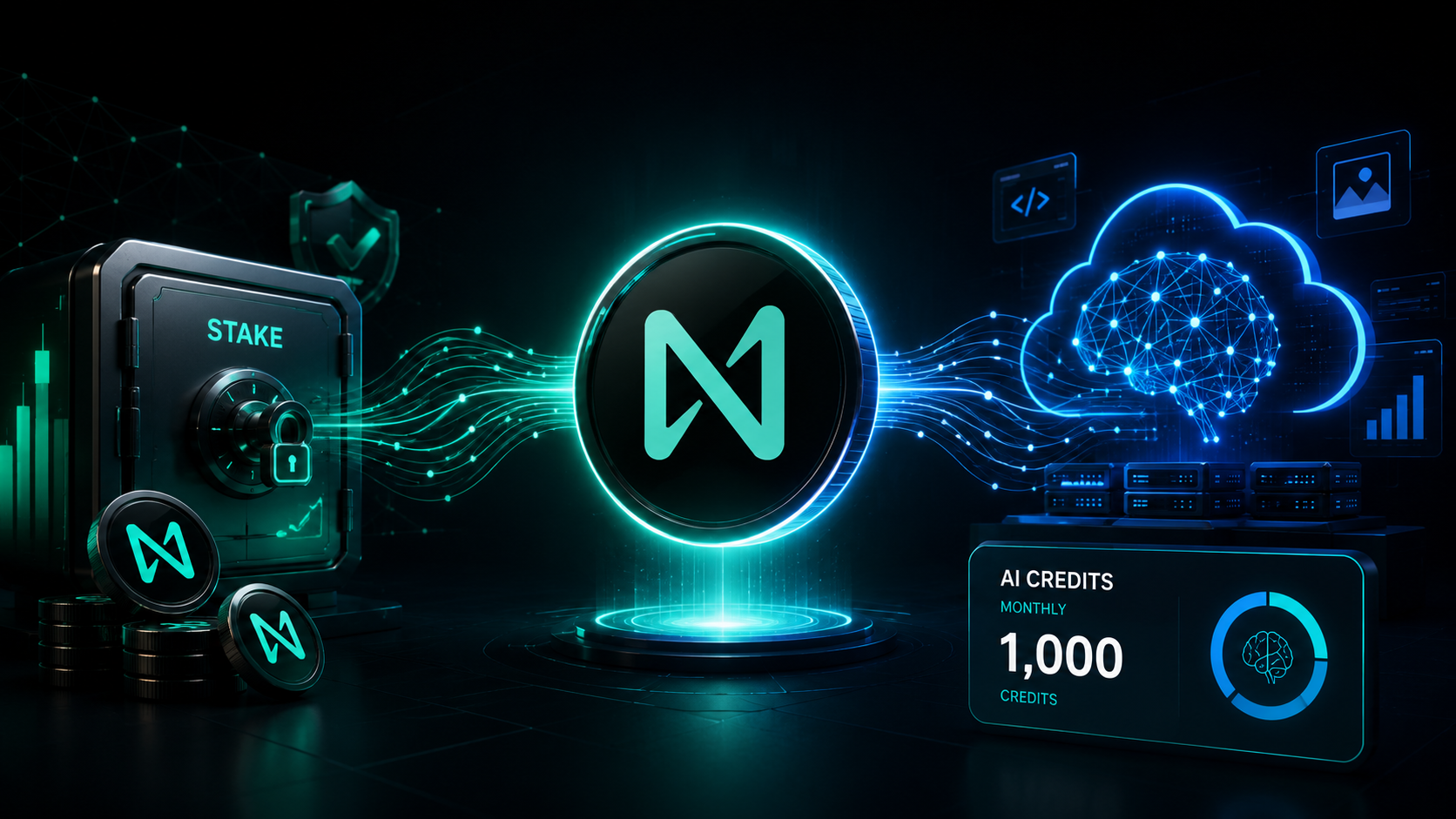
Proof-of-stake rewards have traditionally served one purpose: compensate token holders for helping secure a blockchain. NEAR AI is testing a different model. Instead of receiving staking rewards as additional tokens, users can stake NEAR and obtain credits for AI inference, cloud services and continuously running AI agents. The original NEAR remains under the user’s control, while the rewards generated by that stake are routed directly to NEAR AI as payment for the services.
The launch gives NEAR a clearer connection between token ownership and a service people can consume. It also raises several questions. Users must give up ordinary staking rewards, accept NEAR price risk and spend credits within the NEAR AI ecosystem. Meanwhile, NEAR AI must convert token-denominated rewards into enough revenue to cover GPUs, infrastructure and agent hosting. Stake-to-compute is therefore more than a new staking feature. It is an experiment in whether the economic output of a crypto asset can become a recurring payment rail for real AI services.
What NEAR Actually Launched
NEAR Protocol announced a staking-based payment mechanism that allows holders to access AI services by staking NEAR. The official announcement describes a system in which users receive recurring compute credits while retaining ownership of the underlying stake. NEAR co-founder Illia Polosukhin also said the mechanism can fund private inference and the deployment of always-on IronClaw agents.
The phrase “use staked NEAR to access AI” needs some clarification. Users are not selling the principal or converting the deposited tokens into cloud credits. Instead, the NEAR is delegated through a supported validator or staking structure. The protocol-level staking rewards generated by that position are routed directly to NEAR AI as consideration for the service. The customer does not receive those rewards as interest, income or investment yield.
NEAR AI describes the arrangement as non-custodial. Customers retain ownership of their staked NEAR and control the wallet’s private keys. NEAR AI says it cannot withdraw or transfer the principal through the applicable staking-pool contract. Users may initiate unstaking, although the tokens only become withdrawable after the relevant protocol unlock process has been completed.
The credits themselves are not transferable tokens or cash balances. They are service units that can be consumed within eligible NEAR AI products. NEAR AI’s terms explicitly state that the credits should not be represented as interest, dividends, investment returns or securities.
How Stake-to-Compute Works
The basic process can be understood as a seven-step flow:
-
A user connects a wallet to the supported NEAR AI product.
-
The user stakes NEAR through the designated validator or product workflow.
-
The principal remains associated with the user’s wallet.
-
The stake generates rewards under NEAR’s proof-of-stake protocol.
-
Those rewards are routed directly to NEAR AI.
-
The user receives AI Usage Credits based on the product rules and amount staked.
-
The credits are spent on inference, cloud services or agent hosting.
This structure resembles a subscription funded by the economic output of a deposit. A conventional customer pays a monthly bill using a credit card or stablecoin. A stake-to-compute customer maintains a token position and allows the service provider to receive the rewards produced by that position.
The arrangement does not make the AI service free. The user pays through several less visible costs: forfeited staking rewards, exposure to NEAR price movements and reduced liquidity during the unstaking period. Monthly credits may also expire before they are fully used. A user who stakes NEAR but rarely calls the AI service can therefore incur a real opportunity cost even though the principal remains intact.
The model is most useful when the customer already wants both NEAR exposure and recurring AI services. Someone who would otherwise stake NEAR and separately pay for inference may prefer to combine the two activities. Someone who does not need AI infrastructure may receive more flexible value from ordinary staking rewards.
Two Products, One Staking Model
NEAR AI’s terms describe two related but distinct implementations: Agent Hosting Staking and Cloud Staking. Both route staking rewards to NEAR AI, but they differ in how credits are issued and used.
| Feature | Agent Hosting Staking | NEAR AI Cloud Staking |
| Main purpose | Hosting continuously running AI agents | Private inference and eligible cloud services |
| Credit distribution | Monthly allocation | Continuous or near-continuous accrual |
| Credit expiration | Monthly credits expire at the end of the period | Accrued credits generally do not expire |
| Disclosed minimum | 50 NEAR | Shown in the applicable product interface |
| Principal custody | Non-custodial | Non-custodial |
| Reward destination | NEAR AI | NEAR AI |
| Capacity limits | Number of agents depends on tier | Service usage depends on available credits |
Agent Hosting Staking functions like a monthly subscription. The amount staked determines the plan, the maximum number of agents and the monthly dollar-denominated credit allocation. Unused monthly credits do not roll over. Customers may buy additional one-off credits, which are treated as ordinary service payments rather than staked assets.
Cloud Staking is more flexible. Credits may accrue continuously or nearly continuously and can be applied to eligible NEAR AI Cloud services. They may also be associated with an organization and shared across members, workspaces and API keys. Unless the product states otherwise, already accrued Cloud Staking credits do not expire.
What Users Can Buy With the Credits
NEAR AI Cloud provides an OpenAI-compatible API, allowing developers to use familiar OpenAI client libraries with a different base URL and a NEAR AI API key. This reduces integration work for teams that already use software designed around the OpenAI API format.
The platform supports more than standard chat completions. Its documentation lists reasoning models, tool calling, embeddings, reranking, image generation, audio transcription and privacy-related endpoints. Credits can therefore fund several types of AI workloads rather than a single chatbot subscription.
NEAR AI also offers agent-hosting infrastructure for continuously executing software agents. Its terms define AI agents as software processes capable of initiating actions, calling external APIs and completing multi-step tasks without human authorization for every individual action. IronClaw is identified as NEAR AI’s open-source agent offering.
The service is therefore aimed more directly at developers, agent operators and businesses than at holders looking for a basic consumer chatbot.
Private Inference Is a Major Part of the Pitch
NEAR AI differentiates its cloud partly through Trusted Execution Environments, or TEEs. Its documentation says supported inference workloads run inside hardware-isolated environments built with Intel TDX and NVIDIA confidential-computing technology. Prompts, model weights and outputs are intended to remain inaccessible to the infrastructure provider and NEAR AI while computation is taking place.
The system also produces cryptographic attestation and signatures. These allow a user to check that a request was processed within the expected secure environment and that the response was not modified after leaving it. Both gateway and direct-completion routes can terminate encrypted connections inside a TEE, according to the technical documentation.
That privacy promise has an important limitation. NEAR AI’s model catalog includes both TEE-hosted models and third-party models from external providers. TEE-hosted models receive NEAR AI’s privacy, attestation and verification protections. Models proxied to providers such as OpenAI, Anthropic or Google use a unified API and billing layer, but the same TEE guarantees do not extend to the upstream provider.
Users should therefore check the model type before assuming every request has identical confidentiality. The strength of the privacy protection depends on the selected model, the routing method and whether inference occurs within NEAR AI’s attested environment.
What Does It Cost in Practice?
The clearest public pricing structure applies to Agent Hosting Staking. The minimum is 50 NEAR, and the subscription is divided into three tiers.
| Tier | Staked NEAR | Maximum AI Agents | Monthly Usage Credits |
| Starter | 50–500 NEAR | 1 | $5 flat |
| Basic | 500–2,000 NEAR | 2 | $5–$20 |
| Pro | 2,000–20,000 NEAR | 5 | $20–$200 |
Where the stake sits exactly on a tier boundary, the higher tier applies. NEAR AI may accept more than 20,000 NEAR, but credits generally do not rise beyond the Pro maximum unless the company agrees to different terms. Monthly subscription credits expire at the end of each billing period and cannot be transferred or refunded.
The Starter tier has an unusual structure. Someone staking 50 NEAR receives the same $5 monthly allocation as someone staking 499 NEAR. Unless the customer needs a larger stake for another reason, the bottom of the tier offers much better credit value per NEAR. Basic and Pro credits scale more gradually with the deposited amount.
However, calculating “credit yield” by dividing the annual credits by the market value of the stake can be misleading. A $5 credit is not $5 in withdrawable income. It can only be spent on designated services, and unused monthly credits disappear.
A customer who uses every dollar of credit may find the plan competitive. A customer who leaves most credits unused is effectively surrendering staking rewards for little practical benefit.
Ordinary Staking vs. Stake-to-Compute
Ordinary NEAR staking and stake-to-compute begin with the same asset but produce different outcomes. In ordinary staking, rewards go to the token holder. Those tokens can be sold, held, delegated again or used elsewhere in the ecosystem. In the NEAR AI model, rewards go to the service provider and the holder receives restricted credits instead.
This changes the form of the return. Ordinary staking produces a volatile but transferable crypto asset. Stake-to-compute produces a dollar-denominated service entitlement that cannot normally be withdrawn or transferred. The credit may offer more predictable purchasing power for a developer, but it has less flexibility than a token reward.
The decision depends on the user’s objective:
-
Choose ordinary staking when the priority is accumulating NEAR, preserving flexibility or compounding token rewards.
-
Choose stake-to-compute when the user already expects to pay for inference or agent hosting every month.
-
Avoid over-staking for credits when the plan’s service allowance is likely to go unused.
-
Compare alternatives when equivalent cloud resources are available more cheaply through conventional providers.
NEAR AI’s business model also deserves attention. The company receives NEAR-denominated staking rewards while many infrastructure costs—including GPUs, electricity and hosting—are priced in fiat currency. It may need to sell some of those rewards to meet expenses. Stake-to-compute can reduce the need for users to sell their principal, but it does not necessarily eliminate token selling from the system.
What It Could Mean for the NEAR Token
The strongest argument for the new mechanism is that it gives NEAR a service-linked utility beyond transaction fees and conventional network staking. A developer who wants access to NEAR AI may need to acquire and stake the token, creating a possible source of demand connected to actual product usage.
The model may also place more NEAR into staking contracts. That can reduce the portion of supply immediately available on exchanges, at least while customers maintain their subscriptions. A larger staked base can also strengthen network participation, although stake directed through a small number of designated providers would need to be monitored for concentration.
Several limitations prevent this from being treated as an automatic price catalyst:
-
Existing holders may use tokens they already own, producing no new market demand.
-
Staking rewards are transferred, not burned.
-
NEAR AI may sell rewards to fund operating expenses.
-
Users can eventually unstake and return the tokens to circulation.
-
Credit demand depends on whether NEAR AI’s services are competitive.
-
NEAR AI can adjust future credit ratios as token prices or service costs change.
Three distinctions are especially important. Higher staking demand is not the same as token burning. Locked supply is not permanently removed supply. New utility is not automatically sustainable value accrual. The token benefits only if the service attracts users who continue staking because they find the AI product economically useful.
Why the Model Matters Beyond NEAR
Stake-to-compute introduces a broader idea: using the rewards generated by a crypto asset to fund a recurring subscription while preserving the principal. The same structure could theoretically be applied to storage, connectivity, software tools, data services or other metered digital products.
This differs from a normal crypto payment. When a user pays a subscription with tokens, the spent principal leaves the wallet immediately. Under a reward-funded model, the principal remains withdrawable while its future economic output is assigned to the provider. The system resembles a refundable membership deposit whose yield pays for ongoing access.
The concept may be particularly relevant to proof-of-stake networks searching for utility beyond financial yield. Instead of distributing every reward to passive holders, a protocol ecosystem can redirect part of that cash flow toward services with measurable demand.
Yet the model does not solve every economic problem. If the provider must liquidate rewards to pay centralized data centers, the arrangement mainly shifts the point of sale from the customer to the service company. Long-term sustainability still depends on the value of the service, customer retention and the relationship between staking revenue and infrastructure costs.
The Risks Behind the “No-Sell” Narrative
The ability to keep the NEAR principal is attractive, but it should not obscure the risks.
Token and Liquidity Risk
The principal remains exposed to NEAR’s market price. A user may receive a predictable amount of AI credit while the dollar value of the underlying tokens falls substantially. After cancellation, the user must also wait for the protocol and validator unlock process before withdrawing.
Opportunity-Cost Risk
Staking rewards are permanently routed to NEAR AI during participation. The user cannot later reclaim those rewards, even if the credits were unused. Monthly Agent Hosting credits expire rather than rolling over, increasing the cost of low utilization.
Protocol and Validator Risk
Non-custodial does not mean risk-free. NEAR AI’s terms state that staked NEAR remains exposed to protocol events, slashing, penalties, forks, network halts and validator performance. Lost or compromised private keys cannot be recovered by the company.
Pricing and Product Risk
NEAR AI can change future accrual rates, credit ratios and the services eligible for payment. Adjustments may reflect movements in the NEAR price, changing compute costs or product decisions. Previously accrued Cloud Staking credits are generally protected, but future economics can become less favorable.
Users also face platform dependence. Credits have value only if NEAR AI continues offering services they need at competitive prices. Wallets are subject to sanctions screening, and NEAR AI can request identity or compliance verification and restrict access when required by law.
A New Utility Experiment, Not a Guaranteed Catalyst
NEAR’s stake-to-compute model creates a direct bridge between a proof-of-stake asset and consumable AI infrastructure. Users can retain control of their NEAR principal while assigning the resulting staking rewards to NEAR AI in exchange for private inference, cloud credits and agent hosting. That gives the token a more concrete utility story than attaching an “AI” label to an unrelated blockchain product.
The mechanism is still an early commercial experiment. Users sacrifice transferable staking rewards and accept token, liquidity and platform risks. NEAR AI must deliver competitive services while converting volatile crypto rewards into reliable infrastructure funding. The model will only become meaningful for the token if people continue staking because they genuinely need the AI services—not because a launch campaign temporarily makes the credits attractive.
Stake-to-compute gives NEAR a credible new use case, but staking volume alone will not prove success. Sustainable demand will be visible through active agents, paid inference, customer retention and recurring credit consumption.
|
KuCoin is celebrating its 9th anniversary with a special platform campaign filled with exclusive rewards, trading activities, and limited-time offers. Don’t miss the chance to participate and enjoy the benefits as the exchange marks nine years of growth and innovation. Visit the official campaign page now:
|
FAQs
Can liquid-staking tokens be used to obtain NEAR AI credits?
The published terms describe staking native NEAR through the applicable validator or product workflow. They do not establish general support for liquid-staking assets such as stNEAR or liNEAR. Users should rely on the current product interface rather than assuming all NEAR-based assets qualify.
Can compute credits be transferred to another wallet?
Agent Hosting and Cloud Usage Credits are generally non-transferable and cannot be redeemed for cash. Cloud balances may be shared among authorized members, workspaces and API keys when the account is organized at the company or organization level.
What happens when an account runs out of Cloud Staking credits?
NEAR AI may reject, throttle or suspend further private-inference and related cloud requests until the customer buys more credits or accrues an additional balance through staking.
Can a company use one credit balance for multiple developers?
Are all models available through NEAR AI privately hosted?
No. TEE-hosted models run within NEAR AI’s confidential infrastructure and support attestation. Third-party models can be accessed through the same gateway and billing system, but their external providers are not covered by NEAR AI’s TEE privacy guarantees.
Is the routing of staking rewards taxable?
Tax treatment depends on the user’s jurisdiction and legal status. NEAR AI’s terms place responsibility on customers to determine and report any tax obligations arising from the stake, the routing of rewards and the use of the services.
Disclaimer: This content is for informational purposes only and does not constitute investment advice. Cryptocurrency investments carry risk. Please do your own research (DYOR).