

Morpho (MORPHO) to Hit $60 by 2030? Standard Chartered Initiates Bullish Coverage
2026/07/05 12:00:00
Protocol Documentation and Concept
Morpho has established itself as a leading decentralized lending protocol, second only to Aave in key metrics, by offering efficient, permissionless infrastructure that optimizes yields and supports institutional integration. On July 1, 2026, Standard Chartered initiated coverage with a striking $60 price target for the MORPHO token by the end of 2030, projecting substantial outperformance against Bitcoin and Ethereum. This forecast arrives as the protocol reports approximately $6.874 billion in total value locked (TVL) across multiple chains, with significant activity on Ethereum and Base. Unlike traditional lending protocols that rely on static interest rate models, Morpho is designed to improve capital efficiency by matching borrowers and lenders more effectively while remaining compatible with established DeFi infrastructure.
The protocol has also attracted growing interest from developers building financial applications that require reliable, on-chain lending primitives, contributing to its expanding ecosystem. Standard Chartered's bullish stance highlights Morpho's dual role as a competitive lending market and foundational infrastructure for on-chain finance, positioning MORPHO for potential 30x growth amid expanding DeFi and tokenized real-world assets, provided the protocol sustains its technical advantages, maintains healthy liquidity, and continues to attract users, developers, and institutional participants over the coming years.
Standard Chartered's $60 MORPHO Target and Year-by-Year Projections
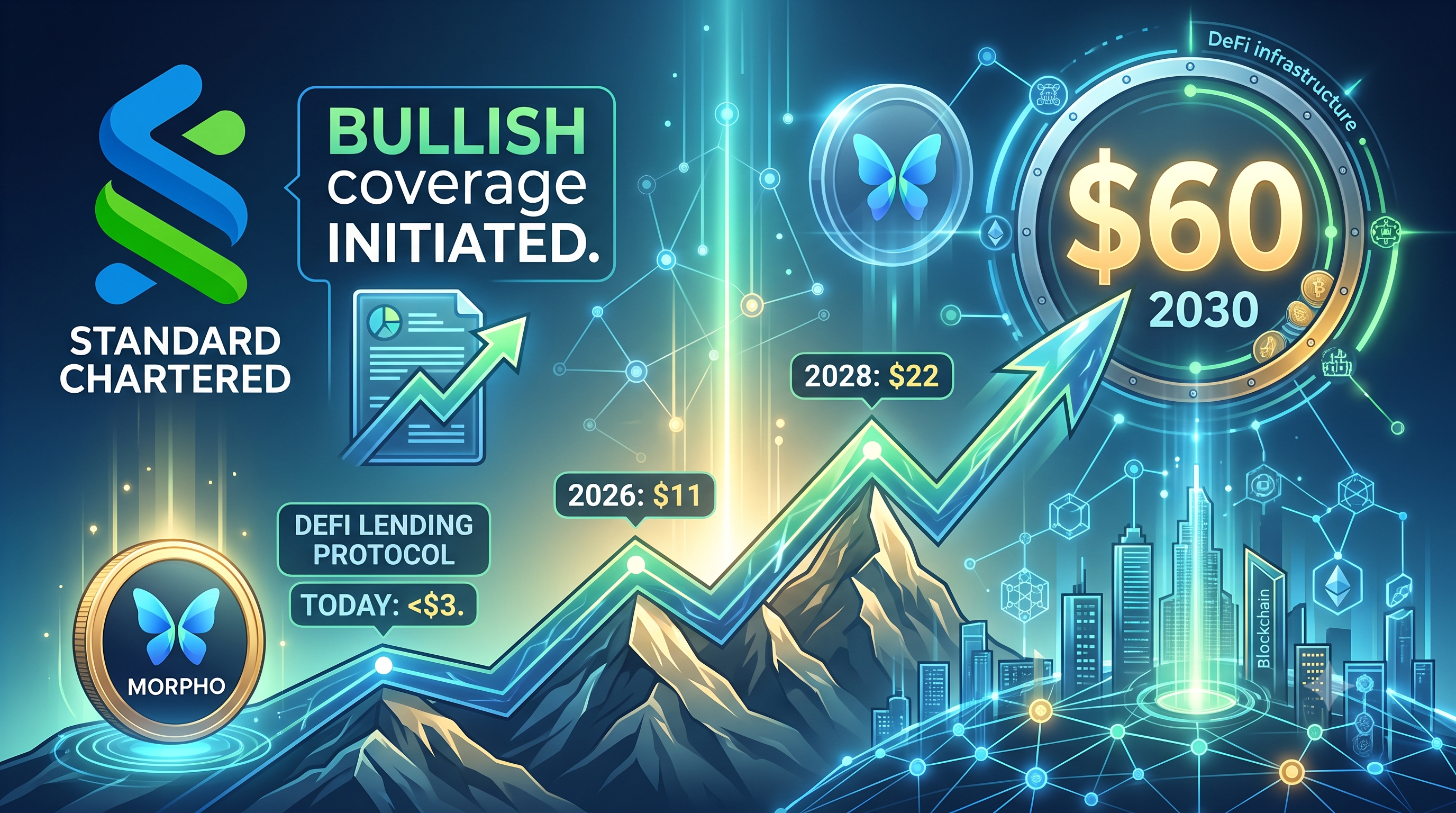
Standard Chartered analyst Geoff Kendrick detailed a phased direction for MORPHO: $3.50 by the end of 2026, scaling to $11 in 2027, $22 in 2028, $40 in 2029, and $60 by 2030. This outlook rests on expectations of DeFi assets growing 37-fold, with tokenized assets playing a central role in driving liquidity into protocols like Morpho. The bank views Morpho as a dual-play opportunity, combining optimized peer-to-peer lending with infrastructure that enables on-chain banks and asset managers to operate efficiently. The latest price action showed MORPHO rising around 5-14% following the announcement, trading near $2.10 with a market capitalization of approximately $1.4 billion and a fully diluted valuation around $2.1 billion. The circulating supply stands near 650 million out of a 1 billion total cap.
These projections assume continued expansion in total deposits, which have already surpassed $10 billion in some reports, and active loans of around $3.6 billion. Kendrick emphasized Morpho's ability to capture value from both crypto-native assets and incoming tokenized RWAs, such as U.S. Treasuries. The report aligns Morpho with broader institutional theses on Bitcoin, Ethereum, and Aave, underscoring confidence in its scalability. Market observers noted the target implies roughly 30x upside from current levels, a significant call that has drawn attention to the protocol's fundamentals amid a maturing DeFi sector. Protocol revenue metrics, including annualized fees near $210 million, further support the viability of sustained growth as usage deepens.
Morpho Protocol's Evolution from Optimizer to DeFi Infrastructure Powerhouse
Morpho originated as a rate optimizer layered on existing lending platforms but evolved into Morpho Blue, a lightweight, immutable primitive enabling permissionless market creation with isolated risk parameters. This design allows users and developers to deploy custom lending markets with flexible collateral, oracles, and loan-to-value ratios, reducing gas costs and improving capital efficiency compared to monolithic protocols. By mid-2026, Morpho Blue accounts for the vast majority of the protocol's TVL, demonstrating strong product-market fit. Integrations with major players, including Coinbase for USDC lending and various fintechs, have accelerated deposits and validated its enterprise readiness.
The architecture separates the core primitive from higher-level products like MetaMorpho vaults, which curators use to build diversified yield strategies. This layered approach aggregates liquidity while maintaining risk isolation, appealing to both retail yield seekers and institutional participants. The latest funding of $175 million on June 9th, 2026, led by Paradigm and a16z crypto with participation from Apollo Global Management and others, provides resources for further development, including Morpho V2 priorities. Such backing signals a strong conviction in Morpho's long-term role in on-chain credit. TVL growth from under $600 million in early 2024 to over $6.7 billion illustrates compounding network effects driven by superior rates and flexibility.
How Morpho Blue Enables Permissionless and Efficient Lending Markets
Morpho Blue's core contract implements isolated pairs, in which each market operates independently with predefined parameters for collateral, debt assets, interest rate models, and liquidation thresholds. This permissionless model contrasts with governed, pooled systems by allowing rapid deployment of tailored markets without protocol-wide changes. Higher collateralization factors and optimized interest rates result from efficient matching, often delivering better terms for lenders and borrowers. Gas efficiency improvements make it suitable for high-frequency use across EVM-compatible chains.
Developers and institutions leverage this base layer to build custom solutions, such as crypto-backed loan products or yield-bearing accounts. Examples include MetaMask routing savings through Morpho vaults and Robinhood Chain integrations offering yield. These implementations highlight practical utility beyond pure DeFi, bridging traditional finance expectations with blockchain execution. Active loans and deposit volumes reflect real usage, with Ethereum and Base contributing the largest shares. The immutable nature of deployed markets enhances security by minimizing governance dependencies for individual pools.
Tokenized Assets and RWAs Driving Morpho Adoption
Tokenization of real-world assets represents a major growth vector for DeFi protocols. Standard Chartered and other analysts project significant inflows of tokenized Treasuries and securities into on-chain lending as regulatory clarity improves and institutional participation increases. Morpho's flexible market position enables it to intermediate this liquidity effectively, offering competitive yields and risk customization attractive to asset managers. Early integrations with RWA-focused curators have already contributed hundreds of millions in deposits, demonstrating growing demand for lending infrastructure capable of supporting tokenized financial products while maintaining transparent and efficient capital markets.
Projections for tokenized assets reaching trillions by 2030 create substantial addressable markets, although the pace of adoption will depend on regulation, market infrastructure, and institutional confidence. Morpho's infrastructure supports compliance-aware vaults and efficient capital allocation, key requirements for institutional flows. Its permissionless architecture also allows developers and curators to design specialized lending markets tailored to different asset types and risk profiles. Partnerships and technical capabilities enable seamless handling of diverse assets, enhancing its appeal as DeFi matures toward broader financial integration. This dynamic supports the bullish forecasts by expanding total addressable liquidity, increasing protocol activity, and creating additional opportunities for sustainable fee generation over the long term.
Competitive Positioning Against Aave and Other Lending Protocols
Morpho holds the second spot in DeFi lending TVL, trailing Aave but gaining market share through greater capital efficiency and customizable lending infrastructure. While Aave offers broad multi-chain coverage and deep liquidity, Morpho differentiates itself through isolated markets and curator-managed vaults that allow users to tailor exposure to specific assets and risk profiles. Data also shows Morpho capturing significant lending activity on Base while sustaining strong growth in deposits and borrowing volume. Its market-cap-to-TVL ratio remains relatively attractive compared with several peers, suggesting potential room for valuation expansion if adoption and protocol revenue continue to increase.
Institutional participation, including deployments built by Galaxy Digital, further strengthens Morpho's positioning by highlighting production-grade use cases rather than purely experimental adoption. The protocol's emphasis on immutable core primitives also reduces reliance on ongoing governance changes, a feature that may appeal to institutions seeking predictable infrastructure. Beyond TVL, metrics such as protocol fees, active vault creation, and expanding user participation reflect growing ecosystem engagement. As the DeFi lending sector increasingly consolidates around a handful of dominant protocols, Morpho appears well-positioned to compete through specialization, efficient capital allocation, and an expanding network of third-party curators building on its infrastructure.
Recent Funding Round and Institutional Backing for Morpho
Morpho's $175 million funding round in June 2026, completed at an approximate $2 billion valuation, attracted a group of prominent investors, including Paradigm, a16z, Ribbit, VanEck, Apollo, and Circle Ventures. The capital is expected to accelerate development of Morpho V2, expand the protocol's commercial reach, and strengthen its position within the decentralized finance ecosystem. In addition, Apollo's structured token purchase agreement introduces a notable source of institutional participation, which could contribute to stronger long-term alignment between the protocol and major financial market participants while potentially supporting token demand over time.
The participation of established venture firms and institutional investors reinforces confidence in Morpho's technology, governance approach, and long-term business model at a time when the DeFi sector continues to prioritize scalable and reliable infrastructure. The newly raised funds are expected to support ecosystem expansion through developer initiatives, strategic integrations, protocol improvements, liquidity incentives, and broader adoption efforts. As these initiatives mature, they may contribute to higher total value locked (TVL), increased protocol activity, and stronger revenue generation. This combination of institutional backing and continued ecosystem development strengthens the broader investment thesis that underpins optimistic long-term analyst projections.
MORPHO Tokenomics, Supply Dynamics, and Utility
MORPHO serves primarily as a governance token with a 1 billion total supply. The governance scope is intentionally limited to approving new interest rate models, oracles, collateral categories, and treasury management, preserving the immutability of Blue markets. Flexible incentive "ages" allow adaptive emissions based on market conditions. A circulating supply of around 650 million leaves room for gradual unlocking and demand absorption. Utility extends to potential fee sharing if activated and participation in protocol evolution. Low market-cap-to-TVL multiples show efficient valuation relative to usage.
Token demand could rise with governance votes on incentives and ecosystem growth, aligning holder interests with protocol success. Governance participants can also influence key protocol parameters within the boundaries established by the protocol's design, ensuring that upgrades remain focused on expanding functionality rather than altering the core lending markets. As Morpho continues integrating with decentralized finance applications and attracting additional users, governance participation may become increasingly relevant for stakeholders seeking to shape the protocol's long-term development while maintaining its security and operational efficiency.
Market Implications of Standard Chartered's Coverage Initiation
The initiation of formal coverage by a major bank lends credibility and visibility to Morpho within traditional finance circles. It frames the token as a high-conviction bet on DeFi infrastructure, potentially encouraging further analyst attention and prompting institutional and professional investors to evaluate on-chain opportunities more closely. Short-term price volatility around the news reflects market sensitivity to institutional narratives, as positive research coverage often influences sentiment even before underlying fundamentals materially change. Over time, analyst coverage from established financial institutions can also increase awareness of Morpho's role within the decentralized finance ecosystem.
Greater visibility may encourage additional market participants to conduct independent research, while developers, liquidity providers, and ecosystem partners could pay closer attention to the protocol's progress. Longer term, such endorsements can support broader market confidence, potentially contributing to increased liquidity and stronger engagement across the ecosystem if the protocol continues to execute on its roadmap. They also help narrow the information gap between traditional finance and decentralized finance by highlighting projects with scalable infrastructure and measurable adoption. For traders and investors, this development adds another fundamental factor to consider alongside technical analysis, on-chain metrics, governance developments, and overall market conditions when evaluating MORPHO's prospects.
Integration Examples with Fintech and Traditional Finance Players
Coinbase's routing of USDC lending through Morpho-powered vaults has scaled to billions in activity, demonstrating how the protocol can serve as an underlying lending infrastructure for large platforms. Rather than requiring users to interact directly with Morpho, these integrations allow lending services to be delivered through familiar interfaces while leveraging Morpho's on-chain architecture. Similar collaborations with Gemini, Crypto.com, and Société Générale Forge illustrate the protocol's adaptability across both retail-focused services and regulated financial environments. These implementations provide users with optimized yield opportunities while allowing integrating platforms to maintain their own user experience, branding, and operational controls.
MetaMask and Robinhood integrations further expand Morpho's reach by exposing its vault infrastructure to broader audiences interested in passive yield strategies. As more wallets, exchanges, and financial applications incorporate Morpho into their offerings, the protocol benefits from increased visibility and usage without relying solely on direct user acquisition. This infrastructure-first approach supports organic total value locked (TVL) growth as assets flow into embedded lending products across multiple platforms and use cases.
Risk Factors and Challenges in Morpho's Growth Path
While growth prospects appear strong, challenges include competition from established protocols, potential shifts in DeFi user preferences, and broader market cycles affecting TVL. Tokenomics and incentive sustainability require careful management to avoid dilution pressures. Technical risks, though mitigated by audits and immutability, remain inherent to smart contract platforms. Adoption of RWAs depends on regulatory clarity and traditional finance readiness, which could evolve unevenly across jurisdictions.
The pace of institutional participation may also vary depending on compliance requirements, infrastructure maturity, and market confidence. Maintaining capital efficiency and security as scale increases will be critical for realizing long-term targets. Diverse chain deployments help mitigate single-point failures but introduce complexity in liquidity fragmentation, cross-chain asset management, and user experience. In addition, continued protocol development will require balancing innovation with stability, ensuring new features are thoroughly tested before deployment. Sustained ecosystem growth will also depend on attracting developers, maintaining active governance participation, and adapting to changing market conditions without compromising security or protocol resilience.
DeFi Sector Outlook and Tokenization Trends Supporting Morpho
DeFi market projections indicate substantial expansion, with estimates reaching hundreds of billions to trillions of dollars in value by 2030, driven by continued usability improvements, clearer regulatory frameworks in some jurisdictions, and increasing institutional participation. Tokenization acts as a catalyst by bringing traditional financial assets, such as bonds, private credit, and real estate, into programmable blockchain environments where protocols like Morpho are designed to facilitate lending, borrowing, liquidity provision, and yield generation. As tokenized assets become more widely integrated into decentralized finance, they may contribute to deeper on-chain liquidity and broader use cases.
Morpho's positioning allows it to benefit from both native DeFi growth and the gradual expansion of real-world asset (RWA) adoption. Its protocol focuses on optimizing lending market efficiency while remaining compatible with established DeFi infrastructure. Industry-wide growth in transaction volume, lending activity, fee generation, and user participation provides important context for evaluating individual protocol performance, with efficient and widely adopted platforms potentially capturing a larger share of activity as the ecosystem matures.
Practical Use Cases for Lenders, Borrowers, and Builders on Morpho
Lenders access competitive yields through MetaMorpho vaults tailored to different risk appetites, often outperforming traditional pooled alternatives through more efficient capital allocation and optimized market selection. Because vault curators can choose which lending markets to allocate funds across, users gain exposure to strategies designed around specific risk and return objectives. Borrowers benefit from flexible loan terms and potentially lower borrowing costs in isolated markets that are designed for particular collateral assets, allowing them to access liquidity without relying on a one-size-fits-all market structure.
Builders can deploy custom lending applications quickly using the Blue primitive, reducing development complexity and accelerating innovation across lending protocols, structured yield products, perpetual trading integrations, and on-chain savings solutions. Real-world implementations include institutional collateralized borrowing, treasury management strategies, and retail yield-earning features built on Morpho's infrastructure, demonstrating the protocol's adaptability across different market segments. As more applications integrate these components, the expanding ecosystem can strengthen user retention, improve capital efficiency, and contribute to network effects that support long-term protocol adoption and value creation.
Conclusion
Standard Chartered's coverage and $60 target for MORPHO by 2030 encapsulate growing recognition of Morpho's role in the evolving DeFi landscape. With robust TVL, innovative architecture, and institutional momentum, the protocol demonstrates clear potential to scale alongside tokenized finance. Realizing this outlook depends on continued execution, market conditions, and sector growth.
Investors should monitor key metrics like TVL retention, fee generation, and integration announcements for signals of sustained progress. Morpho's direction offers a compelling case study in infrastructure-driven value creation within decentralized finance.
FAQs
What does Standard Chartered's $60 price target for MORPHO by 2030 imply about expected growth?
Standard Chartered's forecast outlines a multi-year path with specific annual targets, driven by anticipated 37x expansion in DeFi assets and Morpho's capture of lending and infrastructure value. This implies significant scaling in TVL, deposits, and revenue as tokenized assets integrate into on-chain markets. The projection factors in Morpho's current $6.7+ billion TVL and second-place ranking, assuming it maintains efficiency advantages and benefits from integrations. Realization would require favorable macro conditions, successful V2 upgrades, and continued institutional adoption, showing both opportunity and execution dependencies in DeFi infrastructure plays.
How does Morpho Blue's design differ from traditional DeFi lending protocols?
Morpho Blue uses a minimal, immutable contract for permissionless isolated markets, enabling custom parameters for each pair without pooled risk or heavy governance intervention on active markets. This contrasts with monolithic platforms by offering higher efficiency, lower costs, and flexibility for curators to build vaults. The result is better rates, reduced liquidation risks through tailored LLTVs, and rapid innovation. Its architecture supports diverse use cases from retail yield to institutional credit, contributing to strong TVL growth across chains. This modular yet secure foundation positions Morpho for scalability as DeFi incorporates more complex assets and participants.
What role do tokenized real-world assets play in Morpho's future growth?
Tokenized RWAs, particularly Treasuries and securities, are expected to channel substantial liquidity into DeFi lending. Morpho's customizable markets and vaults allow efficient intermediation with risk-appropriate yields, appealing to asset managers seeking on-chain exposure. Projections for trillions in tokenized value by 2030 amplify this opportunity, with Morpho well-placed due to existing RWA integrations and capital efficiency. Success here could drive higher TVL, fees, and token utility as the protocol facilitates broader financial flows. Monitoring RWA inflows and related partnerships will be key indicators of progress.
Who are the major backers of Morpho, and what does the recent funding signify?
The $175 million round included Paradigm, a16z crypto, Ribbit Capital, Apollo Global Management, and others at a ~$2 billion valuation. Earlier raises brought in Pantera, Coinbase Ventures, and more. This capital supports technical advancement, ecosystem incentives, and commercial expansion. Apollo's token purchase agreement adds demand-side support. Such high-caliber participation signals confidence in Morpho's technology and market potential, providing resources to compete effectively and pursue V2 priorities. It also enhances credibility for further institutional engagement.
What are the main risks investors should consider with MORPHO?
Key risks include DeFi market volatility affecting TVL, competitive pressures from Aave and emerging protocols, regulatory developments impacting tokenization or lending, and smart contract vulnerabilities despite audits. Token supply dynamics and incentive management could influence price if not balanced with demand growth. Broader crypto cycles and execution on roadmap milestones also matter. Diversification, understanding protocol metrics, and staying informed on governance decisions help mitigate these factors. Long-term holders should focus on fundamental usage trends over short-term sentiment.
How can users practically engage with Morpho for lending or borrowing?
Users deposit into MetaMorpho vaults for curated yields or interact directly with Blue markets for specific terms. Lenders earn optimized rates across assets, while borrowers access capital with chosen collateral. Integrations via wallets like MetaMask or platforms like Coinbase simplify access. Builders can deploy markets or build on the primitive. Always review parameters, risks, and conduct due diligence. Platforms like KuCoin offer MORPHO trading pairs for those seeking exposure after researching on-chain opportunities.
What metrics should be tracked to evaluate Morpho's performance?
Focus on TVL trends by chain, active loans, annualized fees, deposit volumes, market share versus peers, and governance activity. Price action relative to TVL multiples, integration announcements, and RWA inflows provides context. On-chain data from sources like DeFiLlama and protocol dashboards offer transparency. Consistent growth in these areas supports bullish theses, while stagnation or declines may signal challenges. Regular review helps inform decisions aligned with long-term projections.
How might Morpho V2 influence the protocol's direction?
V2 aims to enhance market-driven features, scalability, and tools for curators while building on Blue's strengths. Improvements could boost efficiency, attract more liquidity, and expand use cases, accelerating the path toward higher valuations. Successful deployment would reinforce competitive positioning and support revenue growth. Monitoring development updates and post-launch metrics will clarify the impact on adoption and token value.
Disclaimer: This content is for informational purposes only and does not constitute investment advice. Cryptocurrency investments carry risk. Please do your own research (DYOR).