

Korean Retail Investors Flee KOSPI Crash to Crypto
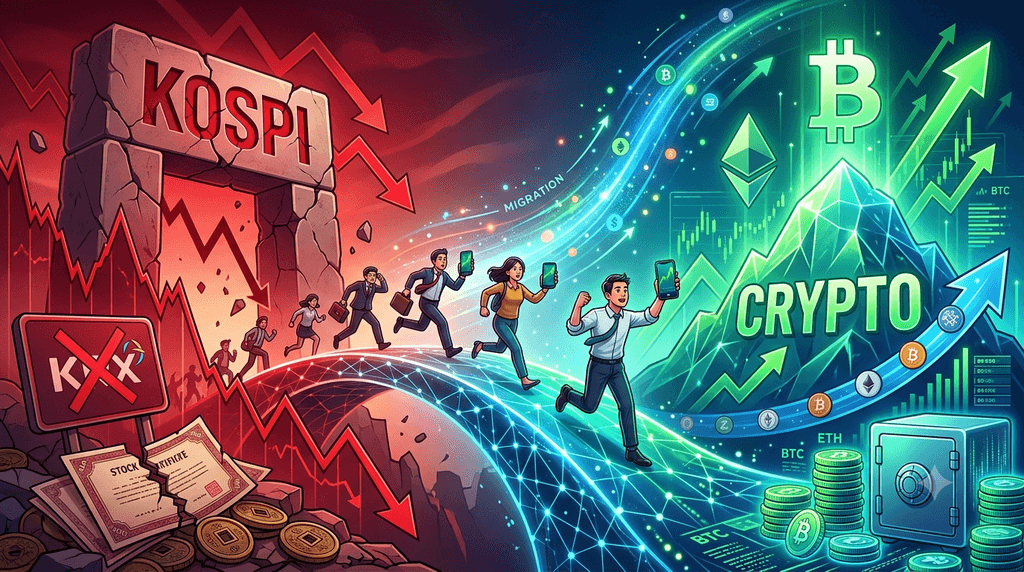
Retail Investors Shift Toward Crypto Amid KOSPI Turbulence
South Korea’s benchmark KOSPI index has experienced dramatic volatility in 2026, with sharp declines erasing substantial market value and prompting retail investors, often called “ants,” to seek alternatives. Recent plunges, including nearly 10% drops in single sessions and cumulative retreats exceeding 20% from June peaks, have triggered multiple trading halts and margin calls affecting hundreds of thousands of leveraged accounts. This shift highlights the interconnected nature of domestic equities and digital assets in one of the world’s most active retail trading environments.
As KOSPI faces its steepest corrections of the year, driven by semiconductor selloffs and leveraged unwinds, Korean retail capital is flowing into crypto markets, boosting volumes on platforms like Upbit and underscoring a persistent “seesaw” dynamic between traditional stocks and cryptocurrencies. Market analysts note that many retail traders view digital assets as an alternative source of opportunity during equity downturns, reinforcing crypto’s growing role as both a speculative investment and a portfolio diversification tool during periods of heightened market uncertainty.
KOSPI's Steep June-July 2026 Declines and Semiconductor Sector Pressure
The KOSPI index suffered significant setbacks in late June and early July 2026, with a nearly 10% plunge on June 23 marking one of its sharpest daily drops in months. Major components like Samsung Electronics and SK Hynix led the decline, each falling over 12% on that day amid overseas investor selling following regulatory cautions on leveraged ETFs. Subsequent sessions saw further pressure, with the index dropping below 8,000 and entering bear market territory after a 20%+ retreat from its June high around 9,385 points. SK Hynix, a key AI memory chip player, faced additional heavy selling after its Nasdaq ADR listing, with one session seeing a 15% drop and widespread margin liquidations impacting an estimated 320,000 to 360,000 accounts.
Retail investors, who heavily utilized margin borrowing that reached record highs earlier in the year, bore much of the brunt. Margin debt levels had climbed significantly, amplifying gains during the earlier rally but exacerbating losses during the correction. This environment wiped out trillions in won value, with over ₩366 trillion erased in some sessions. Analysts noted the concentration risk, as Samsung and SK Hynix together account for a large share of the index’s weight, making the broader market highly sensitive to developments in the semiconductor sector.
Despite strong underlying fundamentals in AI demand, profit-taking and lowered earnings expectations for high-bandwidth memory products contributed to the selloff. The volatility exceeded patterns seen in prior years, with multiple sidecar halts triggered throughout 2026. This created an environment in which many small investors, facing margin calls, began reallocating their remaining capital toward higher-volatility assets perceived as offering a quicker recovery potential. The scale of these moves reflects not just immediate reactions but deeper patterns in how Korean retail capital behaves across asset classes during periods of domestic equity stress.
Record Margin Debt and Leveraged Trading Risks Exposed in Retail Portfolios
Korean retail investors entered 2026 with elevated enthusiasm for leveraged positions in KOSPI components, pushing margin borrowing to approximately 60 trillion won by late May. This borrowing fueled participation in the semiconductor-driven rally but left portfolios vulnerable when sentiment shifted. Reports indicate over 1.2 million leveraged accounts faced margin calls during the July selloffs, with a significant portion resulting in full liquidation. Such events affected a notable share of the working-age population, highlighting the broad exposure of individual traders to amplified market swings.
The prevalence of these strategies stems from accessible trading platforms and a cultural affinity for high-engagement investing among younger and middle-aged demographics. When KOSPI components tumbled, forced sales compounded the downward pressure, creating feedback loops that regulators had previously warned about. Retail net purchases remained high even during declines in some cases, demonstrating conviction, yet the leverage amplified downside outcomes. This dynamic contrasts with more institutional flows, which often exited earlier.
Data from exchanges and regulators underscore how these positions, while boosting participation during uptrends, contributed to fast wealth erosion when external factors like global tech profit-taking or geopolitical signals emerged. The aftermath has left many reassessing risk management, with some liquidating stock holdings to preserve capital for other opportunities. This transition period reveals the maturity challenges within a market dominated by active individual participants who respond swiftly to volatility. Understanding these mechanics provides context for why capital rotation into alternative high-liquidity assets occurs predictably following equity corrections.
Surge in Upbit and Domestic Crypto Exchange Volumes Post-KOSPI Drops
On July 13, 2026, as KOSPI triggered another halt with Samsung and SK Hynix declining sharply, Upbit, the largest Korean crypto exchange, saw its 24-hour trading volume explode to $4.12 billion, a 436% increase. Top traded assets included Bitcoin, XRP, Ethereum, and select altcoins like Threshold (T) and BLAST, reflecting retail preferences for both majors and speculative tokens. This spike reversed weeks of declining volumes across major won-denominated platforms, signaling a clear reallocation of funds from equities.
Similar patterns have repeated during prior KOSPI weakness, where retail traders quickly pivot to crypto for its 24/7 liquidity and potential for rapid price movements. Five major exchanges (Upbit, Bithumb, Coinone, Korbit, and Gopax) had seen subdued activity in early July, but the equity turmoil catalyzed a concentrated release of pent-up capital. Stablecoin inflows also rose notably in the following days, facilitating easier entry into digital assets. This behavior aligns with Korea’s high crypto penetration, where over 16 million individuals, roughly one-third of adults, hold digital assets.
The volume surge demonstrates the agility of retail capital and the deep integration of crypto trading into everyday investor toolkits. It also underscores how domestic market events can influence global crypto flows, given Korea’s outsized role in won-denominated trading, which has accounted for significant portions of worldwide spot volume in 2026. Observers tracking these flows note the speed of rotation, often occurring within one to three trading days of major equity drops.
The Enduring Seesaw Effect Between KOSPI Equities and Crypto Markets
Korean investors have long exhibited a characteristic rotation between domestic stocks and cryptocurrencies, often described as a seesaw dynamic. Periods of KOSPI strength draw capital away from crypto, while equity weakness prompts the reverse, as seen in the July 2026 episode. This pattern stems from shared retail demographics pursuing growth-oriented opportunities across both arenas. With crypto ownership surpassing traditional stock participation in some metrics, the pool of flexible capital remains substantial.
Historical instances, including earlier 2026 volatility, confirm this tendency. When KOSPI faced pressure in March, crypto volumes responded positively in tandem with Bitcoin’s movements. The underlying driver is the search for asymmetric upside in environments where one asset class underperforms. Altcoins often see outsized interest during these shifts due to their volatility profile matching retail trading styles. Regulatory frameworks supporting compliant exchanges further enable seamless movement.
This interconnectedness means KOSPI corrections can provide liquidity tailwinds to crypto, even as broader global factors influence prices. Analysts monitoring on-chain and exchange data observe that such rotations tend to be temporary but impactful, contributing to short-term price support in digital assets. The phenomenon highlights Korea’s unique market structure, where individual traders wield significant influence over both traditional and emerging asset flows.
Retail Demographics Driving Capital Rotation in Volatile 2026 Markets
South Korea’s retail investor base, particularly those aged 40-50 and younger active traders, plays a central role in these asset shifts. This group has demonstrated consistent behavior in reallocating from equities to crypto during downturns, favoring assets like XRP in past episodes. High smartphone penetration and sophisticated trading apps lower barriers, allowing rapid execution across markets. With millions holding crypto accounts, the infrastructure supports quick pivots without significant friction.
These demographics often prioritize high-engagement strategies, using leverage where available and responding to momentum signals from social platforms or news. The 2026 KOSPI rally earlier in the year attracted heavy participation, but subsequent corrections prompted defensive reallocations. Education levels and tech-savviness among Korean investors facilitate understanding of both stock and blockchain mechanics.
Government data and industry reports consistently show crypto users outnumbering certain traditional investor segments, creating a large reservoir of capital ready to move. This dynamic adds resilience to crypto markets during local equity stress but also introduces volatility as funds can exit just as quickly when stocks stabilize. Practical implications include the need for diversified approaches among participants to mitigate concentrated risks.
Bitcoin and Altcoin Preferences Amid Korean Investor Reallocations
Bitcoin remains a core holding and entry point during rotations, with Korean exchanges showing strong BTC/KRW activity alongside altcoin surges. In the July episode, BTC led volume charts on Upbit, while tokens like XRP captured attention due to familiarity and past performance in local markets. Ethereum and newer projects also featured prominently, illustrating a mix of store-of-value and speculative plays. This preference mix reflects strategic layering: majors for stability during transitions and altcoins for potential outperformance. Korea’s kimchi premium, where local prices can exceed global averages, further incentivizes domestic trading activity.
Market participants also tend to monitor trading volumes and exchange inflows closely, using these indicators to gauge whether momentum is broadening across the market or remaining concentrated in a handful of assets. Analysis from 2026 shows won pairs contributing substantially to global spot volumes, underscoring the market’s influence. Investors appear to balance risk by diversifying across categories rather than concentrating solely in one segment.
This approach allows participation in broader crypto cycles while addressing immediate liquidity needs post-equity sales. Understanding these preferences helps contextualize volume spikes and their sustainability. While short-term sentiment can shift rapidly, sustained participation typically depends on broader macroeconomic conditions, regulatory developments, and confidence in digital asset markets. These factors collectively shape whether elevated trading activity develops into a longer-lasting trend or gradually fades as investors reassess risk exposure.
Impact of Semiconductor Industry Developments on Broader Investor Sentiment
The heavy weighting of semiconductor firms in KOSPI ties equity performance closely to global AI and tech trends. SK Hynix’s Nasdaq listing and subsequent Seoul market reaction exemplified “buy the rumor, sell the news” dynamics, with profit forecast adjustments adding pressure. Despite robust long-term demand for high-bandwidth memory, short-term valuation concerns and profit-taking weighed on sentiment, prompting capital flight to crypto.
Broader uncertainty surrounding global technology valuations also contributed to cautious positioning among investors, particularly after months of strong gains across AI-related stocks. This sector concentration amplifies systemic effects, as moves in a few names dictate index direction. Retail investors exposed through direct holdings or leveraged products felt the impact acutely. The resulting uncertainty accelerates diversification searches, with crypto offering uncorrelated or differently timed opportunities.
Industry analysts point to fundamental strength in AI applications but acknowledge near-term digestion needs after rapid prior gains. Such episodes reinforce the appeal of assets less tied to single-industry cycles for portions of portfolios. Market participants continue monitoring earnings reports and guidance from major chipmakers, as these updates are expected to influence both equity sentiment and broader investment allocation decisions.
Global Context of Korean Crypto Trading Influence in 2026
Korea consistently ranks among the top contributors to global crypto liquidity, with won-denominated trades representing notable shares of worldwide volume. The July surge following KOSPI weakness amplified this role, as local flows interacted with international price action. Bitcoin’s price environment around the $60,000-$90,000+ range in 2026 provided a backdrop for these rotations. Market participants also monitored shifts between equities and digital assets, as changing risk sentiment influenced trading behavior.
While not all capital moved directly into cryptocurrencies, the increased activity reflected investors seeking alternative opportunities during periods of stock market uncertainty. International observers track Korean platforms for sentiment indicators, given the speed and scale of retail participation. This influence extends beyond borders, affecting liquidity pools and order books globally.
The maturation of the market, with stable user bases despite fluctuating volumes, suggests deeper embedding rather than fleeting interest. Analysts also note that Korea's active retail investor base often responds quickly to macroeconomic developments and regulatory updates, making the country's trading patterns a closely watched signal for broader trends across the global digital asset market.
Institutional vs Retail Dynamics in South Korean Asset Allocation
Retail dominance characterizes both KOSPI and crypto activity, differing from more institutional-heavy markets elsewhere. While institutions may take measured exits, retail moves drive the visible volume spikes in crypto following equity market declines. This retail-led nature accelerates reactions but can also contribute to sharper short-term price swings as sentiment changes rapidly. Market participation is often influenced by news events, macroeconomic developments, and domestic investor confidence.
Over 16 million crypto users provide significant market scale, yet maturity trends show shifts toward holding rather than constant trading during calmer periods. Long-term investors increasingly balance speculative activity with portfolio diversification, reflecting a more measured approach. The interplay shapes policy and product development, with exchanges adapting to evolving user behaviors through new services and compliance measures. Understanding this balance offers valuable insights into market resilience and the changing relationship between traditional equities and digital assets in South Korea.
Market Maturation and Long-Term Implications for Korean Investors
Despite short-term rotations, Korea’s crypto ecosystem shows signs of maturation, with user numbers stable and activity evolving beyond pure speculation. The 2026 volatility tests this progress, as investors apply lessons from equity corrections to digital strategies. Long-term, this could foster more sophisticated allocation models balancing both asset classes while encouraging broader diversification and stronger attention to risk management during periods of market uncertainty.
Policy support for blockchain and high adoption rates position the market favorably. Sustained interest depends on risk-aware participation and innovation in products. Market participants are also paying closer attention to regulatory developments and institutional involvement, which may influence confidence over time. The current episode adds data points to the ongoing evolution of retail finance in Korea, highlighting how investors continue adapting their strategies as traditional and digital markets become increasingly interconnected.
Analysis of Asset Class Performance in 2026 Volatility
KOSPI’s earlier outperformance gave way to corrections, while crypto provided alternative avenues. Year-to-date equity gains remained notable despite drawdowns, but crypto’s independent drivers offered diversification. Volume data illustrates how capital seeks yield and liquidity across environments, with shifts in investor sentiment often influencing allocations between traditional equities and digital assets. Market participants continued monitoring macroeconomic developments, interest rate expectations, and regulatory updates, all of which shaped activity across both sectors.
This comparison reveals no single dominant class but complementary roles in portfolios. Investors navigating both gain from timing awareness and fundamental analysis. Maintaining exposure across different asset classes may also help reduce concentration risk, particularly during periods when one market experiences heightened volatility while the other demonstrates relative resilience or stronger momentum.
Regulatory and Infrastructure Support Shaping Investor Choices
Supportive infrastructure for compliant trading enables efficient capital movement across digital asset markets and traditional financial systems. Reliable exchanges, custody solutions, payment networks, and settlement mechanisms help participants execute transactions with greater speed and operational efficiency. Focus remains on market functionality rather than specific rules, allowing the discussion to emphasize how infrastructure contributes to smoother trading activity. As technology continues to improve, investors and institutions benefit from enhanced connectivity, better liquidity access, and more streamlined transaction processing.
Standardized operational practices and dependable trading platforms also reduce unnecessary delays that could otherwise affect market participation. This environment facilitates the observed behaviors without undue friction, supporting consistent market activity while allowing participants to respond to changing conditions more effectively. Continued improvements in trading infrastructure may further strengthen market efficiency and enhance the overall experience for both retail and institutional users.
Conclusion
The July 2026 KOSPI correction has once again demonstrated the fluidity of Korean retail capital between equities and crypto. With substantial volumes shifting to platforms amid equity losses, the episode reinforces structural patterns while highlighting risk considerations. As markets evolve, informed participation across asset classes will define outcomes for many investors. Sustained analysis of these dynamics offers valuable perspectives on capital allocation in high-engagement environments.
The movement also reflects how retail investors increasingly monitor multiple markets simultaneously, adjusting their portfolios in response to changing sentiment and perceived opportunities. While cryptocurrencies can offer diversification, they also introduce higher volatility, making disciplined risk management essential. Analysts note that shifts between traditional financial markets and digital assets are becoming more common as access to both continues to improve through online trading platforms.
FAQs
How does the recent KOSPI performance specifically influence crypto trading volumes in South Korea?
The sharp declines in the KOSPI, including multiple percentage point drops in single sessions and over 20% cumulative losses from peaks, have directly correlated with spikes in crypto exchange activity. For instance, Upbit recorded a massive volume increase as investors liquidated or reallocated from leveraged stock positions. This response is consistent with historical patterns where equity market stress prompts rapid shifts to 24/7 crypto markets offering perceived recovery potential.
What role do leveraged trading practices play in prompting Korean investors to enter crypto after stock market losses?
Leveraged positions in KOSPI stocks, which reached high levels before the correction, magnified losses when prices fell, leading to widespread margin calls and liquidations. This forced many retail participants to seek alternative venues for remaining capital. Crypto markets, with their own leverage options but different timing and volatility profiles, attract those looking to redeploy funds aggressively. The transition often occurs swiftly, as seen in July 2026 data, where equity pain translated into crypto volume records.
Which cryptocurrencies see the most activity from Korean retail investors during KOSPI-related shifts?
Bitcoin typically leads as a primary vehicle, followed by Ethereum and popular altcoins such as XRP, which has shown particular strength in local exchanges during past rotations. Speculative tokens also gain traction due to retail preference for higher-beta opportunities. Volume rankings on platforms like Upbit during the July event illustrate this mix, balancing established assets with emerging ones.
How do global semiconductor trends affect the decision-making of Korean investors moving between stocks and crypto?
Developments in AI memory demand and company-specific news around firms like SK Hynix heavily influence KOSPI, prompting reallocations when short-term disappointments arise despite long-term positives. Crypto serves as a hedge or complementary bet less directly tied to single-sector earnings. Investors weigh these fundamentals when timing exits and entries, contributing to the observed seesaw.
What practical strategies can retail investors use when considering asset rotation in volatile Korean markets?
Effective approaches include monitoring real-time index and exchange data, maintaining cash buffers, using appropriate position sizes, and staying informed on sector news. Diversifying across asset classes and employing risk tools available on platforms helps manage transitions. Regular review of portfolio correlations prevents overexposure.
Are the capital flows from KOSPI to crypto likely to persist long-term?
Flows tend to be tactical and reverse when equity conditions improve, though underlying adoption supports baseline crypto activity. Maturation trends suggest more measured participation over time rather than constant rotation. Monitoring volume trends and macroeconomic signals offers guidance on persistence.
How has the number of crypto users in South Korea evolved alongside stock market participation?
User numbers have grown substantially, exceeding 16 million and representing a significant adult population share, often rivaling or surpassing traditional investing engagement. This expansion supports liquidity during rotations and reflects broader digital asset integration.
Disclaimer: This content is for informational purposes only and does not constitute investment advice. Cryptocurrency investments carry risk. Please do your own research (DYOR).