

Korean AI Chip Stocks Rebound After Leverage Wipeout : Can Bitcoin and Crypto Follow?
2026/08/08 08:00:00
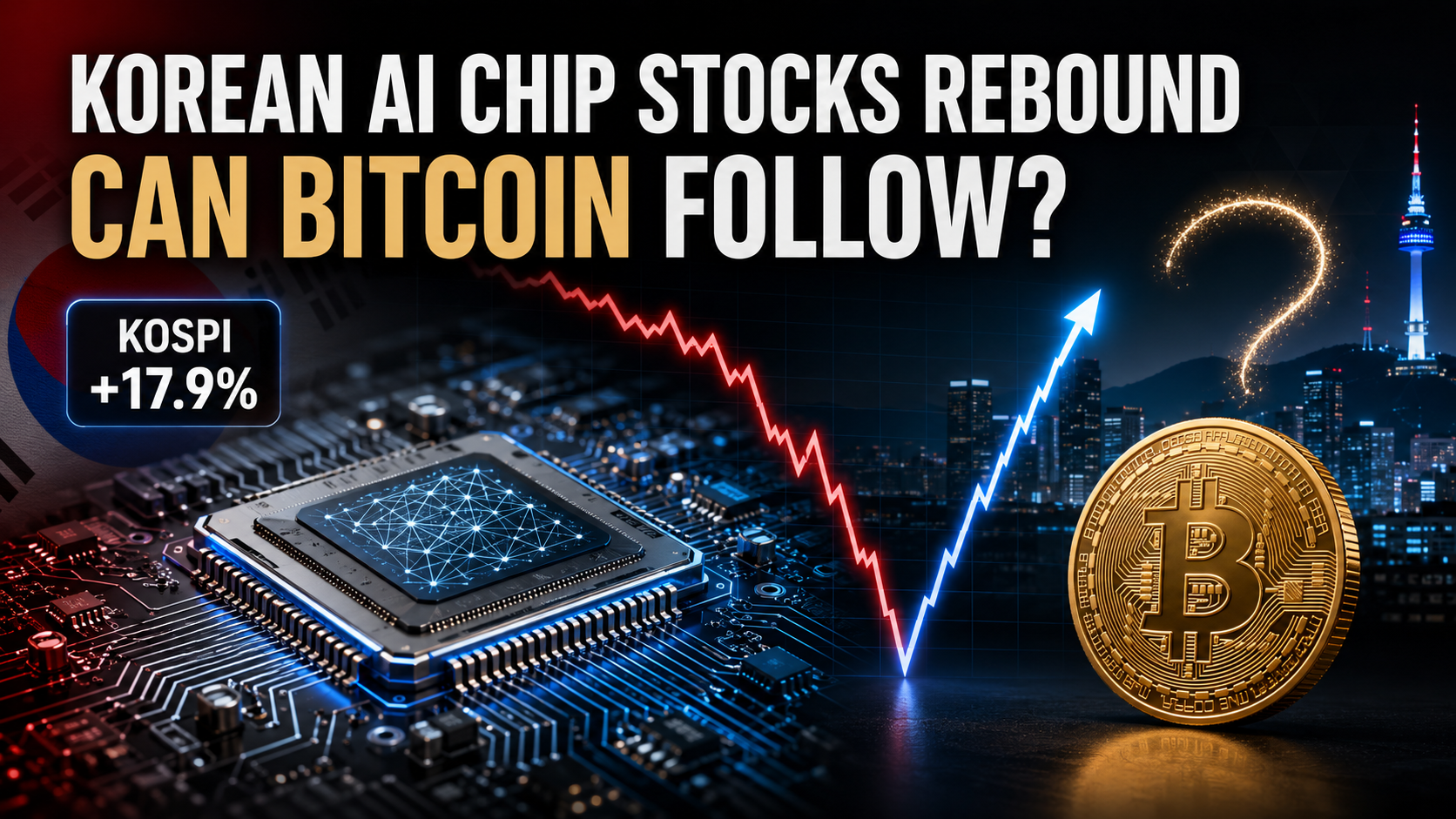
South Korea’s chip-heavy equity market has become one of 2026’s clearest examples of how strong industry fundamentals and fragile market positioning can coexist. After leveraged investment products, margin calls and forced sales accelerated a historic decline, Korean AI memory-chip stocks delivered an equally dramatic rebound. The reversal renewed confidence in the global semiconductor sector, but it did not immediately produce the same response across Bitcoin and the broader crypto market. Understanding whether crypto can follow requires separating a sector-specific equity recovery from a genuine improvement in global liquidity. Korean semiconductor shares are influenced by memory prices, AI infrastructure spending and company earnings, while Bitcoin market cycles are also shaped by spot ETF demand, stablecoin supply, derivatives positioning, interest rates and the strength of the US dollar. The Korean recovery may support global risk sentiment, but additional evidence is needed before it can be treated as a reliable signal for a wider crypto market rebound.
Korean AI Chip Stocks Rebound as KOSPI Jumps 17.9%
South Korea’s AI memory-chip stocks staged a historic rebound on July 31, 2026, lifting the benchmark KOSPI by 17.91% to close at 6,595.45 its largest one-day percentage gain on record. SK Hynix surged 30% to reach its daily price limit, while Samsung Electronics gained nearly 27%, triggering a broader recovery across semiconductor, electronics and technology shares. The rally followed several volatile sessions in which leveraged exchange-traded products, brokerage margin calls and forced position closures intensified losses that had already begun as investors questioned elevated valuations and the sustainability of global AI spending. Sentiment improved after strong results from major US technology companies suggested that demand for cloud computing and AI infrastructure remained resilient. Reports that Citadel acquired most of a distressed AI-focused fund’s leveraged public-equity portfolio also reduced fears that another large block of semiconductor and AI-related shares would be sold into an already fragile market. Together, stronger earnings signals, bargain buying and the removal of a major forced seller helped create the conditions for the record KOSPI rebound.
According to Samsung Q2 results, the company reported revenue of 171.5 trillion won and operating profit of 89.5 trillion won, with its memory business achieving record quarterly revenue and profit. The official SK Hynix results showed revenue of approximately 79.32 trillion won and operating profit of 60.54 trillion won, driven by rising memory prices and demand for high-bandwidth memory, AI-server DRAM and enterprise SSD products. South Korea’s July trade figures, published after the rally, provided further support for the sector’s fundamental outlook: total exports increased 62.8% year over year, while semiconductor exports jumped 179% and computer shipments rose 404%. Nevertheless, the 17.9% gain should be described as a historic relief rebound rather than a complete market recovery. The KOSPI still ended July approximately 22% lower and remained around 30% below its record high, meaning Korean AI chip stocks could remain vulnerable to renewed leverage, changing AI capital-spending expectations, high valuations, regulatory restrictions and growing competition in the global memory market.
How Leveraged ETFs and Margin Calls Triggered the KOSPI Wipeout
How Leveraged ETFs Amplified the 2026 KOSPI Stock Market Crash
Single-stock leveraged ETFs intensified the 2026 KOSPI stock market crash by creating amplified exposure to a small number of influential semiconductor companies. Introduced domestically on May 27, these products used derivatives and daily portfolio rebalancing to target multiples of an underlying stock’s one-day return. If a stock falls 10% in one session, for example, an ETF targeting twice its daily movement could lose approximately 20% before fees, tracking differences and market-price distortions are considered. When the underlying shares declined, leveraged funds and their counterparties also had to reduce exposure or adjust hedges to maintain their target ratios. Those transactions generated additional selling during an already weak market, placing further pressure on the companies with the greatest influence over the KOSPI.
The daily reset created another hidden risk: consecutive losses compounded quickly, while a later gain of the same percentage was insufficient to recover the earlier decline. This volatility decay meant that investors holding leveraged ETFs for several days or weeks could experience significantly weaker returns than expected, even if the underlying stock partially recovered. Concentrated exposure, automatic rebalancing and declining market liquidity therefore transformed an ordinary correction into a faster and more damaging Korean stock-market selloff.
How Margin Calls and Forced Liquidations Deepened the KOSPI Wipeout
Margin calls accelerated the KOSPI wipeout as falling stock prices reduced the value of assets used as collateral for brokerage loans. Retail borrowing for equity investment had reached a record 60 trillion won, approximately $40.4 billion, by the end of May, leaving a large number of accounts vulnerable when the market reversed. Once an account’s collateral fell below the broker’s maintenance requirement, the investor had to deposit additional cash or eligible assets within a limited period. Investors unable to meet that requirement had some or all of their positions automatically sold, regardless of the price or their long-term expectations for the underlying companies.
Goldman Sachs estimated that more than 1.2 million Korean brokerage accounts had received margin calls by July 13, with approximately 320,000 to 360,000 accounts fully liquidated by that date. These were estimates rather than a final official count, but they demonstrate the scale of the retail leverage unwind. Forced sales arrived as buyers were becoming more cautious, weakening market depth and allowing relatively large orders to produce sharper price movements. Every additional decline reduced collateral values in other accounts, creating new margin calls and another round of liquidations. At the height of the Korean stock-market crash, as much as $2.18 trillion in quoted market capitalization had been erased, although this represented a fall in market value rather than the same amount of cash being withdrawn or permanently realized as losses.
South Korea Tightens Leveraged ETF Rules After the KOSPI Crash
South Korean financial authorities introduced stricter leveraged ETF rules after concluding that high-risk retail products had amplified KOSPI volatility and investor losses. The official FSC measures temporarily suspended new single-stock leveraged ETF and exchange-traded note listings, including new inverse and covered-call products, while restricting securities firms and asset managers from advertising existing products. The minimum deposit required for new or additional leveraged positions was increased from 10 million won to 30 million won, with the higher requirement scheduled to take effect on August 5. From August 19, the deposit calculation was expected to include cash only, preventing investors from using the value of other stocks or bonds as substitute collateral.
Authorities also strengthened mandatory investor education, automatic mobile notifications about losses, liquidity-provider responsibilities and controls intended to reduce large differences between an ETF’s trading price and the value of its underlying assets. A higher minimum trading lot was planned for later in the year to make highly leveraged products less accessible for very small speculative positions. These measures may slow the rebuilding of excessive leverage and help investors understand the risks of daily-reset products, but they cannot eliminate losses from existing positions or guarantee future KOSPI stability. Leveraged ETFs did not create the original concerns about valuations, competition or AI capital expenditure; they magnified those concerns by turning declining prices into rebalancing sales, margin calls and forced liquidations across the Korean stock market.
Can Bitcoin and Crypto Follow the Korean AI Chip Stock Recovery?
Bitcoin could benefit if the recovery in Korean AI chip stocks develops into a broader improvement in global risk appetite, but the connection is neither automatic nor consistent. Bitcoin did not immediately follow the Korean equity rebound, falling approximately 3% and slipping below $63,000 on July 31, although it still ended the month with a gain of roughly 7.5%. This divergence shows that Bitcoin can trade alongside technology stocks when monetary policy, liquidity and investor sentiment affect several markets simultaneously, yet crypto-specific conditions can become more important than short-term equity correlations.
Korean semiconductor shares were responding to sector-specific developments and changing expectations for AI infrastructure investment, while Bitcoin remained influenced by spot demand, institutional allocations, derivatives positioning, regulatory uncertainty and the availability of dollar liquidity. Earlier crypto liquidations had already removed some heavily leveraged positions, which may have reduced immediate selling pressure and helped Bitcoin hold above its June lows. However, the same deleveraging also means crypto may have less potential for a sudden rebound driven purely by short covering or the removal of forced sellers.
Institutional demand and on-chain liquidity will probably determine whether Bitcoin can convert improving global sentiment into a sustainable crypto market recovery. US spot Bitcoin ETFs recorded approximately $265.4 million in net outflows on July 31, reversing a $233.1 million inflow during the previous session and demonstrating that professional demand remained inconsistent. These regulated products provide Bitcoin ETF exposure through traditional securities markets, making their daily flows a useful indicator of institutional demand. One negative session cannot define the market’s direction, but persistent ETF outflows can remove an important source of spot buying and leave price movements more dependent on short-term derivatives activity.
Total stablecoin market capitalization also stood near $307.6 billion at the research cutoff and had declined over both the previous seven and 30 days. Stablecoins function as relatively price-stable crypto assets that can be deployed across trading and on-chain markets, making aggregate supply an important measure of stablecoin liquidity. Contracting supply may restrict the amount of capital available to support Bitcoin, Ether and smaller altcoins. Macroeconomic conditions add another obstacle: the Federal Reserve maintained its policy rate at 3.50%–3.75%, but three policymakers preferred an immediate increase, while the US 10-year Treasury yield reached 4.747%. Higher bond yields can attract capital toward interest-bearing assets and increase the opportunity cost of holding Bitcoin, particularly when investors remain uncertain about inflation and future monetary tightening.
Key Signals That Could Confirm a Bitcoin and Crypto Market Recovery
A confirmed Bitcoin recovery would require several demand and liquidity indicators to improve together rather than relying on the performance of Korean technology shares alone. Bitcoin would first need to defend its recent support region and establish sustained trading above the area around $65,000, showing that buyers can absorb existing selling pressure. Several consecutive sessions of positive spot ETF flows would provide stronger evidence of institutional accumulation, while renewed growth in stablecoin supply would indicate that fresh on-chain capital is becoming available for the wider crypto market.
Derivatives positioning should remain controlled, with moderate funding rates and open interest increasing only after spot-market demand strengthens. If leverage grows faster than genuine buying, another liquidation-driven reversal could develop. A broader recovery would also require Ether and other large-cap crypto assets to strengthen relative to Bitcoin, accompanied by rising spot volume rather than isolated speculative rallies in low-liquidity tokens. Until ETF flows, stablecoin liquidity, macroeconomic conditions and market breadth improve together, the Korean AI chip stock recovery should be viewed as a potentially supportive risk signal—not proof that Bitcoin and the broader crypto market have begun an equivalent rebound.
Conclusion
The Korean stock-market reversal demonstrates how leverage can separate market prices from underlying business conditions in both directions. Strong AI memory demand did not prevent a severe decline once concentrated positions began unwinding, just as a historic rebound could not immediately repair every loss or remove the structural risks created by speculative borrowing. The episode is therefore more useful as a lesson in market structure and liquidity than as a simple bullish signal for technology shares. For Bitcoin and the wider crypto market, improving sentiment toward Korean AI stocks may become a supportive external factor, but crypto still requires its own demand recovery. Persistent spot ETF inflows, expanding stablecoin liquidity, controlled derivatives leverage and broader participation across major digital assets would provide stronger confirmation than a one-day move in another market. Until those indicators improve together, the KOSPI recovery should be treated as evidence that forced-selling pressure can reverse quickly—not as a guarantee that Bitcoin and altcoins will follow the same path.
|
KuCoin is celebrating its 9th anniversary with a special platform campaign filled with exclusive rewards, trading activities, and limited-time offers. Don’t miss the chance to participate and enjoy the benefits as the exchange marks nine years of growth and innovation. Visit the official campaign page now:
|
Frequently Asked Questions
What Is High-Bandwidth Memory and Why Is It Important to Korean AI Chip Stocks?
High-bandwidth memory, or HBM, is a specialized type of memory designed to move large amounts of data between processors at very high speeds while using less power than conventional memory arrangements. AI accelerators require HBM because training and running large models involves processing enormous datasets simultaneously. South Korean manufacturers hold important positions in the global HBM supply chain, so changes in data-center construction, accelerator shipments and memory pricing can materially affect their earnings outlook. HBM demand therefore provides a more relevant measure of AI exposure than general smartphone or consumer-electronics sales.
Why Can the KOSPI Experience Larger Moves Than Other Major Stock Indexes?
The KOSPI can experience unusually large movements because a substantial part of its market value is concentrated in a limited number of major companies. When the largest semiconductor and technology shares move together, their combined weight can pull the entire index sharply higher or lower even if many smaller companies remain comparatively stable. Foreign institutional flows, derivatives hedging and active retail participation can amplify this concentration effect. Investors should therefore examine market breadth—the number of rising and falling companies—rather than assuming that a strong KOSPI move represents equal improvement across every part of South Korea’s economy.
What Is the Difference Between a Korean Stock Price Limit and a KOSPI Circuit Breaker?
A stock price limit restricts how far an individual listed company can rise or fall during one trading session, while a circuit breaker temporarily pauses trading across the broader market after an index crosses a specified decline threshold. Individual price limits are intended to prevent uncontrolled moves in a single company, whereas market-wide circuit breakers give investors time to assess information and allow orders to be reorganized during extreme volatility. Neither mechanism guarantees that prices will stabilize after trading resumes. Selling or buying pressure may continue into the next session if investors still need to adjust their positions.
Could Korean Retail Investors Move From AI Stocks Back Into Crypto?
A rotation from AI stocks into crypto is possible, but it should not be assumed solely because Korean equities have become volatile. Investors facing losses or debt obligations may reduce exposure to all speculative assets rather than immediately moving money into Bitcoin or altcoins. Evidence of a genuine rotation would require sustained increases in won-denominated crypto trading volume, new deposits, stronger spot buying and broader participation over several sessions. A temporary rise in activity during an equity-market shock may reflect short-term speculation or hedging rather than a durable transfer of capital from semiconductor shares into digital assets.
How Could the Korean Won Affect AI Chip Stocks and Crypto Sentiment?
The Korean won can influence semiconductor companies because a significant portion of their revenue is earned overseas. A weaker won can increase the domestic-currency value of foreign sales, while a stronger won may reduce translated earnings even when overseas demand remains unchanged. Currency movements can also affect foreign investors’ returns after conversion and influence whether international capital enters or leaves Korean equities. For crypto traders, sharp won movements may change local pricing and risk appetite, but they do not automatically alter Bitcoin’s global value because BTC trades across many currencies and markets.
Disclaimer: This content is for informational purposes only and does not constitute financial advice. Crypto assets are volatile; Always conduct independent research.