

Grayscale Files Amended Litecoin ETF Registration as LTCN Eyes NYSE Arca Listing
Key Takeaways
-
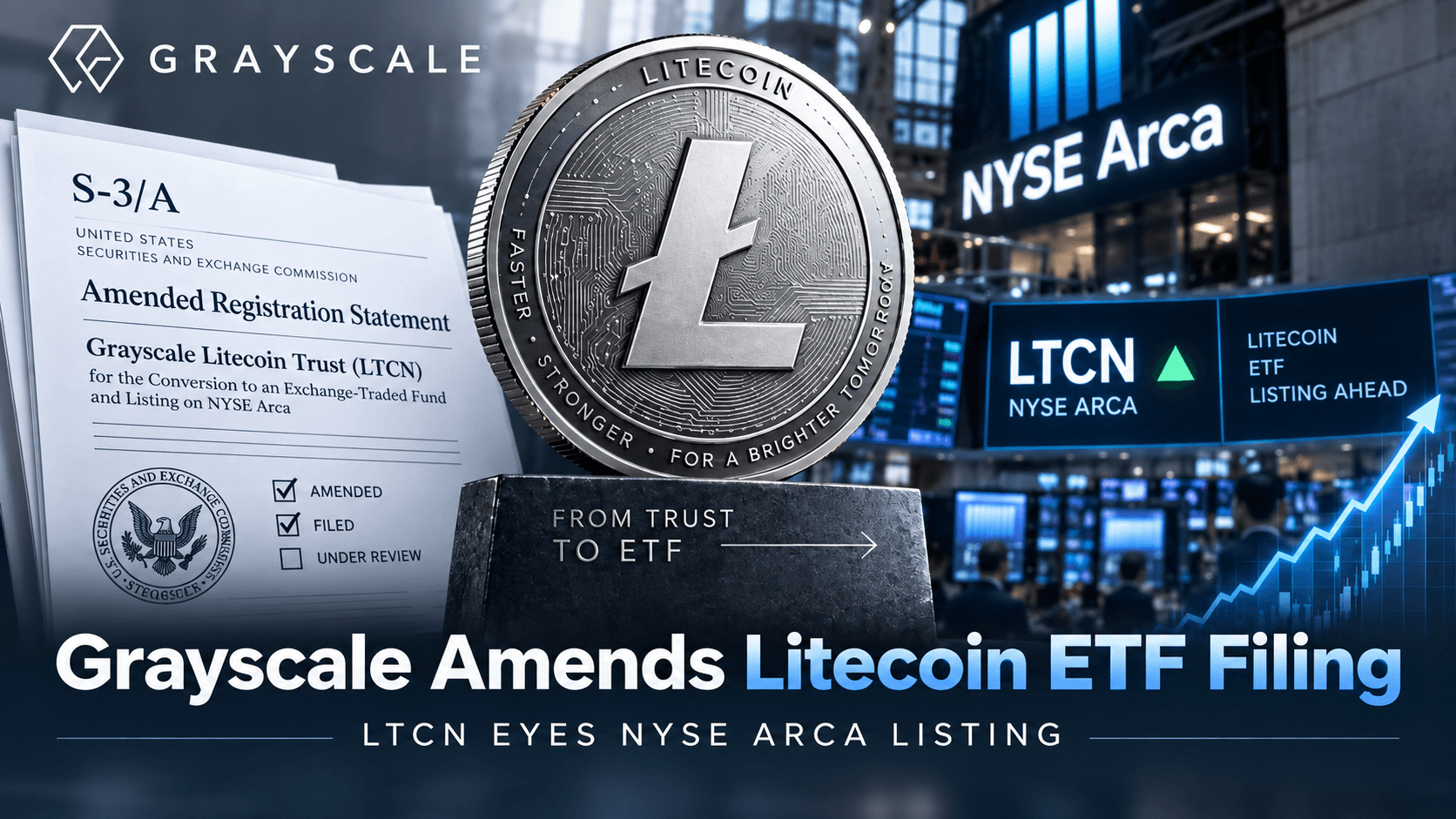
Grayscale filed an amended registration statement on September 11, 2026, as it continues to pursue the conversion of the Grayscale Litecoin Trust into an exchange-traded product listed on NYSE Arca under the existing LTCN ticker.
-
The biggest change would be the introduction of an ongoing creation and redemption mechanism, which could make it easier for arbitrageurs to keep LTCN shares closer to the value of the Litecoin held by the trust.
-
The filing does not mean the Grayscale Litecoin ETF has been approved or launched. Its eventual impact on the LTC price will depend largely on future net inflows, fees, liquidity and broader crypto market conditions.
Grayscale is taking another step toward bringing its long-running Litecoin investment product onto a major U.S. exchange. On September 11, the asset manager filed an amended registration statement for the Grayscale Litecoin Trust, setting out plans to eventually rename the vehicle the Grayscale Litecoin Trust ETF and list its shares on NYSE Arca under the ticker LTCN.
The filing arrives during a much different regulatory environment for crypto exchange-traded products than the one that existed when the Litecoin conversion effort first began. The U.S. Securities and Exchange Commission approved generic listing standards for qualifying commodity-based exchange-traded products in September 2025, while another spot Litecoin product, the Canary Litecoin ETF, is already trading in the United States.
For Litecoin investors, however, the biggest question is not simply whether another ETF-style product can reach the market. It is whether converting an established trust into a more liquid exchange-traded structure can attract fresh capital into LTC. With Litecoin recently trading near $54 while Bitcoin remains around $77,000, the amended filing has strengthened Litecoin's institutional-access narrative without yet triggering an outsized price breakout.
What Did Grayscale File?
Grayscale's September 11 filing is an amendment to the registration statement covering the existing Grayscale Litecoin Trust (LTC). The trust currently trades on the OTCQX market under the ticker LTCN. If the registration statement becomes effective and the required listing conditions are satisfied, Grayscale intends to rename it the Grayscale Litecoin Trust ETF and move the shares to NYSE Arca while retaining the LTCN ticker. Importantly, the amended S-3 is still conditional. It registers the framework for future continuous issuance but does not itself mean the ETF has been approved or that exchange trading has begun.
The proposed structure would allow shares to be created and redeemed by Authorized Participants in blocks of 10,000 shares, known as Baskets. The trust would continue holding actual Litecoin as its underlying asset, while Coinbase-related entities provide custody and trading infrastructure and BNY Mellon serves key administrative functions. The current filing also says creations and redemptions would initially rely on cash orders handled with liquidity providers rather than direct in-kind transfers of LTC.
That distinction matters because headlines describing the filing as a "Grayscale Litecoin ETF launch" go too far. Grayscale is advancing the conversion process, but several steps still separate the amended registration statement from an actively traded NYSE Arca product.
Why Does the LTCN ETF Conversion Matter?
LTCN is not a newly created fund waiting to accumulate its first Litecoin. It is an established trust that has held LTC for years. As of June 30, 2026, the trust owned approximately 1.97 million LTC, valued at roughly $82.3 million at that date. Each share represented an indirect economic interest in the Litecoin held by the vehicle.
The existing structure, however, has an important limitation: the trust has not historically operated a normal continuous redemption program. That has allowed LTCN shares to trade at substantial premiums or discounts to the value of the Litecoin backing them. Grayscale's amended prospectus notes that between August 2020 and June 2026, LTCN experienced extraordinarily wide deviations from NAV, including a maximum historical premium of 5,893% and a maximum discount of 67%. Even on September 9, 2026, LTCN was trading around 8% below NAV.
An ETF-style creation and redemption system could narrow that gap. If LTCN shares trade above the value of the underlying Litecoin, Authorized Participants may have an incentive to create new shares. If they trade below NAV, redemption-related arbitrage can work in the opposite direction. In other words, the most important part of the conversion is not simply adding "ETF" to the product's name. It is giving the market a more functional mechanism for keeping LTCN's share price connected to the Litecoin it represents.
How Would the Grayscale Litecoin ETF Work?
Under the amended structure, Authorized Participants would transact with the trust in 10,000-share Baskets rather than creating or redeeming individual shares. Based on the trust's June 30 holdings, one 10,000-share Basket represented about 811.9 LTC. Grayscale argues that the Basket size should be small enough relative to Litecoin's trading volume to support an effective arbitrage mechanism. Retail investors, meanwhile, would continue buying and selling ordinary LTCN shares through the secondary market rather than redeeming individual shares directly for Litecoin.
Initially, those creations and redemptions would use Cash Orders. In a creation, an Authorized Participant would provide cash, a liquidity provider would acquire the required LTC, and the Litecoin would ultimately enter the trust. A cash redemption reverses the process, with LTC disposed of and cash delivered through the relevant mechanism. The filing notes that cash redemptions are subject to sponsor approval and that Grayscale can also limit the number of cash-created shares on a given day.
Direct in-kind creations and redemptions could potentially be introduced later if the necessary regulatory approvals are obtained. That would allow eligible participants to transfer LTC directly into or out of the trust instead of introducing an additional cash-to-crypto transaction. In-kind functionality can make arbitrage more efficient, but the amended filing makes clear that it is not currently available and there is no guarantee as to when it will be approved.
Why Is the Regulatory Backdrop Different Now?
Grayscale's Litecoin effort began under a regulatory regime in which exchanges typically had to seek SEC approval for individual crypto exchange-traded products through separate rule-change proceedings. That changed materially on September 17, 2025, when the SEC approved generic listing standards for Commodity-Based Trust Shares on Nasdaq, Cboe BZX and NYSE Arca. Qualifying products can now be listed under pre-approved exchange standards without requiring a new individual Rule 19b-4 proposal every time.
The change does not mean every crypto ETF automatically receives approval. Issuers still need to satisfy the applicable securities-registration, exchange-listing, custody, disclosure and operational requirements. Grayscale's latest prospectus itself says the offering would proceed only after the relevant NYSE Arca listing process is approved or individual 19b-4 approval is determined to be unnecessary under the applicable framework.
But the broader direction is clear. The U.S. crypto ETP market has shifted away from a system in which every new asset necessarily triggered a prolonged, stand-alone regulatory battle toward a more standardized listing framework for qualifying products. For Litecoin, the question is therefore no longer simply whether a U.S. spot product can exist. One already does. The more relevant question is how quickly and under what terms Grayscale can convert LTCN into a competitive exchange-listed vehicle.
Grayscale vs. Canary: Who Can Win the Litecoin ETF Race?
Grayscale will not be the first U.S. asset manager to offer investors exchange-traded Litecoin exposure. The Canary Litecoin ETF (LTCC) is already trading and directly holds Litecoin. As of September 9, 2026, Canary reported approximately $7.08 million in net assets, a market price of $13.04, NAV of $13.11 and a 0.95% sponsor fee. The fund's premium or discount was only about -0.54%, illustrating the tighter NAV relationship an exchange-traded structure can potentially deliver.
Grayscale nevertheless enters this competition with a very different advantage. LTCN already has an investor base and a large pool of Litecoin. Its June annual filing showed almost 1.97 million LTC in the trust, far more than would be required to start a small ETF from scratch. The Grayscale name is also well known among crypto investors following the firm's Bitcoin, Ethereum and other digital-asset products. That means the competition is less a simple race to be first and more a contest between Canary's first-mover advantage and Grayscale's legacy assets, distribution and brand recognition.
Fees could become decisive. The existing LTCN trust charges a 2.5% annual sponsor fee, according to its latest annual report, significantly above LTCC's 0.95%. However, Grayscale has not yet specified the final fee for the proposed ETF structure; the amended prospectus still leaves the future sponsor-fee percentage blank. A substantial fee reduction could make LTCN more competitive, while an unusually high fee could encourage price-sensitive investors to consider alternatives.
What Does the Filing Mean for Litecoin Price?
The ETF narrative is generally viewed as constructive for cryptocurrencies because exchange-traded products can make digital-asset exposure accessible through conventional brokerage and retirement accounts. But the relationship between Grayscale's filing and Litecoin price is more complicated than simply assuming "ETF equals new buying." LTC is currently trading around $53.8, with a market capitalization near $4.2 billion. Bitcoin, meanwhile, is trading around the high-$77,000 area, meaning Litecoin is still moving within a broader crypto market heavily influenced by Bitcoin and macro risk appetite.
The biggest reason to be cautious is that Grayscale already owns nearly two million LTC. Converting LTCN from an OTC trust into an exchange-listed product does not require the firm to buy those coins again. A change in legal or trading structure does not automatically create an equivalent amount of fresh spot demand. The real bullish transmission mechanism would come after launch if investor demand produces net share creations. New money flowing into the product could require additional Litecoin purchases, potentially reducing freely available supply and strengthening institutional demand.
The reverse is also possible. A more liquid ETF structure may make it easier for existing LTCN shareholders to exit. If redemptions exceed creations, Litecoin may ultimately be sold to meet those redemptions. That is why investors should focus less on the filing itself and more on future net flows. A competitive fee, strong trading liquidity, sustained net inflows and broader strength across the crypto market would make the ETF story more meaningful for LTC. Weak demand, heavy redemptions or another market-wide risk-off move could significantly reduce that effect.
What Could Still Delay the Listing?
The amended registration is an important procedural step, but it is not the final one. The registration statement still needs to become effective, NYSE Arca's listing conditions need to be satisfied, operational details must be finalized, and Grayscale still has to disclose important commercial terms such as the finished sponsor fee. The filing also highlights limitations associated with the initial cash-only creation and redemption system, including the possibility that less efficient arbitrage could contribute to wider spreads or temporary premiums and discounts.
There is also no guarantee that a successful listing would translate into strong investor demand. An ETF can receive regulatory clearance and still generate limited trading volume or assets. That risk may be particularly relevant because Litecoin is competing not only with another dedicated LTC product but with a much larger universe of Bitcoin, Ethereum and diversified crypto investment vehicles for institutional capital.
For investors, this makes the next phase primarily an execution story. Grayscale has established a proposed ETF structure, but pricing, liquidity and investor adoption will ultimately determine whether LTCN becomes a meaningful institutional gateway for Litecoin.
What Comes Next for LTCN and Litecoin?
The most important milestones are now relatively easy to identify. Investors should watch for the registration statement becoming effective, confirmation of the NYSE Arca listing, disclosure of the final sponsor fee and an official trading date. Once trading begins, attention should quickly shift to first-day volume, bid-ask spreads, premium or discount to NAV and—most importantly—daily creations and redemptions.
Potential approval for in-kind creations and redemptions would be another meaningful development because it could improve the efficiency of the arbitrage mechanism. The relationship between LTCN and its NAV will also offer an early indication of whether the conversion is solving one of the legacy trust's biggest structural weaknesses.
The Litecoin ETF debate has therefore moved into a new phase. Canary has already demonstrated that a U.S. exchange-traded Litecoin product can reach the market. Grayscale's challenge is different: it needs to transform an established but structurally constrained trust into a liquid, competitively priced product capable of turning its legacy investor base into sustainable new demand. If it succeeds, the most important result will not be the word "ETF" attached to LTCN—it will be whether fresh capital begins flowing into Litecoin through the vehicle.
🔥 Beyond the Headlines: What KuCoin 5.0 Means for You
Market news moves fast — but where you act on it matters just as much. This October, KuCoin launches KuCoin 5.0, transforming KuCoin into a rebuilt platform. Here's what actually changes for you:
-
One account for everything. Older platforms split your money across separate "spot," "margin," and "futures" accounts and expected you to understand why. KuCoin 5.0's unified account removes that entirely — deposit once, and everything is simply there.
-
Stocks, indices, and commodities. KuCoin 5.0 expands beyond crypto into global markets. When crypto chops sideways and equities rally (or the reverse), you rotate in minutes instead of opening a brokerage account and waiting days for fiat rails.
-
Real-world assets (RWA). Tokenized exposure to traditional assets like commodities, right inside your crypto account. One of the fastest-growing segments in global finance is no longer reserved for institutions — you access it from the same balance you trade with.
-
Earn while you learn. Not ready to trade? KCUSD lets your stablecoins earn daily, auto-compounding interest. The lowest-stress way to put your idle deposit to work for 4% yield.
-
An AI assistant in plain language. Ask questions, get market context, understand what you're looking at — built into the platform, no jargon required.
-
An app that doesn't overwhelm. Faster, cleaner, and consistent — intuitive from the first tap, not after a tutorial.
-
Safety you can check, not just trust. A MiCAR-licensed EU entity, Proof of Reserves you can verify yourself, and internationally certified security (SOC 2 Type II, ISO 27001:2022).
Create your account in minutes — and start on the platform built for where crypto is going, not where it's been.
FAQs
Can retail investors redeem LTCN shares directly for Litecoin?
No. The proposed creation and redemption process is designed primarily for Authorized Participants operating in large Baskets. Ordinary investors would generally buy and sell LTCN shares on the exchange through their brokerage accounts rather than exchange individual shares directly with Grayscale for LTC.
Will the Grayscale Litecoin ETF hold actual Litecoin?
Yes. The trust is designed to hold LTC directly rather than obtain Litecoin exposure primarily through futures or derivatives. Each share represents a fractional beneficial interest in the assets held by the trust, after accounting for applicable expenses and liabilities.
Could investors hold LTCN in a retirement account?
An exchange-listed product can generally be easier to access through conventional brokerage infrastructure than holding Litecoin directly in a crypto wallet. Availability inside specific retirement accounts, however, can depend on the broker, account provider and its individual investment restrictions.
Is the Grayscale Litecoin Trust ETF a traditional 1940 Act ETF?
No. Despite the ETF terminology, the proposed trust is not registered as an investment company under the Investment Company Act of 1940. It follows a commodity-based trust structure, meaning investors do not receive all of the same regulatory protections that apply to traditional mutual funds and 1940 Act ETFs.
Will a Litecoin ETF earn staking rewards?
No. Litecoin uses a Proof-of-Work consensus mechanism rather than Proof-of-Stake, so LTC does not produce native staking rewards. The investment objective of a spot Litecoin product is primarily to track the value of the Litecoin it holds, less fees and other expenses.
Disclaimer: This article is for informational purposes only and does not constitute investment advice. Crypto assets can be highly volatile, and market conditions, token liquidity and project developments may change rapidly. Readers should conduct their own research and assess their risk tolerance before making financial decisions.