

2026 RWA Tokenization Surge: A bridge between crypto speculation and real-world utility?
2026/03/26 14:06:02
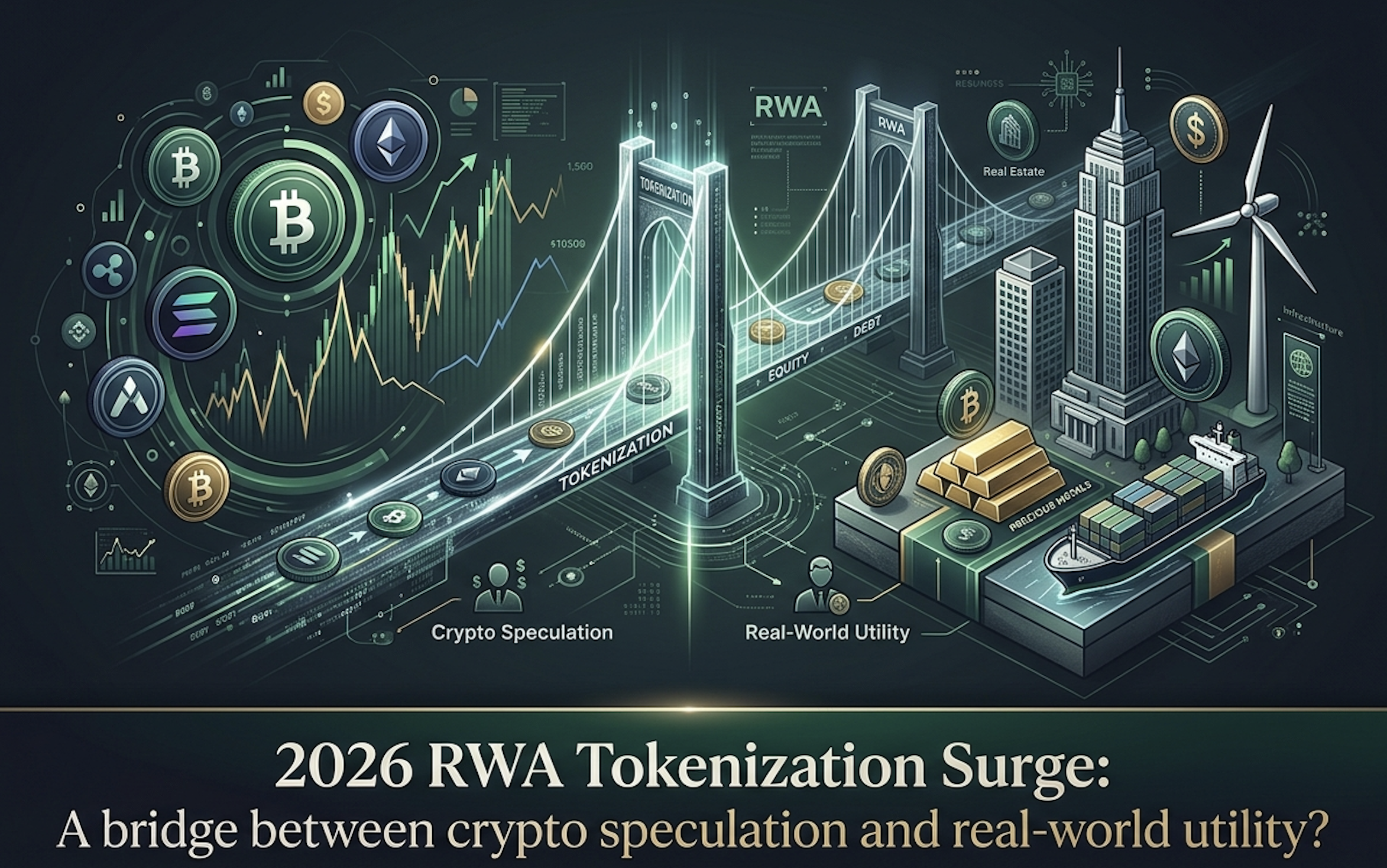
The "2026 RWA (Real-World Asset) Tokenization Surge" marks a pivotal shift in the digital economy. No longer a niche experiment for tech enthusiasts, the tokenization of tangible assets—ranging from US Treasuries to high-end real estate—has surpassed a total value of $26 billion as of early 2026. This transition represents the "normalization of digital finance," where the focus has moved from speculative trading to the creation of repeatable, institutional-grade financial products that provide a sustainable bridge to the real economy.
Key Takeaways
-
2026 marks the definitive transition "from virtual to real," as tokens backed by physical assets like gold and commercial property replace purely speculative "DeFi-native" assets.
-
Fractional ownership has dismantled high entry barriers, allowing retail investors to access historically illiquid markets—such as fine art and New York real estate—with as little as $100.
-
The rise of "Programmable Trust" and modular infrastructure has eliminated traditional T+2 settlement delays, enabling 24/7 atomic settlements and seamless movement of value across different blockchain networks.
What is RWA Tokenization
Real-World Asset (RWA) Tokenization is the process of converting the ownership rights of a physical or traditional financial asset into a digital token on a blockchain.
Essentially, it creates a "digital twin" of a real-world object. If you own the token, you own the underlying asset (or a specific share of it), and your ownership is recorded on an immutable, transparent ledger.
How RWA Tokenization Works
The process typically follows three main steps:
Off-Chain Formalization
A physical asset (like a building or a gold bar) is appraised, and its legal ownership is verified. A legal structure (like an LLC or a Trust) is often created to hold the asset.
Information Mirroring
Data about the asset (value, legal documents, ownership) is converted into a digital format.
Tokenization
A smart contract is deployed on a blockchain (like Ethereum, Polygon, or Solana) to mint tokens. These tokens represent a fractional or total claim on the asset and can be traded 24/7.
What Assets are Being Tokenized?
In 2026, the market expanded far beyond just "experimental" assets. Common examples include:
Cash & Equivalents
US Treasury bills (e.g., Ondo Finance, BlackRock’s BUIDL) and stablecoins.
Real Estate
Fractional ownership of apartments or commercial buildings.
Commodities
Gold (e.g., PAXG), silver, or even agricultural products.
Private Credit
Loans to businesses that are funded by on-chain investors.
Collectibles
Fine art, vintage cars, or rare watches.
From Speculation to Substance: The 2026 Paradigm Shift
For years, the cryptocurrency market was criticized as a "bubble" built on "virtual" assets with no intrinsic value. However, 2026 has witnessed the definitive transition from virtual to real . By pinning digital tokens to physical assets like gold, commercial property, and corporate debt, the industry is providing the "intrinsic value" skeptics once demanded. This year, RWA tokenization is not just an alternative investment; it is the infrastructure through which crypto finance finally passes the reliability test for global capital.
The Role of Institutional On-Chain Yield Rails
A primary driver of the 2026 surge is the appetite for "on-chain institutional yield." Traditional investors are no longer satisfied with the volatile returns of "DeFi-native" assets. Instead, they are flocking to tokenized U.S. Treasury bills and money market funds, which now account for over 44% of the RWA market. These products allow institutions to keep their capital on-chain—benefiting from blockchain efficiency—while earning the predictable returns of traditional finance (TradFi).
Breaking Down Barriers: Fractional Ownership and Accessibility
Tokenization is democratizing high-entry-barrier markets. In 2026, a retail investor in Southeast Asia can purchase a $100 "fraction" of a New York office building or a piece of fine art, assets previously reserved for the ultra-wealthy. By breaking down high-value assets into smaller digital units, tokenization is unlocking massive liquidity in historically illiquid markets, allowing capital to flow where it was once blocked by minimum investment requirements.
Programmable Trust: The End of T+2 Settlement
One of the most significant technical breakthroughs this year is the rise of "Programmable Trust." By embedding compliance, risk controls, and transfer restrictions directly into the asset's smart contract, the industry is eliminating manual reconciliation and "T+2" (two-day) settlement delays that have plagued traditional markets for decades. In 2026, tokenized assets move with "atomic settlement", the asset and the payment swap simultaneously and instantly, 24/7.
Regulatory Clarity: The Strategic Foundation
The 2026 boom is largely fueled by the "legal scaffolding" erected by global regulators. Legislative milestones, such as bipartisan hearings in the U.S. and the implementation of standardized frameworks in hubs like Singapore and Dubai, have given institutions the confidence to scale. We have moved past the era of "unregulated wild west" tokens toward "permissioned" environments where identity (KYC) and anti-money laundering (AML) checks are automated and baked into protocol level.
Enhanced Market Liquidity and the Secondary Market
In 2025, the industry proved it could mint assets; in 2026, it is proving it can trade them. The focus has shifted toward Sustained Trading Volume. Platforms like xStocks and Centrifuge are creating secondary markets where tokenized equities and private credit can be bought and sold with ease. This "secondary market utility" ensures that tokenized assets are not just static digital ledger entries but dynamic, collateral-ready instruments that can be utilized across the entire DeFi ecosystem.
Overcoming Operational Friction: The Modular Infrastructure
Despite the growth, "operational friction" remains a challenge. The 2026 landscape is moving toward a Modular Market Structure to solve this. Instead of siloed blockchains, new interoperability solutions (like Chainlink’s CCIP) act as bridges, allowing tokenized value to move seamlessly across different networks. This allows a tokenized bond issued on a private institutional ledger to be used as collateral on a public DeFi protocol, creating a truly unified global financial system.
The Future: Normalization and Global Integration
As we look toward the end of 2026, the distinction between "crypto" and "finance" is blurring. Major players like BlackRock and JPMorgan are no longer just "experimenting"; they are operationalizing blockchain as a standard part of their core infrastructure. RWA tokenization has become the bridge that allows the digital economy to support the real-world economy, ensuring that the next wave of financial innovation is grounded in tangible, productive utility rather than mere speculation.
FAQs
-
What exactly is a "digital twin" in RWA tokenization?
A digital twin is a token on a blockchain that represents the ownership rights of a specific physical asset. It mirrors the asset’s real-world value, legal status, and ownership details on an immutable digital ledger.
-
Why is "Institutional Yield" driving the 2026 market?
Professional investors are seeking the efficiency of blockchain combined with the predictable returns of traditional finance. This has led to a surge in tokenized U.S. Treasury bills, which now make up over 44% of the RWA market.
-
How does tokenization improve liquidity for real estate?
By breaking a single property into thousands of digital tokens, it allows for fractional ownership. These tokens can be traded instantly on secondary markets, unlike traditional real estate which can take months to sell.
-
Is RWA tokenization regulated?
Yes. The 2026 boom is supported by "legal scaffolding" in major hubs like Singapore, Dubai, and the U.S. Most platforms now operate in "permissioned" environments where KYC (Know Your Customer) and AML (Anti-Money Laundering) checks are automated.
-
What is "Atomic Settlement"?
It is a technical breakthrough where the transfer of the asset and the payment happens simultaneously. This eliminates the risk of one party failing to deliver and removes the need for the multi-day clearing periods (T+2) used in traditional banks.