

Erasing the "Blockchain": Inside the Radical Rebranding of Crypto Pioneers Into Wall Street's Favorite AI Landlords
2026/06/03 17:58:00
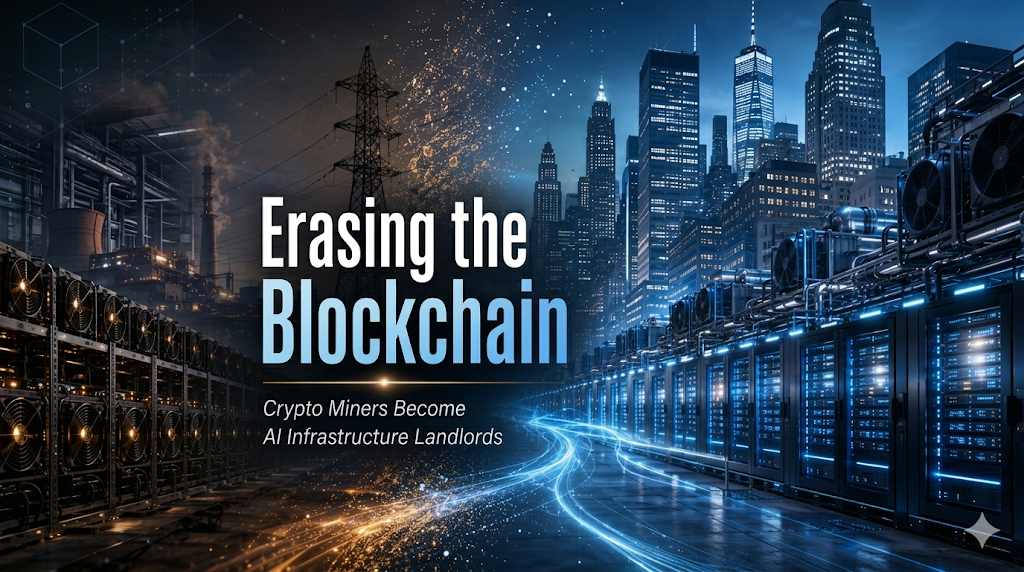
For years, crypto mining companies built their identity around Bitcoin mining, blockchain infrastructure, and the future of decentralized finance. Their value was often measured through hash rate, Bitcoin production, mining efficiency, and exposure to crypto market cycles.
A growing number of Bitcoin miners and crypto infrastructure firms are moving away from the word “blockchain” and replacing it with a new set of market-friendly terms: AI infrastructure, high-performance computing, data centers, power capacity, GPU hosting, and digital infrastructure.
This shift is more than a branding update. It reflects a major business transformation. Companies that once promoted themselves as crypto pioneers are now trying to become the landlords of the artificial intelligence economy.
AI companies need enormous amounts of computing power. But they also need electricity, cooling, land, grid access, and large-scale data center capacity. Bitcoin miners already spent years building energy-intensive facilities. That makes them attractive to investors and AI infrastructure companies looking for faster access to power and industrial-scale sites.
In the new Wall Street narrative, the most valuable asset is not always the Bitcoin being mined. It may be the megawatts behind the mining operation.
From Blockchain Miners to AI Infrastructure Landlords
The crypto mining industry is entering a new phase. Companies that once built their identity around Bitcoin mining, blockchain infrastructure, and hash rate expansion are now repositioning themselves as AI infrastructure providers. This shift is being driven by rising demand for data centers, high-performance computing, and reliable power access.
Instead of only mining Bitcoin, many former crypto miners are now trying to monetize their land, energy contracts, and computing facilities by serving the fast-growing AI economy.
-
Why Bitcoin Miners Are Moving Beyond Crypto Mining
Bitcoin mining remains an important business, but it is also highly cyclical. Revenue depends on Bitcoin price, mining difficulty, energy costs, hardware efficiency, and block rewards. After each Bitcoin halving, miners receive fewer BTC per block, which can pressure profit margins.
AI infrastructure offers a different opportunity. By converting mining sites into data center campuses, miners may create more predictable revenue from enterprise customers.
Key reasons behind the shift include:
-
Lower Bitcoin mining rewards after halving cycles
-
Rising demand for AI data center capacity
-
Greater investor interest in AI infrastructure
-
Need for more stable long-term revenue
-
Existing access to large-scale power and industrial sites
This does not mean Bitcoin mining is disappearing. Many companies still mine BTC. However, the business model is becoming broader. Mining is no longer the only story these companies want investors to hear.
-
How Mining Sites Became Valuable AI Real Estate
Bitcoin miners spent years building facilities designed for energy-intensive computing. These sites often include large power connections, cooling systems, industrial land, and relationships with utility providers. In the AI boom, those assets have become highly valuable.
AI companies need more than chips. They need places to run those chips. That makes crypto mining facilities attractive because some of them can be upgraded faster than building a new data center from scratch.
For Wall Street, the value is no longer just about how much Bitcoin a miner can produce. The bigger question is how much power and data center capacity the company controls.
A mining site with strong power access can become a strategic asset because AI infrastructure faces several bottlenecks:
-
Limited grid capacity
-
Long data center construction timelines
-
Expensive cooling requirements
-
Delays in permitting and utility approvals
-
Rising demand for high-density computing space
This is why former crypto mining campuses are being viewed differently. What once looked like a volatile Bitcoin-linked facility may now look like scarce digital infrastructure.
-
The Rise of the “AI Landlord” Business Model
The new model turns crypto miners into infrastructure landlords. Instead of only using their facilities to mine Bitcoin, they can lease space, power, and data center capacity to AI and high-performance computing customers.
This changes the investment story. A miner with long-term AI hosting contracts may look less like a volatile crypto company and more like a digital infrastructure business.
The “AI landlord” model focuses on:
-
Renting data center capacity
-
Hosting AI and HPC workloads
-
Monetizing power agreements
-
Building long-term enterprise contracts
-
Reducing dependence on Bitcoin price cycles
This is a powerful shift because it moves these companies from speculative crypto exposure toward infrastructure-backed revenue. Investors may still see risk, but the business becomes easier to explain in traditional financial terms.
Instead of asking, “How much Bitcoin did this company mine?” investors are now asking, “How much power does this company control, and who is paying to use it?”
-
Erasing Blockchain From the Pitch Deck
The most important part of this transformation is not only operational. It is also narrative-driven. Many crypto mining firms are not completely abandoning Bitcoin, but they are changing how they present themselves to investors.
The old language of blockchain, decentralization, and mining rewards is being replaced with terms that sound more familiar to Wall Street: data centers, AI infrastructure, power capacity, hosting contracts, and high-performance computing.
This shift matters because public markets often reward businesses that can show stable demand, long-term customers, and infrastructure value. Bitcoin mining is still exposed to crypto cycles, but AI data center leasing can be presented as a more predictable business model.
In that sense, these companies are not just changing what they do. They are changing the story investors are being asked to believe.
-
Why Crypto Companies Are Changing Their Language
During previous crypto bull markets, words like blockchain, mining, digital assets, and Web3 helped companies attract attention. Today, those same words can carry mixed reactions among institutional investors.
After multiple crypto downturns, exchange failures, regulatory disputes, and mining bankruptcies, some public companies want to reduce their dependence on crypto branding. AI, by contrast, has become one of the strongest investment narratives in global markets.
Instead of focusing only on hash rate, mining fleets, BTC production, and blockchain infrastructure, they now emphasize power capacity, data center development, AI hosting, enterprise customers, and long-term infrastructure demand.
This is the core of the rebrand. The blockchain identity is being softened, while the AI infrastructure identity is being pushed forward.
-
The Pivot Is Not Automatic
The transition from Bitcoin mining to AI infrastructure is not simple. AI data centers require stronger networking, more advanced cooling, higher reliability, and different technical standards than mining facilities.
Bitcoin mining sites are usually designed to run ASIC machines for one specialized purpose. AI data centers often need GPU servers, stronger connectivity, advanced cooling, backup systems, storage infrastructure, and enterprise-grade reliability.
This means only some miners may successfully complete the pivot. Companies with strong balance sheets, good locations, large power capacity, and serious infrastructure experience are better positioned than those using AI only as a marketing label.
The winners will likely be the firms that can prove they are not just changing their language, but actually building usable AI-ready infrastructure.
Why Wall Street Is Repricing Crypto Pioneers as Data Center Powerhouses
Wall Street is changing how it looks at crypto mining companies. In the past, investors mainly valued these firms based on Bitcoin production, hash rate, mining efficiency, and BTC market cycles. Today, the focus is expanding toward power capacity, data center infrastructure, AI hosting potential, and long-term enterprise demand.
This shift is helping some crypto pioneers move from a volatile blockchain narrative into a broader digital infrastructure story.
-
Power Access Has Become a Premium Asset
AI data centers need massive and reliable electricity. As demand for artificial intelligence grows, access to secured power has become one of the biggest bottlenecks in the technology sector.
Crypto miners already built their businesses around finding large-scale power sources, which makes their infrastructure more valuable in the AI era.
Wall Street is paying attention because miners may already control:
-
Large power agreements
-
Industrial-scale facilities
-
Grid-connected sites
-
Energy management experience
-
Locations that can support high-density computing
In this market, power is not just an operating cost. It is a strategic asset. Companies that control power capacity may have an advantage over firms trying to build data centers from zero.
-
AI Infrastructure Offers a Stronger Growth Story
Bitcoin mining is closely tied to market cycles. When Bitcoin prices fall or mining difficulty rises, miner revenue can come under pressure. AI infrastructure gives these companies a new growth narrative that may be easier for traditional investors to understand.
Instead of depending only on mined Bitcoin, data center operators can potentially earn revenue through hosting, leasing, and long-term compute contracts. This makes the business model look more stable and attractive to institutions.
The AI story also connects crypto miners to a much broader market. They are no longer only compared with other mining companies. They can now be discussed alongside data center operators, cloud infrastructure firms, power infrastructure companies, and AI supply-chain players.
That broader comparison can change how investors value the business.
-
Long-Term Contracts Can Reduce Crypto Volatility
One reason Wall Street likes the AI data center pivot is the possibility of predictable cash flow. Bitcoin mining revenue can change quickly, but AI hosting contracts may provide longer-term income visibility.
This is important because public markets often reward companies with recurring revenue and contracted demand. If crypto miners can secure enterprise AI customers, they may be valued more like infrastructure firms than pure crypto miners.
A long-term AI hosting agreement can help a company show:
-
Clearer revenue visibility
-
Reduced dependence on daily Bitcoin prices
-
Stronger customer relationships
-
Better financing opportunities
-
A more stable business narrative
This does not remove all risk. But it gives investors a different way to evaluate the company.
-
Data Center Scarcity Is Raising Asset Values
AI companies need chips, but they also need places to run them. Data center capacity is limited, and new projects can take years to build because of permitting, land, power, cooling, and grid constraints.
This makes existing crypto mining sites more attractive. Even if they require upgrades, they may offer a faster path to usable AI infrastructure than starting from zero.
For investors, the key asset is no longer just the mining machine. It is the full site: land, power, cooling, connectivity, and expansion potential.
This is why some mining companies are being repriced. Their facilities are no longer seen only as Bitcoin production sites. They are being viewed as possible AI infrastructure platforms.
-
Wall Street Wants Infrastructure, Not Just Ideology
The crypto industry often speaks in terms of decentralization, financial freedom, and blockchain innovation. Those ideas still matter to many users and investors. But Wall Street usually focuses on cash flow, margins, growth, contracts, and asset value.
AI data centers fit that framework more easily than crypto mining. They are physical assets tied to enterprise demand. They can be financed, leased, expanded, and valued using more familiar infrastructure models.
-
The Repricing Depends on Real Execution
The market is rewarding the AI infrastructure story, but not every crypto miner will succeed. Converting a Bitcoin mining site into an enterprise-grade AI data center is complex and expensive.
AI workloads require stronger technical standards than traditional mining operations, including:
-
Advanced cooling systems
-
Higher uptime reliability
-
Strong networking infrastructure
-
Backup power systems
-
Enterprise-grade security
-
Large capital investment
This means Wall Street’s repricing will depend on execution. Companies that can prove real AI contracts, real infrastructure upgrades, and real customer demand may continue gaining investor attention. Companies that only use AI language without building serious capacity may struggle to hold their valuation.
CoreWeave and Core Scientific: The Deal That Defined the Shift
The CoreWeave and Core Scientific deal became one of the clearest examples of this new market direction. CoreWeave, an AI cloud infrastructure company with roots in crypto mining, moved to acquire Core Scientific, one of the best-known Bitcoin mining companies.
The logic behind the deal was simple: AI companies need power and data center capacity, and crypto miners already control valuable infrastructure.
Core Scientific’s mining background became less important than its ability to support AI infrastructure growth. Its facilities, power access, and data center footprint became the central value proposition.
This deal gave the market a strong message. Crypto mining infrastructure can be repurposed, upgraded, and repriced for the AI economy.
For other miners, the lesson was clear. The market may reward companies that can turn mining sites into AI-ready campuses. The strongest asset may no longer be the machines mining Bitcoin, but the power capacity behind them.
The Risks Behind the AI Rebrand
The AI landlord story is attractive, but it is not risk-free. The shift from crypto mining to AI infrastructure carries major challenges.
-
AI Data Centers Require Heavy Investment
Upgrading mining sites for AI workloads can be expensive. Companies may need to invest in cooling, networking, electrical systems, backup power, building redesigns, and security upgrades.
This can put pressure on balance sheets, especially for miners that are already dealing with volatile crypto revenue.
-
Not Every Mining Site Is Suitable for AI
Some mining facilities may have cheap power but poor connectivity. Others may be located far from major enterprise customers or lack the technical requirements for high-performance computing.
A site that works well for Bitcoin mining may not automatically work well for AI hosting.
-
Customer Concentration Can Become a Problem
Some miners may depend on a small number of AI customers. If one major customer delays a project, cancels a contract, or changes strategy, revenue expectations could fall quickly.
This creates a different kind of risk from Bitcoin volatility, but it is still important.
-
AI Hype Could Cool Down
AI infrastructure demand is strong, but markets can move quickly. If investors become concerned about overbuilding, high costs, or slower AI monetization, valuations for AI-linked infrastructure companies could face pressure.
Companies that rebrand too aggressively without real execution may be exposed if sentiment changes.
-
The Crypto Business Still Matters
Even as miners pivot to AI, many still depend on Bitcoin mining revenue. That means they remain exposed to Bitcoin price movements, mining difficulty, energy costs, and halving cycles.
The AI pivot may reduce crypto dependence over time, but it does not remove it overnight.
What This Means for Crypto Investors
For crypto investors, this transformation changes how mining stocks should be analyzed.
In the past, investors mainly looked at:
-
Bitcoin production
-
Hash rate growth
-
Mining cost per BTC
-
Energy efficiency
-
BTC holdings
-
ASIC fleet upgrades
Now, investors also need to study:
-
Power capacity
-
Data center pipeline
-
AI hosting contracts
-
HPC revenue share
-
Customer quality
-
Capital expenditure
-
Facility conversion timelines
This creates a new category of public companies: part Bitcoin miner, part power operator, part data center developer, and part AI infrastructure play.
That hybrid model may reduce dependence on Bitcoin cycles, but it also makes the business more complex. Investors need to separate real infrastructure progress from marketing language.
A company saying “AI” is not enough. The key questions are:
-
Does it have real power capacity?
-
Does it have signed customers?
-
Can it finance the conversion?
-
Can it meet enterprise data center standards?
-
Can it balance mining revenue with AI infrastructure growth?
The companies that answer these questions clearly may attract stronger long-term investor interest.
What This Means for the Crypto Industry
The rebranding of miners into AI landlords creates a deeper identity question for the crypto industry.
Crypto companies once claimed they were building an alternative financial system. Now, some of the most visible public mining firms are repositioning themselves around centralized AI infrastructure.
This does not mean they are abandoning Bitcoin completely. Many still mine BTC and maintain exposure to crypto markets. But the public narrative has changed.
The industry once said:
“Blockchain will replace old systems.”
Now some companies are saying:
“Our power infrastructure can serve the AI economy.”
That shift shows how flexible capital markets can be. Investors may support crypto businesses when Bitcoin is rising. But when AI becomes the stronger story, companies quickly adjust their identity.
For Bitcoin purists, this may feel like a step away from the original mission. For investors, it may look like a practical survival strategy.
Crypto Miners as Digital Infrastructure Companies
The next phase of the mining industry may not be defined only by hash rate. It may be defined by infrastructure flexibility.
The strongest companies may be those that can use the same power and data center footprint across multiple revenue streams, including Bitcoin mining, AI hosting, cloud services, high-performance computing, and enterprise colocation.
This could create a more balanced business model. During strong Bitcoin markets, mining may remain attractive. During weaker crypto cycles, AI and HPC contracts may provide more stability.
However, the future will depend on execution. Companies must prove they can move beyond branding and actually deliver enterprise-grade infrastructure.
The miners that succeed may become digital infrastructure companies with crypto roots. The miners that fail may be remembered as companies that tried to ride the AI narrative without building the technical foundation to support it.
Conclusion
Crypto miners are no longer selling only the blockchain dream. Many are now selling something Wall Street values more clearly: power, land, data centers, and AI-ready infrastructure. This rebrand may help some companies build more stable businesses beyond Bitcoin cycles, but success will depend on real execution, not just AI language. In the new market narrative, the most valuable crypto asset may not be a token, it may be a megawatt.
FAQs
Why are Bitcoin miners moving into AI data centers?
Bitcoin miners are moving into AI data centers because they already control large power capacity, industrial sites, and computing infrastructure. AI companies need these assets to run high-performance workloads, making mining facilities valuable beyond crypto mining.
Are crypto miners abandoning Bitcoin?
Not completely. Many companies still mine Bitcoin, but they are diversifying into AI and high-performance computing to reduce dependence on Bitcoin price cycles and mining rewards.
Why does Wall Street like the AI data center pivot?
Wall Street likes the pivot because AI infrastructure may offer long-term contracts, stronger revenue visibility, and exposure to one of the fastest-growing technology markets.
Can any Bitcoin mining facility become an AI data center?
No. AI data centers require stronger cooling, networking, backup power, security, and reliability than standard mining facilities. Some mining sites may be suitable for conversion, while others may not meet enterprise requirements.
What does “AI landlord” mean?
An AI landlord is a company that owns or operates the physical infrastructure AI companies need, such as land, power, cooling systems, and data center space. Instead of building AI models, these companies rent infrastructure to AI customers.
What are the main risks of this rebrand?
The main risks include high capital costs, technical execution challenges, customer concentration, unsuitable mining sites, and the possibility that AI infrastructure valuations cool down.
How does this affect crypto investors?
Crypto investors now need to analyze mining companies differently. Bitcoin production still matters, but power capacity, AI contracts, data center development, and HPC revenue are becoming increasingly important.
Is this good or bad for the crypto industry?
It depends on the perspective. For investors, it may create stronger business models. For crypto purists, it may feel like a move away from blockchain ideals. Overall, it shows that crypto-built infrastructure can have value beyond digital asset mining.
Disclaimer
The information provided on this page may originate from third-party sources and does not necessarily represent the views or opinions of KuCoin. This content is intended solely for general informational purposes and should not be considered financial, investment, or professional advice. KuCoin does not guarantee the accuracy, completeness, or reliability of the information, and is not responsible for any errors, omissions, or outcomes resulting from its use. Investing in digital assets carries inherent risks. Please carefully evaluate your risk tolerance and financial situation before making any investment decisions. For further details, please consult KuCoin’s Terms of Use and Risk Disclosure.