

Unlocking Institutional DeFi Liquidity: What is the ERC-7943 Standard?
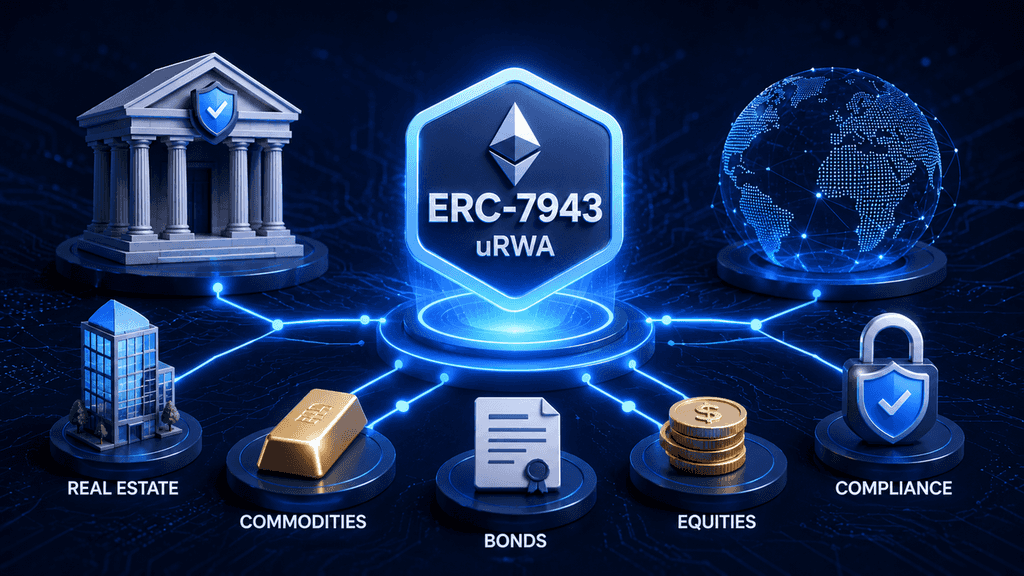
The tokenization of Real-World Assets (RWAs) is driving a historic convergence between traditional finance (TradFi) and decentralized infrastructure. As trillions of dollars in corporate bonds, commodities, and real estate move on-chain, digital asset markets require an interoperable, compliant protocol framework. The emergence of the ERC-7943 standard addresses this systemic need, providing Ethereum with a unified, non-opinionated interface layer designed to scale enterprise-grade assets safely.
In this deep dive, we explore how the ERC-7943 token standard redefines on-chain compliance, unifies fragmented market liquidity, and unlocks institutional access to the broader Ethereum ecosystem.
Key Takeaways
-
Universal Framework: ERC-7943, known as the Universal Real-World Asset (uRWA) standard, provides a minimal, vendor-neutral interface layer for compliant on-chain assets.
-
Multi-Token Integration: Seamlessly extends existing token models, including ERC-20, ERC-721, ERC-1155, and ERC-6909, via ERC-165 interface detection.
-
Pre-Transaction Validation: Utilizes specialized view hooks (canSend, canReceive, canTransfer) to confirm legal compliance before transactions execute on-chain.
-
Absolute Legal Controls: Mandates precise regulatory enforcement actions, explicitly standardizing asset freezing and forced transfers (forcedTransfer) for law enforcement or key-recovery needs.
-
Elimination of Vendor Lock-In: Decouples internal identity or compliance rule sets from the token's structural architecture, granting issuers absolute freedom of choice.
-
DeFi-Ready Composability: Reaching "Final" status in 2026, it empowers automated market makers (AMMs) and lending platforms to support regulated tokens securely without breaking liquidity pools.
The RWA Bottleneck: Why Ethereum Needed a New Framework
Tokenized real-world assets represent one of the most significant addressable markets in blockchain history. However, scaling institutional assets on public ledgers like Ethereum has historically been hindered by the fundamental design mismatch between decentralized networks and regulated financial environments. Public blockchains favor permissionless execution, whereas corporate securities, real estate deeds, and sovereign debt markets require continuous, granular compliance controls.
The Failure of Rigid Compliant Standards (ERC-1400 & ERC-3643)
Early attempts to standardize compliant tokens, such as ERC-1400 and ERC-3643, introduced complex, all-in-one frameworks designed to enforce regulatory restrictions directly inside the smart contract layer. While well-intentioned, these specifications suffered from significant limitations:
-
Over-Engineering: They forced developers to adopt heavy, resource-intensive implementations regardless of the asset's actual simplicity.
-
Gas Inefficiency: Executing granular role-based access control and identity validation checks directly during standard transfers generated excessive gas overhead, rendering high-frequency trading economically non-viable.
-
Enforced Ideology: Many of these legacy standards mandated specific on-chain identity systems or particular metadata structures, failing to accommodate the highly varied, fast-changing requirements of global financial jurisdictions.
Vendor Lock-In: The Core Commercial Problem for Issuers
For asset issuance platforms and enterprise entities, the architectural rigidity of early standards created a severe business risk: vendor lock-in. When a financial institution deployed a regulated token under an opinionated standard, their asset became structurally dependent on specific identity providers or platform registries.
If an issuer wanted to migrate to a more cost-effective identity service, update their automated compliance engine, or transition to alternative zero-knowledge (ZK) identity proofs, doing so often required a complete, highly complex smart contract redeployment. This fragmentation stifled corporate adoption, as risk management teams refused to commit billions in capital to closed, non-migratable token architectures.
Breaking the Fragmented Liquidity Dilemma on Exchanges
From the perspective of a digital asset exchange platform, legacy compliant tokens presented a persistent operational headache. Because every issuance platform built its own unique variation of transfer restrictions and whitelisting logic, secondary market liquidity became severely fragmented.
| Operational Challenge | Impact on Exchanges | Legacy Token Standards | ERC-7943 Solution |
| Integration Complexity | Custom engineering required for every single token listed. | High (Fragmented, non-standard hooks) | Low (Unified, predictable interface) |
| Transaction Failure Rates | High user friction due to unexpected EVM reverts during trading. | High (No pre-flight view checks) | Zero (Pre-validation using canTransfer) |
| Order Book Liquidity | Fragmented across isolated compliance siloes. | Deeply Fragmented | Fully Aggregated & Composable |
When an exchange attempted to aggregate these assets into unified order books or automated liquidity pools, transactions would frequently fail without clear explanations. This volatility disrupted order flows, degraded user experiences, and restricted real-world tokens to isolated, illiquid trading ecosystems.
Deep Dive into ERC-7943: The Universal RWA (uRWA) Interface
To resolve this fragmentation, a lean, universal abstraction layer was needed to standardize how systems query an asset's compliance state without dictating what those underlying rules must be. This is the exact design philosophy behind the ERC-7943 standard.
What is ERC-7943? A Definition for Crypto Traders
For everyday market participants, digital asset managers, and crypto traders, ERC-7943 can be understood as a universal adapter for compliant tokens. Officially designated as the Universal Real-World Asset (uRWA) Interface, this proposal introduces a lean set of administrative control and validation functions to public blockchains.
It does not manage identity directly; instead, it establishes a standardized communication protocol. This allows trading venues, institutional custodians, and decentralized protocols to interact with any regulated real-world token identically, regardless of whether the underlying asset is a tokenized share of commercial real estate or an energy commodity.
Minimalism Over Complexity: The Philosophy of the uRWA Primitive
The defining characteristic of ERC-7943 is its strict commitment to minimalism. The standard operates on the principle that a token contract should remain as lightweight as possible, serving exclusively as a ledger of balances and a broadcast layer for standardized compliance hooks.
By keeping the standard non-opinionated, the internal logic governing whether an address is allowed to trade can be handled off-chain, via a zero-knowledge credential verification system, or through a sovereign on-chain registry. This lean architecture ensures maximum compatibility, minimal gas usage, and absolute operational longevity.
How ERC-165 Interface Detection Powers Automatic Asset Recognition
To ensure seamless integration across the global Web3 ecosystem, ERC-7943 relies heavily on ERC-165 interface detection. ERC-165 is a standard method that allows smart contracts to declare exactly which interfaces they support.
When an ERC-7943 token is deposited into an exchange wallet or a decentralized application (dApp), the host protocol queries the contract using a unique interface identifier. If the contract returns a positive confirmation, the system instantly recognizes that the asset contains compliance controls. It can then dynamically update its user interface, activate pre-transaction validation workflows, and display frozen asset data without requiring manual, custom-coded backend adjustments by developers.
Technical Architecture: ERC-7943 Multi-Token Compatibility
Financial instruments in the traditional world take many different structural forms, ranging from fungible fiat currencies to non-fungible property deeds and fractionalized debt structures. To address this diversity, ERC-7943 is built with a highly flexible architecture, offering tailored sub-interfaces that sit on top of all major Ethereum token primitives.
IERC7943Fungible: Reinvigorating ERC-20 for Fiat and Commodities
The IERC7943Fungible sub-interface is engineered specifically for fungible, divisible digital assets. By extending the baseline ERC-20 standard, it applies universal compliance hooks directly to liquid, interchangeable instruments.
-
Primary Use Cases: Tokenized sovereign fiat currencies (stablecoins), yield-bearing money market funds, fractionalized gold or oil commodities, and corporate equity shares.
-
Core Functionality: Enables automated compliance systems to track and enforce regulatory volume limits, regional transfer bans, and transaction pattern limits across high-velocity token supplies.
IERC7943NonFungible: Adapting ERC-721 for Real Estate and Art
When dealing with unique, non-interchangeable real-world assets, the standard utilizes IERC7943NonFungible. This interface builds directly upon the ubiquitous ERC-721 framework.
-
Primary Use Cases: Commercial real estate deeds, high-value physical fine art registries, intellectual property patents, and structured trade finance invoices.
-
Core Functionality: Instead of managing balance amounts, this variation tracks compliance on an individual token ID level. It ensures that a specific asset cannot be transferred to an unverified participant, while maintaining the ability for authorized legal entities to freeze or reclaim the unique token if a legal dispute arises.
IERC7943MultiToken: Upgrading ERC-1155 & ERC-6909 for Bonds
For complex, multi-tiered financial instruments, ERC-7943 offers the IERC7943MultiToken interface, extending both ERC-1155 and the hyper-efficient ERC-6909 multi-token standard.
-
Primary Use Cases: Multi-tranche corporate bonds, fractionalized real estate funds with diverse share classes, and structured derivative products.
-
Core Functionality: This architecture allows a single deployed smart contract to manage an entire portfolio of diverse RWA asset classes simultaneously. Each individual asset class retains its own unique compliance configurations, significantly reducing gas costs and simplifying treasury operations for institutional issuers.
The 4 View Functions: How ERC-7943 Ensures Compliant Transfers
The inclusion of four standardized, read-only view functions within ERC-7943 completely transforms the user experience of trading real-world assets. These functions provide a predictable, standardized pre-flight check that trading venues and decentralized protocols can utilize to guarantee compliance before initiating an active transaction on the blockchain.
Decoding canSend and canReceive: Separate KYC/AML Sanction Checks
In a highly regulated financial ecosystem, compliance is rarely asymmetrical. An account may be legally authorized to liquidate its holdings and transfer tokens out, but explicitly barred from acquiring more due to updated geographic restrictions or expired identity documentation. ERC-7943 handles this reality by decoupling the sender and receiver checks into two distinct functions:
-
canSend(address account): Queries the asset's compliance backend to determine if the specified address is authorized to broadcast an outward transfer.
-
canReceive(address account): Independently queries whether the destination address is legally cleared to receive and hold the asset according to current KYC/AML and sanctions parameters.
The canTransfer Hook: Preventing Transaction Failures Before Execution
The canTransfer view function provides an all-inclusive evaluation step for complex transaction flows. By passing the sender's address, the receiver's address, and the precise token amount or ID, external protocols can simulate the entire transaction instantly.
This view hook eliminates the operational liability of blind transaction submissions. If an asset transfer would fail due to an active freeze, a compliance lock, or a regulatory breach, canTransfer returns a clear false value. This allows exchange order engines or DeFi dApps to halt the transaction inside the client interface, saving users from paying wasted network gas fees on an inevitable smart contract failure.
Tracking Frozen Assets Visually with getFrozenTokens
Transparency is a core requirement for institutional risk management. The getFrozenTokens(address account) view function allows users, auditing entities, and automated compliance desks to view exactly how much capital within a specific wallet address is currently locked by administrative compliance actions.
By subtracting the frozen value returned by this function from the wallet’s total token balance, external applications can instantly calculate and display a user's net investable, liquid capital.
Administrative Enforcement: Bridging TradFi Law and Web3 Security
While blockchain ecosystems value immutability, traditional property law demands that asset registries remain correctable in response to legal realities. ERC-7943 builds a secure bridge between these two paradigms by codifying specific, bounded administrative functions that authorized compliance entities can execute.
The setFrozenTokens Function: A Lean Overwrite Mechanism
Rather than including complex, multi-step administrative workflows that inflate gas consumption, ERC-7943 standardizes a single, highly efficient administrative function for asset restriction: setFrozenTokens.
-
Absolute Value Control: The function accepts an account address and a raw number representing the exact balance to be frozen. It completely overwrites any previous frozen state for that specific account.
-
Unfreezing Simplified: To completely lift a restriction, the administrator simply updates the value to zero.
-
System Flexibility: Crucially, the standard allows the frozen token amount to be configured higher than the wallet's current balance, enabling proactive restrictions that protect issuers against incoming transfers on compromised accounts.
Forced Transfers (forcedTransfer): Implementing Law Enforcement Actions
One of the most legally critical functions mandated by the ERC-7943 standard is forcedTransfer. This function allows an authenticated, authorized compliance address to unilaterally move an asset from one wallet address to another.
While the concept of a forced transfer can cause concern among pure decentralization advocates, it is a non-negotiable legal requirement for securities, real estate, and institutional capital preservation. If a user loses access to their cold storage private keys, if a wallet is demonstrably compromised by an exploit, or if a sovereign court issues a valid asset seizure order, the issuer possesses the clear protocol-level capability to execute the directive, ensuring full compliance with traditional legal frameworks.
Standardized Error Semantics: Replacing EVM Reverts with Custom Codes
A persistent problem when building automation around legacy compliant tokens was the ambiguity of transaction errors. When a transfer failed, contracts would typically trigger a generic transaction revert, leaving external platforms unable to programmatically determine if the failure was caused by an insufficient gas stipend, a lack of funds, or an active regulatory blocklist match.
ERC-7943 completely resolves this ambiguity by establishing clear, machine-readable custom errors:
-
ERC7943CannotSend(address account): Expressly flags that the transaction failed because the sender address is currently restricted or unverified.
-
ERC7943CannotReceive(address account): Clearly communicates that the destination address failed its specific incoming compliance or location checks.
-
ERC7943InsufficientUnfrozenBalance(address account, uint256 amount, uint256 unfrozen): Explicitly alerts the calling system that while the user possesses enough total tokens on paper, a portion of their capital is currently locked via a setFrozenTokens order, leaving inadequate free capital to complete the transfer.
Ecosystem Milestone: Reaching "Final" Status in 2026
The official elevation of ERC-7943 to "Final" status within the Ethereum Improvement Proposal (EIP) directory represents a pivotal moment for on-chain asset tokenization. This status signals to the global financial industry that the standard's codebase, event signatures, and logical structures are completely mature, frozen, and guaranteed against future breaking changes.
Institutional Adoption: CMTA Framework and Chainlink ACE Integration
Following its finalization, ERC-7943 has seen rapid adoption across key institutional infrastructure providers and market standards bodies:
-
CMTA Core Integration: The Capital Markets and Technology Association (CMTA), a Swiss-led hub for digital capital markets infrastructure, has integrated ERC-7943 natively into its institutional tokenization framework (CMTAT). This provides traditional banking institutions with a direct, legally validated path to issue compliant tokens.
-
Chainlink ACE Synchronization: Chainlink has added native compatibility for the standard inside its Asset Compliance Engine (ACE). This synchronization allows off-chain identity systems and decentralized oracles to securely update ERC-7943 tokens across multiple network layers in real-time.
-
Global Ecosystem Alignment: Major real-world asset issuance platforms, including Brickken and DigiShares, along with notable infrastructure organizations like Bit2me, Casper Network, Compellio, Dekalabs, RealEstate.Exchange, Stobox, and Zoth, have standardized their core product suites around this interface framework.
The Impact of ERC-7943 on Crypto Exchanges and DeFi Composability
For spot trading platforms and decentralized finance (DeFi) networks, the finalization of ERC-7943 removes the foundational risks associated with hosting real-world assets. Because the compliance layer is unified, crypto exchanges can build highly scalable, single-wire deposit and withdrawal systems that service all compliant tokens seamlessly.
In the DeFi space, automated market makers (AMMs) and lending networks can fearlessly integrate these institutional assets into automated liquidity pools. By utilizing the read-only pre-flight view checks, protocols can guarantee that pool operations will never be interrupted by unexpected compliance blocks, paving the way for deep, scalable institutional liquidity on public blockchains.
Conclusion
The finalization of the ERC-7943 standard marks a significant evolutionary step for public ledger asset tokenization. By replacing rigid, over-engineered legacy systems with a minimal, non-opinionated interface layer, the uRWA primitive effectively bridges the gap between traditional legal requirements and decentralized market infrastructure. As major institutional frameworks like the CMTA and leading oracle networks like Chainlink adopt this standard, ERC-7943 establishes a foundation for global capital markets. For digital asset exchanges and DeFi protocols alike, this standard eliminates operational fragmentation, protects liquidity pools from unexpected transaction failures, and unlocks a multi-trillion-dollar stream of compliant, real-world asset liquidity on the Ethereum network.
FAQ:
What is the primary purpose of the ERC-7943 token standard?
The primary purpose of ERC-7943 is to provide a minimal, non-opinionated, and universal interface layer for tokenized Real-World Assets (RWAs) on Ethereum. It standardizes critical regulatory compliance functions—such as asset freezing, forced transfers, and pre-transaction verification checks—without forcing token issuers to use any specific identity provider or compliance logic, ensuring full compatibility with decentralized finance (DeFi).
Is ERC-7943 a completely new token type that replaces ERC-20?
No, ERC-7943 does not replace existing token frameworks. Instead, it serves as an extension layer that sits cleanly on top of established token primitives via ERC-165 interface detection. It features modular sub-interfaces, including IERC7943Fungible for ERC-20 tokens, IERC7943NonFungible for ERC-721 NFTs, and IERC7943MultiToken for ERC-1155 and ERC-6909 multi-token structures.
Who has the operational authority to execute a forced transfer or freeze tokens?
Authority to execute a forcedTransfer or update a freeze status via setFrozenTokens is determined entirely by the individual token issuer's implementation. ERC-7943 mandates that these administrative capabilities must be secured by strict access controls, allowing issuers to assign these permissions to a corporate multi-sig wallet, a decentralized governance smart contract, or an authenticated law enforcement oracle.
How does ERC-7943 prevent transaction failures inside automated DeFi protocols?
ERC-7943 eliminates unexpected transaction reverts by introducing read-only validation hooks, most notably canTransfer. Before an exchange engine, automated market maker (AMM), or decentralized lending pool executes an asset transfer, it can call this view function to simulate the transaction. If the transfer violates a compliance rule, the system can halt the trade in the UI, preserving network gas.
Why is reaching "Final" status in 2026 important for institutional adoption?
Reaching "Final" status means the ERC-7943 technical specification is permanently frozen and fully mature. This stability eliminates development risks for risk-averse institutions, global banks, and major cryptocurrency exchanges, allowing engineering teams to deploy production-ready tokenization platforms and deep liquidity pools with long-term interoperability guarantees across the Ethereum ecosystem.