

Michael Burry’s Palantir Short Faces Pressure as PLTR Surges Nearly 30% After Earnings
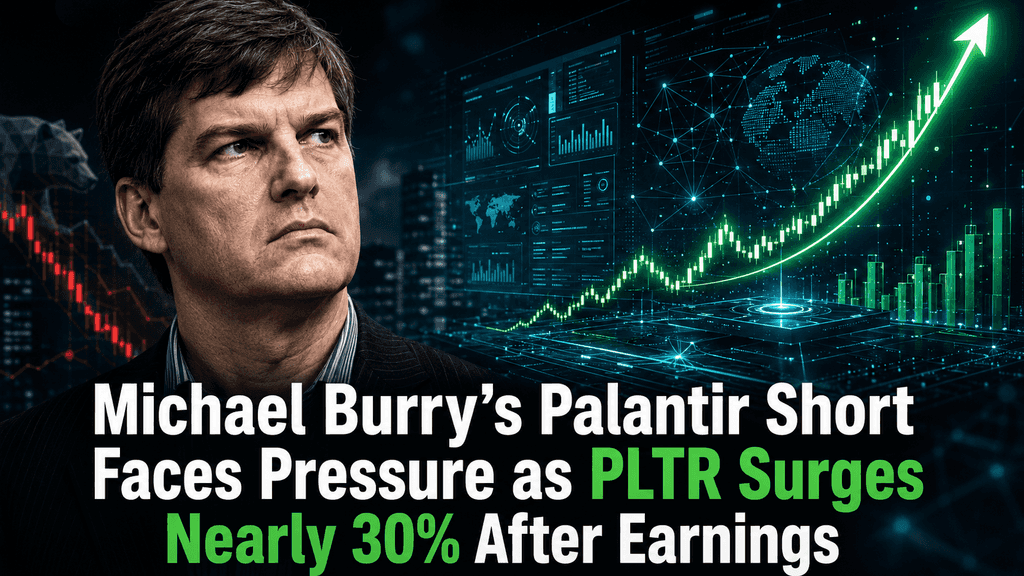
Palantir Technologies returned to the centre of the AI stock debate after PLTR surged nearly 30% following its Q2 2026 earnings report. The company delivered stronger-than-expected revenue and adjusted earnings, recorded rapid expansion across its US business and raised its full-year outlook. The market reaction strengthened the bullish argument that Palantir is becoming a major enterprise and government AI platform rather than simply benefiting from speculative enthusiasm around artificial intelligence.
The rally also renewed attention on Michael Burry’s bearish Palantir trade. The investor made famous by The Big Short has publicly expressed concerns about PLTR’s valuation and disclosed bearish exposure through put options. However, widely repeated claims that Burry placed or lost $912 million on Palantir misinterpret an older regulatory filing. His disclosed position involved leveraged options exposure linked to five million shares, not a straightforward $912 million short sale, and his current profit or loss cannot be calculated from the information available. Palantir’s earnings surge has nevertheless created a difficult environment for the bearish bet. The stock remains well above Burry’s previously disclosed put strikes, while the shorter-dated contracts face increasing time pressure. At the same time, PLTR’s valuation remains unusually demanding, leaving investors divided over whether the company’s exceptional growth can justify the expectations already built into its share price.
What Michael Burry’s Palantir Put Options Really Represent
Michael Burry’s bearish Palantir trade has often been described as a $912 million short position, but that headline gives readers the wrong impression of how much capital he invested and how the position was structured. Scion Asset Management’s November 2025 Form 13F listed Palantir put options connected to five million underlying shares and displayed a reported value of approximately $912.1 million. That figure reflected the value associated with the underlying PLTR shares for regulatory reporting purposes. It did not represent the premium Burry paid, his maximum possible loss or proof that he directly short-sold $912 million of Palantir stock.
A Form 13F provides only a limited snapshot of an investment manager’s holdings at the end of a reporting period. It does not normally reveal the complete economics of an options trade, including the premiums paid, precise transaction dates, subsequent sales, hedges or later adjustments. In Burry’s case, the filing also did not disclose the options’ strike prices or expiration dates. Understanding options pricing, strike prices and expiration dates is therefore essential before treating the underlying share value as the actual amount invested.
Why the Reported $912 Million Palantir Bet Is Misleading
Burry later clarified that the original position involved approximately 50,000 Palantir put-option contracts purchased for a premium of $1.84 per share, or roughly $9.2 million in total. A standard US equity option generally represents 100 shares, meaning 50,000 contracts provided exposure linked to five million PLTR shares. This explains why the notional share value shown in the regulatory filing was dramatically larger than the amount paid for the options.
The difference between notional exposure and invested capital is central to understanding the trade. A put option gives its owner the right, but not the obligation, to sell the underlying security at a specified strike price before or at expiration. If the stock declines substantially, the put may rise in value. If the stock remains above the strike or fails to fall far enough before expiration, the buyer can lose part or all of the premium paid. For a standard purchased put, the maximum loss is generally limited to the premium. That risk structure is very different from directly shorting a stock, where losses can continue increasing as the share price rises. Burry’s original $9.2 million premium was still a significant bearish position, but it was not equivalent to risking the full $912.1 million value displayed in the 13F.
This distinction also explains why claims that Burry lost hundreds of millions of dollars during Palantir’s rally are unsupported. His result cannot be calculated by multiplying PLTR’s price increase by five million shares. He did not simply borrow and sell five million shares through the disclosed position. The value of his puts would have changed according to the stock price, strike, remaining time, expected volatility and the premium paid. The most that can be stated confidently is that Palantir’s rise moved against the direction of the bearish trade. Without the complete transaction history, any precise estimate of Burry’s current gain or loss would be speculation.
How Burry’s Rolled PLTR Puts Changed the Position
The original 2025 regulatory filing is also outdated as a description of Burry’s later exposure. In April 2026, he said that he had rolled the Palantir puts several times and disclosed two later positions:
-
$100-strike puts expiring December 18, 2026
-
$50-strike puts expiring June 17, 2027
Rolling an option normally involves closing or reducing an existing contract and replacing it with another contract carrying a different expiration date, strike price or both. An investor may roll a position to give the thesis more time, change the amount of downside exposure or respond to movements in the underlying stock and option volatility.
The process is not a cost-free reset. Closing an older contract can lock in a profit or loss, while purchasing a later-dated option may require an additional premium. The new contract may also have a different sensitivity to PLTR’s share price, volatility and time decay. Because Burry rolled the position several times, the original $9.2 million premium should not be treated as the confirmed total cost of the later trade. The disclosed strikes reveal the general direction of his view, but they do not provide his exact breakeven levels. A $100 put does not automatically become profitable as soon as PLTR falls below $100. At expiration, the premium paid must also be recovered. For example, a $100 put purchased for $10 per share would have an approximate expiration breakeven price of $90.
Before expiration, the contract can still have market value while PLTR remains above the strike. Its price may respond to changes in expected volatility, broader market risk and the amount of time remaining. This is why option performance cannot be measured by comparing only the current stock price with the strike. The June 2027 $50 puts give the bearish thesis more time to develop, but they require a much deeper decline for the stock to approach the strike. The December 2026 $100 puts it closer to PLTR’s post-earnings price, yet they face faster time decay because their expiration date is nearer.
Burry later referred more broadly to Palantir exposure involving both short positions and puts, suggesting that his bearish trade may have expanded beyond the option position shown in the older filing. However, Scion Asset Management’s regulatory registration ended in November 2025, reducing the level of public visibility into later portfolio changes. Investors therefore do not know Burry’s latest number of contracts, the size or entry price of any direct short position, whether he reduced some exposure or how much capital remains at risk. The most accurate interpretation is that he used put options, and potentially a combination of puts and direct short exposure, to express a bearish view on Palantir’s valuation.
How PLTR’s Earnings Rally Is Pressuring Burry’s Bearish Bet
Palantir’s post-earnings surge has made Michael Burry’s bearish PLTR trade more difficult because the market is now pricing in stronger growth, improved profitability and greater confidence in the company’s AI strategy. A bearish investor does not necessarily need Palantir’s business to fail, but the share price must decline far enough, and within the relevant timeframe, for the position to generate a meaningful return. When a stock rises sharply and remains elevated, put options generally come under pressure because the probability of reaching their strike prices before expiration becomes lower.
The challenge extends beyond PLTR’s nearly 30% one-day rally. Palantir’s earnings changed investor expectations and strengthened the view that its commercial and government AI demand could remain elevated. Burry may still believe the company is priced too aggressively, but options come with fixed expiration dates. A long-term valuation concern can ultimately prove correct while the actual trade still loses money because the expected correction arrived too late.
Several factors now determine whether Burry’s Palantir bearish bet can recover:
1. Burry previously disclosed Palantir put options with strike prices of $100 and $50. After the earnings rally, PLTR remained substantially above both levels, leaving the contracts out of the money. The further the stock trades above a put’s strike, the larger the decline generally required for the option to gain meaningful intrinsic value.
2. The $100 puts expiring in December 2026 face the most immediate pressure because they have less time remaining. Put options gradually lose time value as expiration approaches, especially when the underlying stock remains well above the strike. PLTR does not need to continue rising for these contracts to weaken. Simply trading sideways at an elevated level could reduce their value.
3. The $50 puts expiring in June 2027 provide more time for Burry’s bearish view to develop, but they require a much deeper decline in Palantir’s share price. Their longer duration may preserve more time value, yet a routine market pullback may not be enough to make the position profitable.
4. Palantir’s stronger operating outlook could delay the valuation correction Burry may expect. When a company repeatedly exceeds forecasts, investors may tolerate unusually high multiples because analysts are also raising future revenue and earnings estimates. PLTR can remain expensive while still moving higher if business performance continues surprising the market.
5. The bearish position may now need a clearer negative catalyst. Possible triggers could include slower commercial growth, weaker guidance, delayed government contracts, increased competition or a broader decline in highly valued AI stocks. After a strong earnings report, a minor disappointment may not be enough to change the market’s longer-term view of Palantir.
6. Option volatility can further complicate the trade. Palantir’s large price swings may support demand for downside protection, but they can also make puts expensive to buy or roll. Changes in implied volatility across option strike prices can significantly affect how much investors are willing to pay for bearish contracts.
After a major event such as earnings, implied volatility can decline once the uncertainty surrounding the announcement has passed. This can reduce the value of a put even when the stock does not rise further. A small PLTR decline may therefore be insufficient if option volatility falls at the same time.
7. Burry has said that he rolled the Palantir puts several times, but extending the position may increase the total cost of maintaining the thesis. Selling older contracts and buying later-dated options can involve additional premiums or realised losses. The need for risk management in leveraged trading becomes particularly important when the expected market direction may be reasonable but the timing remains uncertain.
8. Any direct PLTR short position would carry a different risk profile from purchased puts. A put buyer generally risks the premium paid, while a short seller can face growing losses as the stock price rises. Direct short positions can also involve borrowing fees and the possibility of being forced to reduce exposure during a powerful rally.
9. Palantir’s rally separates the quality of Burry’s valuation argument from the performance of the trade itself. He could eventually be correct that PLTR is overvalued while still losing money if the stock declines only after his options expire. The thesis and the instrument used to express it are related, but they are not the same.
10. The market’s current confidence raises the level of disappointment needed to reverse the stock. Before earnings, weaker guidance or slowing demand might have triggered a substantial decline. After the rally, investors may require more convincing evidence that Palantir’s growth story has changed before sharply reducing the valuation they are willing to assign to PLTR.
Does Palantir’s Growth Justify Its Valuation After the Earnings Surge?
Palantir’s latest performance strengthened the argument that PLTR deserves a premium valuation, but it did not remove concerns about how much future growth is already reflected in the share price. After the earnings surge, the company was valued at roughly 50 times the midpoint of its 2026 revenue guidance, while its trailing price-to-earnings ratio remained near 135. Those multiples are far above the levels commonly assigned to established software businesses, meaning investors are not valuing Palantir only on its current revenue or earnings. They are pricing in years of strong customer expansion, high margins, durable government demand and leadership in enterprise AI deployment. Supporters can point to Palantir’s improving cash generation, large contract activity and ability to connect artificial intelligence with real operating systems rather than limiting it to experimental tools. If the company continues raising forecasts and converting customer commitments into recurring revenue, earnings could gradually grow into part of the current valuation.
The risk is that PLTR’s valuation leaves little room for ordinary execution. Palantir does not necessarily need to report a weak quarter for the stock to fall. A modest slowdown in commercial growth, cautious guidance or weaker contract conversion could be enough to challenge investor confidence if expectations remain extremely high. High-growth companies can experience sharp valuation compression when analysts stop raising their forecasts, even while the underlying business remains profitable and continues expanding. Palantir must also prove that its competitive advantages can survive growing AI offerings from cloud providers, model developers and established enterprise-software companies. For now, its performance supports a significant premium, but whether the full valuation is justified depends on how long the company can maintain exceptional growth and margins. The earnings surge strengthened the bullish case, yet PLTR remains priced for sustained execution rather than for a business with substantial room to disappoint.
Conclusion
Palantir’s earnings-driven rally has intensified the debate surrounding Michael Burry’s bearish PLTR trade, but it has not produced a simple conclusion. The company’s operating momentum supports the argument that Palantir deserves a premium as commercial customers and government agencies expand their use of AI-powered data systems. Its stronger outlook has also made it more difficult for bearish investors to argue that demand is driven only by short-term artificial intelligence enthusiasm.
Burry’s position is frequently misunderstood because the $912.1 million figure reported in Scion Asset Management’s older regulatory filing did not represent the premium paid for the puts. His original disclosed cost was approximately $9.2 million, although subsequent rolls mean the total cost and present structure of the trade remain unknown. Claims that he lost hundreds of millions of dollars cannot be verified without a complete record of his contracts, transaction prices and any direct short exposure. The main problem for Burry is timing. His disclosed puts have fixed expiration dates and strike prices that remain well below PLTR’s post-earnings level. Palantir may eventually face slower growth, stronger competition or a lower valuation multiple, but those changes would need to occur while the bearish positions remain active. For investors, the Palantir debate now centres on whether the company can continue meeting expectations that have risen alongside its share price. The earnings surge strengthened the business case, while the valuation continues to demand exceptional execution. Until additional details about Burry’s position become available, the safest conclusion is that his bearish trade is under pressure, but its precise financial result remains unknown.
Frequently Asked Questions
1. What is the difference between buying Palantir puts and directly shorting PLTR stock?
Buying put options gives an investor the right to sell PLTR at a specified strike price before or at expiration. Direct short selling involves borrowing Palantir shares, selling them and attempting to buy them back later at a lower price. A standard purchased put generally limits the maximum loss to the premium paid, while a direct short can produce larger losses if the share price continues rising.
2. Can Michael Burry profit from his PLTR puts before the stock reaches the strike price?
Yes. A put can rise in value before PLTR falls below the strike because its market price also reflects time remaining, expected volatility and the probability of a future decline. Burry would not necessarily need to hold the contracts until expiration. He could potentially sell them earlier if market conditions increased demand for downside protection.
3. Why is a put option’s breakeven price lower than its strike price?
The put buyer must recover the premium paid before achieving an overall profit at expiration. A $100 put purchased for $10 per share would have an approximate expiration breakeven level of $90. Burry’s actual breakeven prices are unknown because the premiums associated with his later rolled contracts have not been fully disclosed.
4. Can Burry lose more than the premium paid for his Palantir puts?
For standard purchased puts, the maximum loss is normally limited to the premium. However, Burry rolled the contracts several times, meaning his cumulative costs may include premiums paid for multiple positions. Any direct short sales or other option structures could carry different risks and potentially larger losses.
5. Why do longer-dated Palantir puts generally cost more?
Longer-dated options give the expected price movement more time to occur, so they normally contain more time value. Burry’s June 2027 puts may retain more value than shorter-dated contracts, but they are not automatically less risky. Their performance still depends on the strike, premium, PLTR volatility and the size and timing of any decline.
6. What happens to put options if PLTR trades sideways?
Put options can lose value even when Palantir shares do not rise. As expiration approaches, time value gradually decreases through a process known as theta decay. A sideways PLTR price can therefore damage a bearish options trade because the expected decline is not occurring quickly enough.
7. Can falling volatility reduce the value of Burry’s puts?
Yes. Lower implied volatility can reduce put prices because the market expects smaller future movements in PLTR. This frequently happens after major events such as earnings reports. A put may therefore lose value even when Palantir declines slightly if the reduction in expected volatility is larger than the benefit from the stock move.
8. Why does a Form 13F provide an incomplete picture of Burry’s position?
A Form 13F shows selected institutional holdings at the end of a quarter and is released with a delay. It does not provide a full trading history, option premiums, exact purchase dates, closing transactions or later changes. The position may have been significantly adjusted before investors see the filing.
9. Could Palantir stock fall even if the company continues growing?
Yes. PLTR could decline through valuation compression if growth slows, guidance becomes less aggressive, interest rates rise or investors become less willing to pay high multiples for AI companies. A business can remain profitable and continue expanding while its stock falls because the market reduces the valuation placed on future earnings.
10. What should investors monitor after Palantir’s earnings rally?
Important indicators include customer growth, contract renewals, remaining deal value, international expansion, operating margins and the conversion of signed contracts into revenue and cash flow. Investors should also watch competition from cloud providers and AI-model developers. For Burry’s position, PLTR’s market price, option volatility and the time remaining before the disclosed expirations are especially relevant.
This article is for informational purposes only and does not constitute financial or investment advice.