

Elon Musk Predicts Robot Memory Demand Will Surge: What It Means for Micron and SK Hynix in 2026
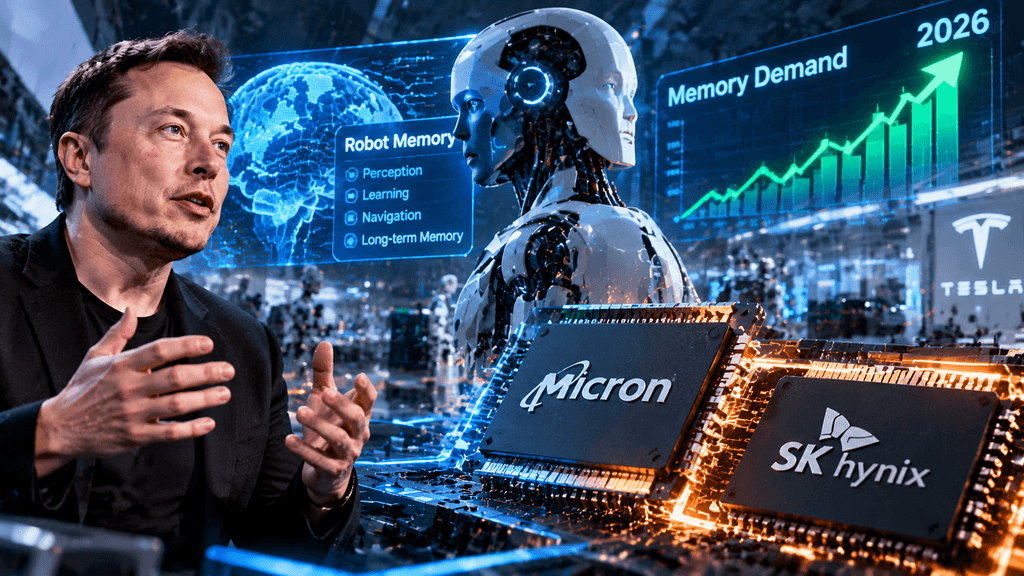
Elon Musk Predicts Robotics Will Drive Massive Growth in Memory Demand
Elon Musk’s recent statement on X regarding the future of robot RAM requirements, which he claims “will exceed everything else on Earth,” has significantly sharpened the focus on the memory demands associated with physical AI systems. The Tesla CEO articulated that robots, which operate on physical substrates to manipulate and shape atoms, will inevitably drive memory consumption to levels that far surpass those of current computing applications. He also noted that the compute power required for superintelligence will largely transition off-planet, indicating a shift in where and how advanced computing will take place. This comment arrived against a backdrop characterized by tight supply chains for DRAM and high-bandwidth memory, record financial results from major memory producers, and the early stages of production scaling for humanoid platforms such as Tesla's Optimus.
Musk’s prediction, which is supported by emerging data on the memory content required per robot and various production volume scenarios, points to a substantial long-term volume opportunity in the low-power DRAM market. This opportunity is particularly relevant for companies such as Micron Technology and SK Hynix as the field of robotics begins to move beyond the constraints typically associated with data-center AI and into the realm of physical-world deployment. The implications of this shift are profound, suggesting that as robotics technology advances, the demand for specialized memory solutions will increase dramatically, creating new avenues for growth and innovation in the memory supply industry.
Musk’s Statement Frames Robots as the Dominant Future Memory Consumer
Musk’s October 26, 2026 post dismissed prior analysis of humanoid DRAM demand as “silly” and asserted that robot memory needs will surpass all other terrestrial uses because physical interaction with the world requires local, high-capacity memory on the robot itself. He distinguished this from superintelligence, which he said would largely rely on deep-space compute. The remarks built on earlier Tesla disclosures about Optimus hardware. In early October, Musk confirmed that Tesla had reduced planned memory on its AI5 chip to 72 GB of LPDDR5 and on AI6 to 144 GB of LPDDR6, describing the cuts as the only practical way to secure sufficient volume for Optimus production while holding bandwidth constant. Performance impact was expected to be negligible.
These technical choices illustrate the tension between desired capability and real-world supply limits that already constrain even early-stage robot programs. The timing coincides with heightened investor attention on memory suppliers. Analysts immediately connected the comments to Micron and SK Hynix, noting that robots primarily use low-power DRAM rather than the high-bandwidth memory dominating data-center AI accelerators. This distinction matters because LPDDR-class products open a different volume pathway once robot production scales beyond pilot volumes. Industry discussion has shifted from whether memory demand will remain elevated to how quickly physical AI platforms could add incremental bit demand on top of already constrained server and HBM markets.
Physical Substrates and Real-Time Sensor Fusion Drive Onboard Memory Intensity
Robots must process continuous streams from cameras, LiDAR, tactile sensors, and internal state models in real time while maintaining autonomy without constant cloud reliance. Micron CEO Sanjay Mehrotra has stated that Level 4 or higher autonomous vehicles and humanoid robots will likely require more than 200 GB of memory and multiple terabytes of storage per unit, comparable to advanced vehicle systems. Current service robots often operate with far lower content, around 12 GB DRAM and hundreds of gigabytes of storage, indicating substantial headroom for growth as capabilities advance. The need for local memory stems directly from latency, reliability, and power constraints inherent in mobile platforms that must “shape atoms” in unpredictable environments.
This architecture differs fundamentally from data-center AI, where memory can be pooled and refreshed centrally. Edge inference memory designs under development aim to balance density, power, and bandwidth for these workloads. Micron has publicly discussed edge inference memory targeted at physical AI applications, with industry observers pointing to potential production timelines later in the decade. The result is a demand profile weighted toward high-volume, lower-power DRAM rather than the specialized, capacity-constrained HBM used in training clusters. Suppliers already investing in LPDDR6 and related low-power technologies stand to benefit if robot fleets expand.
Counterpoint Research Forecasts Sharp Rise in Humanoid DRAM Consumption
Counterpoint Research projects total DRAM demand from humanoid robots rising more than twentyfold between 2026 and 2030, from approximately 8,300 terabits to 172,000 terabits. Average capacity per robot is expected to increase from roughly 19 GB to 39 GB over the same period. Even at these levels, the absolute share of global DRAM production remains modest under base-case robot shipment assumptions. Independent calculations show that 2030 humanoid demand under the Counterpoint trajectory equates to a small fraction of current annual DRAM output, measured in tens of petabytes against global production measured in tens of exabytes.
The forecast’s sensitivity lies in unit volume. Higher production rates or higher per-robot content quickly escalate the totals. Tesla’s own Optimus memory targets already exceed the Counterpoint average, suggesting that leading platforms may pull demand forward. The gap between conservative research forecasts and Musk’s more expansive view largely reflects differing assumptions about how rapidly humanoids reach automotive-scale or higher production. Memory suppliers monitor both trajectories because even intermediate volumes add a new, growing end market on top of server, mobile, and automotive demand.
Tesla’s Memory Reductions Illustrate Supply Constraints Already in Play
Tesla’s decision to cut AI5 memory in half and AI6 memory by one-third was framed explicitly as a volume and cost necessity rather than a performance compromise. Bandwidth was preserved, underscoring that total capacity can be traded against throughput in certain robot control loops. The move followed Micron’s own commentary that humanoids could require over 200 GB, highlighting how even ambitious robot makers are sizing systems around available memory rather than unconstrained ideal specifications. Early Optimus production remains limited, yet the hardware already reflects supply-chain realism.
These adjustments reduce near-term bit demand per robot but simultaneously signal that scaling production will still require large absolute volumes of low-power DRAM. At 72 GB per unit, ten million annual Optimus robots would generate roughly 720 petabytes of demand. While that figure remains hypothetical and depends on Tesla achieving high-volume manufacturing, it provides a concrete reference point for the scale of opportunity analysts have highlighted for volume-oriented memory producers. The episode also demonstrates that memory availability is already influencing robot system architecture.
Analyst Volume Scenarios Point to a Meaningful New End Market
Futurum Equities analyst Shay Boloor translated Musk’s comments into a simple volume illustration: ten million Optimus robots at 72 GB each equals about 720 petabytes of annual memory demand. The calculation is illustrative rather than a formal forecast, yet it clarifies why some observers describe robotics as a potential “much bigger volume story” for Micron and SK Hynix once AI expands beyond data centers. Robots consume LPDDR-class memory rather than HBM, aligning with product lines that can scale more readily than the advanced packaging-constrained HBM segment.
Global DRAM production currently runs in the tens of exabytes annually. Capturing even a single-digit percentage of that capacity for robotics would represent a substantial new market. Achieving automotive-scale volumes (roughly 100 million units) at higher memory content would absorb a material share of industry output. Memory makers already allocate capacity under long-term agreements for AI servers; incremental robot demand would compete for remaining bits or require additional capacity investment. The analytical consensus is that robotics will not displace data center demand but will layer additional growth on an already tight market.
Micron Emphasizes Physical AI as a Future Demand Driver
Micron has repeatedly flagged physical AI and humanoid robots as significant longer-term drivers of memory and storage demand. During its fiscal fourth-quarter commentary, leadership noted that humanoids are expected to need memory and storage levels comparable to advanced autonomous vehicles, more than 200 GB of DRAM and multiple terabytes of NAND. Customers are already sampling next-generation products aimed at these applications. The company has also developed edge inference memory concepts tailored to physical AI workloads, with production horizons later in the decade.
Micron’s automotive and embedded segment currently represents a modest share of overall revenue, yet it provides the closest existing channel to robotics customers. The firm’s broader capacity is heavily committed through long-term agreements covering a substantial portion of output into the late 2020s. Any acceleration in robot adoption would therefore interact with existing allocation decisions and potential capacity expansions. Management has stated it lacks clear visibility on when supply and demand will rebalance, underscoring the tightness that would confront rising robot volumes.
SK Hynix Reports Record Results and Multi-Year Sold-Out Conditions
SK Hynix delivered record third-quarter 2026 results, with revenue exceeding 100 trillion won and an operating margin near 80 percent, driven largely by HBM and AI-related DRAM. The company stated that DRAM and HBM volumes through 2029 are effectively sold out when combining secured long-term agreements and active customer discussions. Demand is expected to continue outrunning supply through 2030. HBM4 is projected to overtake HBM3E as the primary product in the fourth quarter.
These results reinforce the broader industry picture of constrained supply. While HBM remains the highest-margin product, SK Hynix and peers also supply the low-power DRAM categories relevant to robotics. The company has collaborated on low-power memory for robotics computing platforms, positioning it for physical AI growth. Prolonged tightness implies that any material increase in robot-related LPDDR demand would occur in an environment where capacity is already prioritized toward the most profitable AI server applications, potentially elevating prices or lengthening lead times for other segments.
Low-Power DRAM Becomes the Relevant Technology for Robotics Scale
Humanoid and mobile robots prioritize power efficiency, thermal management, and cost at volume. High-bandwidth memory, optimized for dense GPU clusters, is less suitable for battery-powered or thermally constrained platforms. Industry participants therefore expect LPDDR5, LPDDR6, and related low-power variants to dominate robot designs. Tesla’s explicit use of LP5 and LP6 memory in its AI5 and AI6 chips confirms this direction. Suppliers advancing these product lines can address both current mobile and automotive markets and the emerging robotics opportunity without diverting scarce advanced packaging capacity from HBM.
This technology split creates differentiated growth paths. HBM demand remains concentrated among a small number of hyperscalers and AI accelerator vendors. Low-power DRAM can scale across consumer devices, vehicles, and robots. As robot production rises, the absolute bit demand for LPDDR-class products could grow faster in percentage terms than the more capacity-constrained HBM segment, supporting the “volume story” characterization offered by analysts. Memory makers balancing their product mix will need to allocate wafer starts carefully between the two categories.
Robot Memory Profiles Differ from Data-Center Workloads in Key Ways
Data-center AI emphasizes peak bandwidth and capacity for training and large-batch inference, often using HBM stacked near the processor. Robot workloads emphasize continuous real-time sensor fusion, local model execution, and resilience to intermittent connectivity. Memory content must support simultaneous vision, proprioception, planning, and control loops while remaining within strict power and cost envelopes. The result is a preference for high-density, lower-power DRAM with sufficient bandwidth rather than the extreme bandwidth of HBM. Storage requirements also rise with the need to log experiences or cache large models onboard.
These differences imply that robotics will not simply compete for the same HBM wafers that serve AI servers. Instead, it expands the overall addressable market for conventional and low-power DRAM. Capacity planning becomes more complex because HBM conversion ratios already reduce the effective output of standard DRAM; adding a growing robot segment further tightens the residual supply available for PCs, smartphones, and other traditional uses. Suppliers that maintain flexible process technology across product types will be better positioned to capture the incremental demand.
Scaling Memory Supply to Match Potential Robot Volumes Presents Structural Challenges
New DRAM fabs and advanced packaging facilities require years and multi-billion-dollar investments. Existing capacity is largely committed under long-term agreements for AI infrastructure. SK Hynix and Micron have both signaled multi-year periods of undersupply. Even if robot demand materializes more slowly than Musk’s rhetoric suggests, intermediate volumes measured in millions of units would still absorb meaningful bits. At higher content levels approaching 100–200 GB per robot, the industry would need significant additional capacity to avoid diverting supply from other growth markets.
Historical memory cycles have been characterized by sharp price swings once capacity finally catches demand. The current cycle differs because AI-related long-term agreements lock in a larger share of output, raising the floor under earnings. Robotics demand, if it scales, would further support utilization and pricing power. Conversely, slower robot adoption would leave suppliers still facing robust server demand. The key variable remains the pace at which humanoid platforms move from prototypes and limited production to mass deployment.
Pricing and Capacity Dynamics Through the End of the Decade
Memory pricing has already risen substantially, with further sequential increases expected in some product categories. Long-term agreements covering large portions of 2027–2029 output provide revenue visibility for suppliers while limiting spot-market availability. Robot makers entering the market later may face higher costs or longer qualification cycles. Tesla’s early memory reductions illustrate one adaptation strategy: design systems to the available supply rather than ideal specifications. Other robot developers will likely follow similar pragmatism.
For Micron and SK Hynix, the combination of sustained AI server demand and emerging physical AI creates a multi-year growth backdrop. Capacity expansions currently under construction will ease some pressure later in the decade, yet both companies have indicated that demand is likely to remain ahead of supply into 2030. Robotics represents an additional call on that capacity rather than a replacement for existing demand. Investors monitoring the sector will watch unit shipment ramps for Optimus and competing platforms as leading indicators of how quickly the volume thesis converts into orders.
Broader Context Links AI Infrastructure Expansion to Physical AI Platforms
The same hyperscalers driving HBM demand are also investing in robotics and embodied AI. Progress in foundation models trained in data centers ultimately feeds into robot control stacks that run locally. Memory suppliers therefore benefit at both ends of the AI value chain: high-value HBM for training and inference clusters and high-volume low-power DRAM for the resulting physical systems. This dual exposure strengthens the structural case for continued investment in memory capacity even as near-term cycles fluctuate.
Industry forecasts for humanoid robot shipments vary widely, ranging from hundreds of thousands to low millions by 2030 under different assumptions. Musk’s public targets and Tesla’s internal production planning sit toward the more ambitious end of the spectrum. Regardless of the precise trajectory, the direction is clear: physical AI will increase the memory intensity of the overall computing landscape. Suppliers that successfully navigate the transition from data-center dominance to a more diversified end-market mix stand to capture durable growth.
Indicators That Will Determine the Pace of Memory Demand Realization
Key metrics to watch include actual Optimus production rates and memory content per unit as Tesla scales manufacturing, competing humanoid platforms’ design wins and shipment announcements, and quarterly commentary from Micron and SK Hynix on physical AI or robotics sampling activity. Capacity allocation decisions between HBM and conventional DRAM will also signal how suppliers prioritize the emerging opportunity. Price trends in LPDDR products versus HBM will reveal relative tightness across segments.
Longer-term, the interplay between robot unit growth and per-robot memory content will determine whether robotics becomes a primary or secondary demand driver. Conservative research forecasts keep absolute demand modest through 2030; more aggressive volume assumptions produce larger impacts. Musk’s insistence that robot needs will eventually exceed all other Earth applications sets a high bar that current data do not yet confirm, yet the underlying technical logic, local memory for physical interaction, remains sound. Memory suppliers and their investors will measure progress against both the cautious forecasts and the more expansive vision in the years ahead.
FAQs
What exactly did Elon Musk say about robot memory demand?
Musk stated that robot RAM needs will exceed everything else on Earth because robots must operate on physical substrates to shape atoms. He added that superintelligence requirements will be even larger but will largely reside in deep-space compute. The comments were made in response to an analysis of humanoid DRAM forecasts and reflect his view that physical AI will dominate terrestrial memory consumption.
How much memory does a humanoid robot currently require according to industry estimates?
Counterpoint Research expects average DRAM per humanoid to rise from about 19 GB in 2026 to 39 GB by 2030. Micron has indicated that advanced humanoids may need more than 200 GB of memory and multiple terabytes of storage, similar to Level 4 autonomous vehicles. Tesla has designed its next-generation Optimus chips around 72 GB and 144 GB configurations to balance capability with volume production feasibility.
Why do robots use low-power DRAM instead of high-bandwidth memory?
Robots operate under strict power, thermal, and cost constraints that favor LPDDR-class memory. HBM is optimized for dense data-center accelerators where power and cooling are less constrained. Bandwidth remains important, but total capacity and energy efficiency take higher priority in mobile physical platforms, leading designers to select low-power DRAM variants.
What do current forecasts say about the scale of humanoid DRAM demand by 2030?
Counterpoint projects a more than twentyfold increase in total humanoid DRAM demand from roughly 8,300 terabits in 2026 to 172,000 terabits in 2030. Under base shipment assumptions, this remains a small share of global DRAM output. Higher unit volumes or higher per-robot content would increase the absolute contribution significantly.
How have Micron and SK Hynix positioned themselves for robotics-related demand?
Both companies supply the low-power DRAM technologies relevant to robots. Micron has highlighted physical AI as a future demand driver and is developing edge inference memory. SK Hynix has worked on low-power solutions for robotics platforms and benefits from overall memory tightness that supports pricing. Neither treats robotics as the primary near-term driver, yet both acknowledge the longer-term opportunity.
What evidence shows that memory supply is already constraining robot designs?
Tesla reduced planned memory content on its AI5 and AI6 chips specifically to secure enough volume for Optimus production. Micron has stated it lacks line-of-sight to when supply and demand will rebalance. SK Hynix reports that DRAM and HBM volumes through 2029 are effectively sold out under existing agreements and discussions. These statements indicate that availability is influencing system architecture today.
Disclaimer: This general market information, possibly from third-party, commercial, or sponsored sources, is provided for reference and educational purposes only and does not constitute financial or investment advice, an offer, solicitation, or guarantee. We disclaim liability for its accuracy, completeness, reliability, and any resulting losses. Investments/trading are risky; past performance doesn’t guarantee future results. Users should research, judge prudently, and take full responsibility. For further details, please consult KuCoin’s Terms of Use and Risk Disclosure.