

Claude Fable 5 vs Mythos 5: Anthropic's New Frontier Model Explained
AI Research and Development
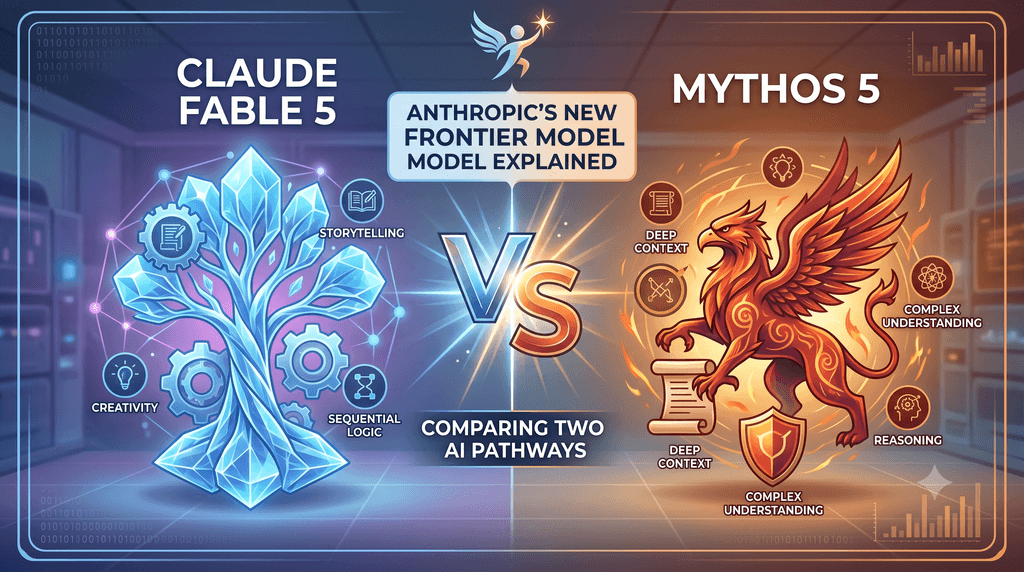
The artificial intelligence industry entered a new phase on June 9, 2026, when Anthropic unveiled Claude Fable 5 and Claude Mythos 5, introducing a new category of systems known as Mythos-class models. The launch represents more than a routine model upgrade. It marks the first time Anthropic has publicly deployed technology that sits above its Opus family while simultaneously creating a separate access tier for organizations working on cybersecurity, critical infrastructure, and advanced scientific research. According to Anthropic, both models share the same underlying architecture, yet they differ significantly in how users can access and interact with their capabilities. The distinction is important because it shows a growing challenge facing frontier AI developers. As models become increasingly capable of autonomous reasoning, software engineering, long-horizon planning, and scientific analysis; providers must decide how much of that capability can safely be made available to the public.
Anthropic's answer is a dual-track approach. Claude Fable 5 delivers Mythos-level intelligence to enterprises and developers while applying safeguards that restrict high-risk requests. Claude Mythos 5, meanwhile, offers fewer limitations but is reserved for carefully vetted organizations operating in specialized environments. The launch arrives during one of the most competitive periods in AI history, with major laboratories racing to improve coding performance, reasoning depth, multimodal understanding, and agentic workflows. Against that backdrop, Fable 5 and Mythos 5 provide insight into how leading AI companies intend to balance capability growth with deployment safety over the coming years.
Why Anthropic Created a New Mythos-Class Tier Above Opus
For several years, Anthropic's model hierarchy followed a relatively straightforward progression, with each generation improving upon its predecessor in reasoning, coding, and multimodal tasks. The introduction of Mythos-class AI changes that structure significantly. Rather than positioning Fable 5 as simply the next Opus release, Anthropic created an entirely new category that sits above previous public models. This move signals that the company views recent capability gains as substantial enough to warrant a separate classification rather than an incremental version update. Anthropic describes Mythos-class systems as models capable of handling longer and more complex autonomous workflows than earlier Claude generations. These systems are designed to maintain context over extended periods, manage sophisticated chains of reasoning, and execute multi-step tasks with reduced supervision. Such capabilities are increasingly valuable in software development, research analysis, enterprise operations, and agent-based applications where AI systems must work through complicated objectives without requiring constant human intervention.
The creation of a new tier also shows a broader trend among frontier AI developers. As performance gains become harder to measure using traditional benchmarks alone, companies are beginning to emphasize practical measures such as task completion, workflow persistence, and long-duration reasoning. Research published in June 2026 suggests that frontier AI systems continue to extend their ability to solve increasingly time-intensive tasks, making long-horizon execution a critical competitive metric. By establishing Mythos-class models as a distinct category, Anthropic is effectively signaling that the next stage of AI competition will be defined less by isolated benchmark scores and more by how effectively models can sustain performance across complex, real-world assignments. This strategic repositioning provides the foundation for understanding both Fable 5 and Mythos 5 throughout the rest of this analysis.
Claude Fable 5 Brings Frontier Capabilities to the Broader Market
Claude Fable 5 serves as Anthropic's public-facing implementation of Mythos-class technology. While the company describes it as sharing the same underlying model as Mythos 5, Fable 5 has been engineered for broad deployment across enterprise platforms, developer ecosystems, and cloud infrastructure providers. The model is available through Anthropic's own services as well as major cloud environments, making it the first Mythos-class system accessible to a wide audience. A key feature of Fable 5 is its emphasis on long-horizon task execution. Anthropic states that the model can operate autonomously for longer periods than previous Claude generations, enabling more sophisticated software engineering workflows, complex document analysis, and extended research projects. This capability is increasingly important as organizations seek to deploy AI agents that can handle end-to-end tasks rather than isolated prompts.
Benchmark data released alongside the launch suggest substantial gains in coding, reasoning, vision, and knowledge work tasks. Reports indicate that Fable 5 significantly outperforms earlier Claude models on software engineering evaluations and demonstrates stronger performance on difficult reasoning challenges. Industry observers have noted that many of these gains appear particularly relevant to enterprise use cases where sustained accuracy matters more than raw conversational fluency. Perhaps most importantly, Fable 5 represents Anthropic's attempt to commercialize frontier capabilities without dramatically expanding risk exposure. Rather than limiting access to its most advanced architecture, the company chose to distribute the technology broadly while embedding safety mechanisms designed to prevent misuse in specific high-risk domains. This balance between accessibility and control has become one of the defining characteristics of the Fable 5 release and will likely influence how future frontier models are deployed across the industry.
Mythos 5 Reveals Anthropic's Vision for Restricted Frontier AI
While Claude Fable 5 is intended for broad usage, Claude Mythos 5 occupies a very different role within Anthropic's ecosystem. The model is not marketed as a consumer or enterprise product in the traditional sense. Instead, it functions as a restricted-access system reserved for organizations that require advanced capabilities in areas such as cybersecurity research, infrastructure defense, and scientific discovery. Anthropic has described Mythos 5 as sharing the same core architecture as Fable 5 but operating with fewer protective constraints. This distinction shows a fundamental challenge facing frontier AI development. Certain capabilities that can provide significant benefits to researchers and security professionals can also create opportunities for misuse if distributed without restrictions. Anthropic's response has been to create a separate deployment pathway that allows vetted organizations to access a more capable configuration while limiting availability to the broader public.
AI industry analysts have pointed to cybersecurity as a particularly relevant example. Advanced AI systems can assist defenders in identifying vulnerabilities, analyzing attack surfaces, and improving infrastructure resilience. The same capabilities, however, could potentially be used to accelerate offensive activities if appropriate safeguards are absent. Mythos 5 appears designed to support legitimate security research while operating within a controlled access framework. The restricted nature of Mythos 5 also provides insight into Anthropic's broader strategic philosophy. Rather than pursuing a single model for every user segment, the company is experimenting with differentiated access levels based on risk profiles and operational requirements. This approach may become increasingly common as AI systems continue to improve and developers seek mechanisms that allow advanced research without exposing the full spectrum of capabilities to unrestricted public use.
How Anthropic Separates Capability From Access Through Safety Architecture
The most important aspects of the Claude Fable 5 and Mythos 5 launch are not the underlying model itself but the deployment architecture surrounding them. Historically, AI providers often released different models with different capability levels. Anthropic has taken a more nuanced approach by making both Fable 5 and Mythos 5 versions of the same Mythos-class system while controlling access through layers of safeguards, oversight, and eligibility requirements. This distinction reflects a growing belief within the frontier AI sector that the question is no longer simply how powerful a model is but who can access specific capabilities and under what circumstances. According to Anthropic, Fable 5 includes routing mechanisms that redirect certain high-risk requests involving cybersecurity, biology, chemistry, and model replication to safer systems or apply stricter controls. The company reported that such interventions affect fewer than 5% of typical user interactions, allowing most enterprise and developer workflows to proceed without interruption while maintaining protections in sensitive areas.
This deployment strategy carries broader implications for the industry. As frontier models become increasingly capable of conducting advanced research, generating sophisticated software, and solving highly specialized technical problems, providers face mounting pressure to prevent misuse without significantly degrading utility. Anthropic's architecture suggests that future AI governance may focus less on restricting entire models and more on selectively governing specific categories of behavior. The approach resembles permission systems commonly used in cloud computing and cybersecurity environments, where access is granted according to operational needs rather than universally applied. For enterprises, this model offers a practical compromise between capability and risk management. Organizations can access cutting-edge performance through Fable 5 while benefiting from built-in safeguards designed to address sensitive use cases. The result is a framework that may influence how future frontier systems are deployed, especially as regulators, enterprises, and researchers increasingly demand mechanisms that preserve innovation while reducing the likelihood of harmful applications.
Benchmark Results Show Anthropic Targeting Real-World Workflows
Benchmark scores remain an important method for evaluating AI systems, but the Fable 5 and Mythos 5 launches suggest that Anthropic is increasingly focused on measuring performance through practical workflow execution rather than isolated test results. While benchmark improvements were highlighted during the announcement, the company emphasized long-duration reasoning, autonomous task completion, and software engineering effectiveness as key differentiators. This reflects a broader shift occurring across the AI industry, where organizations deploying large language models are often more concerned with productivity gains than leaderboard rankings. In enterprise environments, the ability to complete complex projects consistently can generate far greater value than marginal improvements on academic evaluations. Available benchmark data indicate that Fable 5 performs strongly across coding, reasoning, multimodal analysis, and knowledge-intensive tasks. Early evaluations published by independent analysts suggest notable gains in software development scenarios involving repository navigation, bug fixing, architectural planning, and extended coding sessions.
These improvements align with one of the fastest-growing AI adoption trends in 2026: the integration of advanced models into software engineering workflows. Research from industry analysts continues to show that coding assistance remains among the highest-value use cases for generative AI, particularly as organizations seek to accelerate development cycles without sacrificing quality. Reports examining Fable 5's performance have highlighted its ability to maintain context across larger projects and execute more sophisticated reasoning chains than previous Claude generations. The emphasis on workflow-oriented performance may ultimately prove more important than benchmark leadership itself. Businesses evaluating AI investments increasingly prioritize measurable operational outcomes such as reduced development time, improved accuracy, faster research cycles, and enhanced productivity. By focusing on practical execution capabilities, Anthropic appears to be positioning Mythos-class models as tools designed for real-world deployment rather than systems optimized primarily for benchmark competition. That distinction could become increasingly important as enterprises evaluate which frontier models offer the strongest return on investment.
Long-Horizon Reasoning Could Become the Defining AI Metric of the Next Decade
One theme appears repeatedly throughout Anthropic's discussion of Fable 5 and Mythos 5: long-horizon reasoning. The concept refers to a model's ability to sustain coherent problem-solving across extended periods, maintaining context and strategic direction while working through complex objectives. This capability has become increasingly important because many real-world tasks cannot be solved through a single prompt-response interaction. Software development projects, scientific investigations, financial research assignments, and operational planning exercises often require dozens or even hundreds of interconnected reasoning steps. Traditional benchmarks only partially capture these demands, creating a growing need for new evaluation methods. Academic research has documented rapid improvements in the amount of time frontier AI systems can effectively spend solving complex tasks. A June 2026 study examining the progression of AI capabilities found that the duration of tasks AI models can complete has expanded significantly over recent years, suggesting that long-horizon performance may represent one of the most important dimensions of future capability growth.
This trend aligns closely with Anthropic's positioning of Mythos-class systems. Rather than emphasizing conversational improvements alone, the company highlights the ability of Fable 5 and Mythos 5 to remain effective across extended workflows that involve planning, execution, adaptation, and iterative problem-solving. The implications extend far beyond software engineering. In research environments, long-horizon reasoning can support literature reviews, hypothesis generation, experiment planning, and data interpretation. In enterprise settings, it can enhance document processing, operational analysis, strategic planning, and project management. As AI systems increasingly function as collaborative agents rather than simple assistants, the ability to sustain coherent reasoning over time may become a more meaningful measure of value than traditional benchmarks. Anthropic's focus on this capability suggests that the next frontier of AI competition may center on endurance, consistency, and task completion rather than raw response quality alone.
Enterprise Adoption May Be the Most Important Test for Mythos-Class Models
Although benchmark performance and technological innovation attract significant attention, the long-term success of Claude Fable 5 will likely depend on enterprise adoption. Businesses represent one of the largest and fastest-growing markets for frontier AI, and their requirements differ substantially from those of individual consumers. Organizations typically prioritize reliability, security, scalability, governance, and measurable productivity improvements over novelty. Anthropic's decision to make Fable 5 broadly available through enterprise channels suggests that the company views commercial deployment as the primary proving ground for Mythos-class technology. Several factors support this strategy. Enterprises increasingly seek AI systems capable of handling sophisticated workflows that extend beyond simple content generation. These include software development, knowledge management, customer operations, legal analysis, financial research, and internal automation. Models that can sustain performance across complex assignments while integrating into existing workflows are often more valuable than systems optimized solely for conversational tasks.
Anthropic's emphasis on long-horizon execution directly addresses this demand. By positioning Fable 5 as a tool capable of managing larger and more complicated projects, the company is targeting some of the highest-value use cases in the market. The availability of Mythos-class capabilities through major cloud providers also expands potential adoption. Enterprise customers often prefer deploying AI within existing infrastructure environments rather than managing entirely new systems. Integration with established cloud ecosystems reduces implementation friction and allows organizations to apply existing security, compliance, and operational frameworks. This can accelerate experimentation and deployment across multiple business functions. The coming months will provide valuable insight into whether enterprises view Mythos-class models as a meaningful advancement over previous generations. If adoption accelerates across software engineering, research, and operational workflows, Fable 5 could become a key benchmark for how frontier AI systems transition from impressive demonstrations to broadly deployed business tools.
Competition with OpenAI, Google, and xAI Is Shifting Toward Agent Performance
The launch of Claude Fable 5 and Mythos 5 arrives at a time when competition among frontier AI developers is increasingly focused on agentic performance rather than traditional chatbot capabilities. Over the past two years, leading laboratories have steadily improved reasoning, multimodal understanding, and coding benchmarks. As those gains become more common across top-tier models, differentiation is shifting toward a model's ability to operate autonomously across longer workflows. Anthropic's Mythos-class strategy appears designed specifically for this environment. Rather than framing Fable 5 primarily as a conversational assistant, the company presents it as an intelligent system capable of handling complex projects with reduced human supervision. This positioning places it directly into competition with advanced offerings from OpenAI, Google DeepMind, and xAI, all of which are investing heavily in autonomous AI agents capable of planning, executing, and refining tasks over extended periods.
Industry analysts increasingly view agent performance as one of the most important indicators of future commercial value. Organizations are less interested in how well a model answers isolated questions and more interested in whether it can complete meaningful work. Coding projects, research assignments, operational audits, and enterprise knowledge management tasks all require persistent reasoning and contextual awareness. Anthropic's emphasis on long-horizon execution suggests that the company sees this transition clearly. Reports released following the launch highlighted improvements that appear particularly relevant to agent-based workflows, including stronger task persistence and more effective management of complex objectives. If the industry continues moving toward autonomous systems that function as digital collaborators rather than simple assistants, the ability to sustain performance across lengthy assignments could become one of the most important competitive advantages. In that context, Fable 5 and Mythos 5 are not merely new language models; they represent Anthropic's attempt to define the next stage of AI competition.
Cybersecurity and Scientific Research Could Become the Biggest Beneficiaries
While much public discussion surrounding frontier AI focuses on productivity and software development, Anthropic's deployment strategy suggests that cybersecurity and scientific research may be among the most transformative applications of Mythos-class systems. The existence of Claude Mythos 5 itself shows this possibility. Anthropic specifically reserves access for organizations involved in security research, infrastructure protection, and advanced scientific work. This indicates that the company believes these sectors can derive exceptional value from capabilities that exceed what is appropriate for broad public deployment. The decision is notable because it highlights areas where advanced reasoning and long-duration task execution may generate significant societal and economic benefits. In cybersecurity, AI systems increasingly assist with vulnerability analysis, threat detection, incident response, and infrastructure assessment. Security teams often face overwhelming volumes of data and highly complex environments that require rapid analysis.
A model capable of maintaining context across extended investigations could help accelerate defensive operations while reducing analyst workloads. Scientific research presents similar opportunities. Large-scale investigations frequently involve reviewing extensive literature, identifying relationships across datasets, generating hypotheses, and interpreting results. These activities align closely with the strengths Anthropic attributes to Mythos-class models. The company's restricted-access approach acknowledges that some scientific and technical domains require advanced capabilities while also demanding careful oversight. The broader significance lies in how frontier AI may reshape expert work. Historically, many AI deployments have focused on the automation of routine tasks. Mythos-class systems appear aimed at augmenting highly specialized professionals performing intellectually demanding activities. If successful, this approach could accelerate research cycles, improve infrastructure resilience, and expand the range of problems that experts can address effectively. The sectors benefiting most from advanced AI may therefore extend well beyond consumer applications and enterprise productivity software, reaching into areas where improved reasoning and analytical depth can have substantial real-world impact.
The Mythos-Class Rollout Reflects a New Philosophy of AI Deployment
Anthropic's launch of Claude Fable 5 and Mythos 5 is significant not only because of the underlying technology but also because of the deployment philosophy it represents. Throughout the history of modern AI development, companies have generally approached releases through a relatively simple framework: either make a model broadly available or restrict it entirely. Anthropic is experimenting with a more layered structure that separates model capability from user access. By offering the same Mythos-class foundation through different deployment pathways, the company is testing whether advanced AI can be distributed more flexibly while maintaining meaningful safeguards. This approach reflects a growing recognition that frontier systems may require governance mechanisms more sophisticated than traditional release models. The strategy resembles frameworks commonly used in critical technology sectors. Cloud providers, cybersecurity platforms, and enterprise software vendors frequently apply differentiated access controls based on organizational needs and risk profiles. Anthropics appear to be adapting similar principles to frontier AI.
Rather than withholding advanced capabilities altogether, the company grants broader access through Fable 5 while reserving less constrained functionality for vetted organizations operating in specialized environments. This creates a spectrum of availability rather than a binary choice between public and restricted deployment. The implications could extend far beyond Anthropic. As AI capabilities continue advancing, other developers may adopt similar strategies to balance innovation, commercialization, and safety considerations. Such frameworks could allow organizations to access highly capable systems without exposing every capability to unrestricted public use. The Mythos-class rollout, therefore, serves as a case study in how frontier AI providers may navigate future deployment challenges. Whether this model becomes an industry standard remains uncertain, but it represents one of the most visible attempts to rethink how advanced AI technologies are introduced into the market while preserving both utility and oversight.
Why Developers Are Closely Watching Early Fable 5 Adoption Metrics
The initial reception of Claude Fable 5 may provide valuable insight into how organizations evaluate frontier AI systems in the years ahead. While benchmark performance often dominates launch announcements, long-term adoption tends to depend on practical utility. Developers and enterprises will closely monitor whether Fable 5 delivers measurable improvements in software engineering, workflow automation, research productivity, and operational efficiency. Early adoption metrics may reveal whether Anthropic's emphasis on long-horizon reasoning translates into tangible business outcomes. This question is particularly important because organizations increasingly demand evidence that AI investments generate value beyond experimentation. Software development represents one of the most closely watched use cases. Industry surveys consistently show that coding assistance remains among the leading applications for generative AI. If developers report meaningful improvements in project completion speed, code quality, debugging efficiency, and repository management, Fable 5 could strengthen Anthropic's position within one of the most commercially important segments of the AI market.
Research organizations and enterprise teams will likely evaluate similar outcomes within their own workflows. Productivity gains, error reduction, and enhanced decision-making capabilities are often more influential than benchmark scores when determining whether a technology becomes widely adopted. Adoption patterns may also provide insight into broader market preferences. Organizations are increasingly comparing models not only on capability but also on reliability, governance, and integration flexibility. Anthropic's deployment strategy addresses each of these factors through cloud availability, safety architecture, and differentiated access controls. If enterprises respond positively, competitors may face pressure to develop similar frameworks. The success of Fable 5, therefore, extends beyond Anthropic's commercial interests. It may influence how future frontier models are evaluated, deployed, and integrated into professional environments across multiple industries.
Claude Fable 5 and Mythos 5 Signal the Beginning of the Next Frontier Era
The introduction of Claude Fable 5 and Claude Mythos 5 represents one of the most significant AI launches of 2026. While the models deliver notable improvements in reasoning, coding, and long-duration task execution, their broader importance lies in what they reveal about the future direction of frontier AI development. Anthropic is not merely introducing a more powerful model; it is introducing a new framework for how advanced AI systems can be categorized, deployed, and governed. The creation of the Mythos class establishes a distinct tier above previous Claude generations and signals a shift toward evaluating AI through practical task execution rather than isolated benchmark performance. Several themes emerge from the launch. Long-horizon reasoning is becoming a central measure of capability. Agent-based workflows are increasingly important in enterprise environments. Access controls and deployment architecture are evolving into competitive differentiators alongside model performance.
Most importantly, AI developers are beginning to acknowledge that capability and accessibility do not need to be identical concepts. Anthropic's dual-track approach demonstrates how organizations can receive advanced functionality while preserving additional controls for sensitive use cases. The coming years will determine whether this strategy becomes a broader industry trend. If enterprises adopt Fable 5 at scale and Mythos 5 demonstrates value within specialized research environments, Anthropic's deployment philosophy could influence how future frontier systems are released. Regardless of market outcomes, the launch provides a clear indication that the next phase of AI competition will extend beyond conversational intelligence. Success will increasingly depend on how effectively models complete complex work, integrate into professional environments, and balance powerful capabilities with practical governance. In that respect, Fable 5 and Mythos 5 may be remembered as early examples of a new frontier era in artificial intelligence.
FAQs
What is the main difference between Claude Fable 5 and Claude Mythos 5?
Claude Fable 5 and Claude Mythos 5 are built on the same underlying Mythos-class architecture, but they differ in deployment and access. Fable 5 is broadly available to enterprises and developers through Anthropic and cloud partners, while Mythos 5 is restricted to carefully vetted organizations working in areas such as cybersecurity research, critical infrastructure protection, and advanced scientific investigation. Anthropic applies additional safeguards to Fable 5 that limit certain high-risk requests, whereas Mythos 5 provides broader capabilities within controlled environments.
Why did Anthropic introduce a new Mythos-class category?
Anthropic created the Mythos class because it believes recent capability improvements justify a distinct category above previous Claude generations. The company emphasizes long-horizon reasoning, autonomous task execution, and sustained workflow performance as defining characteristics. Rather than presenting Fable 5 as a simple upgrade to the Opus family, Anthropic established Mythos as a separate tier to reflect what it considers a significant advancement in practical AI capability.
What does long-horizon reasoning mean in practice?
Long-horizon reasoning refers to an AI model's ability to maintain context and solve problems over extended periods. Instead of responding to a single prompt, the model can manage complex projects involving many interconnected steps. Examples include large software engineering assignments, research investigations, document analysis projects, and operational planning tasks. This capability is increasingly important because many real-world workflows require sustained reasoning rather than isolated answers.
Is Claude Fable 5 primarily designed for software development?
Software development is one of the most prominent use cases highlighted during the launch, but Fable 5 is designed for a broader range of applications. Enterprises can use it for research, business analysis, workflow automation, document processing, knowledge management, and operational support. The model's strength lies in handling complex assignments that require contextual understanding and multi-step reasoning across extended workflows.
Why is Mythos 5 restricted to selected organizations?
Anthropic believes certain advanced capabilities may create risks if made universally available without restrictions. By limiting Mythos 5 access to vetted organizations, the company aims to support legitimate research and security activities while reducing the potential for misuse. This approach reflects a broader trend in frontier AI development, where access controls are becoming an important component of deployment strategies.
How does Fable 5 compare with competing frontier AI models?
Anthropic positions Fable 5 as one of the most capable publicly accessible AI systems available today. The company highlights improvements in coding, reasoning, multimodal understanding, and long-duration task execution. Competitive comparisons continue evolving as OpenAI, Google DeepMind, xAI, and other developers release new systems, but Fable 5's emphasis on sustained workflow performance distinguishes it within the current market.
Could Mythos-class models change enterprise AI adoption?
They potentially could. Many organizations are looking for AI systems that can complete meaningful work rather than simply generate responses. If Mythos-class models consistently improve productivity, accelerate research, and support complex workflows, they may encourage broader enterprise adoption. Businesses typically prioritize measurable operational value, making practical execution capabilities a key factor in future deployment decisions.
What does the launch reveal about the future of AI development?
The release suggests that future AI competition will increasingly focus on agent performance, workflow execution, and long-horizon reasoning. It also indicates that deployment architecture and access management may become as important as raw model capability. Anthropic's strategy demonstrates how developers may balance powerful AI systems with differentiated access controls, potentially shaping how future frontier technologies are introduced and governed.
Disclaimer: This content is for informational purposes only and does not constitute investment advice. Cryptocurrency investments carry risk. Please do your own research (DYOR).