

CLARITY Act Senate Vote Countdown: Can the Crypto Bill Clear the 60-Vote Hurdle?
CLARITY Act Faces Critical Senate Deadline as Bipartisan Support Remains Uncertain
The Digital Asset Market Clarity Act, known as the CLARITY Act or H.R. 3633, sits on the Senate legislative calendar after advancing through committee earlier in 2026. Lawmakers released an updated roughly 600-page merged text in late July that incorporates work from the Banking and Agriculture Committees. The measure seeks to establish clear jurisdictional lines between the Securities and Exchange Commission and the Commodity Futures Trading Commission for digital assets. As of July 28, 2026, the Senate has temporarily set the bill aside to address Russian sanctions and federal nominations, reducing the available window before the August recess.
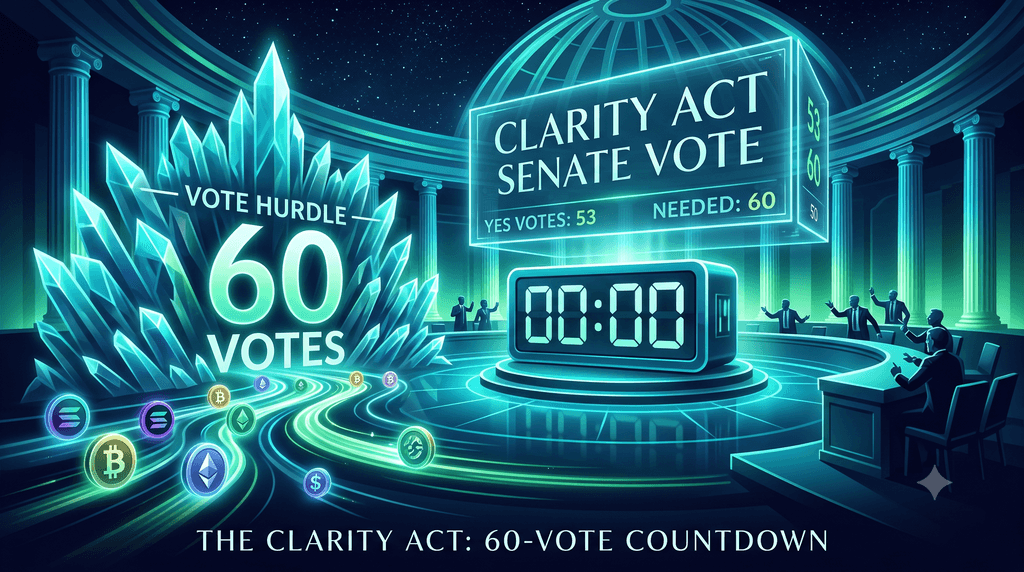
Republicans hold 53 seats, meaning the legislation requires approximately seven Democratic votes to reach the 60-vote cloture threshold needed to advance past a potential filibuster. The central question is whether bipartisan negotiations on ethics provisions and remaining policy differences can secure the necessary support in time for a floor vote or whether calendar constraints and partisan divisions will delay comprehensive market structure rules into a more uncertain post-election environment.
House Passage and Early Senate Committee Progress
The House of Representatives approved the Digital Asset Market Clarity Act on July 17, 2025, by a bipartisan vote of 294 to 134. That margin included every Republican and 78 Democrats, reflecting broad support for establishing statutory definitions that distinguish digital commodities from securities. The bill then moved to the Senate, where the Banking, Housing, and Urban Affairs Committee marked it up and advanced an amended version on May 14, 2026, by a 15-to-9 vote. All committee Republicans supported the measure, joined by Democratic Senators Ruben Gallego of Arizona and Angela Alsobrooks of Maryland. The committee reported the bill with an amendment in the nature of a substitute, and it was placed on the Senate Legislative Calendar under General Orders on June 1, 2026, as Calendar No. 423.
This sequence established the formal pathway for floor consideration. The early bipartisan committee result suggested potential for broader agreement, yet subsequent negotiations revealed persistent differences on several policy details. Industry participants viewed the House margin and committee advancement as evidence that market structure legislation had moved beyond conceptual debate into concrete legislative form. The timeline from House passage to Senate calendar placement spanned nearly a year, illustrating the complexity of reconciling competing jurisdictional and consumer-protection priorities. Official records on Congress.gov document each procedural step, providing a clear public record of the bill’s progression through both chambers.
Updated July Text and Merged Committee Work
Senate Banking Digital Assets Subcommittee Chair Cynthia Lummis released an updated version of the CLARITY Act text on July 22, 2026. The revised draft joins the products of the Banking and Agriculture Committees into a single comprehensive package of approximately 600 pages. This consolidated text aims to resolve differences between the two committees’ earlier approaches and present a unified framework for floor debate. The release followed months of staff-level work intended to produce legislation capable of attracting the bipartisan support required for cloture. Key structural elements remain focused on allocating oversight of digital commodities primarily to the Commodity Futures Trading Commission while preserving Securities and Exchange Commission authority over investment contract assets.
The updated language also incorporates additional provisions addressing stablecoin asset treatment and intermediary registration. Market observers noted that the timing of the release aligned with efforts to schedule floor action before the August recess. Supporters described the merged text as the product of extensive negotiation designed to create workable rules rather than leave regulation to case-by-case enforcement. Critics, however, immediately focused on specific sections they viewed as incomplete. The formal release of the updated text marked the most significant legislative development since the May committee vote and placed the bill in a position for potential Majority Leader scheduling decisions.
Ethics Provisions and Democratic Concerns
The July 22 updated text includes new ethics language that would prohibit presidents and other federal officials from issuing or sponsoring digital assets. Enforcement authority is assigned to the Department of Justice, with potential daily fines of up to $250,000 for violations. The provisions also allow a one-year period for certain existing holdings to be placed into a blind trust. President Trump reportedly accepted the ethics section, according to statements from supporting senators. Democratic responses were largely critical. Senators Alsobrooks and Gallego, the two Democrats who supported the earlier Banking Committee version, stated that the ethics language does not go far enough.
A group of seven Democrats who had been open to supporting the bill issued a joint statement describing the Republican-proposed text as falling short. Ranking Member Elizabeth Warren released an analysis arguing that the language contains significant loopholes and fails to adequately address potential conflicts. These objections center on the choice of enforcement agency and the strength of restrictions on existing financial interests. The ethics dispute has become a central obstacle to assembling the Democratic votes required for cloture. Negotiations on this section continued after the text release, yet public statements indicate substantial remaining distance between the parties.
The 60-Vote Cloture Requirement and Current Senate Math
Senate rules require 60 votes to invoke cloture and end debate on most legislation, a threshold designed to protect minority rights. With Republicans holding 53 seats and Democrats plus independents totaling 47, the CLARITY Act needs support from at least seven Democrats, assuming full Republican unity. The May committee vote demonstrated that two Democrats were willing to advance an earlier version, yet both have publicly opposed the July 22 ethics language. Additional Democratic support has proven difficult to lock in amid broader disagreements over consumer protections and enforcement mechanisms. Majority Leader John Thune has stated that the bill will receive a vote, though he has not committed to a specific date.
The practical arithmetic means that even modest Democratic defections or Republican absences could prevent the bill from clearing the procedural hurdle. Historical patterns show that market-structure legislation often requires extended negotiation to reach the necessary bipartisan threshold. Current public statements from key Democratic senators suggest that further changes to the ethics and related sections will be necessary before those votes materialize. The 60-vote requirement therefore remains the single most important procedural barrier facing the legislation in the current Congress.
Calendar Pressure and Competing Floor Priorities
As of July 27, 2026, Senate Majority Leader John Thune directed floor time toward a package of nominations and a Russia sanctions bill, effectively delaying consideration of the CLARITY Act. Senate procedures generally allow only one major disputed measure to proceed at a time, and the cloture process for any bill involves mandatory waiting periods. The Russia legislation and related funeral observances for the late Senator Lindsey Graham occupied additional attention in late July. The chamber is scheduled to begin its summer recess around August 8, leaving a narrow window of working days.
Even if preliminary cloture steps begin in the final week before recess, final passage could slip into September. After the November midterms, the subsequent lame-duck session presents its own political uncertainties. The limited remaining legislative days in 2026 have prompted some market participants to lower their expectations for enactment this year. Galaxy Digital reduced its assessed probability of 2026 passage to 30 percent, citing the cloture threshold, remaining policy differences, and the shrinking calendar. Leadership statements continue to express intent to address the bill, yet the sequence of competing priorities has reduced the practical runway available for floor action.
Core Jurisdictional Framework Between SEC and CFTC
The CLARITY Act’s primary structural contribution is the statutory allocation of regulatory authority over digital assets. Digital commodities, assets intrinsically linked to a blockchain system and trading on spot markets, would fall under exclusive Commodity Futures Trading Commission jurisdiction. Investment contract assets would remain under Securities and Exchange Commission oversight. The bill establishes mechanisms for determining when an asset transitions between categories and creates a joint advisory committee to promote consistent rules. This framework aims to replace the current environment of overlapping and sometimes conflicting enforcement actions with clearer registration pathways and compliance expectations.
Intermediaries such as exchanges and brokers would face tailored requirements depending on the nature of the assets they handle. Supporters argue that defined jurisdiction reduces regulatory uncertainty that has constrained institutional participation and product development. The approach also seeks to preserve the SEC’s authority over securities offerings while expanding the CFTC’s role in commodity markets that have grown substantially. Practical implementation would require both agencies to issue follow-on rules and interpretive guidance once the statute is enacted. The jurisdictional clarity remains the element most frequently cited by industry participants as essential for long-term market development.
Stablecoin Treatment and Banking Industry Positions
Earlier negotiations produced compromise language limiting certain stablecoin rewards programs so they would not function as direct competitors to traditional bank deposits. Banking trade associations, including the American Bankers Association and the Financial Services Forum, continued to express concerns after the July 22 text release, stating that the measure still risks local lending capacity. The compromise reflected months of discussion between crypto market participants and traditional financial institutions over the treatment of yield or rewards on payment stablecoins. The final statutory language attempts to draw distinctions that allow innovation in digital payment instruments while protecting the deposit base that funds community lending.
These provisions illustrate the broader tension between fostering new financial technology and maintaining the stability of existing banking channels. Continued engagement from banking groups indicates that this section could still face amendment pressure during floor consideration. The resolution of stablecoin rules carries implications for both payment innovation and the competitive landscape between digital assets and conventional deposits. Market participants monitoring the bill have treated the banking compromise as a necessary but still contested element of the overall package.
Industry Support and Advocacy Efforts
Companies including Coinbase and Ripple have publicly advocated for the passage of market-structure legislation that would create predictable registration and compliance pathways. Industry groups have emphasized that clear rules would encourage domestic innovation and reduce the incentive for firms to locate operations in jurisdictions with more defined frameworks. Advocacy has focused on the benefits of statutory definitions over continued reliance on enforcement actions and staff guidance. At the same time, some consumer and investor-protection organizations have urged stronger disclosure, custody, and anti-fraud provisions.
The range of stakeholder positions underscores the complexity of drafting rules that simultaneously promote innovation and address retail-investor risks. Public statements from company executives in July 2026 continued to call for a floor vote and final enactment. The intensity of advocacy reflects the view that 2026 represents a meaningful window before potential shifts in congressional composition following the midterms. These efforts have contributed to sustained legislative attention even as procedural and policy obstacles persist.
Potential Market Implications of Enactment or Delay
Enactment of the CLARITY Act would provide the first comprehensive federal statutory framework for digital asset markets, potentially increasing institutional willingness to offer custody, trading, and product services. Defined registration processes and jurisdictional lines could lower compliance costs for firms operating across multiple asset types. A prolonged delay, by contrast, would leave market participants subject to the existing mix of enforcement actions, interpretive releases, and state-level requirements. Some firms have already adjusted business models in anticipation of eventual clarity, while others have deferred certain product launches.
Price discovery in major digital assets has at times reflected shifts in legislative odds, with bitcoin price reactions observed around key committee and text-release dates. The absence of final rules continues to influence capital allocation decisions and the pace of traditional financial institutions entering the sector. Longer-term, the existence or absence of a federal framework will shape competitive dynamics between U.S. and offshore platforms. Market participants therefore monitor both the substance of remaining negotiations and the procedural calendar with equal attention.
Procedural Path to a Potential Floor Vote
Advancing the bill requires Majority Leader Thune to file a cloture motion on the motion to proceed, followed by the requisite waiting period and a 60-vote threshold vote. Successful cloture would open the bill to amendment and further debate, after which a second cloture vote would be needed on the underlying measure. The final passage would then require only a simple majority. Each of these steps consumes floor time that is currently allocated to other priorities. Leadership has indicated openness to scheduling the bill once outstanding policy differences narrow.
The absence of a filed cloture motion as of late July means that even an accelerated process would push final action close to or beyond the start of the August recess. September sessions offer a secondary window, yet the approach of the midterm elections will increasingly dominate the legislative calendar. The multi-step cloture process itself therefore functions as both a procedural safeguard and a practical constraint on the bill’s near-term prospects.
Remaining Negotiating Points and Possible Compromises
Beyond ethics language, outstanding issues include the precise treatment of decentralized finance protocols, the scope of anti-evasion provisions, and the calibration of disclosure requirements for different categories of market participants. Democratic senators have signaled that stronger consumer-protection and conflict-of-interest rules are prerequisites for broader support. Republican sponsors have emphasized the need to avoid creating new barriers that would disadvantage U.S. firms relative to international competitors. Staff-level discussions continue, and public statements from both sides leave open the possibility of further text changes.
Any compromise package would need to satisfy enough Democrats to reach 60 votes while retaining sufficient Republican support to avoid defections. The history of the bill shows that earlier disagreements over stablecoin rewards were ultimately bridged through detailed drafting. A similar process on ethics and remaining issues remains possible, yet the compressed calendar reduces the time available for iterative negotiation. The outcome of these talks will determine whether the bill advances in the current session or returns in modified form in a subsequent Congress.
Perception for 2026 Enactment and Beyond
Galaxy Digital’s reduction of 2026 passage odds to 30 percent reflects the combination of the 60-vote threshold, unresolved policy differences, and limited remaining legislative days. Majority Leader Thune’s public comments leave the door open for a vote, yet competing priorities have already consumed part of the available window. If the bill does not clear the Senate before the August recess, September offers a secondary opportunity before full campaign mode begins. A post-election lame-duck session could still produce legislation, though political dynamics after the midterms introduce additional uncertainty.
Failure to enact the CLARITY Act in 2026 would leave market participants operating under the existing regulatory patchwork into 2027. Parallel stablecoin legislation and ongoing agency interpretive work would continue, yet the absence of comprehensive market-structure rules would prolong the current environment of jurisdictional ambiguity. The coming weeks will therefore test whether the accumulated legislative work of the past year can be converted into final statutory text or whether further delay becomes the more likely path.
|
KuCoin is celebrating its 9th anniversary with a special platform campaign filled with exclusive rewards, trading activities, and limited-time offers. Don’t miss the chance to participate and enjoy the benefits as the exchange marks nine years of growth and innovation. Visit the official campaign page now:
|

FAQs
What is the current status of the CLARITY Act in the Senate as of late July 2026?
The bill has been placed on the Senate legislative calendar since June 1, 2026, after the Banking Committee advanced it in May. An updated merged text was released on July 22, but the Senate has temporarily prioritized other measures, including Russian sanctions and nominations, leaving no floor vote scheduled before the approaching August recess.
How many votes does the CLARITY Act need to advance in the Senate?
Cloture requires 60 votes to end debate. With Republicans holding 53 seats, the legislation needs support from at least seven Democrats, assuming all Republicans vote in favor, to overcome a potential filibuster and proceed to final consideration.
What are the main points of disagreement preventing a quick vote?
Ethics provisions restricting federal officials from issuing or sponsoring digital assets form the primary public dispute. Several Democrats, including those who supported the earlier committee version, have stated that the current language is insufficient, while other differences remain on consumer protections and enforcement details.
When could a Senate floor vote realistically occur?
Majority Leader Thune has indicated the bill will receive a vote, potentially in the final days before the August recess or in September sessions. The multi-step cloture process and competing priorities make precise timing uncertain, and failure to act before recess would push consideration later in the year.
What would the CLARITY Act change for digital asset markets if enacted?
It would create statutory definitions separating digital commodities under CFTC oversight from investment contract assets under SEC jurisdiction, establish registration pathways for intermediaries, and reduce reliance on case-by-case enforcement, providing greater predictability for market participants.
How has the banking industry responded to the legislation?
Banking trade groups have supported the overall goal of a clear framework while continuing to seek tighter restrictions on stablecoin rewards that could compete with traditional deposits. Compromises have been reached on some points, yet associations have stated that remaining language still raises concerns about impacts on local lending.
What happens if the bill does not pass in 2026?
Digital asset markets would continue operating under the existing combination of agency enforcement actions, interpretive guidance, and state requirements. Parallel work on stablecoin rules and agency rulemaking would proceed, but the absence of comprehensive market-structure legislation would prolong jurisdictional uncertainty into the next Congress.
Where can readers follow official developments on the bill?
Primary sources include the Congress.gov page for H.R. 3633, statements from the Senate Banking Committee, and releases from lead sponsors such as Senator Cynthia Lummis. These channels provide the most authoritative updates on text changes, scheduling, and vote outcomes.
Disclaimer: This content is for informational purposes only and does not constitute investment advice. Cryptocurrency investments carry risk. Please do your own research (DYOR).