

CFTC Moves to Dismiss CME Lawsuit as U.S. Crypto Perpetual Futures Battle Escalates
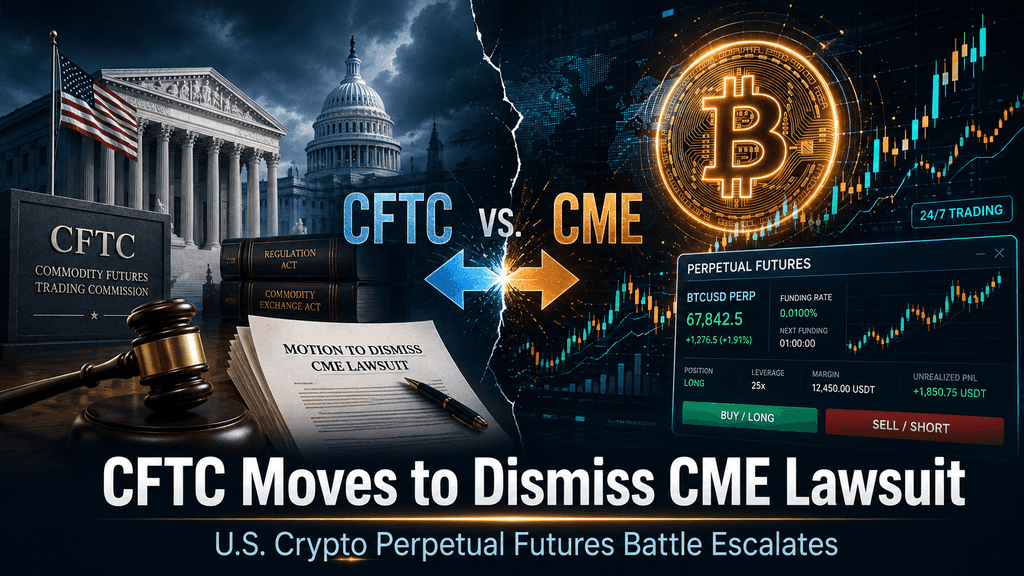
The battle over crypto perpetual futures in the United States has entered a new phase. On September 2, 2026, the Commodity Futures Trading Commission asked a federal court to dismiss Chicago Mercantile Exchange's lawsuit challenging the regulator's decision to treat certain cryptocurrency perpetual contracts as futures rather than swaps. The CFTC argues that CME has not shown a plausible competitive injury and lacks legal standing to use the case to block rival products.
The dispute began after the CFTC approved KalshiEX's BTCPERP contract on May 29 as a Bitcoin futures contract and, on the same day, confirmed that certain crypto perpetuals offered through Coinbase Financial Markets' affiliated foreign venue could qualify as foreign futures. CME sued on June 18, arguing that perpetual contracts belong under the swap framework created by the Commodity Exchange Act and Dodd-Frank reforms.
What may look like a technical dispute over derivatives terminology has much broader implications. The case could influence which exchanges can offer perpetual products, what regulatory framework applies, how quickly regulated crypto derivatives expand in the United States and whether a market structure popularized by offshore crypto exchanges eventually spreads into traditional finance.
What Happened in the CFTC-CME Lawsuit?
The conflict began on May 29 when the CFTC approved KalshiEX's BTCPERP contract, a perpetual product referencing the spot price of Bitcoin, as a futures contract. Kalshi is a designated contract market, or DCM, and the regulator concluded that the contract complied with relevant Commodity Exchange Act requirements and CFTC rules. The agency also published a broader policy statement indicating that perpetual contracts could be reviewed case by case because their characteristics may vary depending on the underlying asset.
The same day, CFTC staff responded to Coinbase Financial Markets and confirmed that certain digital-commodity perpetuals listed on its affiliated foreign board of trade, Deribit FZE, could be categorized as foreign futures. Less than three weeks later, on June 18, CME filed suit in the U.S. District Court for the District of Columbia against the CFTC and Chairman Michael Selig. The case challenges the regulator's policy under the Administrative Procedure Act.
On September 2, the regulator escalated the fight by asking the court to dismiss CME's complaint. That procedural step is important: the CFTC is attempting to end the lawsuit before the court necessarily reaches the deeper question of whether perpetuals should legally be treated as futures or swaps.
Why Is CME Suing the CFTC?
CME's central legal argument is that perpetual contracts are not ordinary futures. Unlike conventional futures, perpetuals have no fixed expiration date and are designed to provide continuous exposure to an underlying asset. CME argues that this structure fits more naturally within the legal definition of a swap and that the CFTC improperly bypassed the regulatory framework established for swaps after the 2008 financial crisis.
The dispute is also commercial. CME is one of the world's dominant derivatives marketplaces and already offers regulated Bitcoin and Ether futures. According to its complaint, allowing Kalshi and other entrants to list crypto perpetuals as futures brings new competitors into a market in which CME has historically played a leading role. CME says this could divert retail derivatives customers and weaken its competitive position.
Those two arguments are closely connected. CME is challenging what it sees as a legally incorrect product classification, but the classification also determines which platforms can compete and under what rules. The lawsuit is therefore both a regulatory dispute and a fight over the future structure of the U.S. derivatives market.
Why Does the CFTC Want the Case Dismissed?
The CFTC's September motion does not ask the court simply to agree that perpetuals are futures. Instead, one of its main arguments is more procedural: CME allegedly lacks standing to bring the case. To sue in federal court, a plaintiff generally must show a concrete injury linked to the challenged government action and demonstrate that a favorable court ruling could address that injury.
The agency called CME's case "much ado about nothing" and argued that the exchange has failed to establish plausible competitive harm. According to the CFTC, CME remains free to list perpetual futures itself because it is also a designated contract market. The regulator therefore contends that CME cannot claim it has been unfairly excluded from a market that remains open to it.
The CFTC has also challenged whether a court victory would actually solve CME's alleged problem. Even if perpetuals were reclassified as swaps, the agency argues, competitors might still restructure their offerings under that framework. In other words, changing the legal label would not necessarily eliminate the competition CME says is harming it.
Can CME Simply Launch Its Own Perpetual Futures?
This is one of the most important arguments in the CFTC's motion. Because CME operates a DCM, the regulator says the exchange could seek to list its own perpetual futures under the same regulatory path available to competitors. The CFTC therefore describes CME's claimed harm as at least partly "self-inflicted."
That argument turns the lawsuit into an unusual competitive question. CME says the CFTC has changed the rules in a way that unfairly benefits new entrants. The regulator effectively responds that CME is free to compete under those rules instead of trying to stop other exchanges from doing so.
However, CME may argue that its objection is not simply that competitors are offering a product it has chosen not to offer. The deeper question is whether the CFTC had the legal authority to create that competitive environment by classifying no-expiry perpetual contracts as futures in the first place. That distinction is likely to remain important as the case develops.
Has CME Actually Lost Business?
The CFTC also points to trading activity to challenge CME's competitive-injury claim. According to figures cited in the dismissal brief, monthly trading volumes for CME's Bitcoin- and Ether-related futures were higher in both June and August than in May, the month before the contested regulatory decision took effect.
That data allows the CFTC to argue that there is little evidence so far that Kalshi's perpetual products have materially damaged CME's existing crypto derivatives franchise. If CME's own volumes remain healthy, proving a current economic injury may be more difficult.
Still, short-term volume figures do not fully resolve the competitive question. New financial products can take time to gain liquidity and customer adoption. CME could argue that the threat lies in future market-share erosion rather than an immediate collapse in trading activity. The legal issue may therefore depend on whether anticipated competitive harm is concrete enough to satisfy federal standing requirements.
Are Crypto Perpetuals Futures or Swaps?
This is the question that gives the case its long-term importance. Traditional futures normally specify a contract maturity and settlement structure. Traders who want to maintain exposure beyond expiration must typically roll their position into a later contract. Crypto perpetuals were designed differently: they offer continuous exposure without a fixed expiration and often use recurring mechanisms to keep the contract price aligned with the underlying spot market.
| Feature | Traditional Futures | Crypto Perpetuals |
| Expiration | Usually fixed | No fixed expiration |
| Position duration | Ends or rolls at maturity | Can remain open indefinitely |
| Price alignment | Convergence near settlement | Continuous pricing mechanism |
| Market structure | Common in traditional derivatives | Popular in crypto markets |
| Typical trading hours | Depends on venue | Often designed around continuous crypto trading |
The CFTC's May 29 order determined that Kalshi's Bitcoin perpetual could be listed as a futures contract. The regulator also stressed that perpetual designs vary by asset class and that products outside the scope of the Bitcoin order should generally undergo case-by-case review.
CME argues that a contract with indefinite duration is economically and legally closer to a swap. That disagreement matters because the futures and swap frameworks impose different regulatory structures. The court may ultimately have to decide whether the absence of a fixed maturity is enough to move perpetuals outside the futures category—or whether the broader economic characteristics of the contract can still support futures treatment.
Why the Futures-vs-Swaps Label Matters
The difference is not merely semantic. Product classification can determine the type of venue on which a derivative is offered, applicable registration requirements, reporting obligations, clearing arrangements, margin rules and the types of market participants that can access it.
If crypto perpetuals are treated as futures, designated contract markets can potentially seek approval to list them within the existing futures framework. That could make perpetual-style products a more conventional part of regulated U.S. derivatives markets. Kalshi's BTCPERP approval represents an important example of this route.
If the products are instead treated as swaps, providers could face a different regulatory architecture. A CME victory therefore would not necessarily eliminate perpetual contracts, but it could materially change how platforms design and distribute them. That is why the legal classification could influence the speed and shape of U.S. perpetual-market growth.
Why Kalshi Is at the Center of the Fight
Kalshi is central because its BTCPERP product became the clearest domestic test of the CFTC's new approach. The platform is best known for prediction markets, but its expansion into perpetual derivatives indicates broader ambitions in regulated financial markets.
The strategy is already moving beyond Bitcoin. Reuters reported on September 2 that Kalshi planned to file for approval of a perpetual WTI crude oil contract. The company has also filed for perpetual products linked to equity indexes, metals, foreign exchange and interest rates. If approved, the oil product would be the first perpetual crude futures contract on a regulated U.S. platform.
That expansion makes the CME lawsuit much more significant. If perpetual market design migrates from crypto into commodities, indexes and rates, the dispute will no longer be mainly about a niche digital-asset derivative. It could become a test of whether no-expiry contracts are capable of reshaping parts of traditional futures markets.
Where Does Coinbase Fit Into the Case?
Coinbase is not a defendant, but its regulatory arrangement is part of the broader dispute. On May 29, CFTC staff confirmed that certain digital-commodity perpetual contracts offered through Coinbase Financial Markets' affiliated foreign board of trade, Deribit FZE, could be categorized as foreign futures. The agency also issued a related no-action position covering certain transfers of customer-owned digital assets and stablecoins as margin, subject to specified conditions.
For CME, this suggested that the CFTC was opening more than one route for crypto perpetual exposure. Kalshi represented a U.S. DCM listing a domestic Bitcoin perpetual, while Coinbase represented a regulated U.S. intermediary connecting customers to qualifying perpetual contracts on an affiliated foreign venue.
Together, those developments signal a broader policy direction: crypto perpetuals that were historically associated with offshore exchanges may increasingly become accessible through regulated channels.
The U.S. Crypto Perpetual Market Is Already Expanding
The lawsuit is unfolding while regulators and exchanges continue developing the market. The CFTC's May policy statement explicitly established a case-by-case review approach for perpetual products outside the specific asset classes covered by its initial order.
This creates an unusual dynamic. CME is asking a federal court to challenge the legal foundation of a regulatory model at the same time that market participants are beginning to build products around that model. The longer the litigation continues, the more commercial activity may develop under the existing interpretation.
That means any eventual ruling could affect more than the first Bitcoin contract. It could influence exchange investment decisions, product-development pipelines and how aggressively regulated U.S. venues compete for a derivatives market that has historically been dominated by offshore crypto platforms.
Why Crypto Traders Care About Perpetual Futures
Perpetual futures became popular in crypto because they solve a practical problem associated with dated derivatives. Traders do not have to repeatedly roll exposure from one expiration month to another, while liquidity can remain concentrated in a single continuous contract. This structure is particularly well suited to digital assets, which trade around the clock rather than following traditional exchange sessions.
Perpetuals are widely used for hedging, directional trading and leveraged exposure. Their importance is reflected in trading volumes: Reuters reported that crypto perpetual futures activity grew 29% in 2025 to approximately $61.7 trillion.
That scale explains why U.S. regulation matters. The question is not whether perpetuals are a marginal crypto product. They are already one of the dominant mechanisms for trading digital-asset derivatives globally. The unresolved issue is where U.S. customers and institutions will access them and under which regulatory framework.
Could U.S. Regulation Bring Perpetual Trading Onshore?
For years, much of the global crypto perpetual market developed outside traditional U.S. derivatives infrastructure. Offshore exchanges and crypto-native venues captured liquidity because U.S. regulatory uncertainty limited domestic access to comparable products.
The CFTC's 2026 approach could begin changing that balance. If regulated DCMs can list perpetual futures and registered intermediaries can connect customers to qualifying foreign futures, more crypto derivatives activity could migrate toward regulated U.S.-linked venues. The CFTC has framed its broader innovation agenda around promoting responsible innovation and U.S. market competitiveness.
The commercial stakes are substantial. Bringing more perpetual trading onshore could increase competition among CME, Kalshi, Coinbase-linked venues and other regulated platforms. It could also force traditional exchanges to decide whether perpetual design is a temporary crypto innovation or a market structure they eventually need to adopt themselves.
What Happens If the CFTC Wins?
There are several ways the CFTC could prevail. The court could accept the motion to dismiss and conclude that CME lacks standing, ending the lawsuit without necessarily resolving the fundamental futures-versus-swaps classification question. Alternatively, the case could survive the initial procedural fight and ultimately result in a ruling supporting the regulator's interpretation.
Either outcome would strengthen the practical stability of the CFTC's current regulatory path. Exchanges would likely have greater confidence in pursuing perpetual futures approvals, while competition in regulated crypto derivatives could accelerate.
The consequences could eventually extend beyond digital assets. Kalshi's plans for crude oil and filings involving indexes, metals, currencies and rates show that the perpetual structure is already being considered for traditional markets. A CFTC victory could therefore support broader experimentation with no-expiry derivatives.
What Happens If CME Wins?
A CME victory could force the regulator to reconsider how perpetual contracts are classified and approved. If the court concludes that the relevant products belong within the swap framework, exchanges and intermediaries may need to redesign their legal and compliance structures before offering them.
That could slow product launches and alter the economics of U.S. perpetual trading. Venue requirements, reporting obligations and other regulatory considerations could differ depending on the final classification.
However, a CME victory would not necessarily mean perpetuals disappear from the United States. The CFTC itself argues that competitors might still offer similar contracts under a swap framework, which is one reason the agency says CME's alleged injury may not be redressable. The more accurate conclusion is that a CME victory could redirect the market rather than eliminate it.
What Happens Next in the Lawsuit?
The next stage will focus on whether CME can keep the case alive. The CFTC filed its motion to dismiss on September 2, and the court's scheduling order gives CME until October 2, 2026 to oppose that motion. The agency has also requested an oral hearing.
CME will likely need to address several issues raised by the regulator: whether it has suffered a sufficiently concrete competitive injury, whether that harm is genuinely caused by the CFTC's policy and whether a court ruling could meaningfully repair the injury.
If the court rejects the standing arguments and allows the case to proceed, attention could shift more directly toward the underlying legal question of whether the CFTC acted lawfully in treating the relevant perpetual products as futures. That stage would carry much larger implications for the derivatives industry.
Why This Case Matters Beyond Bitcoin
The dispute began with Bitcoin perpetuals, but it is rapidly becoming a broader debate about market design. Crypto popularized no-expiry derivatives because its markets operate continuously and traders value concentrated liquidity. U.S. exchanges are now testing whether those features can fit inside traditional regulated infrastructure.
Kalshi's move toward crude oil perpetuals shows how quickly the concept can expand beyond digital assets. If similar structures eventually reach equity indexes, currencies, metals or rates, perpetual contracts could begin competing directly with dated futures that have formed the foundation of traditional derivatives markets for decades.
The CME-CFTC case therefore raises a much larger question than whether one Bitcoin product was properly classified. It asks whether the U.S. derivatives system can absorb a crypto-native market structure—and, if so, whether incumbent exchanges or newer trading platforms will shape its development.
Conclusion: The Fight Is About More Than Crypto Perpetuals
The CFTC's motion to dismiss marks an important escalation in its legal fight with CME. The regulator argues that CME has not shown a real competitive injury and remains free to launch perpetual futures itself. CME, meanwhile, maintains that the underlying products were classified under the wrong legal framework and that the CFTC's approach threatens both regulatory consistency and fair competition.
At stake are three connected questions: whether crypto perpetuals are futures or swaps, how regulated exchanges should compete for this rapidly growing market and whether the United States can bring more global crypto derivatives activity into domestic regulatory channels.
The court has not yet decided the dispute. But as perpetual products expand from Bitcoin toward other cryptocurrencies and even traditional assets, the outcome could influence far more than one lawsuit. It may help define what the next generation of U.S. derivatives markets looks like.
FAQs
Do crypto perpetual futures expire?
No. Perpetual futures are designed without a fixed expiration date, allowing positions to remain open as long as margin requirements are met. Positions can still be closed voluntarily or liquidated if losses reduce available collateral too far.
What is a funding rate in perpetual futures?
A funding rate is a periodic payment mechanism commonly used in crypto perpetual markets to help keep the contract price close to the underlying spot price. Depending on market positioning, traders on one side may pay traders on the other.
Are perpetual futures the same as spot crypto trading?
No. Spot trading involves buying or selling the underlying cryptocurrency itself. A perpetual contract is a derivative that provides price exposure without necessarily giving the trader ownership of the underlying asset.
Can perpetual futures be traded without high leverage?
Perpetual contracts can support leverage, but traders do not necessarily have to use the maximum leverage available. Exact margin and leverage rules depend on the exchange, product and regulatory framework.
Why can perpetual liquidations increase market volatility?
If leveraged positions no longer have sufficient collateral, they may be forcibly closed. During sharp market moves, many liquidations can occur at once, adding forced buying or selling and temporarily accelerating price volatility.
Are decentralized perpetual exchanges directly affected by the CME lawsuit?
Not directly. The case concerns CFTC-regulated products and the U.S. legal treatment of perpetual contracts. However, its outcome could influence how U.S. regulators approach similar products and how centralized and decentralized perpetual markets compete for U.S.-linked liquidity.
🔥 KuCoin Offers A More Stable Option in A Volatile Market
If you worry about the frequent ups and downs in the market, and pursue a more stable option to earn money passively, KuCoin is the right place to come:

Simple Earn: Deposit and withdraw tokens anytime, earning stable returns.
Kucoin Earn: Earn stable profits with professional asset management.
Hold to Earn: Earn rewards by holding assets in Funding, Trading, Margin, Futures, Mining, and Unified Accounts.
Staking: Unlock the earning potential of on-chain assets.
Advanced Investments: Advanced Investments offer a variety of structured products to help your money grow in any market.
Shark Fin: Principal Protection and Guaranteed Gains
Dual Investment: Buy low and sell high with transparent return calculations.
Snowball: High yields, with price protection.
Discount Buy: Buy crypto at discount prices.
KCS Loyalty: Level up to enjoy exclusive perks by staking ≥ 1 KCS.
KuCoin Wealth: Discover future value and begin your smart investing journey.
KCS Benefits: Hold and stake KCS to access benefits across the platform.
KCS Staking 2.0: Participate in KCS on-chain governance to earn yield.
Disclaimer: This content is for informational purposes only and does not constitute investment advice. Cryptocurrency investments carry risk. Please do your own research (DYOR).