

BTQ Technologies Q3 2026: QCIM Chip, Kaia Deal and Zero Revenue
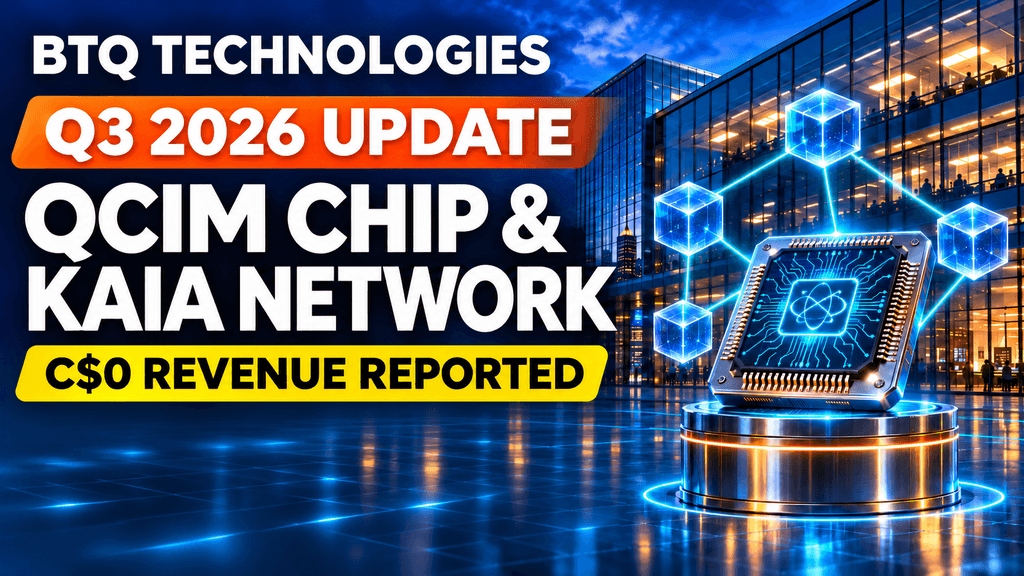
BTQ Technologies' Q3 2026 corporate update, released on November 17, highlighted progress across quantum-security chips, blockchain infrastructure, and quantum computing software. The company completed important QCIM design and validation work, signed a three-year agreement with the Kaia DLT Foundation, and expanded distribution of QPerfect's MIMIQ emulator. Bitcoin Quantum's planned mainnet launch moved to the first half of 2027. However, BTQ's financial statements showed no recognized quarterly revenue, a C$19.48 million net loss, and continued reliance on external financing. The developments illustrate the distinction between advancing technology and establishing sustainable commercial operations.
Key Takeaways
-
QCIM chip design was completed with ICTK, and its cryptographic core was validated with ITRI in a TSMC 28nm design environment.
-
BTQ targets Q1 2027 for initial FPGA IP, ASIC IP beta, and standalone QCIM chip samples; additional testing remains necessary.
-
QSSN signed a three-year Kaia agreement involving transaction-fee sharing; its 100,000-plus mainnet transaction milestone had already been reported in Q2.
-
Bitcoin Quantum remains under external security review, with its mainnet launch targeted for the first half of 2027.
-
QPerfect's MIMIQ expanded through SDT QUREKA and qBraid, whose developer community exceeds 35,000; actual MIMIQ adoption remains unquantified.
-
BTQ reported zero Q3 revenue, a C$19.48 million net loss, and C$21.57 million in cash, alongside ongoing financing needs.
BTQ QCIM Chip Development: TSMC 28nm Validation and 2027 Release Plans
BTQ Technologies advanced its Quantum Compute-in-Memory (QCIM) chip program during the third quarter, with design and validation work intended to support post-quantum cryptography in specialized hardware. QCIM is being developed to accelerate cryptographic operations while accommodating multiple algorithms within a common architecture. The completed work marks a technical step toward commercialization, but does not establish that finished chips have entered volume manufacturing or received formal security certifications. The company's 2027 product roadmap spans programmable hardware, licensable chip designs, and standalone security components.
What BTQ Achieved With ICTK and ITRI in QCIM Chip Validation
In July 2026, BTQ and South Korean semiconductor company ICTK completed a security-chip design combining QCIM with ICTK's VIA PUF physically unclonable function technology. The integration is intended to strengthen hardware-rooted device authentication and provide flexibility as cryptographic standards evolve. QCIM's proposed applications include connected devices, industrial systems, defense equipment, and other infrastructure where secure computations may need to operate within power or size constraints.
On August 7, BTQ announced that Taiwan's Industrial Technology Research Institute (ITRI) had completed the first technical milestone in their collaboration. The QCIM core was validated in a TSMC 28-nanometer design environment, with the company reporting successful operations associated with NIST's FIPS 203, 204, and 205 post-quantum standards. These algorithms are part of the wider transition from conventional to quantum-resistant cryptography. The result demonstrates design feasibility, not independently certified chip performance or completed physical production.
When BTQ Plans to Release QCIM FPGA IP, ASIC IP and Standalone Chips
BTQ plans its initial field-programmable gate array (FPGA) intellectual-property release in Q1 2027, enabling potential customers to evaluate the architecture on reprogrammable hardware. An application-specific integrated circuit (ASIC) IP beta is also expected that quarter, when test-chip silicon validation is scheduled to begin. The company targets first standalone security-chip samples for the same period. These formats offer different development and licensing routes, but samples and beta software should not be confused with fully qualified commercial products.
BTQ's roadmap subsequently calls for ASIC design-in activity and a standalone-chip production tape-out in Q2 2027, followed by further validation in Q4. Security certification goals include FIPS 140-3 and relevant Common Criteria frameworks; BTQ has not reported these approvals as completed. Manufacturing results, security assessments, partner performance, and customer requirements could change the timetable. In its financial disclosures, the company also identifies additional funding as necessary to advance some development objectives.
How BTQ's Kaia QSSN Agreement Works and When Bitcoin Quantum May Launch
BTQ's blockchain initiatives follow two different approaches. Quantum Secure Systems & Networks (QSSN) adds post-quantum wallet and transaction-validation capabilities to existing networks, whereas Bitcoin Quantum is a separate proof-of-work blockchain project built around quantum-resistant digital signatures. The company is pursuing a commercial integration for the former while continuing audit and launch preparations for the latter. Their results should be assessed separately: a signed infrastructure agreement does not establish actual transaction-fee revenue, and a functioning testnet is not a live mainnet.
How BTQ's Three-Year Kaia Agreement Could Generate QSSN Revenue
On September 30, 2026, BTQ announced a three-year agreement with the Kaia DLT Foundation to deploy QSSN across Kaia's blockchain ecosystem. BTQ is entitled to a portion of fees from activity secured by its technology, while LINE NEXT's Unifi Wallet is among the first proposed consumer use cases. The Kaia blockchain's native asset, KAIA, is distinct from the terms of BTQ's commercial arrangement; the company has not disclosed that agreement revenue will be paid in a specific token. Deployment on Kaia was a Q4 2026 objective, rather than a completed Q3 rollout. BTQ previously projected six-figure first-year revenue in US dollars, but its quarterly filing recorded no revenue under the agreement and cautioned that future receipts depend on transaction volumes.
What QSSN's 100,000 Mainnet Transactions Show About Blockchain Security
BTQ reiterated that QSSN had processed more than 100,000 mainnet transactions. This threshold was first reported in its August Q2 update, so it should not be interpreted as an additional 100,000 transactions during Q3 or as proof of activity on the planned Kaia integration. Technically, QSSN is designed as a wallet-security and validation layer, pairing conventional ECDSA signatures with post-quantum ML-DSA signatures without requiring a replacement of the underlying blockchain. BTQ also reported a South Korean stablecoin proof of concept involving iM Bank and Finger and a security partnership with MoonPay Korea. Those engagements indicate institutional testing and interest, but they do not establish a measured number of paying users.
When Bitcoin Quantum Mainnet Could Launch After Its Security Audit
Bitcoin Quantum is BTQ's proposed fork of Bitcoin, not a protocol upgrade adopted by the existing Bitcoin network. Its testnet has operated since January 2026, and the company completed an internal audit of the core protocol during Q2 before progressing to an external security review. BTQ now targets mainnet in the first half of 2027, later than the late-2026 launch goal described in its earlier update. Exchange and custody integrations are planned for the second half of 2027, subject to technical, infrastructure, and regulatory conditions. The wider debate over quantum security for Bitcoin concerns threats that sufficiently powerful future computers might pose; no completed external audit or guaranteed launch date for Bitcoin Quantum has been disclosed.
How QPerfect's MIMIQ Expanded Through QUREKA and qBraid
BTQ expanded its quantum computing software activities through QPerfect, the French company it fully acquired on July 7, 2026. QPerfect's MIMIQ emulator gained distribution through SDT's commercial quantum cloud in South Korea and, after quarter-end, through qBraid's developer platform. Rather than running calculations on a physical quantum processor, MIMIQ models quantum circuits using classical computing resources. This allows researchers to test some algorithms and hardware-related assumptions before using specialized quantum machines. Greater availability creates potential commercial channels, but it does not by itself measure paying customer adoption.
How MIMIQ Became Available Through SDT QUREKA and qBraid
On July 2, BTQ announced that MIMIQ would support the commercial launch of SDT's QUREKA cloud at Quantum Korea 2026. QUREKA brings together classical and quantum computing services, while QPerfect provides and maintains the emulation software and SDT handles the customer-facing platform. The arrangement gives research institutions and enterprise development teams a cloud channel for testing quantum circuits. It is a practical form of distribution for software that can be used before large-scale fault-tolerant quantum hardware is available.
On October 29, QPerfect and qBraid announced that MIMIQ had become available through qBraid's managed API, potentially exposing the emulator to a developer community of more than 35,000. MIMIQ combines state-vector simulation with Matrix Product State methods; the latter can handle certain circuits with thousands of qubits and millions of gates when their structure allows efficient representation. That technical qualification matters because the capability does not apply equally to every possible quantum circuit. The 35,000 figure describes the broader qBraid community, not verified MIMIQ users, subscriptions, or sales.
What QPerfect's Enterprise Projects and Digital Twin Roadmap Mean for 2027
QPerfect also introduced an on-premises MIMIQ offering during Q3, targeting organizations that prefer to run simulation software within their own computing environments. BTQ reported a paid proof of concept with an unnamed major French bank, which suggests a possible institutional use case for quantum emulation in sensitive workflows. However, the company did not publicly identify the bank or disclose the contract value. Without those details or broader customer metrics, the engagement is best described as early commercial evidence rather than proof of large-scale adoption.
Next on QPerfect's schedule is a Digital Twin designed for the aQCess neutral-atom quantum computing platform, with an initial version targeted for the end of 2026 and a cloud-accessible release planned for mid-2027. Such software aims to represent the characteristics of specific quantum hardware so developers can evaluate programs before running them on physical processors. QPerfect is also researching error correction and logical-qubit management through its longer-term Quantum Logic Unit effort. Hardware validation, software reliability, and additional customer contracts will determine whether these research and distribution milestones support sustained revenue.
What BTQ's Q3 2026 Financial Results Reveal About Revenue, Losses and Cash
BTQ's unaudited financial statements for the three months ended September 30, 2026 show a company funding product development before meaningful sales have appeared in its accounts. Its reporting separates recognized financial performance from management's expected future income streams. The results also reflect increased research expenses, substantial share-based compensation, and reliance on equity financing. All financial amounts below are in Canadian dollars unless another currency is identified. The figures provide a clearer picture of the company's financial capacity as its major development programs approach their planned 2027 milestones.
Why BTQ Technologies Reported Zero Revenue in Q3 2026
BTQ recorded C$0 revenue in Q3 2026, unchanged from Q3 2025. Revenue for the first nine months of 2026 was also nil, compared with C$315,497 in the first nine months of 2025. The earlier amount came from software licensing and related consulting services, according to the financial statements. The lack of revenue in the current period does not contradict the existence of signed partnerships or available software, but it means the company had not recognized sales from its current activities through September 30.
Contractual performance obligations, service delivery, and other accounting requirements govern when revenue can be reported. For BTQ, the timing and scale of future income remain especially dependent on whether infrastructure deployments and enterprise software engagements generate billable activity. Its next financial reporting periods will help establish whether technical and commercial milestones have started producing measurable financial results. The timing is particularly relevant to the Kaia agreement, which was announced on September 30, the final day of the reporting quarter.
How BTQ's Q3 2026 Net Loss and Operating Expenses Changed
The company's quarterly net loss widened to C$19.48 million from C$9.02 million a year earlier, an increase of approximately 115.9% in the reported loss amount. Basic and diluted loss per share increased from C$0.07 to C$0.13. For the first nine months of 2026, BTQ reported a C$56.16 million net loss against C$12.78 million in the comparable 2025 period. The widening losses reflect the greater scale and cost of the company's development and corporate activities, rather than a decline in quarterly revenue from the year-earlier period, which was also zero.
Research and development expenses reached C$6.75 million in Q3, compared with C$1.17 million a year earlier. Professional fees rose to C$5.30 million from approximately C$665,000, while share-based compensation totaled C$6.55 million. The latter is a substantial noncash expense; an unrealized C$3.40 million gain on investments also affected the reported result without representing operating sales. These accounting items make cash flow an important additional measure when assessing the cost of BTQ's development programs.
How Much Cash BTQ Had and What Its Financing Needs Mean for 2027
At September 30, BTQ held C$21.57 million in cash, compared with C$20.94 million at the end of 2025. Working capital nevertheless declined from C$20.24 million to C$13.05 million over the same interval. Operating activities used C$25.59 million during the first nine months of 2026, compared with C$7.24 million in the prior-year period. The contrast between cash on hand and operating cash use illustrates why a quarter-end balance alone is insufficient to establish the company's ability to fund its full roadmap.
BTQ issued approximately 5.77 million shares under its at-the-market equity program during the first nine months of 2026, generating C$30.03 million in gross proceeds. It subsequently reported another C$4.95 million in net proceeds after quarter-end, which was not included in the September 30 cash figure. The financing raised capital but also increased the share count. Management's filing identifies a need for substantial additional funding and material uncertainty about the company's ability to continue as a going concern without it. Future financing terms, spending, and realized commercial income will therefore matter to the execution of BTQ's planned 2027 milestones.
Conclusion
BTQ Technologies' Q3 2026 update describes tangible progress in QCIM chip design, quantum-safe blockchain infrastructure, and QPerfect's quantum emulation software, alongside a revised 2027 target for Bitcoin Quantum. The commercial significance lies in moving these products toward customer use, but their stages of readiness differ substantially, and some of the headline metrics predate the reported quarter. The financial statements provide an essential counterbalance: revenue had not yet been recognized, losses had widened, and further financing was needed. The clearest measures of progress from here will be completed security and hardware validation, actual deployments, and contracts that translate into reported revenue.
FAQs
Does BTQ's QCIM chip require a quantum computer?
No. BTQ's Quantum Compute-in-Memory (QCIM) chip uses conventional semiconductor technology to accelerate post-quantum cryptographic operations. It does not require a quantum computer to function. The term post-quantum refers to cryptographic methods designed to withstand attacks from sufficiently powerful future quantum computers, rather than the type of hardware performing the calculations.
Has BTQ received FIPS 140-3 certification for its QCIM chip?
BTQ has not announced FIPS 140-3 certification for its QCIM chip as of its November 17, 2026 corporate update. The company reported successful testing of cryptographic operations associated with NIST's FIPS 203, 204, and 205 standards. However, validating these algorithms differs from obtaining formal certification for a finished security module. Additional testing, documentation, and independent assessment may be required before certification can be achieved.
Does BTQ's Kaia partnership affect the supply or price of KAIA tokens?
The September 30, 2026 agreement did not announce changes to KAIA token supply, issuance, or burning mechanisms. Instead, the partnership establishes a commercial arrangement under which BTQ may receive a share of fees generated by transactions secured through QSSN. Any potential market implications would depend on actual implementation, network usage, and broader market conditions. The agreement alone does not establish a measurable effect on KAIA's market price.
Will BTQ's QSSN automatically secure every transaction on the Kaia blockchain?
No network-wide protection has been confirmed. BTQ identified LINE NEXT's Unifi Wallet as an early potential application, but the November 2026 update did not establish that every Kaia transaction would use QSSN security. The extent of protection depends on wallet integration, transaction-validation arrangements, and participating applications. Deployment coverage and actual usage will be important measures for evaluating the technology's practical adoption.
Can QPerfect's MIMIQ simulate quantum computers with thousands of qubits?
MIMIQ can simulate certain quantum circuits involving thousands of qubits by using computational techniques such as Matrix Product States. However, its performance depends heavily on circuit structure, entanglement, available computing resources, and simulation requirements. Highly complex circuits may remain impractical to simulate efficiently on classical hardware. Consequently, a high qubit count does not guarantee that MIMIQ can simulate every quantum computing workload at that scale.
Disclaimer: This general market information, possibly from third-party, commercial, or sponsored sources, is provided for reference and educational purposes only and does not constitute financial or investment advice, an offer, solicitation, or guarantee. We disclaim liability for its accuracy, completeness, reliability, and any resulting losses. Investments/trading are risky; past performance doesn’t guarantee future results. Users should research, judge prudently, and take full responsibility. For further details, please consult KuCoin’s Terms of Use and Risk Disclosure.