

Why Bitcoin OG and Miner Selling Could Be Bullish: How Institutional Investors and Bitcoin ETFs Are Absorbing Supply
2026/06/05 11:08:00
Introduction
What if the Bitcoin selling that many investors fear is actually one of the strongest bullish signals in the current market cycle?
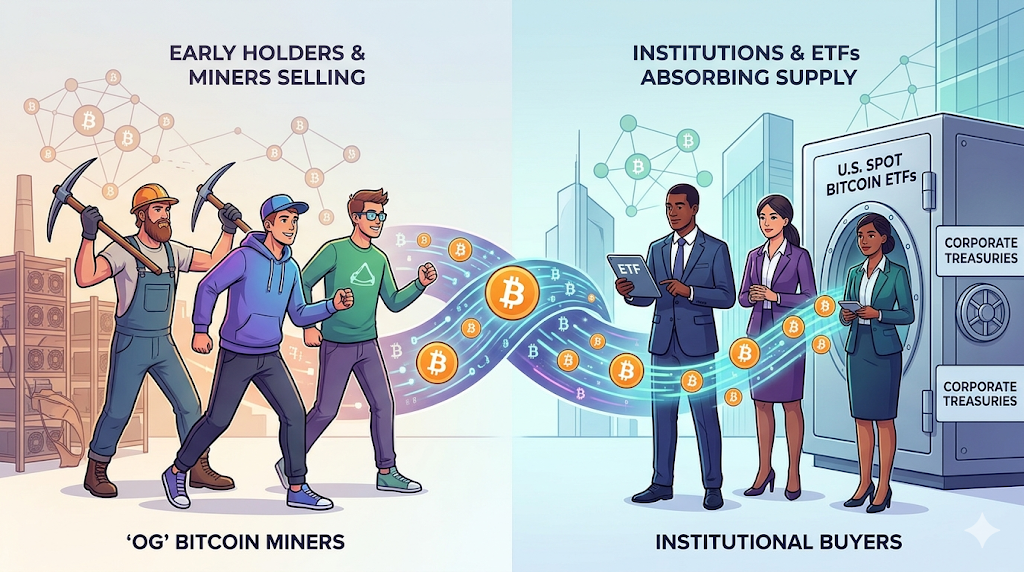
For years, Bitcoin veterans often viewed large-scale selling by early adopters and miners as a warning sign. However, the structure of today's market is fundamentally different from previous cycles. Instead of triggering prolonged price collapses, Bitcoin sold by long-term holders and miners is increasingly being absorbed by institutional investors, corporate treasuries, and U.S. spot Bitcoin ETFs.
This shift represents one of the most important structural developments in Bitcoin's history. Rather than signaling weakness, the transfer of Bitcoin from early participants to regulated financial institutions may help create a more mature ownership base, reduce speculative volatility, and lay the foundation for the next phase of adoption.
The key question is no longer whether OG holders are selling. The real question is who is buying.
Why Are Bitcoin OGs and Miners Selling?
Bitcoin OGs and miners are selling primarily because they are taking profits after years of holding, not because they have lost confidence in Bitcoin.
Many early Bitcoin holders accumulated BTC when prices were below $1,000 or even below $100. At current valuations, these investors are sitting on extraordinary gains. Portfolio diversification, estate planning, tax considerations, and liquidity needs naturally encourage some degree of profit-taking.
Similarly, miners face ongoing operational expenses.
Why Miners Must Sell Bitcoin
Miners continuously incur costs, including:
-
Electricity expenses
-
Hardware upgrades
-
Data center operations
-
Employee salaries
-
Debt repayments
Following the 2024 Bitcoin halving, mining rewards were cut in half, increasing financial pressure across the industry. As a result, many miners have been forced to sell a portion of their Bitcoin reserves to maintain profitability.
Historically, miner selling often created significant market pressure because there were relatively few large buyers capable of absorbing that supply.
That dynamic is changing rapidly.
Who Is Buying the Bitcoin Being Sold?
The primary buyers today are institutions, ETFs, corporations, wealth managers, and traditional investors. This is arguably the biggest difference between the current cycle and previous Bitcoin bull markets.
In earlier cycles, Bitcoin largely circulated between retail investors, crypto funds, and speculative traders. Today, Bitcoin is increasingly moving into regulated investment vehicles and long-term institutional portfolios.
According to recent ETF market data, U.S. spot Bitcoin ETFs accumulated billions of dollars in net inflows during several periods of 2026, with cumulative inflows since launch exceeding $58 billion. Institutional buyers have become one of the largest sources of demand in the Bitcoin market.
The Rise of Bitcoin ETFs
The approval of spot Bitcoin ETFs fundamentally changed market structure. Instead of managing private keys, wallets, and custody risks, traditional investors can now gain Bitcoin exposure through familiar brokerage accounts.
Major asset managers such as BlackRock and Fidelity Investments have helped introduce Bitcoin to pension funds, family offices, RIAs, and institutional investors who previously lacked access to the asset class. Every time ETF issuers receive net inflows, they generally need to acquire additional Bitcoin to back newly created shares. This creates a direct mechanism through which institutional capital absorbs market supply.
Why Is the Transfer From OGs to Institutions Potentially Bullish?
The transfer is potentially bullish because it shifts Bitcoin ownership toward investors with longer investment horizons and greater capital resources.
Many early Bitcoin holders accumulated wealth through Bitcoin's exponential growth. Their selling is often a natural stage in asset maturation rather than a bearish signal.
Bitcoin Is Becoming Institutionally Owned
A useful way to view the current market is as a generational ownership transition.
The first phase of Bitcoin ownership was dominated by:
-
Cypherpunks
-
Early adopters
-
Retail speculators
-
Miners
The current phase increasingly includes:
-
Pension funds
-
Wealth managers
-
Public companies
-
Sovereign entities
-
ETF investors
This transition resembles the evolution of other major asset classes.
Gold, for example, experienced a similar transformation when ETF products expanded access to institutional investors. Ownership gradually shifted from physical holders to financial institutions managing large pools of capital.
Bitcoin appears to be following a comparable path.
Institutional Investors Often Hold Longer
Institutional capital generally operates differently from speculative traders. Many ETF investors allocate Bitcoin as:
-
A portfolio diversifier
-
A digital store of value
-
An inflation hedge
-
A long-term strategic asset
Because these investors often have multi-year investment horizons, their purchases can reduce the amount of Bitcoin actively circulating in the market. This process may contribute to increasing scarcity over time.
Can ETF Demand Absorb Ongoing Bitcoin Selling?
The answer depends on market conditions, but historical evidence suggests ETF demand has repeatedly demonstrated the ability to absorb significant supply.
In April 2026 alone, U.S. spot Bitcoin ETFs attracted approximately $2.44 billion in net inflows, representing one of the strongest months of institutional demand during the year. Analysts noted that ETF purchases exceeded the amount of newly mined Bitcoin entering circulation.
Several periods during 2026 also saw multi-billion-dollar ETF inflow streaks despite ongoing profit-taking from holders and miners.
Supply Is Finite
A critical factor often overlooked by investors is Bitcoin's fixed supply. Only 21 million Bitcoin will ever exist.
Every time long-term holders sell and institutions acquire those coins, ownership becomes concentrated within entities that may be less likely to trade actively.
If institutional accumulation continues while new Bitcoin issuance remains constrained by halvings, the long-term supply-demand balance could become increasingly favorable.
Why Are Some Investors Misinterpreting Miner and Whale Selling?
Many investors focus only on the seller and ignore the buyer. This creates a common analytical mistake.
When headlines report:
-
Whale selling
-
Miner distribution
-
OG wallet activity
Market participants often assume bearish implications. However, every transaction has two sides.
Recent on-chain analysis suggests large holders have distributed substantial amounts of Bitcoin over the past year. At the same time, institutional buyers, ETFs, and corporate entities have continued accumulating significant amounts of BTC.
The more important question is not whether selling exists. The more important question is whether demand is strong enough to absorb that selling.
Historically, Bitcoin bull markets have continued as long as demand exceeds available supply.
Could Institutional Ownership Trigger the Next Bitcoin Bull Market?
Institutional accumulation could become one of the most important drivers of future Bitcoin appreciation. Bitcoin's historical bull markets were largely fueled by retail speculation and crypto-native capital.
The next phase may be different. Instead of relying solely on retail investors, Bitcoin now has access to:
-
Global asset managers
-
Pension funds
-
Insurance companies
-
Corporate treasuries
-
Registered investment advisors
These institutions collectively manage tens of trillions of dollars. Even relatively small portfolio allocations can generate substantial demand for Bitcoin. While ETF inflows have fluctuated throughout 2026, the broader trend remains clear: Bitcoin has become a recognized institutional asset class.
Conclusion
Bitcoin OG and miner selling is not automatically a bearish signal. In many cases, it represents a natural transfer of ownership from early participants to a new generation of investors.
The emergence of spot Bitcoin ETFs has fundamentally altered market structure by creating a powerful bridge between traditional finance and the cryptocurrency ecosystem. As miners, whales, and early adopters realize profits, institutional investors increasingly appear willing to absorb available supply.
This transition may ultimately strengthen Bitcoin's long-term investment thesis. Instead of remaining concentrated among a relatively small group of early holders, Bitcoin is gradually becoming embedded within pension funds, wealth management portfolios, public companies, and regulated investment products.
Short-term price volatility will continue, and ETF flows will fluctuate over time. However, the broader trend points toward increasing institutional participation and a more mature ownership structure. For long-term investors, the most important story may not be that OGs are selling. It may be that some of the world's largest financial institutions are buying.
FAQs
-
Does miner selling always cause Bitcoin prices to fall?
No. Miner selling only becomes bearish when market demand is insufficient to absorb the additional supply. Strong institutional buying can offset miner sales.
-
Why are Bitcoin ETFs important for Bitcoin's price?
Spot Bitcoin ETFs create direct demand because fund issuers generally purchase Bitcoin when investors allocate new capital into ETF shares.
-
Are Bitcoin whales abandoning the market?
Not necessarily. Many whales are simply realizing profits or reallocating capital. Selling activity does not automatically indicate a loss of confidence in Bitcoin.
-
How much Bitcoin do spot ETFs currently hold?
Spot Bitcoin ETFs collectively hold over one million BTC and represent some of the largest institutional Bitcoin holders globally.
-
What is the biggest bullish implication of institutional accumulation?
The biggest implication is that large pools of long-term capital may continue absorbing available Bitcoin supply, potentially increasing scarcity and supporting long-term price appreciation.