

Warren vs. Trump: How a 1.4 Billion USD Conflict of Interest is Tearing the US Crypto Bill Apart
2026/07/06 17:02:00
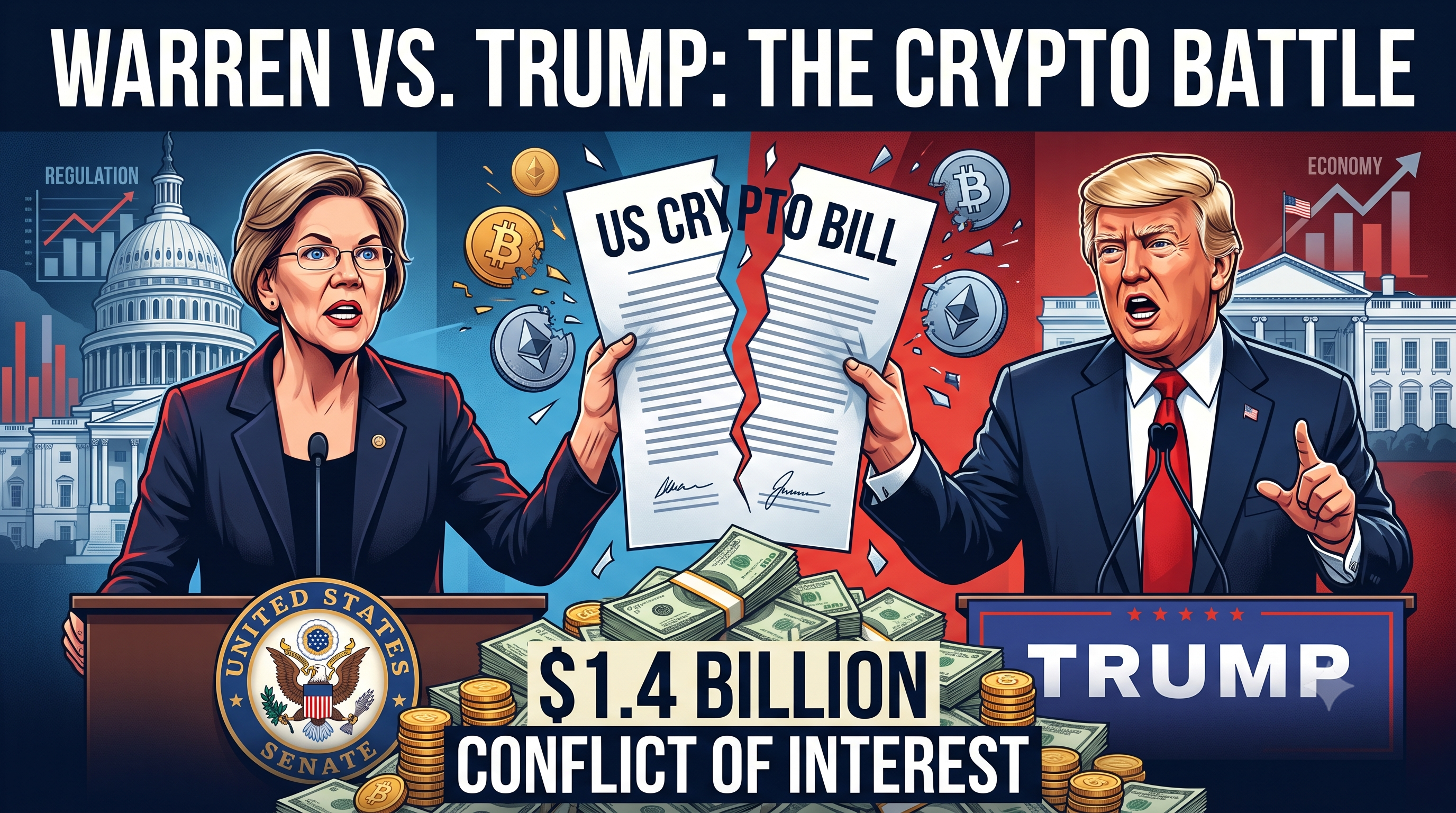
The summer of 2026 in Washington D.C. is proving to be exceptionally volatile, and for the cryptocurrency industry, the heat is entirely political. Just months ago, the crypto market was on the verge of celebrating a regulatory renaissance. The highly anticipated "Clarity Act" was supposed to be the bipartisan bridge that finally integrated digital assets into the traditional financial system. Instead, the legislation has crashed into a massive, 1.4 billion USD roadblock.
At the center of this legislative trainwreck is an unprecedented scenario: a sitting U.S. President with a massive personal stake in the very industry Congress is trying to regulate. President Donald Trump’s staggering financial disclosures have handed Senator Elizabeth Warren the ultimate political ammunition, sparking a fierce partisan battle over government ethics.
For crypto investors, this is no longer just a political drama—it is a high-stakes standoff that will directly impact the legality, taxation, and market value of every asset in your portfolio. Will the Clarity Act survive the impending 2026 midterms, or is the dream of clear U.S. crypto regulation dead on arrival? Let us dive into the 1.4 billion USD conflict of interest tearing the Senate apart.
What is the Clarity Act Anyway?
To understand the magnitude of the current crisis, we first have to look at what the Clarity Act was meant to achieve. Officially, it was designed to be the most comprehensive, bipartisan cryptocurrency legislation in U.S. history.
For years, the crypto industry has begged lawmakers for clear rules of the road. The Clarity Act promised to deliver just that by establishing a definitive framework for stablecoins, outlining clear rules for centralized exchanges, and, most importantly, creating a legal pathway for digital assets to transition from being classified as unregistered securities to regulated commodities.
Industry insiders, institutional investors, and retail traders alike were practically ready to pop the champagne. The bill had strong initial momentum, driven by a growing consensus that the U.S. was falling behind jurisdictions like the EU (with their MiCA framework) and Hong Kong.
Throughout early 2026, the illusion of bipartisan cooperation held strong. White House advisors publicly signaled hopes that the bill would land on the President’s desk for a signature before the 4th of July recess. However, as the deadline approached, the legislative gears ground to a violent halt. The bill did not pass. It did not even make it to a full Senate vote. Behind closed doors, the fragile bipartisan coalition had shattered, giving way to a fierce debate over ethics, personal wealth, and political leverage.
Trump's 1.4 Billion USD Crypto Bag Explained
The catalyst for this legislative collapse can be traced directly to President Donald Trump’s 2025 mandatory financial disclosures. While the market knew Trump had dabbled in NFTs and decentralized finance (DeFi), the sheer scale of his exposure caught both his allies and his critics completely off guard.
The Financial Disclosure Breakdown
The disclosures revealed that approximately 1.4 billion USD of the President’s 2 billion USD income and asset portfolio was directly tied to the cryptocurrency ecosystem.
| Asset Category | Estimated Value (USD) | Source of Revenue / Holdings |
| DeFi Ventures | ~800 Million | Equity and token allocations in projects like World Liberty Financial. |
| NFT Collections | ~400 Million | Royalties and primary sales from various official Trump Digital Trading Card collections. |
| Direct Holdings | ~200 Million | Holdings in major market-cap assets like Bitcoin (BTC) and Ethereum (ETH), alongside speculative meme coins gifted by developers. |
The President as a Crypto Whale
We are witnessing a historical first: a sitting U.S. President operating as a literal "whale" in a nascent financial market. While Trump's pro-crypto stance during his campaign won him immense support from the Web3 community, his massive financial footprint is now a double-edged sword.
To his supporters, it proves he has "skin in the game" and genuinely understands the technology. To his detractors, it represents a glaring, insurmountable conflict of interest. How can the executive branch objectively sign legislation that could overnight increase the President's net worth by hundreds of millions of dollars?
Elizabeth Warren Strikes Back: The Ethics Clause
Senator Elizabeth Warren, the de facto leader of the Senate's anti-crypto faction, did not let this opportunity slip away. Armed with the 1.4 billion USD figure, Warren launched a blistering counter-offensive against the Clarity Act, transforming a debate about financial market structure into a moral crusade.
The "Poison Pill" Strategy
Warren’s strategy was simple but highly effective: she introduced a strict "Ethics Clause" as an amendment to the Clarity Act.
The Ethics Clause Proposal: This provision would strictly prohibit senior executive branch officials, lawmakers, and their immediate family members from operating, promoting, or holding significant financial stakes in digital asset projects that stand to benefit from the legislation.
In the political arena, this is known as a "poison pill." Republican lawmakers immediately recognized that this clause was custom-built to target the President. They vehemently opposed the amendment, arguing that it was a bad-faith tactic designed solely to derail the legislation.
The Senate Divide
The introduction of the ethics clause has fractured the Senate. It is no longer just a fight between Republicans and Democrats; it is a battle for the middle ground. Moderate Democrats, whose votes are absolutely essential to overcome a filibuster (requiring 60 votes), are caught in the crossfire.
Senator Ruben Gallego recently issued a stark warning: without enforceable, transparent ethical standards, he will not support the Clarity Act. The math for the crypto industry is currently looking grim. Without the moderates, the bill is effectively paralyzed on the Senate floor.
SEC vs. CFTC: The Hidden Turf War
While the Trump-Warren clash dominates the headlines, a quieter, equally destructive battle is raging between two powerful Senate committees. Even if the ethics dispute vanished tomorrow, the Clarity Act would still have to survive a vicious turf war over who actually gets to regulate the crypto space.
-
The Senate Agriculture Committee (The CFTC Camp): This committee oversees commodities. In the crypto world, treating assets as "digital commodities" regulated by the Commodity Futures Trading Commission (CFTC) is the gold standard. The CFTC is generally viewed as having a lighter, more market-friendly regulatory touch. The agriculture committee is fighting hard to ensure the Clarity Act defines the vast majority of tokens as commodities.
-
The Senate Banking Committee (The SEC Camp): Led by crypto-skeptic Democrats like Sherrod Brown, this committee oversees banking and securities. They firmly believe that almost all cryptocurrencies (with the possible exception of Bitcoin) are unregistered securities and must fall under the iron fist of the Securities and Exchange Commission (SEC). This means strict anti-money laundering (AML) checks, grueling disclosure requirements, and heavy investor protection mandates.
The Bottleneck: Congressional staffers are working exhausting hours behind the scenes, desperately trying to draft a compromise that satisfies both committees. Until they can draw a clear, legally sound line between a "digital commodity" and a "digital security," the Clarity Act cannot move forward.
The Ticking Clock: Why Midterms Could Kill the Bill
In Washington, time is just as dangerous as political opposition. The legislative calendar for 2026 is aggressively working against the crypto industry. The Clarity Act is currently racing against three immovable deadlines.
-
The August Recess: Congress traditionally leaves Washington for a summer break in August. If a compromise on the ethics clause and the SEC/CFTC turf war is not reached before lawmakers board their flights home, the bill will be shelved for weeks, bleeding crucial momentum.
-
The 2026 Midterm Elections: By September and October, the entire House of Representatives and one-third of the Senate will be entirely focused on re-election campaigns. During midterm season, controversial legislation is radioactive. No politician wants to cast a risky vote on a massive, highly publicized financial bill right before their constituents head to the polls.
-
The Lame-Duck Risk: If the bill is pushed past the November elections, it enters the "lame-duck" session. This is the perilous transitional period before the newly elected Congress takes office in 2027. If the Clarity Act fails to pass before the current session ends, the bill automatically dies. All the progress made over the last two years will be erased, and the crypto industry will have to start from scratch in 2027.
How Will This Affect Your Crypto Portfolio?
For the everyday trader, developer, or HODLer, Washington’s political theater has very real financial consequences. The stalling of the Clarity Act is already sending ripples through the market.
Market Uncertainty and Institutional Hesitation
Institutional capital craves regulatory certainty above all else. Wall Street firms, hedge funds, and pension funds that were waiting for the Clarity Act to deploy massive amounts of capital into Web3 are now hitting the pause button. This lack of fresh institutional inflows could suppress major breakouts for large-cap assets like Ethereum and Solana.
DeFi and Altcoins Remain in Limbo
If the bill dies, the status quo remains. That means the SEC will continue its strategy of "regulation by enforcement." Decentralized Finance (DeFi) protocols, decentralized exchanges (DEXs), and virtually all altcoins will continue to operate under the constant threat of sudden SEC lawsuits. The "security vs. commodity" debate will remain unresolved, forcing crypto startups to either block U.S. users entirely or move their operations overseas to places with clearer frameworks.
Actionable Takeaways for Investors
-
De-Risk to Bitcoin: Historically, Bitcoin is the only asset universally agreed upon by both the SEC and CFTC to be a commodity. In times of regulatory panic, BTC often acts as a safe haven within the crypto ecosystem.
-
Monitor the Moderates: Keep a close eye on the public statements of moderate U.S. Senators over the coming weeks. If lawmakers like Ruben Gallego signal that a compromise on the ethics clause is near, markets may react with a sudden, aggressive relief rally.
-
Prepare for Volatility: The news cycle out of D.C. will drive short-term price action. Be cautious with high leverage, as a single tweet from Elizabeth Warren or Donald Trump regarding the bill's status could trigger massive liquidations.
Conclusion: Is the US Crypto Bill Dead in the Water?
The 2026 Clarity Act began as a beacon of hope for an industry desperate for legitimacy. Today, it stands as a monument to the complexities of modern American politics.
The 1.4 billion USD conflict of interest surrounding President Trump has given Senator Elizabeth Warren the leverage she needed to effectively stall the legislative process. Combined with the bitter SEC vs. CFTC turf war and a rapidly shrinking pre-election calendar, the window for passing the bill is closing fast.
While behind-the-scenes negotiations are still ongoing, the crypto industry must brace for the very real possibility that U.S. regulatory clarity will be delayed until 2027—or beyond. The industry wanted rules, but instead, it got a front-row seat to a political war of attrition.
Frequently Asked Questions (FAQs)
What is the US Crypto Clarity Act?
The Clarity Act is a proposed piece of legislation aimed at creating a comprehensive regulatory framework for digital assets in the U.S. Its primary goals are to define the rules for stablecoin issuers, establish oversight for centralized crypto exchanges, and finally clarify which digital assets are regulated as commodities versus securities.
Why is Elizabeth Warren blocking the crypto bill?
Senator Warren and her allies have stalled the bill primarily due to severe ethical concerns regarding President Trump's massive personal cryptocurrency holdings. She has introduced an "ethics clause" to prevent government officials from financially benefiting from the bill, a move that has caused a deep partisan gridlock.
Does Donald Trump own crypto?
Yes. According to mandatory 2025 financial disclosures, President Trump holds an estimated 1.4 billion USD in crypto-related assets. This includes equity in DeFi projects, revenue from NFT collections, and direct holdings in major cryptocurrencies like Bitcoin and Ethereum.
What happens if the crypto bill isn't passed in 2026?
Due to the rules of the U.S. legislative system, if a bill is not passed before the end of the current congressional session (the "lame-duck" period at the end of 2026), it expires. The incoming 2027 Congress would have to draft, debate, and vote on entirely new legislation, essentially resetting the clock on crypto regulation.
Disclaimer: This article is for informational purposes only and should not be considered financial advice. Cryptocurrency markets are volatile, and readers should conduct their own research before making trading or investment decisions.