

VC Winter & Tech Centralization: Why Capital Flees to the Top 3 Titans as the AI Bubble Peaks
2026/06/15 11:15:00
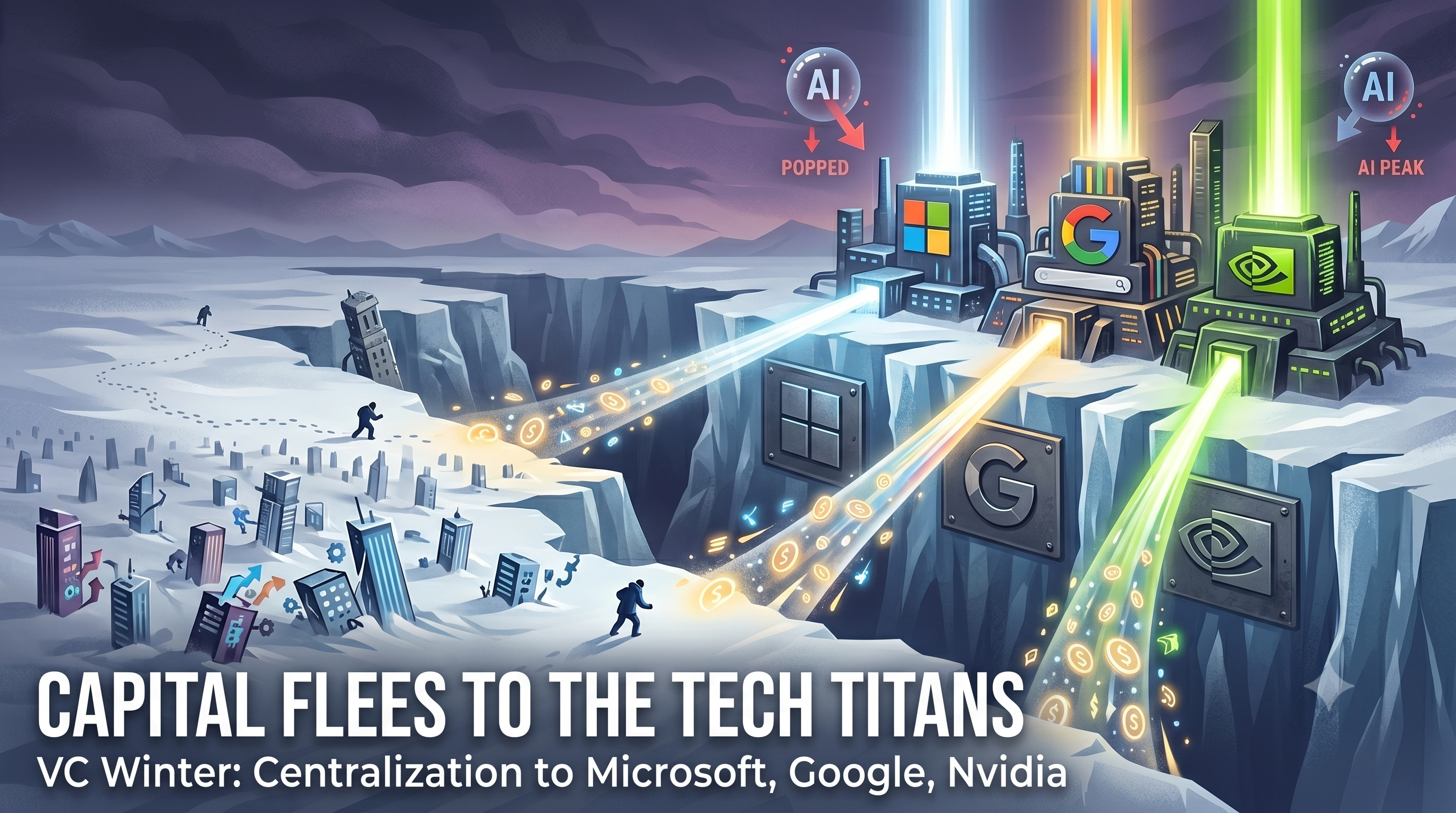
Whether you're a Web3 builder pitching your twentieth VC deck or an AI founder watching your Series B evaporate, the feeling is unmistakable: the money is gone. But here's the twist—capital hasn't disappeared. It's executing the largest "flight to safety" in modern tech history. As generative AI's monetization faces Wall Street scrutiny and global AI spending is projected to exceed $2.5 trillion in 2026 (Gartner), institutional money isn't sitting in cash. It's surging into three companies that have become the ultimate black holes of the tech universe: Microsoft, Google, and Nvidia.
This isn't just a market correction. It's a structural reallocation that threatens the very foundations of Web3's decentralization thesis while simultaneously creating the conditions for crypto's most important evolution yet. In this article, we dissect the mechanics of capital flight, expose the monopoly logic of the "Big Three," and reveal why DePIN and Real Yield represent crypto's only credible counter-attack.
The Mechanics of Capital Flight: Why Web3 and Alt-AI Are Starving
The AI Startup Bubble Bursts
The numbers tell a brutal story. Over $350 billion was spent on AI infrastructure between 2023 and 2025. The revenue generated? A paltry $12–18 billion, mostly by OpenAI. That's a 95% gap between investment and return—and Wall Street has noticed. When enterprise AI budgets face cuts in Q2–Q3 2026, the correction in public AI stocks could reach 30–50%.
For venture capital, the math became impossible to ignore. Why bet on a pre-revenue AI wrapper startup when Nvidia delivers $75 billion in quarterly data center revenue with 75% gross margins? Why fund another Layer 1 blockchain when Microsoft's Azure AI run-rate has quadrupled to $40+ billion in just 24 months?
The Crypto VC Winter: A Two-Tier Market
The crypto venture landscape in 2025–2026 presents a stark paradox. Total funding surged to $20–25 billion (some estimates including mega-deals reach $40–50 billion), yet the number of active investors collapsed 93% to just 377 firms. Deal counts remained flat at approximately 2,153 transactions, meaning average round sizes ballooned while early-stage founders were left in the cold.
The driver? AI absorbed 61% of global VC capital, pulling massive sums away from crypto and prompting even pure-play funds like Paradigm to expand into AI and robotics. Q2 2025 saw deployment collapse 59% quarter-over-quarter to $1.97 billion—not a broad dip, but a targeted freeze on anything that wasn't a mega-deal.
Opportunity Cost: When Big Tech Beats Altcoins
From a macro perspective, the opportunity cost equation has flipped. When Nvidia's stock delivers returns with the "certainty" of a treasury bond (while still offering tech-like upside), and when altcoins face a prolonged "Bitcoin season" with the Altcoin Season Index hovering near 21 in early 2026, institutional capital rotates decisively out of high-risk crypto positions.
Ethereum has corrected 36%. AI-related tokens have dropped 48%. Multiple $500 million to $1 billion+ liquidation cascades have become routine. In October 2025 alone, over $19 billion in leveraged positions were liquidated in roughly 24 hours as order book depth evaporated across major venues.
The message from institutional allocators is clear: in an environment of uncertainty, bet on the infrastructure owners, not the application layer hopefuls.
The Historical Precedent: Echoes of the Dot-Com Crash and Web2 Consolidation
Lessons from 2000: Infrastructure Survives, Applications Die
The parallels to the dot-com bubble are impossible to ignore. Between 1995 and 2000, the Nasdaq skyrocketed from under 1,000 to over 5,000—only to crash by 76.81% by October 2002, wiping out over $5 trillion in market value went from a $300 million market cap to zero in less than a year.
But the companies that survived—and ultimately thrived—shared one characteristic: they owned infrastructure. Amazon fell from $100 to $7 per share but had built logistics and cloud foundations. Cisco, despite an 80%+ drawdown, owned the networking backbone. eBay survived because it owned the marketplace infrastructure.
The "Winner-Takes-All" Web2 Playbook
The 2010s mobile internet era followed an identical pattern. When incremental growth became zero-sum, capital abandoned edge innovation and concentrated in platforms with network effects: Google (search/data), Amazon (cloud/commerce), Apple (ecosystem), Meta (social graph). The "Magnificent Seven" now account for 60–70% of S&P 500 gains.
AI and Web3 are experiencing the same cycle. The only difference? This time, the consolidation is happening faster, and the winners are already visible.
The Top 3 Titans: The Ultimate Black Holes of Capital
Nvidia – The "Picks and Shovels" Monopoly
Regardless of whether the AI bubble soft-lands or pops, compute is the non-negotiable substrate of the future. Nvidia owns 92% of the AI chip market (down marginally from 95%+ in 2023, but still dominant). It has become the tax collector of the AI revolution.
-
Q1 FY2027 Revenue: $82.0 billion (up 85% YoY)
-
Data Center Revenue: $75.0 billion (up 92% YoY)
-
Gross Margin: 74.9% GAAP, 75.0% non-GAAP
-
Free Cash Flow: $49.0 billion in a single quarter
-
Supply Commitments: $145 billion locked in
-
Blackwell + Rubin Revenue Pipeline: $1 trillion committed from 2025 through 2027
Jensen Huang's "virtuous cycle of AI" thesis is self-fulfilling: more AI demand → more Nvidia sales → more AI capabilities → more demand. Even AMD's MI300X and custom silicon from Google (TPU) and Amazon (Trainium) have only nibbled at the edges. When Meta runs 40%+ of Llama 4 inference on AMD, that's notable—but it's still the exception.
Why Capital Flees Here: Nvidia offers exposure to AI's infrastructure layer without betting on which application wins. It's the closest thing to a "sure thing" in a volatile market—and in 2026, certainty commands a premium.
Microsoft – The Enterprise Integration King
Microsoft didn't just invest in AI; it built the enterprise distribution moat that makes AI monetization inevitable. Through its exclusive OpenAI partnership, Microsoft transformed AI from a research curiosity into a line item on every Fortune 500's budget.
-
Azure AI Run-Rate: $40+ billion (quadrupled from $10B in 24 months)
-
Azure Overall Growth: 33% YoY
-
OpenAI Equity Stake: 27% (valued at ~$135 billion)
-
Azure Commitment from OpenAI: $250 billion incremental over 7–8 years (~$30–35B annually)
-
Copilot Seats: 10M+ paid Microsoft 365 Copilot, 20M+ GitHub Copilot active users
-
Enterprise Seat Base: 400M+ paid M365 commercial seats
-
2026 CapEx: $85–90 billion
The $250 billion Azure commitment from OpenAI alone provides revenue visibility that no crypto protocol can match. Microsoft's IP rights to OpenAI models extend through 2032, and the "AGI clause"—once a threat—has been neutralized with independent expert verification.
Why Capital Flees Here: Microsoft offers the only end-to-end enterprise AI stack: identity (Entra), productivity (M365), developer tools (GitHub), CRM/ERP (Dynamics), and cloud (Azure). Competitors can match pieces; none can match the integration.
Google – The Data & Infrastructure Behemoth
Google is the only company with a fully vertically integrated AI stack: proprietary data (Search, YouTube), custom silicon (TPU v5e/v5p/Trillium), frontier models (Gemini 2.5 Pro), and cloud infrastructure. In a bubble, "too big to fail" becomes a self-fulfilling prophecy.
-
Cloud Revenue Q1 2026: $20.03 billion (up 63% YoY, first time exceeding $20B)
-
Cloud Operating Income: $6.6 billion (up from $2.2B prior year)
-
Cloud Contract Backlog: $460 billion (nearly doubled QoQ)
-
Gemini Enterprise Growth: 40% QoQ in paid monthly active users
-
Vertex AI Usage Growth: 25x YoY
-
Total Paid Subscriptions: 350 million
-
Search Revenue Growth: 19% YoY
-
2026 CapEx: $75–80 billion
Google's structural advantage is unit economics. Per independent benchmarks, Gemini 2.5 Pro runs at 40–55% lower per-token inference cost than equivalent GPT-5 on Nvidia H200s. For high-volume enterprise workloads, that math is irresistible. Spotify, Snap, Cohere, and Salesforce have all cited cost as a reason for choosing Google Cloud.
Why Capital Flees Here: Google owns the data moat that no competitor can replicate. Search and YouTube generate proprietary training data at scale, while the $460 billion cloud backlog provides multi-year revenue visibility that rivals can't match.
Tech Centralization: The Existential Threat to Web3
Here lies the central paradox of 2026: Web3 is built on the promise of decentralization, yet the infrastructure powering the next generation of AI and Web3 applications is being consolidated into three highly centralized corporate entities. Whether developers want to train a decentralized AI model, host a DePIN node, or process on-chain data at scale, they cannot escape Nvidia’s GPU dominance, Azure’s massive pricing power, or the cost floor set by Google’s TPUs. This ironic reality—that a decentralized future is being constructed on heavily centralized foundations—presents a systemic problem that no project whitepaper can simply solve.
At the same time, the extreme capital magnetism of these three titans has triggered a severe liquidity crisis within crypto’s middle market. With the Altcoin Season Index hovering at a low of 21, the market signals a period of prolonged Bitcoin dominance, while Ethereum’s reasserted correlation to traditional tech stocks completely strips away the long-standing "uncorrelated asset" narrative. Without a compelling counter-narrative, projects lacking real utility are rapidly dying. Under this K-shaped market dynamic, Bitcoin continues to absorb institutional capital flows, while altcoins face a brutal trifecta of challenges: a severe liquidity drain, macro regulatory uncertainty (such as Europe’s MiCA and evolving U.S. frameworks), and an identity crisis as these tokens increasingly morph into equity-like assets without any of the corresponding legal protections.
The VC Playbook Shift: Where Does "Smart Money" Go Beyond the Titans?
The Barbell Strategy in Tech Investing
Savvy VCs aren't putting all their eggs in the Big Three basket. They're executing a "barbell strategy." On one end, they hold heavy positions in Microsoft, Google, and Nvidia—either via public markets or late-stage rounds—for capital preservation. On the other end, they make ultra-early seed investments in disruptive infrastructure, including decentralized compute, zero-knowledge architectures, and AI-native blockchain protocols. The middle ground—valuation-inflated C/D rounds with no path to profitability—has been abandoned entirely.
From "Narrative" to "Real Yield" in Web3
In crypto specifically, VC capital is rotating from "new chain" narratives to protocols generating actual cash flow. Real-World Asset (RWA) Tokenization is a prime example: BlackRock's tokenized money market fund has crossed billions in AUM, and the global tokenized asset market is projected to exceed $16 trillion by 2030. Protocols with Real Yield—those generating returns from trading fees, borrowing interest, and staking rewards rather than inflationary token emissions—are attracting fresh capital. Enterprise-grade infrastructure is also drawing attention, including ZK-proof systems, cross-chain interoperability, and compliant DeFi protocols that appeal to institutional allocators. The message is clear: in a winter, only fundamentals survive.
Survival Guide: How Crypto Can Counter the Titans
The Rise of DePIN (Decentralized Physical Infrastructure Networks)
If Nvidia monopolizes centralized compute, Web3's answer is DePIN—networks that aggregate idle GPUs, storage, bandwidth, and sensors into decentralized marketplaces.
The State of DePIN in 2026:
-
Market Cap: $10–19 billion (peaked at $19B in Sept 2025)
-
Projects: 650+ active networks
-
Active Devices: 8.8 million globally across 199 countries
-
On-Chain Revenue: ~$72 million (2025), projected to double to $100M+ in 2026
-
Addressable Market by 2028: $3.5 trillion (Messari)
Key Players:
-
Render Network (RNDR): The industry standard for decentralized GPU rendering and AI media generation, integrated with major creative suites.
-
Akash Network (AKT): An open "Supercloud" marketplace for containerized applications, offering competitive pricing for Nvidia H100s and A100s.
-
Filecoin: Shifted from "capacity" to "useful, paid storage" with nearly 3,000 storage providers.
-
Helium Mobile: A functioning MVNO carrier with $2.2M+ monthly revenue and 30-day ARR nearing $21 million.
-
Bittensor (TAO): Grayscale filed for a spot ETF trust in December 2025, marking the first institutional vehicle for a DePIN-adjacent asset.
The Challenge: DePIN's $72M revenue against a $19B market cap means the average project generates just ~$110,000 annually—roughly one San Francisco engineer's salary. The sector must solve three problems to break out: service quality guarantees (SLAs), enterprise go-to-market infrastructure, and sustainable unit economics where customer revenue exceeds token subsidies.
Focus on Utility Over Hype: The Real Yield Imperative
For retail investors and builders surviving the VC winter, the strategy is clear. First, abandon the "next 100x" mentality. The era of meme-driven speculation is ending. Second, seek Real Yield by prioritizing protocols generating returns from actual usage—trading fees, lending interest, validator rewards—not token inflation. Third, bet on RWA integration, as tokenized treasuries, real estate, and private credit are crossing from experimental to institutional-grade, with BlackRock, JPMorgan, and Goldman Sachs already live. Fourth, evaluate DePIN on metrics rather than narrative, demanding revenue per node, utilization rates, and paying customers. Projects that cannot deliver will die.
Conclusion: Winter Kills Speculators, But It Also Seeds Giants
The capital flight to Microsoft, Google, and Nvidia in 2026 is not a conspiracy—it is rational behavior in an uncertain environment. When AI spending reaches $2.5 trillion but returns remain elusive, capital seeks the infrastructure owners who profit regardless of which application wins.
For Web3, this winter is both an existential threat and an evolutionary pressure test. The projects that survive will be those that generate real revenue from real users, build decentralized infrastructure that undercuts centralized pricing, tokenize real-world assets with institutional compliance, and deliver real yield without inflationary gimmicks. The 2018 crypto winter killed ICO scams but created DeFi. The 2026 AI bubble peak will kill narrative-driven projects—but it may finally birth the decentralized infrastructure layer that makes Web3 indispensable.
FAQs
Is the AI bubble actually bursting in 2026, or is this just a market correction?
It is a "softening bubble" rather than a full-scale collapse. While over $350B was invested in AI infrastructure since 2023 against just $12B–$18B in revenues (a 95% monetization shortfall), the infrastructure layer remains highly robust. Speculative application-layer "wrapper" startups are bursting, but infrastructure titans like Nvidia and Microsoft continue to absorb the world's capital.
Why are VCs abandoning Web3 specifically, and will they come back?
VCs are not abandoning Web3 entirely—they are adopting a strict barbell strategy. Driven by AI absorbing 61% of global venture capital, dried-up altcoin liquidity, and stricter regulations like Europe's MiCA, VCs are avoiding overvalued mid-tier projects. Capital is now selectively concentrating on ultra-early seed infrastructure (ZK proofs, DePIN, RWAs) and late-stage mega-deals with proven revenues.
Can DePIN realistically compete with Nvidia, Microsoft, and Google?
DePIN is building a complementary hybrid model rather than a head-to-head replacement. Protocols like Akash and Render win heavily on cost, offering compute resources at a fraction of Big Tech's pricing. However, Big Tech still dominates enterprise workloads due to superior uptime SLAs and sales cycles. DePIN will capture edge computing, rendering, and emerging markets first before climbing the enterprise ladder.
What exactly is "Real Yield" in crypto, and which protocols offer it?
Real Yield refers to returns generated from actual protocol usage and cash flow, rather than inflationary token emissions. In 2026, prominent examples include RWA tokenization protocols (Ondo, Centrifuge), sustainable DeFi lending (Aave), and utility-driven DePIN networks (Render, Helium). If a project's platform revenue exceeds its token emissions, it offers true Real Yield.
Disclaim: This article is for informational purposes only and does not constitute financial or investment advice. Cryptocurrency investments carry significant risk. Always conduct your own research before trading.