

NVIDIA’s $500 Billion AI Financing Deal: Why Markets Rejected the Hype
2026/08/11 10:50:00
Introduction
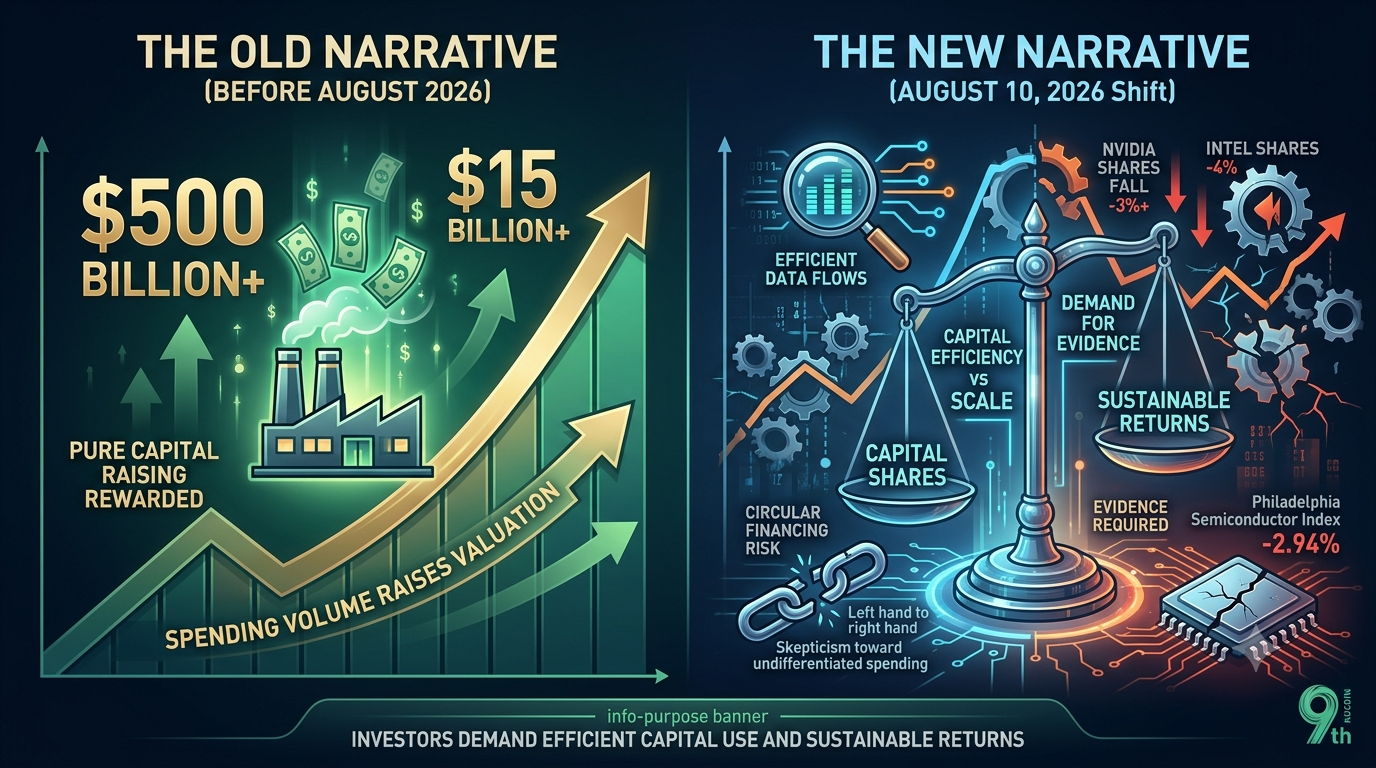
On August 10, 2026, NVIDIA announced partnerships with six major Wall Street firms to mobilize over $500 billion in third-party capital for AI compute infrastructure. The market response was immediate and negative: NVIDIA shares fell nearly 3%, chip and optical communication stocks sold off, and the Philadelphia Semiconductor Index dropped about 2.94%.
Investors no longer reward pure capital-raising or spending announcements in AI. They demand evidence of efficient capital use and sustainable returns. This shift explains why the deal, despite its scale, triggered selling rather than buying. The same pattern appeared in Intel’s concurrent $15 billion equity raise, which also sent its shares lower by roughly 4%.
Markets have moved past the phase where any large AI outlay automatically lifts valuations. Capital efficiency and measurable returns now dominate investor focus.
What Exactly Did NVIDIA Announce on August 10, 2026?
NVIDIA signed memorandums of understanding with Apollo, BlackRock, Blackstone, Brookfield, Goldman Sachs, and KKR to create independent compute financing platforms. These platforms aim to mobilize more than $500 billion of third-party capital over time to finance AI factories for NVIDIA’s customers, including frontier labs, enterprises, and AI cloud providers.
The structure treats NVIDIA compute as an investable asset class with long-duration, usage-linked revenue potential. NVIDIA may provide residual-value support of up to 25% on a project-by-project basis, according to statements from CEO Jensen Huang. The capital is not NVIDIA revenue and does not represent a single fund or commitment to one customer. Financial institutions will independently underwrite each opportunity based on customer demand, utilization, cash flow, and residual value.
According to company announcements and reports from Reuters, the Financial Times, and Blackstone on August 10, 2026, the initiative expands access to scarce AI compute while supporting NVIDIA’s hardware sales and software ecosystem. Huang described it as turning AI factories into productive infrastructure financed by long-term institutional capital.
Why Did Markets Sell NVIDIA and Semiconductor Stocks After the News?
Markets interpreted the deal as circular financing that risks amplifying rather than resolving AI infrastructure excesses. NVIDIA shares dropped approximately 2.5% to 3% on August 10, 2026, with intraday losses exceeding 3% at points, according to market data reported that day. The Philadelphia Semiconductor Index closed down roughly 2.94%. Chip and optical communication concept stocks faced broad pressure.
Investors saw the arrangement as “left hand to right hand” financing: NVIDIA helps customers obtain capital to buy NVIDIA products. This structure raises concentration risk and echoes concerns about an AI version of the subprime crisis if utilization or residual values disappoint. Earlier AI narratives rewarded aggressive spending; current sentiment prioritizes disciplined capital allocation and clear returns on investment.
The reaction aligns with a broader reassessment. Pure spending announcements no longer drive multiples higher when valuations already embed aggressive growth assumptions.
How Does Intel’s $15 Billion Raise Confirm the Same Market Shift?
Intel announced a plan to raise approximately $15 billion through a public offering of common stock on the same day to strengthen its balance sheet and fund AI compute, purpose-built silicon, advanced packaging, external wafer services, and physical AI investments. Shares closed down about 4%.
The market rejected the capital raise despite Intel citing strong customer demand driven by AI investment. Dilution concerns combined with skepticism toward undifferentiated AI spending produced the decline. Both NVIDIA’s financing platforms and Intel’s equity offering illustrate that investors now require evidence of efficient capital deployment rather than sheer scale of outlays.
This pattern reinforces the emerging consensus that AI-related chip valuations have reached a phase where further upside depends on smarter execution rather than larger checks.
Why Has the Market Narrative Shifted from Spending Volume to Capital Efficiency?
AI trading narratives have progressed beyond the stage where burning capital and aggressive capacity expansion automatically attract capital. Investors now evaluate whether companies allocate funds productively and generate measurable returns. Circular structures that primarily recycle demand for the supplier’s own products face heightened scrutiny.
NVIDIA’s deal and Intel’s raise arrived against a backdrop of elevated AI infrastructure commitments across the sector. Reports from August 2026 highlight that combined Big Tech AI outlays continue at high levels, yet equity reactions to additional financing signals have turned cautious. Residual value risk on rapidly evolving hardware and potential overbuild scenarios amplify these concerns.
Smart capital allocation has become the differentiator. Companies demonstrating efficient use of AI-related spending attract more stable investor support.
Which Companies Better Align with the New Focus on Smart AI Spending?
Google (Alphabet) stands out as a more measured approach relative to pure hardware-centric or heavily financed models. Berkshire Hathaway has repeatedly increased its stake in Alphabet, building a position that reached tens of billions of dollars by mid-2026, including participation in capital raises tied to AI infrastructure.
Alphabet combines existing high-margin businesses with AI investments, reducing pure dependence on external financing cycles. Its cloud and internal silicon efforts provide diversified exposure. Investors seeking exposure to AI infrastructure growth with relatively stronger capital discipline have increasingly viewed such profiles as preferable amid the valuation reset in pure-play chip names.
The consensus that AI chip valuations have bottomed in relative terms further supports selective focus on operators that deploy capital efficiently rather than those primarily expanding balance-sheet leverage or circular financing.
Should You Trade AI-Related Opportunities on KuCoin?
NVIDIA’s financing announcement and the subsequent market reaction highlight ongoing volatility and narrative shifts in the AI infrastructure theme. Crypto markets often price related narratives around AI tokens, decentralized compute projects, and blockchain-based AI infrastructure plays with high sensitivity to mainstream semiconductor and hyperscaler developments.
KuCoin offers access to a range of AI-focused tokens and trading pairs that allow participants to express views on compute demand, efficiency trends, and broader AI adoption without direct equity exposure. Users can monitor NVIDIA and semiconductor price action as leading indicators while trading liquid AI-related assets on the platform. Registration on KuCoin provides tools for spot, futures, and other products suited to capturing short-term reactions or longer-term efficiency themes in the AI space. Always conduct independent research and manage risk carefully given the sector’s sensitivity to capital allocation news.
Join KuCoin 9th Anniversary Trading Campaign
KuCoin is celebrating its 9th anniversary with a special platform campaign filled with exclusive rewards, trading activities, and limited-time offers. Don’t miss the chance to participate and enjoy the benefits as the exchange marks nine years of growth and innovation. Visit the official campaign page now:

Conclusion
NVIDIA’s August 10, 2026, announcement of partnerships targeting over $500 billion in third-party AI compute financing with Apollo, BlackRock, Blackstone, Brookfield, Goldman Sachs, and KKR failed to lift its shares or the broader semiconductor sector. The stock declined nearly 3%, the Philadelphia Semiconductor Index fell about 2.94%, and related concept stocks sold off as investors focused on circular financing risks rather than incremental demand support.
Intel’s simultaneous $15 billion equity raise produced a similar roughly 4% decline, confirming that markets no longer reward undifferentiated AI spending. The prevailing narrative has shifted toward capital efficiency and sustainable returns. Companies such as Alphabet, supported by repeated Berkshire Hathaway additions, better match this preference.
Investors should prioritize disciplined deployment of AI capital over scale alone. The financing platforms may ultimately expand access to compute, yet the immediate market verdict underscores heightened scrutiny of leverage and residual value assumptions in the AI buildout.
FAQs
What is the main purpose of NVIDIA’s $500 billion financing platforms?
The platforms aim to mobilize third-party capital so NVIDIA customers can finance AI factories and compute infrastructure at attractive rates, treating NVIDIA systems as an investable asset class with usage-linked revenue.
Did NVIDIA commit its own capital in the deal?
NVIDIA may provide residual-value support of up to 25% on selected projects on a case-by-case basis, but the $500 billion figure represents targeted third-party capital, not NVIDIA revenue or a single fund commitment.
How does the market view pure AI spending announcements now?
Markets prioritize evidence of efficient capital allocation and returns over the absolute size of spending or financing packages, as shown by the negative reactions to both NVIDIA’s and Intel’s announcements.
Which AI-related company has attracted significant Berkshire Hathaway investment recently?
Alphabet (Google) has seen repeated Berkshire Hathaway additions, including participation in capital raises, reflecting preference for diversified operators with stronger existing cash flows alongside AI investments.