

NAVER, NVIDIA and Brookfield Plan to Expand South Korea AI Factory to 200 MW by 2028
2026/07/28 18:40:00
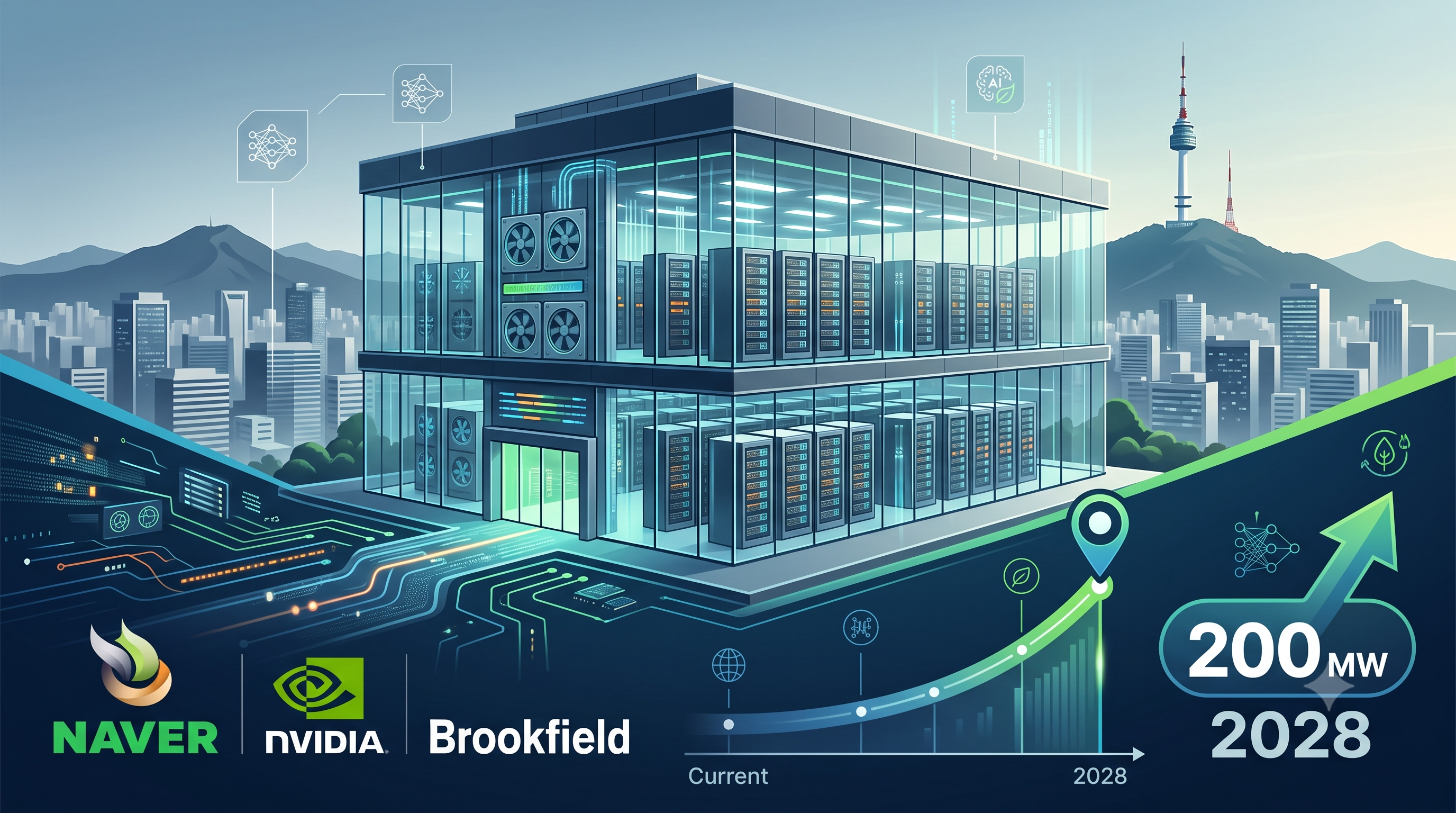
NAVER, NVIDIA and Brookfield plan a 200 MW South Korea AI factory by 2028. Explore its $10 billion funding, 100,000 GPUs, growth potential and risks. South Korea’s proposed AI factory expansion would more than triple the initial capacity planned for NAVER’s GAK Sejong hyperscale data center, creating a potentially important source of artificial-intelligence computing for Korean and U.S.-based customers. NAVER, NVIDIA and Brookfield announced the proposal on July 24, 2026, with the official NAVER project announcement outlining a planned increase from 55 MW to 200 MW, a project value of $10 billion and infrastructure equivalent to approximately 100,000 NVIDIA GPUs. These figures describe a future target rather than capacity that is already operational, and the development remains subject to financing, construction and other conditions.
The proposal arrives as access to electricity, advanced processors and production-scale computing becomes a strategic issue across technology, finance and digital markets. If completed, the GAK Sejong AI factory could support Korean-language models, autonomous agents, robotics, enterprise applications and public-sector workloads. Within digital-asset markets, AI systems used for crypto trading can process large datasets and automate continuous market analysis, illustrating why access to scalable computing is becoming relevant across multiple industries. The project announcement does not identify cryptocurrency companies as customers, however, so any connection to crypto should be understood as part of the wider demand for AI infrastructure rather than a confirmed business relationship.
NAVER, NVIDIA and Brookfield have announced plans to expand the GAK Sejong AI factory in South Korea from an initial 55 megawatts to 200 MW by 2028, creating one of the country’s most ambitious artificial-intelligence infrastructure projects. The initial 55 MW deployment is expected to become operational during the first half of 2027, while the proposed second phase would add another 145 MW and make the completed facility approximately 3.6 times larger than its original planned capacity. According to NVIDIA’s official announcement, the 200 MW development could support approximately 100,000 NVIDIA GPUs built around NVIDIA DSX AI factory architecture. The infrastructure is expected to incorporate NVIDIA Blackwell and next-generation Vera Rubin computing platforms, although the companies have not disclosed the final number or precise mixture of GPU systems. If completed on schedule, the expanded AI data center would provide significantly more computing capacity for training large artificial-intelligence models, operating high-volume inference workloads and supporting enterprise, research and public-sector AI applications. However, the 200 MW figure remains a future development target rather than currently operational capacity, making that distinction important for accurately evaluating the project’s scale and timeline.
The partnership combines NAVER’s cloud, data-center and Korean-language AI capabilities with NVIDIA’s accelerated-computing hardware and software ecosystem, while Brookfield contributes experience in financing, power development and large-scale digital infrastructure. This combination is intended to address several requirements of modern AI factories, including access to advanced chips, dependable electricity, high-density cooling, network connectivity and sufficient capital for construction and expansion. The GAK Sejong project also forms part of NAVER’s broader ambition to develop as much as 1 gigawatt of sovereign AI infrastructure, although that long-term target could involve additional facilities in South Korea and other markets rather than being located entirely at the Sejong campus. For South Korea, a 200 MW domestic AI factory could expand local access to advanced computing, support the development of Korean AI models and allow sensitive workloads to operate under national data-governance and security requirements. Its eventual impact will nevertheless depend on the completion of financing arrangements, construction progress, grid and power availability, NVIDIA GPU supply, customer demand and the facility’s ability to maintain high utilization after launch.
Proposed $10 Billion Financing Structure and Each Partner’s Role
The financing framework behind the GAK Sejong expansion is intended to support a $10 billion AI infrastructure project, but the full amount has not yet been finalized or deployed. NVIDIA plans to invest $1 billion in NAVER, while Brookfield has entered into a nonbinding term sheet to provide up to $9 billion as the project’s exclusive capital partner. NAVER is expected to cover any remaining financing requirement. NVIDIA’s official financing and infrastructure announcement states that its proposed investment remains subject to customary closing conditions and NAVER securing at least $9 billion in committed project financing separate from NVIDIA’s contribution. The headline figure should therefore be understood as a planned funding structure rather than $10 billion in cash that has already been secured and spent.
If completed, the financing would provide the capital needed to expand the GAK Sejong facility to 200 MW and install the complex infrastructure required for production-scale AI computing. This includes accelerated-computing systems, high-speed networking, data storage, power distribution, cooling equipment, construction and operational software. Brookfield would contribute its financing, digital-infrastructure and energy-development experience, NVIDIA would supply its accelerated-computing platform, and NAVER would manage the AI cloud using its data-center and full-stack AI expertise. NAVER’s project announcement does not provide a detailed breakdown of how much funding will be allocated to GPUs, electricity infrastructure, construction or other components. Actual spending could therefore change as the partners finalize financing, hardware configurations and development schedules.
How 100,000 NVIDIA GPUs and DSX Could Improve AI Computing Capacity
The completed 200 MW AI factory is expected to contain approximately 100,000 NVIDIA GPUs, creating a substantial computing resource for AI companies, enterprises, researchers and government organizations. The planned infrastructure will feature NVIDIA Blackwell and next-generation Vera Rubin platforms, although the final mixture and number of each GPU model have not been disclosed. These systems are expected to support the training of large AI models, high-volume inference, physical AI applications and autonomous software services. Comparable concepts are also emerging in Web3, where AI agents can analyze information, make decisions and interact with blockchain applications. NAVER plans to operate the infrastructure as a multi-tenant AI cloud, but the partners have not confirmed whether blockchain companies will use the facility. Performance will ultimately depend on networking speed, memory, storage, cooling efficiency and workload utilization rather than the GPU count alone.
The NVIDIA DSX AI factory platform is designed to coordinate these components as one integrated infrastructure stack spanning chips, systems, software, facilities and partner technologies. DSX reference designs provide validated architectures covering computing, networking, storage and data-center infrastructure, while DSX MaxLPS software is intended to maximize AI-token throughput within a fixed power budget. DSX OS adds lifecycle management, health automation, operational resilience and multi-tenant workload controls, helping operators manage a facility containing tens of thousands of GPUs. By aligning computing equipment with power and cooling resources, the platform is designed to increase tokens produced per watt and reduce the cost of running AI workloads. Whether the GAK Sejong AI factory achieves those efficiency targets will ultimately depend on its final system configuration, electricity availability, construction progress and successful operation at high utilization.
The expansion represents more than additional data-center capacity; it could become an important part of South Korea's effort to control the infrastructure, data and AI models needed for its future digital economy. Building more computing capacity inside the country could reduce dependence on overseas cloud regions, strengthen local data governance and give Korean organizations greater access to the resources required for generative AI, autonomous agents, robotics and industry-specific models. However, infrastructure alone will not guarantee technological sovereignty or economic returns. Its long-term value will depend on accessibility, pricing, energy availability, cybersecurity and the development of a competitive domestic AI ecosystem.
Stronger Control Over Korean Data and AI Workloads
Domestic AI infrastructure can allow sensitive information and important computing workloads to remain under South Korean jurisdiction. This is particularly relevant for government agencies and regulated industries such as healthcare, finance, telecommunications and national defense, where privacy, security and data-residency requirements may limit the use of overseas infrastructure.Locally operated computing could also give Korean organizations greater control over where their models are trained, how information is stored and which security policies govern access. Nevertheless, sovereign AI should not be confused with complete technological independence. South Korea would still depend on international hardware, software and supply chains, meaning true resilience will require diversified suppliers, domestic expertise and clear contingency planning.
Faster Development of Korean-Language and Industry-Specific AI
Greater access to computing could accelerate the development of models designed for the Korean language, culture, legal environment and domestic business requirements. NAVER could use the infrastructure to advance HyperCLOVA X, its Korean AI-agent platform and the Seoul World Model, while startups, universities and enterprises could create specialized applications for manufacturing, robotics, healthcare, commerce and public services. This would help the Korean AI ecosystem move beyond dependence on general-purpose foreign models. The benefits will be broader if smaller companies and research institutions receive affordable access instead of most capacity being reserved for a limited number of large customers.
New Growth Opportunities for Korean Businesses and Startups
The AI factory could increase demand for cloud engineering, cybersecurity, data management, cooling, electricity infrastructure and software-development services. It may also encourage startups and international technology companies to establish operations around South Korea's expanding AI ecosystem. The connection between computing capacity and Web3 innovation is visible in AI and blockchain projects spanning infrastructure, data, autonomous agents and analytics, although no specific crypto deployment has been announced for GAK Sejong. South Korea's national AI policy targets adoption rates of 70% across industry and 95% in the public sector by 2030. Economic gains will depend on whether businesses convert infrastructure access into commercially useful products, productivity improvements, skilled employment and sustainable revenue.
A Stronger Position in the Global Sovereign Cloud Market
Demand for locally governed cloud infrastructure is rising as governments introduce stricter rules covering privacy, cybersecurity and sensitive information. Gartner forecasts worldwide sovereign-cloud infrastructure spending will reach $80 billion in 2026, representing a 35.6% increase from 2025. This trend could allow South Korea to serve domestic customers while competing for international workloads requiring trusted, secure and jurisdiction-specific infrastructure. Success will depend on service reliability, operating costs, regulatory compliance and whether Korean providers can compete effectively with larger global cloud platforms.
Electricity, Grid Capacity and Sustainability Challenges
Large AI facilities require continuous electricity, sophisticated cooling systems and reliable grid connections. The International Energy Agency's analysis of electricity demand from AI and data centers projects that global data-center consumption will approximately double to around 945 terawatt-hours by 2030, with AI becoming the most important driver of that growth. South Korea will therefore need to consider how additional AI infrastructure affects regional electricity demand, grid stability, energy prices and emissions. Long-term power planning, grid upgrades, efficient cooling and greater use of lower-carbon electricity could reduce these pressures, but the partners have not disclosed a complete energy-supply or environmental plan for the expanded facility.
Commercial Demand, Technology Changes and Concentration Risks
A larger AI factory will create meaningful economic value only if customers use enough of its capacity to support operating and infrastructure costs. Demand could fall below expectations, competing facilities could offer lower prices, or rapid improvements in AI chips could make installed systems less competitive sooner than anticipated. Dependence on one principal computing ecosystem may also create vendor-concentration risks, while cyberattacks, service interruptions and supply shortages could affect operations. The project should therefore be evaluated through measurable results such as customer utilization, system uptime, energy efficiency, affordable startup access, locally developed AI models and the amount of economic value retained within South Korea.
The proposed expansion of NAVER’s GAK Sejong AI factory from 55 MW to 200 MW by 2028 could strengthen South Korea’s sovereign AI strategy by increasing domestic access to high-performance computing for Korean-language models, enterprise services, autonomous agents and public-sector applications. Combining NAVER’s cloud and data-center experience, NVIDIA’s accelerated-computing ecosystem and Brookfield’s infrastructure capabilities gives the project a potentially important role in South Korea’s wider AI development. However, the announced capacity, financing and GPU figures remain forward-looking targets rather than completed infrastructure.
The project should ultimately be judged by execution, utilization and energy efficiency, not headline scale alone. Closing the financing arrangements, securing dependable electricity, completing construction, installing the planned systems and attracting long-term customers will determine whether GAK Sejong creates sustainable economic value. If those milestones are achieved, the South Korea AI factory could improve access to sovereign AI infrastructure and strengthen the country’s position in the global AI cloud market. If costs rise, schedules slip or customer demand remains weak, the size of the planned facility will not by itself guarantee commercial success.
|
KuCoin is celebrating its 9th anniversary with a special platform campaign filled with exclusive rewards, trading activities, and limited-time offers. Don’t miss the chance to participate and enjoy the benefits as the exchange marks nine years of growth and innovation. Visit the official campaign page now:
|

What Does 200 MW Measure in an AI Factory?
Megawatts measure electrical power capacity, not computing speed or the number of AI tasks a facility can complete. A 200 MW rating indicates the intended power scale of the AI factory, but it does not mean the site will consume exactly 200 MW at every moment. Actual electricity use will change with the number and type of systems installed, workload demand, cooling requirements, maintenance periods and operating efficiency.
Will All 100,000 NVIDIA GPUs Be the Same Model?
The announced figure represents an approximate target rather than a finalized hardware inventory. The partners expect to use NVIDIA Blackwell and Vera Rubin platforms, but they have not disclosed how many systems will come from each generation or whether other configurations will be included. Performance cannot be judged from the headline GPU count alone because newer processors, networking designs and memory configurations can deliver very different results.
What Is the Difference Between AI Training and Inference?
AI training is the resource-intensive process of teaching or refining a model using large datasets, while inference occurs when a trained model generates an answer, image, prediction or action for a user. A large multi-tenant AI factory can allocate some computing resources to model development and others to continuously operating services. The final balance at GAK Sejong will depend on customer demand and NAVER’s service strategy.
Can Startups or Individual Developers Rent Computing Capacity?
The partners have not announced public pricing, eligibility rules or a retail access program for the expanded infrastructure. Startups and enterprise customers may eventually obtain capacity through NAVER’s cloud services or negotiated contracts, but the precise access model has not been confirmed. Important details to watch include minimum commitments, usage-based pricing, accelerator availability and whether research institutions receive dedicated capacity.
Are the AI Tokens Mentioned by NVIDIA DSX Cryptocurrencies?
No. In artificial intelligence, a token is a small unit of information that a model processes when reading or generating text and other content. References to tokens per watt, tokens per second or token cost describe AI performance and efficiency. These tokens are not blockchain assets, cannot be traded and have no connection to cryptocurrency tokens.
Disclaimer: This article is for informational purposes only and does not constitute financial or investment advice. Project financing, timelines and technical specifications may change.