

The Evolution of DOGE: Can 6.3 Million Users Transform a Joke Currency into a Global Payment Rail?
2026/06/03 15:47:00
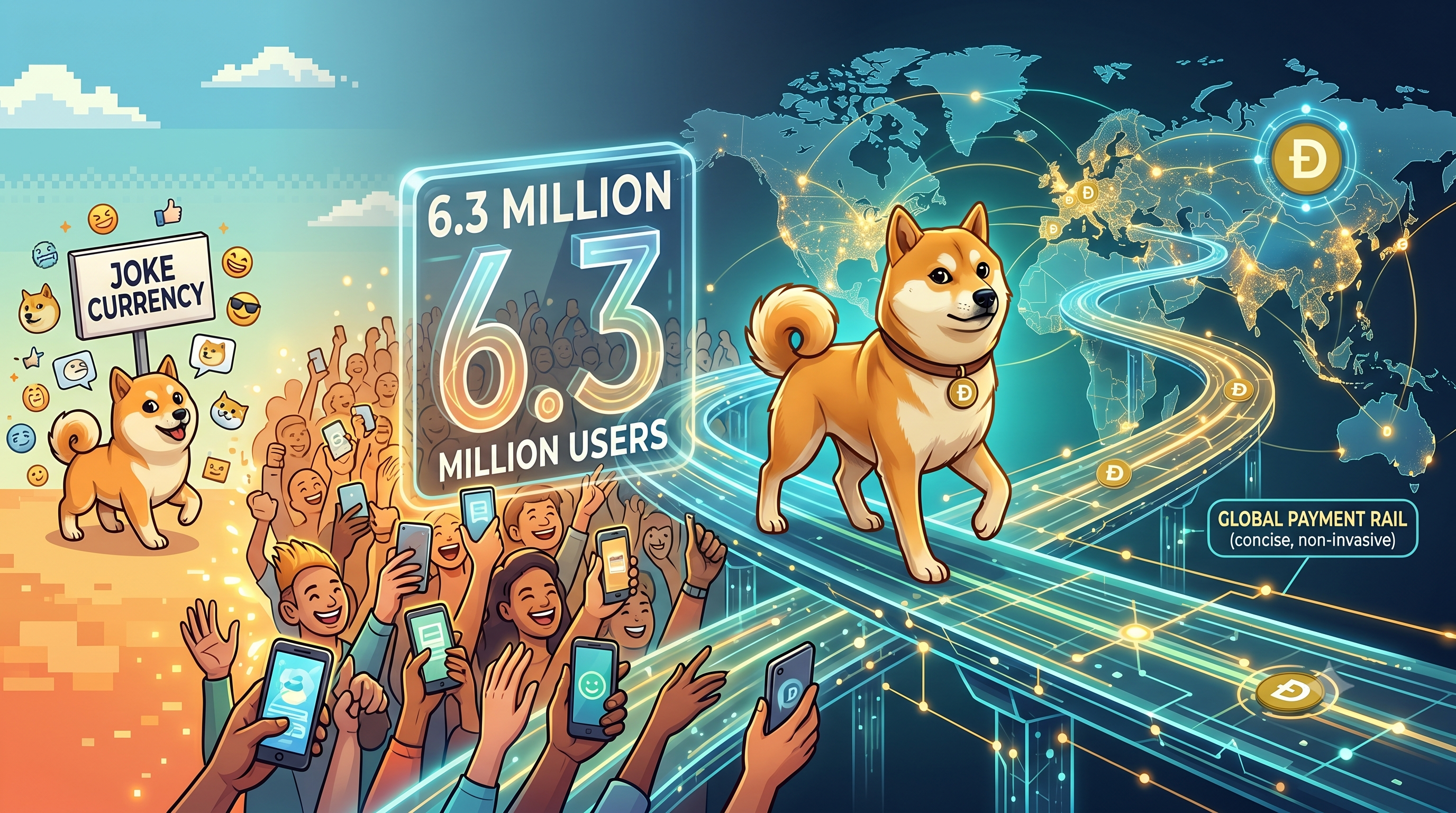
In a cryptocurrency market where heavily funded Layer-1 blockchains routinely boom and bust, Dogecoin (DOGE)—created in 2013 as a literal joke—stands as a masterclass in structural survival. Consistently retaining a top-10 global market capitalization through multiple brutal market cycles, DOGE has evolved far beyond speculative meme mania. It has established deep organic liquidity and a level of decentralized network resilience that many institutional networks have failed to replicate.
The ultimate proof of this paradigm shift lies in a single on-chain anchor metric: over 6.3 million non-zero addresses. For serious traders and macro analysts, this extensive wallet distribution signals a critical inflection point—the legitimate transformation of a cultural phenomenon into a high-velocity, low-cost, global payment rail. This analysis dissects the core tokenomics, network mechanics, and market dynamics that dictate whether Dogecoin can fulfill that fundamental promise.
Unpacking the 6.3 Million Users: An On-Chain Analysis
For quantitative analysts, the total number of wallets is just the beginning of the story. To determine if Dogecoin is functioning as a payment network or just a hoarding mechanism for speculators, we must look at the on-chain metadata, wallet distribution, and transaction velocity.
Wallet Distribution: The Whale vs. Retail Dynamic
A frequent criticism of Dogecoin in its earlier years was its heavy concentration of wealth among a few massive addresses—often exchange cold wallets or early miners. However, as the network has matured and surpassed 6.3 million non-zero addresses, the Gini coefficient (a measure of wealth inequality) on the Dogecoin network has begun to flatten. While top-tier wallets still hold a significant percentage of the total supply—a reality common to almost all Proof-of-Work (PoW) networks—the growth in addresses holding between 1,000 and 100,000 DOGE indicates a robust middle class of retail and small-to-medium enterprise holders. This wide distribution is critical for a payment rail; a currency cannot function if it is only held by a dozen entities.
Transaction Velocity and Network Activity
A network's utility is measured by its velocity—how often the currency changes hands. During quiet market periods, DOGE's daily active addresses (DAA) and transaction counts often outpace those of major smart contract platforms. Furthermore, the introduction of experimental token standards on the Dogecoin blockchain—such as DRC-20 tokens and ordinal-like inscriptions ("Doginals")—has proven that the network can handle massive spikes in transaction throughput. These inscription events battle-tested the network, demonstrating that even under heavy load, Dogecoin's node infrastructure remains decentralized and capable of processing blocks without catastrophic fee spikes or network halts.
The Lindy Effect in Action
In cryptocurrency, survival is the ultimate proof of value. The Lindy Effect theorizes that the future life expectancy of a non-perishable thing (like a technology or an idea) is proportional to its current age. Dogecoin has survived and thrived through multiple vicious, multi-year bear markets (2014, 2018, 2022). This longevity creates a unique form of "social consensus" and embedded trust that simply cannot be replicated by newly launched, heavily marketed tokens. When users choose a decentralized payment rail, historical reliability is a premium feature, and DOGE has over a decade of uninterrupted uptime.
The Mechanics of a Global Payment Rail: Can DOGE Deliver?
If Dogecoin is to transition from a speculative asset to a medium of exchange, its underlying technology and economic model must support high-frequency, low-friction commerce.
Speed and Cost Efficiency
To compete with traditional rails like Visa or Mastercard, or even digital-native payment networks like PayPal, a base-layer blockchain must be fast and cheap. Bitcoin, with its 10-minute block times and fee market designed around scarcity, has effectively pivoted to a "digital gold" store-of-value narrative. Dogecoin, essentially a fork of Luckycoin (which itself was a fork of Litecoin), was explicitly designed for speed and volume.
With a 1-minute block time, Dogecoin settles base-layer transactions ten times faster than Bitcoin. More importantly, the transaction fees remain reliably sub-penny. For micro-transactions—buying a cup of coffee, tipping a content creator online, or paying for a small digital service—Bitcoin's base layer is unusable. Dogecoin's parameters make it technologically feasible for everyday retail commerce without forcing users onto complex Layer-2 scaling solutions like the Lightning Network.
Macroeconomics: Inflation as a Feature, Not a Bug
Perhaps the most misunderstood aspect of Dogecoin by novice traders is its tokenomics. Dogecoin has no maximum supply cap; instead, it has a fixed issuance of 10 billion DOGE per year.
While deflationary assets (like Bitcoin, with its hard cap of 21 million) are excellent for wealth preservation, they are terrible for currencies. Gresham's Law dictates that "bad money drives out good"—meaning if people hold a deflationary asset that they believe will increase in purchasing power, they will hoard it and refuse to spend it. By contrast, an asset with a predictable, slightly inflationary tail emission encourages spending.
Crucially, because the annual issuance is fixed at 10 billion, the inflation rate actually decreases every year as a percentage of the total supply. It operates asymptotically towards zero but never reaches it. This predictable emission pays miners to secure the network without relying entirely on transaction fees, ensuring low costs for users while incentivizing the actual exchange of the currency. For a global payment rail, this macroeconomic design is a feature, not a bug.
The "Elon Factor" and X Integration Rumors
No analysis of Dogecoin's utility is complete without addressing the geopolitical and corporate wildcard: Elon Musk and his acquisition of X (formerly Twitter). Musk has long championed DOGE as "the people's crypto" and has successfully lobbied for its acceptance at Tesla and SpaceX for merchandise.
The market continues to speculatively price in the possibility of DOGE being integrated natively into X's transition toward an "everything app." X has been quietly acquiring money transmitter licenses across numerous U.S. states. While official confirmation of cryptocurrency integration remains pending, the sheer volume impact of 500 million monthly active X users gaining a frictionless fiat-to-DOGE on-ramp would be unprecedented. For traders, tracking X's regulatory filings has become as important as tracking Dogecoin's on-chain metrics.
Market Dynamics: Trading the DOGE Evolution
For the active trader and market maker, Dogecoin's evolution presents a highly liquid, volatile, and profitable playground. Trading DOGE requires an understanding of its unique market structure.
Liquidity, Market Depth, and Institutional Access
As a perennial top-10 cryptocurrency by market capitalization, Dogecoin boasts massive liquidity. The asset is integrated into nearly every major digital asset venue globally; consequently, understanding the transactional infrastructure of how to buy doge and navigate its primary liquidity gateways has become basic baseline knowledge for market participants looking to exploit its deep order books.
This ubiquitous market access means that whales and institutional funds can enter and exit multi-million dollar positions without suffering devastating slippage. The bid-ask spread on DOGE pairs remains incredibly tight across global spot and derivatives markets, making it a prime candidate for high-frequency trading (HFT) algorithms, arbitrage plays, and structured market-making strategies.
Beta to Bitcoin vs. Idiosyncratic Rallies
Historically, DOGE has acted as a high-beta asset relative to Bitcoin. When BTC breaks macro resistance, DOGE tends to follow with amplified percentage gains. Furthermore, DOGE often acts as the "starting gun" for retail altcoin seasons. When retail liquidity returns to the market, it flows first to the most recognizable, accessible brands—and DOGE is the king of crypto brand recognition.
However, we are beginning to see signs of decoupling. As DOGE establishes its own network effects and specific adoption catalysts (like DRC-20 mints or X payment rumors), it experiences idiosyncratic rallies that are uncorrelated to the broader crypto market. Traders must utilize tools like the Network Value to Transactions (NVT) ratio to gauge whether a DOGE rally is being driven by speculative momentum or actual on-chain utility.
Derivatives, Open Interest, and Funding Rates
The futures market for DOGE is massive. For derivatives traders, monitoring Open Interest (OI) and funding rates across Binance and Bybit is critical. Because DOGE is heavily shorted during bear market consolidations by fundamental purists who dismiss it as a meme, it is highly susceptible to violent short squeezes. When funding rates turn deeply negative while on-chain support holds steady, savvy traders position themselves for rapid, explosive mean-reversion trades.
The Bear Case: Headwinds to Global Adoption
While the bullish narrative is compelling, objective analysts must weigh the structural headwinds and risks that threaten Dogecoin's ascendancy to a global payment standard.
The Layer-2 Threat
Why would a user choose base-layer Dogecoin for payments when they can use fast, cheap Ethereum Layer-2 networks (like Arbitrum or Base) or high-throughput Layer-1s like Solana? These networks offer transaction speeds and costs comparable to or better than DOGE, with the added benefit of settling in highly liquid stablecoins (like USDC or USDT). For merchants, accepting stablecoins removes the volatility risk inherent in accepting DOGE. Dogecoin must prove that its brand and decentralized PoW nature offer a premium over the convenience of stablecoin rails.
Lack of Smart Contract Dominance
Dogecoin was designed to do one thing: move value from Point A to Point B. It lacks native, Turing-complete smart contract functionality. While wrapping DOGE on other chains (like renDOGE) or building sidechains exists, the base layer cannot natively support complex decentralized finance (DeFi) primitives like lending markets, automated market makers (AMMs), or complex escrow services. In a world moving toward programmable money, DOGE's simplicity is a double-edged sword.
Regulatory Scrutiny
As Dogecoin transitions from a meme to a mechanism for global value transfer, it will inevitably attract the gaze of global regulators. While its PoW consensus and fair launch protect it from being classified as an unregistered security (unlike many ICO-era tokens), its use as an unregulated payment network could face crackdowns. Anti-Money Laundering (AML) and Know Your Customer (KYC) regulations present a significant hurdle for any decentralized currency attempting to interface with traditional banking rails.
Conclusion: The Verdict on DOGE's Future
Dogecoin’s journey from a satirical internet joke to a multi-billion dollar financial network is one of the most fascinating phenomena in modern economic history. The foundation is undeniable: 6.3 million non-zero addresses, a battle-tested Proof-of-Work network, deep global liquidity, and a macroeconomic structure perfectly suited for transactional velocity.
However, a large user base and a fast block time are not enough to usurp established financial rails. The final transition from speculative asset to global currency requires massive commercial catalysts. Whether that catalyst comes in the form of integration into a mega-platform like X, widespread adoption by global merchants, or the continued development of on-chain tooling, Dogecoin is positioned at the starting line. For traders and analysts, the play is no longer blindly holding for a meme-driven moonshot; it is systematically tracking network adoption, transaction volume, and derivative metrics to front-run the evolution of the internet's native currency.
Frequently Asked Questions (FAQs)
Is Dogecoin actually fast enough for daily retail payments?
Yes. Dogecoin features a 1-minute block time, meaning base-layer transactions are confirmed ten times faster than Bitcoin's 10-minute blocks. Combined with network fees that consistently cost a fraction of a cent, DOGE is highly optimized for fast, cheap micro-transactions like buying coffee or tipping creators online.
How does Dogecoin's user base compare to other major cryptocurrencies?
With over 6.3 million non-zero addresses, Dogecoin possesses one of the widest distributions in the crypto ecosystem. While it trails Ethereum and Bitcoin, its active wallet count and historical network resilience (having survived over a decade of market cycles) often outpace many newer, highly funded Layer-1 blockchains and smart contract platforms.
Will Elon Musk integrate DOGE into X (Twitter) as a payment method?
While Elon Musk has been a vocal supporter of Dogecoin and has accepted it for Tesla merchandise, there has been no official confirmation that DOGE will be natively integrated into X's financial infrastructure. X is actively securing money transmitter licenses in the U.S. to build an "everything app," but whether those rails will support crypto—specifically Dogecoin—remains heavily debated speculation within the market.
As an analyst, how do I accurately track Dogecoin's network adoption?
Traders and analysts should look beyond price action and utilize on-chain data providers like IntoTheBlock, Glassnode, or native Dogecoin block explorers. Key metrics to monitor include Daily Active Addresses (DAA), the Gini coefficient (wallet wealth distribution), transaction velocity, and the Network Value to Transactions (NVT) ratio to gauge true fundamental growth.
Disclaimer: This article is for informational purposes only and is not financial advice. Cryptocurrency investments are highly volatile and carry risk. Readers should do their own research before making any investment decisions.