

DeepSeek 2.0 Moment Fails to Materialize: Memory Chip Stocks Stabilize as US Markets Brace for Earnings Season
2026/07/21 10:51:00
Introduction
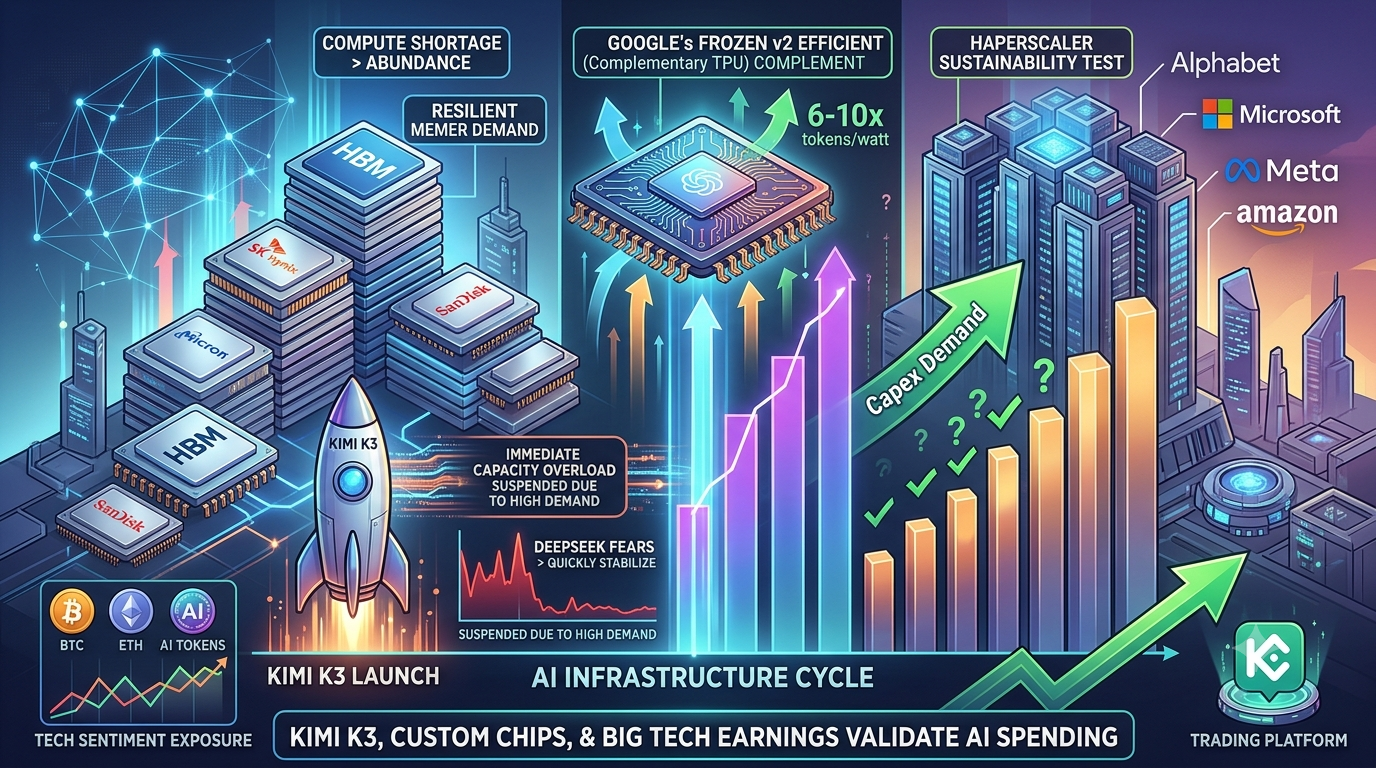
Memory chip stocks showed resilience after the July 2026 launch of Moonshot AI’s Kimi K3 model, countering fears of a repeat DeepSeek-style selloff triggered by low-cost AI narratives. SK Hynix dipped modestly while peers like Micron and SanDisk posted gains, signaling sustained demand for high-bandwidth memory (HBM) despite open-weight model hype.
Chip stocks held steady because Kimi K3’s rapid capacity overload highlighted persistent compute shortages rather than abundance. This shift reinforces the AI infrastructure investment thesis instead of undermining it. With Big Tech earnings season underway in late July 2026, investors now focus on whether hyperscaler capex will continue driving memory and GPU demand or face margin pressure from rising depreciation, power, and leasing costs.
What the Kimi K3 Launch Reveals About AI Compute Economics
Kimi K3, a 2.8-trillion-parameter open-weight model with a 1-million-token context window, launched to massive demand in mid-July 2026. Within 48 hours, Moonshot AI suspended new consumer subscriptions as its GPU cluster hit capacity limits. Existing users retained priority while the company scrambled to add infrastructure.
Unlike DeepSeek’s earlier low-cost models that sparked selloffs by questioning massive compute needs, Kimi K3 demonstrated the opposite. The model’s scale requires substantial hardware—estimates suggest dozens of H100/H200 GPUs per instance even with Mixture-of-Experts optimization and quantization. This underscores that frontier AI remains hardware-intensive, supporting memory and accelerator demand.
Market reaction confirmed this: After initial volatility, memory names stabilized. Micron and SanDisk shares recovered modestly on July 21, 2026 trading, while broader concerns over a “DeepSeek 2.0” repeat—cheap models cratering infrastructure spending—faded. Analysts noted that open-weight models still drive inference workloads that favor high-memory setups.
Google’s Frozen v2 Chip Boosts Efficiency Narrative
Google’s reported development of the “Frozen v2” server chip further steadied sentiment. The project embeds portions of the Gemini architecture directly into silicon, targeting 6-10x more tokens per unit of power compared to current TPUs. Deployment is eyed for 2028 as a specialized complement to general-purpose TPUs.
This custom silicon push addresses Google’s internal compute shortages, which have reportedly forced Google Cloud to turn away customers. By reducing data movement and computation overhead, Frozen v2 aligns with the industry trend of hyperscalers designing inference-optimized hardware. Similar efforts by Amazon, Microsoft, Meta, and even DeepSeek itself (working on its own inference chip) show that efficiency gains complement—not replace—massive capex.
The news lifted Alphabet shares around 3% on July 20-21, 2026, helping offset broader chip sector weakness from the prior week. It reinforces that leading AI labs continue investing heavily in both software optimization and hardware.
Hyperscaler Earnings: The Next Critical Test for AI Spending
Big Tech must demonstrate that AI and cloud revenue can offset escalating costs during the upcoming earnings wave. Alphabet, Meta, Microsoft, and Amazon face scrutiny on capex sustainability, with combined 2026 spending estimates exceeding $700 billion—up sharply year-over-year.
Key questions for investors:
-
Will continued GPU and memory purchases translate into proportional revenue growth?
-
Can depreciation and power expenses be managed without compressing margins?
-
Are custom chips and software efficiencies delivering measurable returns?
Memory suppliers like SK Hynix, Micron, and SanDisk will highlight how hyperscaler burn translates into HBM pricing power and volume. Analysts watch not just absolute capex levels but whether guidance exceeds expectations, as the market has priced in aggressive AI infrastructure expansion.
Recent data shows memory stocks already entered correction territory earlier in July after strong runs, with some names down over 20% from peaks amid rotation and profit-taking. However, the Kimi K3 episode and Google chip news suggest underlying demand fundamentals remain intact.
Risks and Opportunities in the AI Infrastructure Cycle
Short-term volatility persists around earnings and macroeconomic factors like power costs and geopolitics. Yet structural tailwinds—rising AI adoption, agentic workflows, and data center buildouts—support prolonged demand for chips.
Common misconceptions include assuming open-source models will collapse proprietary infrastructure spending. Evidence from Kimi K3 shows the reverse: high-parameter models amplify compute needs. Another is underestimating efficiency innovations; Google’s Frozen v2 and peers’ custom silicon extend the viability of large-scale deployments.
For traders on platforms like KuCoin, this environment creates opportunities in crypto assets correlated with tech sentiment, such as Bitcoin and AI-related tokens, as equity volatility often spills into digital markets.
Should You Trade Chip Stocks or Related Crypto on KuCoin Ahead of Earnings?
KuCoin offers leveraged trading pairs and futures on major indices and crypto assets that track tech momentum. Monitor real-time news on capex guidance and memory pricing.
Position sizing should account for potential swings—earnings beats on AI revenue could reignite rallies in memory and GPU names, while cautious commentary might extend rotations. Diversify with crypto exposure, as AI narrative strength often buoys blockchain projects in decentralized compute and data sectors.
-
If you worry about the recent volatility, you may resort to KuCoin's copytrading hub or TraderPro campaign, to follow other lead traders' strategies, or register as the lead traders.

Conclusion
The absence of a DeepSeek 2.0-style collapse after Kimi K3 highlights AI’s enduring hardware intensity. Compute shortages and efficiency innovations like Google’s Frozen v2 keep chip demand robust despite short-term profit-taking. As earnings season unfolds, hyperscalers’ ability to convert massive capex into sustainable revenue and profits will determine the next leg for memory and semiconductor stocks.
Investors and traders should stay agile. Fundamentals point to continued AI infrastructure growth, but execution risks around costs and returns remain. On KuCoin, this translates to tactical opportunities across equities-linked crypto products and direct spot/futures trading amid heightened volatility. The AI cycle is far from over—earnings will provide the next set of data points confirming its trajectory. (Word count: 2,248)
FAQs
1. Did Kimi K3 cause a major selloff in memory chip stocks?
No. Demand overload led to subscription pauses rather than reduced compute needs, helping stabilize names like Micron and SanDisk.
2. What is Google’s Frozen v2 chip and when will it launch?
It is a specialized server chip embedding Gemini architecture for 6-10x efficiency gains; targeted for 2028 as a TPU complement.
3. Why are hyperscaler earnings so important right now?
They will reveal whether AI/cloud revenue covers rising depreciation, power, and capex, validating or challenging the infrastructure spending thesis.