

Bitcoin Runes Explained: Is It Hype or Real Demand?
2026/04/12 16:10:09

The crypto market is full of narratives, but only some of them turn into lasting infrastructure. Bitcoin Runes is one of the clearest examples of that tension. It arrived with heavy attention, strong opinions, and a surge of on-chain activity, but the bigger question has never been whether it exists. The real question is whether Bitcoin Runes represents durable demand on the Bitcoin network or just another speculative wave.
By the end of this article, you will understand what Bitcoin Runes is, how it works, why it attracted so much attention, and whether the demand behind it looks sustainable or mostly hype-driven. You will also see how it compares with earlier Bitcoin token experiments and why its current position is more nuanced than either side of the debate usually admits.
Hook
Can a token protocol built on Bitcoin be both a real innovation and an overhyped trend at the same time? Bitcoin Runes suggests the answer may be yes.
Overview
This article covers the basics of Bitcoin Runes, its impact on Bitcoin activity, the benefits supporters point to, the challenges critics raise, and the evidence that helps separate real demand from temporary market excitement.
Thesis
Bitcoin Runes is a real Bitcoin-native fungible token protocol with genuine technical substance, but most of the visible demand so far appears to have been driven more by speculation and launch momentum than by stable, broad-based utility.
What Is Bitcoin Runes?
Bitcoin Runes is a protocol designed for creating and transferring fungible tokens on Bitcoin. It was introduced by Casey Rodarmor as a more efficient and Bitcoin-native alternative to earlier token experiments such as BRC-20. The main idea behind Runes is simple: if fungible tokens are going to exist on Bitcoin, they should work in a way that fits Bitcoin’s underlying structure instead of forcing a system that feels borrowed from other blockchains.
What made Runes stand out so quickly was its design philosophy. Rather than adding more unnecessary complexity, it was built to align with Bitcoin’s UTXO model, which is the way Bitcoin already tracks and spends value. This gave Runes an immediate advantage in the eyes of many developers and Bitcoin users who wanted a cleaner token standard without as much extra indexing overhead or blockchain clutter.
According to the Ordinals documentation and official specification, Runes uses runestones to encode protocol instructions inside Bitcoin transactions. These instructions define actions such as creating a new rune, minting supply, and transferring balances between users. The protocol officially went live at Bitcoin block 840,000, which gave it a clear activation point and made its launch easy to verify on-chain.
In practical terms, Bitcoin Runes is not a new cryptocurrency, a separate blockchain, or a replacement for Bitcoin. Instead, it is a token protocol that sits on top of Bitcoin’s existing transaction framework and allows fungible assets to be issued and moved more naturally within the network.
Key points about Bitcoin Runes:
-
It is a fungible token protocol on Bitcoin Runes allows developers and users to create tokens that are interchangeable, similar to how token standards work on other blockchains.
-
It was proposed by Casey Rodarmor The creator of Ordinals introduced Runes as a more efficient way to handle Bitcoin-based token activity.
-
It is built around Bitcoin’s UTXO model This is one of its biggest differences from earlier Bitcoin token experiments and a major reason it gained attention.
-
It uses runestones to encode actions These runestones contain the instructions for creating, minting, and transferring rune tokens.
-
It officially activated at block 840,000 That gave the protocol a transparent and publicly verifiable launch point.
-
It is not a new coin or separate chain Bitcoin Runes does not replace Bitcoin. It simply adds a way to issue and manage fungible assets on top of Bitcoin.
-
It was designed to be cleaner than earlier token systems Supporters see Runes as a more natural and less messy approach compared with older Bitcoin token standards.
Bitcoin Runes is best understood as Bitcoin’s attempt to support fungible tokens in a way that feels more native to the network itself. That is exactly why it attracted attention so quickly: it offered a more technically aligned approach at a time when interest in Bitcoin-based tokens was already growing.
Main Reasons Bitcoin Runes Got So Much Attention
Bitcoin Runes attracted major attention in the crypto market for a few clear reasons. It was not just another trending token idea. It arrived with strong timing, a clear technical purpose, and real on-chain activity that made people pay attention very quickly.
Key reasons Bitcoin Runes gained so much attention:
-
It combined Bitcoin with token speculation Bitcoin already has enormous market attention, and anything connected to it tends to generate strong interest. When Runes introduced a new way to create fungible tokens on Bitcoin, it immediately attracted traders, developers, and crypto communities looking for the next major narrative.
-
The market was already interested in Bitcoin-based tokens Before Runes launched, there was already growing curiosity around Bitcoin token experiments. That meant people were ready for a newer and cleaner alternative, which helped Runes gain momentum even before it officially went live.
-
It was seen as a “better version” of earlier token experiments Runes was introduced as a more efficient and more Bitcoin-native approach than older systems like BRC-20. That gave it a strong positioning in the market and made it appealing to people who liked the idea of Bitcoin tokens but disliked the structure of earlier methods.
-
It had real technical credibility Runes was not marketed as a vague concept or empty trend. It came with a clear design philosophy, a defined protocol structure, and a reference implementation. This made it look more serious and more legitimate than many short-lived crypto trends.
-
It aimed to solve a real problem One reason people took Runes seriously is that it tried to address actual inefficiencies in Bitcoin tokenization, especially around complexity and unnecessary UTXO growth. That gave the project more substance than pure hype.
-
It created visible on-chain impact Runes did not stay limited to social media discussions. It quickly became a noticeable share of Bitcoin transaction activity during its peak period. That kind of measurable network effect made it far more than just a talking point.
-
It influenced Bitcoin’s transaction activity When a new protocol begins changing how Bitcoin blockspace is being used, the market pays attention. Runes became part of a larger discussion about fees, miner revenue, and the growing demand for Bitcoin network activity.
-
Its launch timing helped amplify interest Timing matters in crypto, and Runes entered the market when Bitcoin-related narratives were already strong. That gave it a much bigger spotlight than it might have received under normal conditions.
Bitcoin Runes got so much attention because it sat at the intersection of Bitcoin relevance, speculative excitement, technical credibility, and real network impact. That combination made it one of the most discussed Bitcoin token developments in the market.
How Bitcoin Runes Works
To understand whether Runes is hype or real demand, it helps to understand why supporters think the design matters. In the official documentation, runes are created through etching, can define mint terms, and are transferred using edicts inside runestones. Rune IDs are represented as the block and transaction index where the rune was first etched.
That structure matters because Bitcoin is not an account-based chain like Ethereum. Bitcoin uses UTXOs, and many token experiments built for other blockchain models do not fit neatly on top of it. Runes tries to reduce that mismatch. Supporters argue this makes it more efficient and more aligned with Bitcoin’s architecture than earlier methods such as BRC-20.
This is the strongest argument for taking Runes seriously. Even if someone has no interest in memecoins or token trading, Runes still represents an attempt to solve a real technical issue inside the Bitcoin ecosystem: how to handle fungible assets more cleanly on a chain that was not originally designed around token issuance.
Main reasons Bitcoin Runes may reflect real demand
-
The protocol is real and publicly documented Bitcoin Runes is not just a concept or social media narrative. It has a published specification, a clear design, and a working ecosystem around it. That gives it more credibility than many crypto trends that attract attention without real implementation.
-
It responded to an existing market interest Before Runes was introduced, users were already experimenting with fungible token activity on Bitcoin. This means Runes was not creating demand out of nothing. Instead, it was entering a market where people had already shown interest in Bitcoin-native token systems.
-
Its activity appeared in real Bitcoin network data One of the strongest signs of genuine demand is that Runes activity showed up directly on-chain. During its strongest periods, it became a noticeable part of Bitcoin transaction activity. That means users were actively using blockspace, not just talking about the protocol online.
-
Users were willing to compete for Bitcoin blockspace When people are willing to spend money on transaction fees to use a protocol, that shows real market participation. Even if much of that activity was speculative, it still reflects actual demand in economic terms.
-
It gained support from wallets and platforms Runes attracted enough attention that major platforms, wallets, and ecosystem tools integrated support for it. This shows that market participants saw enough relevance in the protocol to build around it.
-
It moved beyond social media hype Many crypto ideas stay trapped in online discussion without producing real user activity. Runes went further than that. It became part of live Bitcoin network behavior and wider ecosystem development.
-
It was taken seriously by builders and market participants The fact that developers, platforms, and users paid attention to Runes suggests it was viewed as more than just a passing trend. It had enough technical and market weight to become part of the broader Bitcoin token conversation.
The Case That Bitcoin Runes Was Mostly Hype
The strongest evidence against the “real sustained demand” thesis is the decline in activity after the initial excitement. The Block’s current Runes Transaction Share data shows a recent reading around 1.46% of Bitcoin transactions, which is far below the high-attention phase that made Runes feel dominant for a period. That kind of drop is classic hype-cycle behavior.
This does not mean Runes is fake. It means the most visible phase of its adoption may have been driven by launch excitement, speculation, and token-chasing rather than recurring user need. A sustainable protocol usually has a clearer floor of activity once the headlines fade. With Runes, the public data suggests that floor is much lower than the early narrative implied.
There is also the utility problem. Outside speculative trading, community tokens, and ecosystem experimentation, it is still hard to point to a major everyday use case that has made Runes indispensable. That is often where crypto protocols struggle. A technically sound system can still fail to prove why ordinary users need it regularly. This is partly an inference, but it is a reasonable one given the gap between launch momentum and current activity.
Bitcoin Runes vs BRC-20
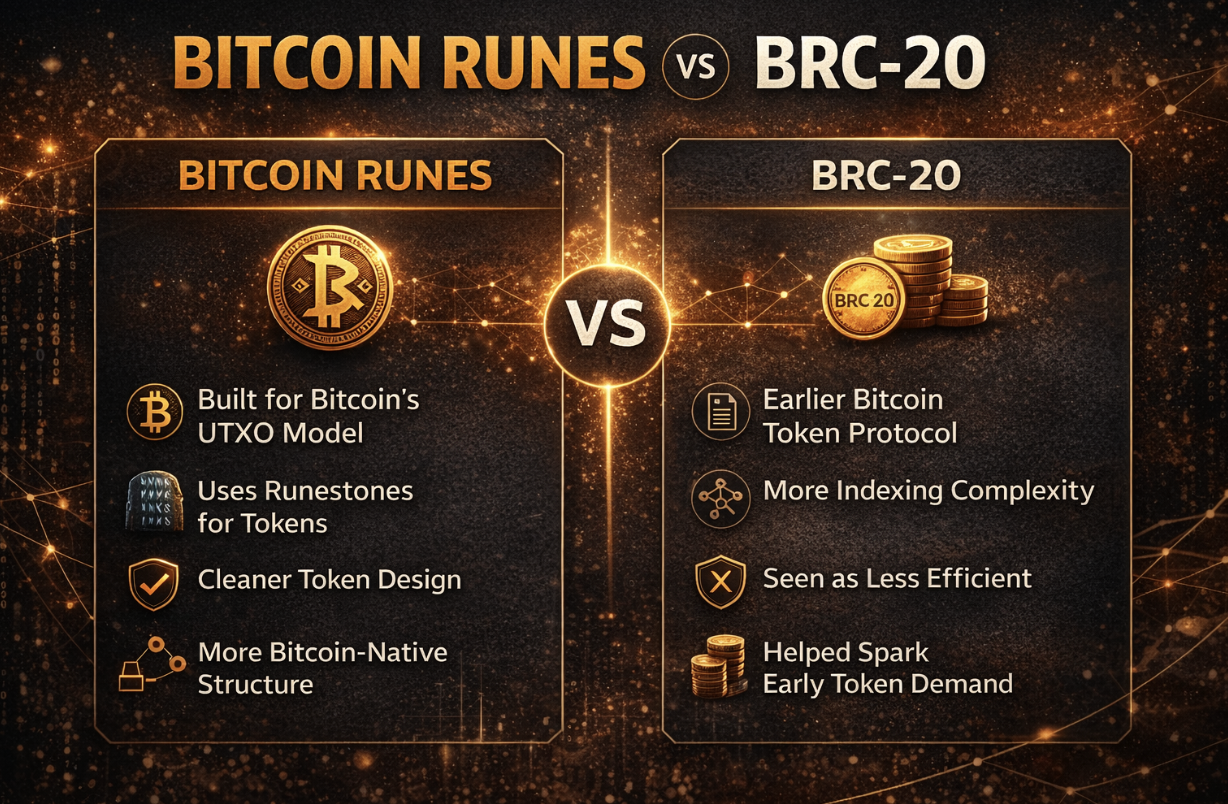
A useful way to judge Runes is to separate the protocol from the tokens created on it.
Runes was largely framed as an improvement over BRC-20. The idea was not that Bitcoin suddenly needed token speculation for the first time, but that if users were going to create and trade fungible assets on Bitcoin anyway, there should be a protocol that handles it more cleanly. That is why many people who are skeptical of token mania still acknowledge the design merits of Runes.
This distinction is critical. There may be real demand for a better Bitcoin token primitive, while demand for many individual rune assets remains mostly speculative. Those are not the same thing. The protocol can be technically meaningful even if a large share of the token activity around it is driven by hype.
Advantages of Bitcoin Runes in the Current Market
One clear advantage of Runes is better alignment with Bitcoin’s architecture. Because it is built around the UTXO model, it fits the chain more naturally than token systems that feel imported from other blockchain designs.
Another benefit is clarity of implementation. The published specification gives developers and services a common reference point. That reduces ambiguity around how balances, mint rules, and transfers should be interpreted. In any token ecosystem, clearer rules make infrastructure easier to build and maintain.
Runes also demonstrated that token protocols can generate meaningful blockspace demand on Bitcoin. Even critics have to admit that the network processed the activity and miners benefited from the fees during periods of heavy usage. Whether that demand is healthy or lasting is another question, but its presence was real.
Runes has value as an experiment in Bitcoin’s broader evolution. It tests whether Bitcoin can support tokenized assets in a form that some developers consider less messy than prior attempts. Even if it stays niche, the experiment itself matters because it reveals what the market actually wants from Bitcoin-native assets.
Challenges and Considerations
-
Sustainability remains uncertain A protocol can generate strong excitement at launch, but the real test comes later. What matters is whether users continue to interact with it once the novelty fades and quick speculative opportunities become less attractive. So far, Bitcoin Runes has not clearly proven a strong long-term usage base.
-
Long-term demand is still unproven Early spikes in interest do not automatically mean lasting adoption. Public transaction-share data suggests that while Runes had strong activity during peak periods, it has not yet established a stable level of ongoing demand.
-
There is cultural resistance within the Bitcoin community Not everyone in the Bitcoin ecosystem supports token protocols. Some view Runes as an interesting innovation, while others see it as an unnecessary use of scarce blockspace. This creates a challenge because acceptance depends not only on technology, but also on community attitudes and ideology.
-
Legitimacy is not only a technical issue Even if Runes is well designed, it still has to win support in a community that often debates what Bitcoin should and should not be used for. That makes adoption more complicated than simply having a functional protocol.
-
Ecosystem durability is a serious concern Token standards need strong infrastructure to survive. Wallets, marketplaces, explorers, and indexing services all play an important role. If some of these tools reduce support or scale back, it can weaken confidence in the long-term health of the ecosystem.
-
Infrastructure support must remain consistent A token protocol becomes harder to use and less attractive when surrounding services are unstable. Long-term growth depends on continued support from the platforms that help users access and trade these assets.
-
Speculative spikes can create a misleading picture Sudden increases in fees and transaction activity can make a protocol look stronger than it really is. In many cases, these spikes reflect short-term excitement or trading mania rather than real ongoing utility.
-
Launch-week momentum should not be confused with lasting adoption The best way to judge Bitcoin Runes is not by its biggest moments, but by how it performs during quieter market conditions. Consistent usage over time is a much better sign of real demand than short bursts of activity.
Conclusion
Bitcoin Runes is not fake. It is a legitimate fungible token protocol on Bitcoin, with a public design, a reference implementation, and a verifiable activation point at block 840,000. On the technology question, the answer is straightforward: Runes is real.
The harder question is whether the market demand behind it is real or mostly hype. The strongest public evidence suggests the answer is mixed. There was real demand for blockspace, real attention from builders, and real interest in a better Bitcoin token standard. But the scale and shape of the early surge also look heavily speculative, and current transaction-share data shows activity at a much lower level than the launch frenzy.
So the most balanced conclusion is this: Bitcoin Runes is real technology surrounded by a lot of hype. The protocol deserves serious attention. The market narrative deserves caution. Whether Runes becomes a lasting part of Bitcoin’s economic stack will depend on sustained utility, durable infrastructure support, and user behavior that continues after speculation cools.
Call to Action
Explore market trends, trading pairs, and platform tools on KuCoin, or learn more about its features through the KuCoin Learn Center.
Frequently Asked Questions
What is Bitcoin Runes?
Bitcoin Runes is a fungible token protocol built on Bitcoin. It allows tokens to be created and transferred using Bitcoin’s UTXO-based transaction system.
Who created Bitcoin Runes?
Bitcoin Runes was proposed by Casey Rodarmor, who introduced it as a better approach to fungible tokens on Bitcoin.
Is Bitcoin Runes a separate cryptocurrency?
No. Runes is not a separate blockchain or a replacement for Bitcoin. It is a protocol for issuing fungible assets on Bitcoin.
When did Bitcoin Runes launch?
The protocol activates at Bitcoin block 840,000, according to the published specification.
Is Bitcoin Runes better than BRC-20?
Runes was designed to align more cleanly with Bitcoin’s UTXO model, which is why many observers view it as a technically stronger approach than BRC-20.
Is Bitcoin Runes just hype?
Not entirely. The protocol is real and had measurable on-chain impact, but much of the visible demand so far appears to have been speculative and launch-driven.
Does Bitcoin Runes still have activity today?
Yes, but recent public data shows it at a much lower share of Bitcoin transactions than during its peak period.
What is the biggest risk for Bitcoin Runes?
The biggest risk is that the early excitement does not translate into long-term utility, sustained usage, or durable ecosystem support.
Disclaimer: The information provided on this page may originate from third-party sources and does not necessarily represent the views or opinions of KuCoin. This content is intended solely for general informational purposes and should not be considered as financial, investment, or professional advice. KuCoin does not guarantee the accuracy, completeness, or reliability of the information, and is not responsible for any errors, omissions, or outcomes resulting from its use. Investing in digital assets carries inherent risks. Please carefully evaluate your risk tolerance and financial situation before making any investment decisions. For further details, please consult our Terms of Use and Risk Disclosure