

AI Token Consumption Keeps Rising as DRAM Supply Shortage Is Expected to Last Through 2H 2028
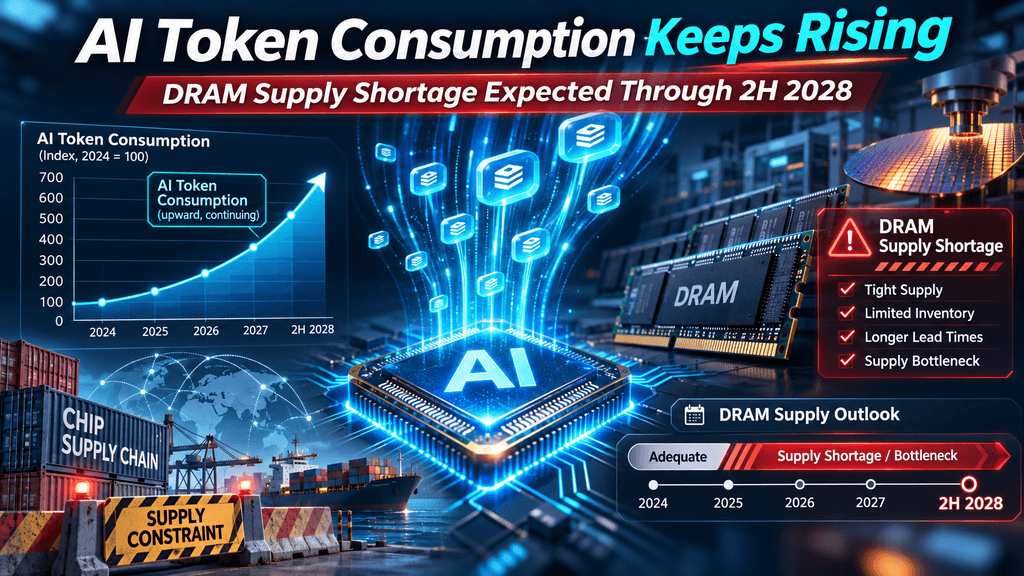
AI inference activity continues to increase across major platforms, leading to higher token consumption as more businesses and users rely on AI-powered services. Interestingly, this growth is happening even as the cost of processing individual tokens continues to fall. Lower prices are making AI tools more accessible, encouraging wider adoption and increasing overall usage. At the same time, server manufacturers and memory producers have warned that shortages of key components, including DRAM and high-bandwidth memory (HBM), could persist well into the second half of 2028.
The growing demand for computing resources, particularly high-bandwidth memory used in AI accelerators, is putting additional pressure on an already stretched supply chain. Although manufacturers are working to expand production, the limited availability of wafer capacity means that supply may struggle to keep pace with demand in the near term.
This imbalance is beginning to influence memory prices, component procurement schedules, and the time required for data center operators to secure essential hardware. As a result, companies across the data center industry are having to reconsider their infrastructure plans, manage purchasing timelines more carefully, and prepare for supply constraints that could remain a challenge over the next few years.
Key Takeaways
-
OpenRouter data shows overall token consumption rising roughly 8% month-over-month in recent periods despite a sharp drop in average per-token pricing.
-
HPE CEO Antonio Neri stated that shortages of memory, NAND, and other critical components are expected to continue at least through the second half of 2028.
-
Micron and other producers report that the majority of 2027 HBM and DRAM output is already committed, with conditions tighter than in 2026.
-
HBM is projected to consume nearly 30% of top manufacturers’ DRAM wafer starts by 2027, up from around 23% in 2026, because it requires three to four times more wafer capacity per bit than conventional DRAM.
-
Server DRAM and enterprise NAND prices remain elevated with limited near-term relief expected; lead times for some components stretch to 28–40 weeks or longer.
-
New fabrication capacity is scheduled to ramp mainly from 2028 onward, leaving the industry in a constrained environment for the next two years.
Why Is AI Token Consumption Still Rising Despite Falling Prices
AI Token volumes on aggregation platforms have continued climbing even as the effective cost per token has fallen substantially. OpenRouter data for October 2026 recorded approximately 790 trillion tokens processed, a 37% increase from September and roughly 25 times the volume seen in January of the same year. Weekly figures in mid-to-late November hovered around 210 trillion tokens, reflecting continued sequential growth.
A large share of this activity is agentic rather than human-driven. Agentic API keys accounted for about 76% of tokens in October, up sharply from single-digit percentages a year earlier. Chinese open-weight models have dominated recent weekly rankings, often supplying the majority of tokens while closed models capture a larger share of spend. The combination of cheaper inference, broader model availability, and the shift toward multi-step agent workflows has expanded total demand faster than price reductions have restrained it.
This pattern illustrates a classic volume response: lower unit costs encourage more intensive use of AI systems for coding, customer support, data processing, and autonomous agents. The result is sustained pressure on the underlying hardware that delivers those tokens, particularly the memory hierarchy that supports large-context inference and high-throughput serving.
How Long Will the DRAM and HBM Supply Shortage Last
Hewlett Packard Enterprise CEO Antonio Neri told investors on the company’s fiscal fourth-quarter 2026 earnings call that supply constraints for memory, NAND flash, and other critical components are expected to persist at least through the second half of 2028. He noted that certain parts currently require lead times of 28 weeks, 40 weeks, or longer. HPE has responded by increasing purchasing commitments and building inventory, which reached $14.1 billion by the end of the quarter.
Memory manufacturers have issued similar guidance. Micron Technology CEO Sanjay Mehrotra stated that supply-demand conditions in the calendar years 2027 and 2028 will be tighter than in 2026. More than 75% of Micron’s 2027 memory output was already committed at the time of its late-September 2026 earnings discussion, with customer conversations shifting toward 2028 volumes. SK Hynix has indicated that demand is likely to exceed supply through 2030 and has locked in multi-year agreements covering more than half of its 2027–2028 capacity. Samsung has reported that its 2027 HBM supply is fully sold out at target pricing.
These statements from both buyers and sellers point to a multi-year period of constrained availability rather than a short-term imbalance.
What Is Driving the Shift of DRAM Capacity Toward HBM
High-bandwidth memory has become the preferred companion for AI accelerators because of its superior bandwidth and proximity to the GPU or accelerator die. Producing HBM, however, consumes significantly more manufacturing resources. Industry analyses indicate that HBM requires roughly three to four times the wafer starts of conventional DRAM for equivalent bit output, owing to stacking, advanced packaging, and lower yields on the more complex process.
TrendForce and other trackers project that HBM will account for approximately 23% of DRAM wafer input at the three largest producers in 2026 and nearly 30% in 2027. As manufacturers allocate a larger share of limited clean-room capacity to HBM to fulfill AI contracts, the residual supply available for standard server DRAM, PC DRAM, and mobile DRAM shrinks. This reallocation is the primary structural reason conventional memory remains tight even as overall bit production grows in the low-to-mid 20% range annually.
How Are Memory Prices and Lead Times Evolving
Contract and spot prices for DRAM have risen sharply over the past year as AI demand absorbed available capacity. Reports cite increases of several times for certain density grades, with server DRAM and enterprise NAND showing particular resilience. Dell executives have noted the absence of clear signs of near-term price declines for these categories. Some high-end modules and HBM products have seen even steeper gains as customers lock in multi-year supply.
Lead times have lengthened correspondingly. HPE’s experience of 28- to 40-week (or longer) waits for certain components is consistent with broader industry commentary. Procurement teams at system builders and hyperscalers have moved to longer-term contracts that include volume commitments, price collars, and prepayments. These arrangements provide manufacturers with visibility but leave less flexible capacity for spot or short-notice orders.
The following table consolidates several of the most frequently cited quantitative indicators from recent manufacturer guidance and industry tracking. It shows the scale of the capacity move toward high-bandwidth memory, the degree of pre-commitment already locking up near-term supply, and the extended lead times now reported by major system builders. Together these figures illustrate why the shortage is expected to remain structural rather than temporary.
|
Measures
|
Approximate Figure
|
Timeframe / Source Context
|
|
HBM share of top-3 DRAM wafer starts
|
~23% → ~30%
|
2026 → 2027
|
|
Wafer intensity of HBM vs. standard DRAM
|
3–4×
|
Industry consensus
|
|
Micron 2027 output is already committed
|
>75%
|
Late 2026 reporting
|
|
HPE component lead times
|
28–40+ weeks
|
Nov 2026 earnings
|
|
Expected shortage duration
|
Through at least 2H 2028
|
HPE, Micron, others
|
What Does Rising Token Use Mean for AI Infrastructure Costs
Even as the price of individual tokens falls, total spending on inference continues to climb because volume growth outpaces the unit-price decline. Platforms that process hundreds of trillions of tokens per month require corresponding increases in accelerator capacity, memory bandwidth, and storage. Memory has become a larger fraction of the bill of materials for AI servers; some analyses place it approaching or exceeding 40–50% of hyperscaler AI capital expenditure in the later years of the decade.
The economics favor operators who secured long-term memory allocations early. Newer entrants or those expanding rapidly face higher marginal costs and longer wait times. This dynamic reinforces the advantage of scale and existing supplier relationships while raising the barrier for smaller deployments or experimental workloads that cannot tolerate extended procurement cycles.
How Are Server and PC Markets Being Affected by the Memory Crunch
The same capacity that serves AI accelerators is drawn from the broader DRAM pool. As a result, conventional server DRAM used alongside CPUs and the modules destined for PCs and workstations, have become scarcer and more expensive. System builders report difficulty fulfilling configurations that include higher memory densities. Some consumer and commercial PC makers have adjusted product roadmaps or raised prices to reflect the elevated component costs.
Enterprise IT buyers planning hardware refreshes must now factor in multi-quarter lead times and the possibility of configuration compromises. Inventory strategies have shifted toward earlier ordering and larger safety stocks, tying up working capital. The shortage, therefore, transmits from the AI data center core into the wider installed base of servers and endpoints.
When Will New Memory Production Capacity Come Online
Meaningful additions to DRAM and HBM capacity are scheduled primarily from 2028 onward. Micron has outlined new clean-room space in Idaho and elsewhere that begins contributing wafers in stages during 2027–2028, with fuller ramps later. Similar timelines apply to expansions by Samsung and SK Hynix. Because new fabs require years of construction, tool installation, and process qualification, and because HBM packaging remains a separate bottleneck, the industry does not expect a rapid rebalancing before the second half of 2028 at the earliest.
Even after initial wafers appear, production typically ramps gradually. Combined with continued growth in AI demand, these timelines support the consensus view that tightness will persist through at least that horizon.
What Role Do Long-Term Contracts Play in the Current Market
Memory suppliers have increasingly relied on multi-year agreements that include volume commitments, prepayments, and pricing mechanisms tied to market conditions within agreed bands. Micron has referenced dozens of strategic customer agreements covering a substantial portion of projected revenue through 2030. SK Hynix has similar long-term arrangements with major cloud providers covering more than half of near-term capacity. These contracts reduce uncertainty for both parties but also reduce the amount of unallocated supply available for new or smaller buyers.
The shift toward contracted allocation is a structural response to the multi-year nature of the AI infrastructure buildout. It stabilizes manufacturer utilization and margins while making the residual spot market thinner and more volatile.
How Might the Shortage Influence Broader Semiconductor and Technology Investment
The memory constraint elevates the strategic importance of companies that control HBM and advanced DRAM capacity. It also increases the relative value of packaging technologies, advanced substrates, and any innovations that improve bits per wafer or bandwidth efficiency. Investors and operators are monitoring the pace of new fab construction, yields on next-generation HBM (including HBM4 and HBM4E), and the degree to which Chinese capacity expansion later in the decade could alter the global balance.
For the AI software layer, sustained high memory costs encourage continued optimization of models, quantization techniques, and caching strategies that reduce the memory footprint required for a given level of capability. Token economics remain favorable for volume growth, but the hardware substrate that supports them will stay expensive and capacity-constrained for the foreseeable planning horizon.
What Steps Are Enterprises Taking Amid Tight Memory Supply
Companies building or expanding their AI infrastructure are taking longer to secure the memory components they need. Many are extending procurement timelines, working with multiple suppliers to reduce their dependence on a single source, and paying higher prices to guarantee access to available supplies. Some are also looking for ways to make their systems use memory more efficiently while giving priority to AI workloads that offer the greatest value. At the same time, businesses are keeping larger inventories to avoid supply disruptions and adjusting their budgets to account for memory costs over several years rather than treating them as routine quarterly expenses.
These changes show a growing understanding that the memory shortage is not simply a temporary supply problem that will disappear with a short-term increase in production. The industry is facing a deeper imbalance between rapidly growing demand and the time required to bring additional manufacturing capacity online. Until more supply becomes available and demand growth begins to slow or becomes easier to manage through greater efficiency, memory availability will continue to influence how quickly companies can build and expand their AI infrastructure.
FAQs
How significant is the recent increase in AI token consumption?
Platforms such as OpenRouter have recorded strong sequential growth, with monthly volumes reaching hundreds of trillions of tokens and year-to-date expansion measured in multiples. Agent-driven traffic now constitutes the large majority of tokens processed, amplifying total demand even while average prices per token decline. This volume growth translates directly into higher requirements for accelerators and the memory that feeds them.
Why does HBM production tighten the overall DRAM market so much?
Each bit of HBM requires substantially more wafer starts, advanced packaging steps, and process complexity than conventional DRAM. As the share of wafer capacity devoted to HBM rises toward 30%, the absolute volume of standard DRAM available for servers, PCs, and other uses declines relative to historical norms, creating shortages across multiple end markets.
Is the shortage expected to ease before 2028?
Statements from major server OEMs and memory manufacturers consistently point to continued tightness through at least the second half of 2028. New fabrication facilities begin contributing later in the decade, but ramps are gradual and must absorb ongoing AI demand growth. Earlier relief would require either a material slowdown in AI deployment or unexpectedly rapid yield and capacity gains, neither of which is the base-case expectation.
How are lead times affecting enterprise buying decisions?
Lead times measured in many months force earlier ordering, larger inventories, and greater reliance on long-term contracts. Enterprises that wait for shorter-cycle purchases risk being unable to secure the configurations they need when projects are ready to deploy. Planning horizons have therefore lengthened, and memory has become a more strategic, less tactical procurement category.
What is the outlook for DRAM and HBM pricing?
Prices for server DRAM, enterprise NAND, and HBM remain elevated with limited evidence of near-term declines. Contract negotiations for 2027 already reflect higher pricing than 2026 levels. While sequential increases may moderate as new capacity approaches, the overall price environment is expected to stay firm through the period of constrained supply.
Disclaimer: This general market information may come from third-party, commercial, or sponsored sources and is provided for informational and educational purposes only. It does not constitute financial or investment advice, an offer, a solicitation, or a guarantee. We assume no responsibility for the accuracy, completeness, or reliability of this information or for any losses arising from its use.
Investing and trading involve risks. Past performance does not guarantee future results. Users should conduct their own research, exercise sound judgment, and take full responsibility for their decisions. For more information, please refer to KuCoin's Terms of Use and Risk Disclosure.