

Circle USDC Freeze Controversy: $232M Stolen Funds and the Regulatory Battle
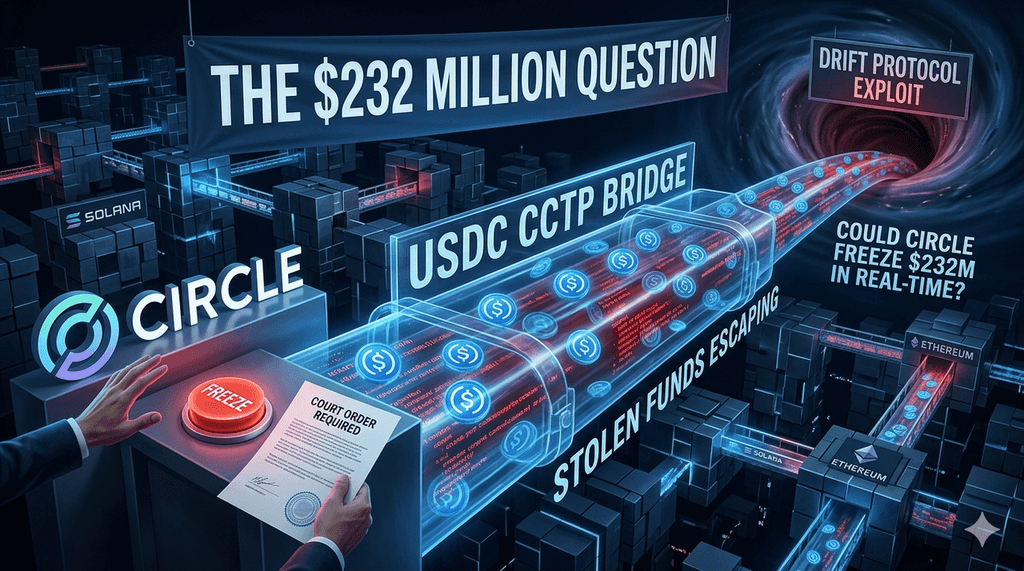
Introduction: The $232 Million Question
What would you do if $232 million in stolen funds were flowing through your system — and you had the power to stop it, but chose not to?
That’s exactly what happened on April 1, 2026, when hackers executed one of the largest DeFi exploits in history, stealing approximately $285 million from Drift Protocol. Within hours, the attackers converted most stolen assets to USDC and bridged $232 million across blockchains using Circle’s native Cross-Chain Transfer Protocol (CCTP).
The question that dominated cryptocurrency newsfeeds for weeks: Could Circle have frozen these funds in real-time? The answer, according to former federal prosecutors and on-chain security researchers, is a definitive yes.
So why didn’t they? This article explores the most controversial stablecoin decision of 2026 — and what it means for the future of cryptocurrency security, regulation, and user trust.
What Happened: The $232 Million Question
In April 2026, the cryptocurrency world witnessed one of the most controversial decisions in stablecoin history. Circle, the issuer of USDC, refused to freeze $232 million in stolen USDC during the massive Drift Protocol exploit, despite having the technical capability to do so.
The incident, which resulted in approximately $285 million in total losses from the Drift Protocol hack, has evolved into a full-blown regulatory and public relations battle. According to on-chain investigator ZachXBT, Circle’s delayed or failed freeze actions across 15 incidents since 2022 have resulted in over $420 million in stolen funds escaping liquidation.
This decision has drawn sharp criticism from former federal prosecutors, on-chain investigators, and the broader crypto security community, while Circle maintains its stance is legally required and philosophically consistent with protecting all users.
The timing of this controversy couldn’t be worse for Circle. Just as major financial institutions are increasingly embracing cryptocurrency and stablecoins as legitimate financial instruments, this incident raises fundamental questions about whether the infrastructure supporting this adoption is adequately protecting users from fraud and theft.
Understanding the Drift Protocol Exploit
On April 1, 2026, hackers exploited a vulnerability in Drift Protocol, a decentralized finance platform built on Solana, making off with approximately $285 million in various cryptocurrencies. The attack represented one of the largest DeFi exploits in history and sent shockwaves through the entire cryptocurrency ecosystem.
The sophistication of the attack was notable. The attackers didn’t simply steal funds and hold them — they executed a complex money laundering operation designed to maximize the difficulty of recovery. Within hours of the initial exploit, the attackers had converted most stolen assets into USDC, which they then transferred through Circle’s native Cross-Chain Transfer Protocol (CCTP) to bridge approximately $232 million across different blockchains.
This cross-chain bridging capability, which Circle has marketed as a revolutionary feature enabling seamless USDC transfers between blockchain ecosystems, became the mechanism through which the stolen funds effectively disappeared beyond the reach of any single jurisdiction’s law enforcement.
The critical question that emerged in the aftermath: Could Circle have frozen these funds in real-time, preventing the bulk of theft from becoming irreversible? The answer, according to multiple sources, including former federal prosecutors and on-chain security researchers, appears to be definitively yes.
Circle’s Official Position
Circle’s CEO Jeremy Allaire defended the company’s decision in a series of public statements, explaining that USDC wallet freezes occur only when directed by law enforcement or court orders — not in real-time during active hacks.
“We freeze wallets only when we receive legitimate legal process from law enforcement or a court order,” Allaire stated in his public response. “We don’t make independent judgments about who is a good actor or bad actor in the midst of an active exploit. That would be inappropriate and potentially illegal.”
This stance represents a deliberate policy choice that Circle argues protects the fundamental integrity of decentralized finance and prevents corporate overreach that could ultimately harm all users. The company has maintained this position consistently across multiple incidents, including at least 15 cases involving stolen funds since 2022.
Circle’s Chief Strategy Officer Dante Disparte elaborated on the company’s philosophy, emphasizing that security in the cryptocurrency ecosystem requires shared accountability across all participants. In a public statement addressing the criticism, Disparte noted that while Circle possesses certain technical capabilities to intervene in transactions, exercising those capabilities without proper legal authorization would set a dangerous precedent that could ultimately undermine confidence in stablecoins as a whole.
The company further clarified its historical approach, stating that across more than a dozen cases involving suspected theft or fraud since 2022, their policy of requiring legal process before freezing wallets has remained consistent. This consistency, according to Circle, is essential for maintaining USDC’s position as a neutral and reliable financial infrastructure used by millions of individuals and businesses worldwide.
However, this consistency is precisely what critics point to as the problem. With over $420 million in stolen funds having escaped freeze actions across these incidents, the practical impact on users who have lost money to hackers appears substantial.
The Growing Criticism
The crypto security community has responded with unprecedented criticism, with some of the most respected voices in on-chain investigation and cryptocurrency security questioning whether Circle’s approach serves its users or merely protects the company from legal liability.
Leading on-chain investigator ZachXBT publicly analyzed Circle’s freeze patterns across multiple incidents, concluding that the company’s failure to freeze over $230 million in Drift funds after approximately six hours of the exploit was “unacceptable” and represented a fundamental failure of user protection. His analysis revealed a pattern across 15 separate incidents since 2022 where either delayed action or complete inaction had allowed stolen funds to escape freeze.
Former federal prosecutor Amanda Wick, speaking on the Unchained Podcast, highlighted the practical implications for both individual victims and the broader cryptocurrency ecosystem. According to Wick, Circle possessed both the legal authority and technical capability to act in real-time during the Drift hack, and the decision not to do so set a dangerous precedent for how major stablecoin issuers handle large-scale thefts.
The criticism extends beyond single incidents to question the fundamental consistency of Circle’s enforcement approach. A particularly troubling detail that emerged in the aftermath: during the same period that Circle declined to freeze the $232 million in stolen Drift funds, legitimate user accounts were being frozen through what appeared to be automated systems responding to different triggers. This discrepancy raised serious questions about whether the company’s enforcement standards were being applied equitably.
On-chain security researchers have documented numerous instances where stolen USDC was transferred through mixing services and other privacy tools within hours of the initial theft, effectively rendering the funds untraceable even if Circle had chosen to act. The window for meaningful intervention during a hack is often measured in minutes, not days — a reality that makes Circle’s requirement for legal process during active exploits particularly problematic from a user protection standpoint.
The controversy has also sparked broader debates about the appropriate role of corporate discretion in handling suspected fraud. While Circle argues that requiring legal process protects against abuse, critics suggest that the company’s approach effectively prioritizes avoiding liability over protecting users from clearly criminal activity.
The Regulatory Implications
This controversy arrives at a pivotal moment for cryptocurrency regulation in the United States and globally. Congress has been actively working on stablecoin legislation, with particular focus on consumer protection requirements and anti-money laundering compliance. The incident provides ammunition for both those seeking stricter regulation and those arguing for clearer legal frameworks that define issuer obligations.
Circle’s position that it cannot freeze wallets without legal process highlights a fundamental gap in current regulatory frameworks. Unlike traditional banking institutions, which have clear legal obligations to freeze accounts suspected of involvement in fraud, cryptocurrency issuers often operate in a legal gray area where their obligations are undefined or ambiguous.
Industry experts suggest that without explicit legal guidance, stablecoin issuers like Circle are effectively making policy decisions that could have significant legal consequences regardless of the choice made. Choosing to freeze wallets without legal authorization might expose the company to liability for improperly restricting access to user funds. Choosing not to freeze, as in the Drift case, exposes users to losses and potentially exposes the company to criticism for failing to act.
The incident has amplified calls for comprehensive cryptocurrency legislation that addresses these specific scenarios. Consumer advocates argue that stablecoin users deserve the same protections as bank customers, where suspicious activity can be frozen pending investigation. Industry participants counter that requiring automatic freezes would create new attack vectors where malicious actors could exploit the freeze mechanism to harm legitimate users.
Several members of Congress have referenced the Circle incident in their ongoing discussions about stablecoin regulation, suggesting that this case may influence the final form of any legislation that emerges from the current congressional session.
What This Means for USDC Users?
For the millions of users who trust USDC as a cornerstone of their cryptocurrency holdings, the incident raises important questions about security, accountability, and the fundamental nature of the relationship between users and stablecoin issuers.
Key Concerns for Users
The practical implications of Circle’s freeze policy create a challenging environment for users seeking to protect their funds. When a hack occurs and funds are stolen, the window for recovery depends entirely on external factors — law enforcement attention, legal process timelines, and the cooperation of various blockchain analytics firms — rather than any action the stablecoin issuer might take in real-time.
Users must understand that their USDC holdings, while backed by transparent reserve holdings and maintaining their 1:1 peg to the U.S. dollar, do not come with real-time fraud protection against sophisticated attacks. The same technical infrastructure that enables fast, global transactions also enables fast, global theft — and the mechanisms designed to prevent abuse require legal processes that cannot be expedited during active emergencies.
This reality has important implications for how users should approach their cryptocurrency holdings. Many security experts now recommend that USDC holdings for daily transactions be kept small, with larger amounts held in cold storage or in protocols that offer additional security features. The incident has also spurred discussions about the importance of insurance coverage for cryptocurrency holdings, a market segment that remains underdeveloped.
The Broader Industry Context
This debate reflects a fundamental tension in cryptocurrency that has existed since the earliest days of technology: the balance between decentralization and accountability. On one hand, the crypto ethos champions permissionless transactions, resistance to centralized control, and the belief that code is law. On the other hand, users expect protection when their funds are stolen through obvious exploitation, and regulators expect cooperation in preventing money laundering and other illicit activities.
Circle’s defenders argue that requiring legal process before freezing funds actually strengthens the credibility of USDC as a neutral financial infrastructure. By not allowing corporate discretion over who deserves to have their funds frozen and who doesn’t, Circle maintains that it protects all users from potential abuse of power. In this view, the ability to freeze funds on corporate command represents a dangerous power that could ultimately be turned against legitimate users.
However, practical reality presents a significant challenge to this philosophical position. With over $420 million in stolen funds escaping freeze actions since 2022, the cumulative impact on users who trusted USDC as a secure store of value has been substantial. The question becomes whether protecting users from potential corporate overreach justifies allowing them to suffer losses from clearly criminal activity.
The cryptocurrency industry has historically relied on a narrative of superior security and user control, distinguishing itself from traditional financial systems that critics argue are slow, inefficient, and prone to abuse. Circle’s current approach aligns more closely with traditional banking constraints than with the revolutionary promises of cryptocurrency — a tension that may ultimately prove unsustainable as the industry matures.
Comparing Stablecoin Responses
The Circle controversy invites comparison with how other major stablecoin issuers handle similar situations, revealing significant variation in approaches across the industry.
This comparison reveals that there is no industry-wide standard for how stablecoin issuers should respond to theft. Some maintain approaches similar to Circle’s legal-first policy, while others reserve more discretion to act unilaterally in suspected fraud cases. The lack of consistent standards creates uncertainty for both users and regulators.
Paxos, which issues USDP and also handles BUSD, has historically maintained a more active approach to freezing suspected stolen funds, though its policies have also faced criticism in various incidents. Tether has faced its own controversies, with critics noting occasional delays in freezing wallets even when fraud is obvious.
The variation in approaches suggests that the industry has not yet converged on a standard that balances user protection, legal compliance, and operational practicality. This regulatory vacuum is likely to be addressed through either explicit legislation or market pressure as users increasingly factor issuer security policies into their choice of stablecoins.
What Could Change?
Several potential developments could reshape this landscape and address the concerns raised by the Circle controversy.
Regulatory Action
Congress could include specific requirements for stablecoin issuers regarding freeze capabilities, response times, and incident reporting in upcoming legislation. Several draft bills currently being discussed include provisions that would require stablecoin issuers to maintain certain capabilities for responding to suspected fraud, potentially creating legal obligations that supersede current voluntary policies.
Industry Standards
Major DeFi protocols, infrastructure providers, and stablecoin issuers could establish collective standards for incident response through industry associations. Such standards might include minimum response time expectations, clear escalation procedures, and shared protocols for coordinating with law enforcement during active exploits.
Competitive Pressure
If users consistently lose funds due to perceived issuer inaction, competing stablecoins could differentiate themselves through superior security policies. Some issuers are already exploring real-time freeze capabilities and other security features as competitive advantages.
Legal Precedent
Court decisions in cases involving frozen funds or failed-to-freeze situations could establish clearer guidelines for what obligations stablecoin issuers actually have. Lawsuits from victims of major exploits could eventually reach judgments that define the legal boundaries of issuer responsibility.
Earn Stable Yields by Depositing USDC on KuCoin
While the Circle USDC freeze controversy has sparked important discussions about stablecoin security and issuer policies, USDC remains one of the most widely used dollar-pegged stablecoins in the crypto space. Many users choose to deposit their USDC on KuCoin to earn reliable and relatively safe yields while keeping their funds in a stable asset.
On KuCoin, you can easily deposit USDC into KuCoin's Simple Earn to generate passive income. These products typically offer stable annual percentage yields (APY), with options for flexible or fixed-term deposits that allow you to access your funds when needed.Here’s how to get started in just a few steps:
-
Log in to your KuCoin account and transfer USDC to your account.
-
Go to the “Earn” section and locate the USDC savings or staking products.
-
Select the plan that best suits your needs, choose your deposit amount, and confirm to start earning yields immediately.
By depositing USDC on KuCoin, you can benefit from stable returns, deep liquidity, and professional risk management provided by the platform. Whether you’re looking for short-term parking or longer-term holding, KuCoin offers a convenient and secure way to make your USDC work for you.
Ready to earn passive income on your USDC? Log in to KuCoin now and start depositing today!
Conclusion
Circle’s refusal to freeze $232 million in stolen USDC has ignited a critical debate about the responsibilities of stablecoin issuers in the face of theft. While the company maintains its stance is legally required and philosophically justified, the crypto community and regulators are increasingly questioning whether technical capability without action serves user interests.
The incident highlights a fundamental challenge facing the cryptocurrency industry: how to maintain the promise of decentralized, permissionless financial infrastructure while providing adequate protections against fraud and theft. The answer will likely require coordinated action among issuers, protocols, regulators, and users.
As the cryptocurrency industry continues to mature, the resolution of this debate will shape regulatory approaches to stablecoins for years to come. Users, developers, and policymakers must work together to balance the ideals of decentralization with practical protections against fraud — a challenge that has proven far more complex than simply moving money across networks.
The question that remains: In a financial system built on code and trust, who bears ultimate responsibility when that trust is exploited? For now, the answer appears to be: the users themselves, with limited recourse against issuers who choose not to act.
FAQs
Why didn’t Circle freeze the $232 million in stolen USDC?
Circle states it only freezes USDC wallets when directed by law enforcement or court orders, not during active hacks. The company argues this policy protects the neutrality and reliability of USDC as financial infrastructure and prevents potential abuse of freeze powers against legitimate users.
Can Circle technically freeze USDC wallets in real-time?
Yes, according to multiple sources including former federal prosecutors and on-chain security researchers, Circle has the technical capability to freeze USDC wallets in real-time. The company chooses not to exercise this capability without legal authorization.
How much has been lost due to Circle’s freeze policy?
According to on-chain investigator ZachXBT’s analysis, over $420 million in stolen funds has escaped freeze actions across 15 incidents since 2022 where Circle either delayed or failed to freeze USDC.
Is USDC still safe to use?
USDC maintains its 1:1 peg to the U.S. dollar and continues to be backed by transparent reserve holdings that are regularly audited. However, users should understand that stolen funds may not be recoverable if exploits occur, as Circle’s policy requires legal process before freezing any wallet.
What was the Drift Protocol hack?
The Drift Protocol hack occurred on April 4, 2026, resulting in approximately $275 million in losses. Attackers converted most stolen assets to USDC and bridged approximately $232 million across blockchains using Circle’s CCTP protocol within hours of the initial exploit.
What is CCTP?
CCTP (Cross-Chain Transfer Protocol) is Circle’s native protocol that enables the transfer of USDC between different blockchains without requiring centralized exchanges. This capability, while marketed as a revolutionary feature, also enables rapid transfer of stolen funds across jurisdictional boundaries.
Could regulation change Circle’s policy?
Likely yes. If Congress passes stablecoin legislation with specific requirements for freeze capabilities and response times, Circle may be legally required to modify its current approach.