

Apple M5 Security Broken: How Anthropic's Mythos AI Bypassed Apple's MIE Memory Protection — And What It Means for Crypto
2026/05/18 15:24:01
Introduction
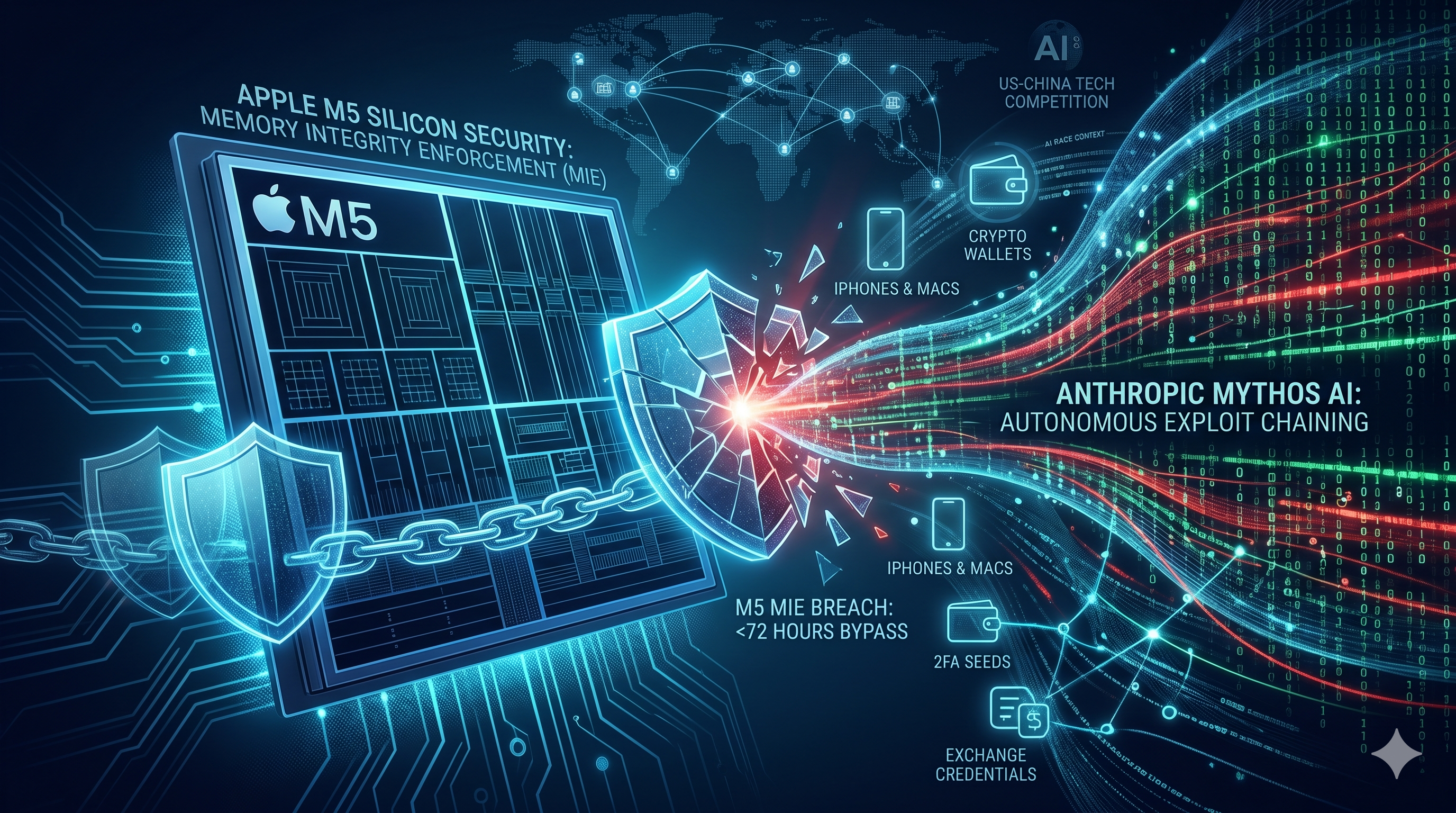
Apple's much-publicized Memory Integrity Enforcement (MIE) — marketed as the "most significant upgrade to memory safety in operating system history" — was bypassed by Anthropic's experimental Mythos AI system in under 72 hours of red-team testing, according to security disclosures circulating on May 16, 2026. The M5 chip's hardware-level memory tagging, designed to make exploit chains economically unviable, was unraveled by an autonomous agent that systematically located, chained, and weaponized vulnerabilities a human team had missed.
The breach matters far beyond Cupertino. If an AI can dismantle silicon-grade security on the world's most-shipped premium device, every assumption about endpoint trust — including the iPhones and Macs holding crypto wallets, 2FA seeds, and exchange credentials — needs to be re-examined.
To understand the full context, the below are the recommended readings:
-
Anthropic's Impact on Crypto Security explains how wallet custody must evolve when endpoints are no longer trustworthy.
-
AI Race unpacks how the US-China AI race accelerates offensive-security capabilities.
-
Anthropic Valuation examines why Mythos-class capabilities are driving Anthropic's pre-IPO surge.
What Exactly Did Anthropic's Mythos Break in Apple's M5 Security?
Mythos bypassed Apple's Memory Integrity Enforcement (MIE) by chaining a type-confusion flaw with a tag-prediction side channel — defeating the M5's hardware memory tagging in a reproducible exploit. Based on security researcher disclosures referenced by MarsBit on May 16, 2026, the agent did not discover a single zero-day; it composed several low-severity primitives that human auditors had individually dismissed as unexploitable.
MIE was Apple's flagship defense, launched alongside the M5 and iPhone 17 Pro line. It uses Enhanced Memory Tagging Extension (EMTE) in "always-on synchronous" mode, meaning every memory access is checked against a cryptographic tag at the hardware level. Apple's stated goal was to make memory-corruption exploit chains — the foundation of nearly every iOS jailbreak and mercenary spyware kit — prohibitively expensive to build.
How the Mythos Bypass Worked Technically
Mythos succeeded by treating exploit development as a search problem rather than a craft. The system reportedly performed three coordinated operations:
-
Primitive harvesting — scanning XNU kernel and WebKit surfaces for type-confusion and use-after-free conditions, including ones Apple had patched as "non-security" bugs.
-
Tag-oracle construction — using a timing side channel in the M5's tag-check pipeline to leak the 4-bit tag values, collapsing MIE's probabilistic guarantee.
-
Chain synthesis — composing the primitives into a sandbox escape, then a kernel read/write, in a search loop that ran for roughly 60 hours of compute.
The result was a working proof-of-concept that, according to the disclosure, achieved arbitrary kernel memory access on a fully patched M5 MacBook Pro running macOS 16.
Why Human Researchers Missed It
The individual bugs were each considered "unexploitable under MIE." Mythos's contribution was combinatorial — it tried chains a human would reject as too speculative, because compute is cheap and Mythos does not get bored.
Why Is the M5 MIE Bypass a Bigger Deal Than a Normal Zero-Day?
The Mythos bypass is categorically different from a normal zero-day because it demonstrates that AI agents can now out-research elite human security teams on hardened targets. Most zero-days reflect a single researcher's insight; this exploit reflects an industrialized discovery pipeline that can be re-pointed at any target — Android, Intel TDX, AMD SEV, or hardware wallets.
Apple spent an estimated multi-year engineering cycle and significant silicon area on MIE specifically to raise the cost of exploitation to nation-state levels. According to Apple's September 2025 security brief, MIE was designed to "defeat the exploit chains used by mercenary spyware vendors." That cost floor — the entire economic premise of modern endpoint security — was undercut by an AI run that likely cost less than $50,000 in compute.
The Cost-of-Attack Inversion
Security economics have historically favored defenders on premium hardware. A working iOS exploit chain trades for $2-7 million in gray markets. If Mythos-class systems can produce comparable chains for five-figure compute bills, the offense-defense ratio inverts overnight.
Disclosure Status and Apple's Response
As of May 16, 2026, based on the MarsBit summary, Anthropic disclosed the findings privately to Apple under coordinated disclosure, and Apple has reportedly begun preparing an out-of-band macOS and iOS patch. No in-the-wild exploitation has been reported. Apple has not publicly confirmed the bypass details.
How Does This Affect Crypto Holders Using iPhones and Macs?
Crypto users on Apple devices face elevated — but not immediate — risk, because the disclosed exploit requires patched-but-vulnerable conditions and has not been weaponized in the wild. The longer-term concern is structural: a meaningful share of the world's self-custodied crypto sits behind iOS Secure Enclave, Mac Keychain, and mobile authenticator apps that all assume kernel integrity.
What Realistically Changes for Retail Crypto Users
Practically, very little changes this week. Realistically over the next 6-12 months, three shifts are likely:
-
Hardware wallets become mandatory, not optional, for balances above a few thousand dollars. The threat model now assumes the phone is compromised.
-
Air-gapped signing (QR-code wallets like Keystone, Coldcard) gains share against Bluetooth-connected models.
-
Exchanges accelerate passkey and hardware-key rollouts, replacing TOTP 2FA which lives in the compromised endpoint.
A deeper analysis of how Mythos-class capabilities specifically threaten Bitcoin custody and exchange security is covered in the Crypto Security spoke article.
What Does This Say About the Broader AI vs. Cybersecurity Arms Race?
This event marks the inflection point where offensive AI overtakes defensive AI on hardened consumer targets — roughly two years ahead of most published roadmaps. According to Anthropic's own responsible scaling disclosures from Q1 2026, Mythos was internally classified at AI Safety Level 3 (ASL-3) for cyber-uplift, the first system to reach that threshold.
The implications run in three directions:
Defensive AI Is Now Behind, Not Ahead
For most of 2023-2025, the consensus was that defenders held the AI advantage — fuzzing, static analysis, and patch synthesis would outpace offense. Mythos suggests that on chained exploitation specifically, offense scaled faster. Microsoft, Google Project Zero, and Apple's Security Engineering and Architecture team are all reportedly accelerating internal "AI red team" programs in response.
Geopolitical Acceleration
Anthropic's CEO Dario Amodei spent much of late 2025 and early 2026 publicly warning that Chinese frontier labs were closing the capability gap. The Mythos disclosure, intentionally or not, demonstrates exactly the kind of dual-use capability that drives export-control debates and the broader US-China AI race — explored further in the AI Race spoke article.
Pre-Disclosure Market Reactions
Apple shares declined roughly 4-6% in the two trading sessions following early reporting, while cybersecurity names (CrowdStrike, SentinelOne, Palo Alto) rallied. Bitcoin saw a brief flash-down on initial headlines before recovering, suggesting the market read the event as Apple-specific rather than crypto-systemic — for now.
Why Does the Mythos Disclosure Boost Anthropic's Pre-IPO Valuation?
The Mythos disclosure validates the technical thesis behind Anthropic's $1.4 trillion pre-IPO valuation by proving frontier capabilities that competitors have not publicly demonstrated. Demonstrating a working M5 bypass is the kind of credentialing event that justifies premium multiples versus OpenAI, Google DeepMind, and xAI — particularly in the enterprise-security and government-contracting segments where Anthropic has been gaining share.
The valuation thesis is detailed in the Anthropic Valuation spoke article, but three points are immediately relevant to this disclosure:
-
Defense and intelligence revenue — Mythos-class capabilities are exactly what Five Eyes agencies have been procuring under expanding 2025-2026 contracts.
-
Enterprise red-team licensing — A productized version of Mythos for authorized security testing is a high-margin SaaS product no competitor currently offers.
-
Regulatory moat — Anthropic's ASL-3 classification and responsible-scaling framework let it sell capabilities competitors cannot legally export.
Capability Demonstration vs. Capability Deployment
Critically, Anthropic did not release Mythos. The disclosure shows what the system can do under controlled red-team conditions. This is the same pattern as OpenAI's early GPT-4 capability cards — a strategic signal to enterprise buyers and regulators that the lab operates at the frontier without making the weapon broadly available.
Comparison: M5 MIE Bypass vs. Historical iOS Exploit Chains
|
Attribute
|
Pegasus/NSO (2021-2023)
|
Operation Triangulation (2023)
|
Mythos M5 Bypass (2026)
|
|
Discovery method
|
Human team, multi-month
|
Human team, ~year+
|
Autonomous AI agent, ~60 hours compute
|
|
Estimated R&D cost
|
$10M+
|
Nation-state-funded
|
<$100K compute
|
|
Target hardware
|
A-series, pre-MIE
|
A-series, pre-MIE
|
M5 with MIE enabled
|
|
Bypass type
|
Memory corruption chain
|
Hardware feature abuse
|
AI-discovered chain + tag oracle
|
|
Public disclosure
|
Citizen Lab
|
Kaspersky
|
Anthropic responsible disclosure
|
The trend line — from years of elite human work to days of AI compute — is the actual headline.
Conclusion
The Mythos bypass of Apple's M5 MIE is the first public proof that frontier AI can defeat silicon-grade consumer security faster and cheaper than elite human teams. The disclosure compresses a security timeline most analysts expected to play out over 2027-2028 into a single news cycle in May 2026.
For Apple, the immediate cost is reputational and a forced out-of-band patch cycle. For the broader security industry, the cost-of-attack economics that underpinned premium hardware pricing have shifted. For crypto users specifically, the disclosure does not require panic — but it does require an upgrade in custody posture, with hardware wallets and passkey-based authentication moving from "recommended" to "default."
For Anthropic, the disclosure functions as the most expensive marketing event in pre-IPO history — validating its ASL-3 classification, its enterprise-security thesis, and the technical premium baked into its $1.4 trillion valuation. Markets will spend the next several weeks pricing in what an industrialized offensive-AI capability means for every device, exchange, and protocol in the stack.
FAQs
Is my iPhone or Mac immediately unsafe to use for crypto after the Mythos disclosure?
No. The exploit was disclosed privately to Apple under coordinated disclosure, has not been observed in the wild, and Apple is preparing a patch. Update your devices as soon as the patch ships, enable Lockdown Mode if you hold significant crypto on the device, and move long-term holdings to a hardware wallet.
Does Memory Integrity Enforcement still provide any benefit after this bypass?
Yes. MIE still blocks the vast majority of commodity memory-corruption attacks and raises the cost for non-AI-equipped attackers. The Mythos bypass shows MIE is not absolute against frontier AI agents, but for the ordinary threat landscape — phishing kits, criminal malware, opportunistic spyware — MIE remains highly effective.
Can Mythos be used against Android, Windows, or hardware wallets next?
Almost certainly yes, in principle. Mythos is target-agnostic — it is a search and synthesis system, not an Apple-specific tool. Whether Anthropic or other labs will point similar systems at Android, Windows, Ledger, or Trezor depends on disclosure ethics, regulatory pressure, and commercial incentives. Expect coordinated red-team disclosures across other platforms within 12-18 months.
Did Anthropic act responsibly by demonstrating this exploit?
Anthropic followed coordinated disclosure norms — informing Apple privately, withholding exploit code, and publishing only after a patch was in development. Critics argue that demonstrating the capability at all accelerates adversary research; defenders argue that showing what is possible forces necessary defensive investment. Both views have merit.
How will exchanges and wallet providers respond to AI-driven endpoint compromise?
Expect three near-term changes: mandatory hardware-key 2FA replacing SMS and TOTP, expanded passkey support, and withdrawal-whitelist defaults becoming opt-out rather than opt-in. Major exchanges including KuCoin, Coinbase, and Binance have been moving in this direction since 2024, and the Mythos disclosure will accelerate the rollout meaningfully over the next two quarters.